Q Fever: Causes, Symptoms, and Treatment Options

Updated: 2 days ago
Medically reviewed by Dr. Baraa Alnahhal, MD · Last reviewed: October 2026
Quick Answer: Key Facts About Q Fever
Q fever is an infection caused by the Coxiella burnetii bacterium, commonly carried by cattle, sheep and goats. [1] [3] People catch it by breathing in contaminated dust or mist. [1] Acute cases appear 3 to 30 days after exposure, with fever, fatigue, headache and muscle aches. [1] The primary treatment is antibiotics, typically doxycycline. [1] [3]
What the research says
Q fever fatigue syndrome can disrupt work and daily life for many years. In a survey of 291 people with Q fever fatigue syndrome 10 or more years after infection, 80.4% of the 250 who had paid work before Q fever stopped working or worked fewer hours because of it. More than half spent less time on each social role than before they got sick. (Brus et al., PLoS One, 2024) [4]
Long-term health stays low for many people with Q fever fatigue syndrome. Among 368 people assessed at least 10 years after infection, the median number of long-term complaints was 12, and 98.9% reported post-exertional malaise (symptoms that worsen after physical or mental effort). Young and middle-aged patients reported worse outcomes than older patients. (Spronk et al., Epidemiol Infect, 2023) [5]
Sheep contact is a major route in farming regions. A review of 258 Q fever cases in Quebec found that 93% of patients had been exposed to sheep and 76% were male. Among acute cases, the most common symptoms were fever (99%), headache (83%), and chills (80%). (Dolcé et al., J Assoc Med Microbiol Infect Dis Can, 2023) [6]
What Is Q Fever?
Q fever is a rare zoonotic illness, meaning it is a disease that spreads from animals to humans. [1] The infection is caused by a specific bacterium called Coxiella burnetii. [1] [3] The name "Q fever" is short for "query fever," a term coined when healthcare providers first encountered the illness and were unsure of its exact cause. [1] [3] While it is not common in the general population, it is a significant concern for those who live or work in close proximity to livestock. [1]
The bacteria can survive in the environment for long periods. [3] In the United States, about 200 cases were reported in 2019, with the majority occurring in Western and Midwestern states like California, Texas, and Iowa. [1] [2] Most people who contract the infection will experience a mild, flu-like illness, but a small percentage may develop serious, long-term complications. [1] [3]
How Does Q Fever Spread to Humans?
The most common way humans contract Q fever is by breathing in contaminated dust or mist. [1] Infected animals, most notably sheep, goats, and cattle, shed the bacteria in their bodily fluids, including urine, feces, milk, and birthing products like the placenta. [1] When these fluids contaminate the soil and dry out, the bacteria can travel through the air. [1]
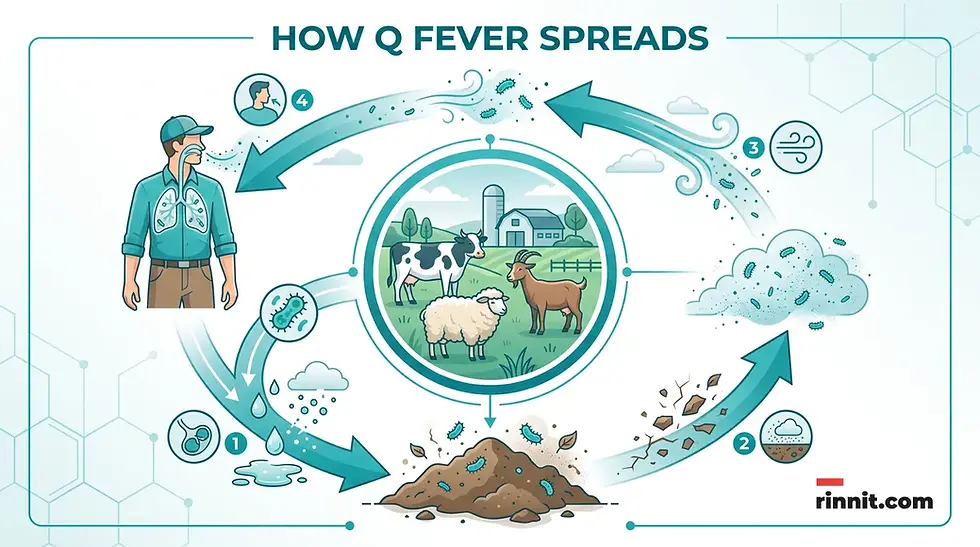
Because the bacteria can travel through the air, you do not necessarily need to have direct contact with an animal to get sick. [1] However, certain professions face a much higher risk. This includes veterinarians, farmers, slaughterhouse workers, and laboratory researchers who handle animal samples. [1]
What are the symptoms of Q fever?
Symptoms of Q fever typically fall into two categories: acute and chronic. Most people develop the acute form, which begins anywhere from three to 30 days after exposure. [1] The symptoms are often flu-like and can last for a few weeks. [1]

Acute Symptoms
Individuals with acute Q fever often report feeling extremely tired, a condition known as fatigue. [1] Other common signs include high fever, chills, a persistent dry cough, and intense headaches. [1] Some people also experience stomach issues, such as nausea, vomiting, diarrhea, or abdominal cramps. [1] In some cases, small rash-like spots called purpura may appear under the skin. [1]
Chronic Q Fever
Chronic Q fever is a much more serious and potentially life-threatening condition. It occurs when the infection persists for months or even years, sometimes appearing long after the initial exposure. [1] Only about 1 to 5 out of every 100 people infected with the bacteria develop this chronic form. [1] [3] Those with pre-existing heart valve problems, cancer, or chronic kidney disease are at a significantly higher risk for this progression. [1]
How Is Q Fever Diagnosed and Treated?
If a doctor suspects Q fever, they will typically start by reviewing your work and health history, especially if you have spent time near farm animals. [1] Because the symptoms are so similar to other illnesses, specific laboratory tests are required to confirm the presence of the bacteria.
Diagnostic Testing
The primary method for diagnosing Q fever is a combination of serologic testing (which looks for antibodies in the blood) and PCR testing (which detects the bacteria's genetic material). [1] [3] If a patient shows signs of complications, doctors may also order a chest X-ray to check the lungs or an EKG to monitor heart health. [1]
Treatment Options
Antibiotics are the standard treatment for Q fever. [1] Doxycycline is the most commonly prescribed medication for acute cases, usually taken for about two weeks. [1] [3] It is vital to finish the entire course of medicine, even if symptoms improve quickly, to prevent the infection from returning. [1]
For those with chronic Q fever, the treatment is much more intensive, often requiring a combination of antibiotics for 18 months or longer. [1] [3] Regular follow-up appointments are necessary to ensure the infection is fully resolved and to monitor for any damage to internal organs.
What are the complications and long-term effects of Q fever?
Most people recover fully from Q fever, but complications can occur, and about 20% of patients develop what is known as Q fever fatigue syndrome. [1] [3] This condition causes persistent, debilitating tiredness that can last for months or years after the initial infection has cleared. [1]
More severe complications involve inflammation of vital organs. This can include the lungs (pneumonitis), the heart (endocarditis), the brain (encephalitis), or the liver (hepatitis). [1] [3] In rare instances, the infection can even spread to the bones. [1] [3] Pregnant individuals who contract Q fever face additional risks, including a higher likelihood of miscarriage or other pregnancy-related complications. [1]
How can Q fever be prevented?
Preventing Q fever primarily involves reducing exposure to the bacteria, especially for those in high-risk environments. If you work with livestock, wearing protective gear like masks and gloves when handling animal fluids is a critical safety measure. [1]

Avoid unpasteurized dairy. Do not consume raw milk, cheese, or ice cream, as these can harbor the bacteria. [1]
Use protective gear. Wear appropriate personal protective equipment when assisting with animal births or processing animal products.
Ask about medical screening. If you have had acute Q fever and have a history of heart problems, ask your doctor about regular screenings to prevent chronic complications. [1]
Know the vaccine situation. While a vaccine exists, it is currently only available in Australia for high-risk workers. [1] [3]
Conclusion
Q fever is a complex illness that ranges from a mild nuisance to a life-threatening chronic condition. By understanding the risks associated with livestock and recognizing the early signs of infection, you can take proactive steps to protect your health. If you live or work near farm animals and develop flu-like symptoms that don't go away, seek medical attention promptly.
Want more health guides? Explore more plain-language health information and wellness tips at Rinnit.com.
Frequently Asked Questions
Is Q fever contagious between people?
It is very rare for Q fever to spread from person to person. It has occasionally happened through blood transfusions or from a parent to a child during pregnancy or birth. [1]
Can pets like dogs and cats carry Q fever?
Yes. Domesticated animals like dogs, cats, and rabbits can carry the bacteria, often without showing any symptoms themselves. [1]
Why is it called "Q" fever?
The "Q" stands for "query." It was named this because doctors were originally unsure of what was causing the illness. [1] [3]
How long does it take to recover from acute Q fever?
Symptoms of acute Q fever usually last around two weeks, even without treatment, though some people feel very tired for much longer. [1]
What is the most common symptom of Q fever?
High fever, headache, fatigue, and muscle aches are among the most commonly reported symptoms. [3]
Can you have Q fever without knowing it?
Yes. Some people have very mild symptoms or none at all during the first infection, but may still be at risk for chronic Q fever later. [1]
Is Q fever common in cities?
Q fever is uncommon overall. Most cases are linked to farms and livestock, although outbreaks have happened where goat or sheep farms sit close to towns. [3]
What happens if Q fever is left untreated?
Many people recover on their own, and the death rate is usually low even without treatment. The risk of serious complications and death rises if the infection inflames the heart, so people with heart valve problems should seek care promptly. [1]
Does Q fever cause a rash?
Q fever can sometimes cause small, flat, reddish-purple spots under the skin called purpura. [1]
Can Q fever affect the heart?
Yes. One of the most serious complications is endocarditis, which is inflammation of the heart's inner lining. [1] [3]
Are there different types of Q fever?
Yes. It is classified as either acute (short-term) or chronic (long-term). [1]
What antibiotic is usually used for Q fever?
Can Q fever cause pregnancy problems?
Yes. It can lead to miscarriage, premature birth, or poor fetal growth [3], so anyone who is pregnant and suspects Q fever should talk to a healthcare provider.
Is there a vaccine for Q fever?
A vaccine exists, but it is currently only available in Australia, for people at higher risk. [1] [3]
How do doctors test for Q fever?
Doctors use blood tests to look for specific antibodies (serologic testing) and tests that detect the bacteria's genetic material (PCR). [1] [3]
References
Cleveland Clinic. Q Fever. Cleveland Clinic. Updated March 26, 2026. https://my.clevelandclinic.org/health/diseases/17883-q-fever
Centers for Disease Control and Prevention. Epidemiology and Statistics. CDC. Updated May 15, 2024. https://www.cdc.gov/q-fever/data-research/index.html
Patil SM, Regunath H. Q Fever. StatPearls. Updated November 18, 2022. https://www.ncbi.nlm.nih.gov/books/NBK556095/
Brus IM, et al. Work participation, social roles, and empowerment of Q-fever fatigue syndrome patients ≥10 years after infection. PLoS One. 2024;19(4):e0302573. PMID 38687756. https://doi.org/10.1371/journal.pone.0302573
Spronk I, et al. Long-term health outcomes of Q-fever fatigue syndrome patients. Epidemiol Infect. 2023;151:e179. PMID 37724460. https://doi.org/10.1017/S0950268823001401
Dolcé P, et al. The lower Saint Lawrence River region of Quebec, a hot spot for sheepfold-associated Q fever in Canada: Review of 258 cases. J Assoc Med Microbiol Infect Dis Can. 2023;8(3):201-213. PMID 38058500. https://doi.org/10.3138/jammi-2023-0001
Medical disclaimer
This article is for general informational purposes only and does not constitute medical advice. Always consult a qualified healthcare professional for diagnosis and treatment decisions. If you develop a fever or flu-like illness after contact with farm animals, seek medical care promptly.



Comments