Pulp Necrosis: Understanding the Causes and Treatments for Dead Teeth

Updated: 2 days ago
Medically reviewed by Dr. Baraa Alnahhal, MD · Last reviewed: October 2026
Definition: Pulp necrosis is the death of the innermost tissue (pulp) of a tooth, often caused by untreated infection.
Key Symptoms: Initial sensitivity to heat and cold that eventually disappears as the nerve dies, often followed by pain when tapping the tooth.
Treatment: Once the pulp dies, it must be removed via a root canal or the tooth must be extracted.
Prevention: Regular dental hygiene, routine checkups, and wearing night guards for teeth grinding can prevent the condition.
Quick Answer
Pulp necrosis is the death of a tooth's innermost tissue, the pulp, which contains its nerves and blood vessels, due to infection, trauma or untreated inflammation. The tooth loses temperature sensation but may hurt when touched or tapped. Treatment, typically a root canal or extraction, is essential to stop infection spreading, and early intervention can prevent necrosis.
What the research says
Root canal treatment succeeds less often in necrotic teeth than in teeth with a living pulp. A systematic review of 11 studies of root canal treatment performed by undergraduate dental students included a meta-analysis of 3 studies, which found success rates of 87.8% for teeth with a vital pulp and 65.6% for teeth with pulp necrosis. Weighted success was 56.3% for teeth with preoperative radiolucencies (areas of bone loss visible on X-ray) and 86.8% for teeth without them (Chien et al., Int Endod J, 2026).
Regenerative procedures also show high success in necrotic permanent teeth. A meta-analysis of 27 randomized controlled trials found success rates of 95.6% (95% CI 92.4% to 97.5%) for necrotic immature permanent teeth and 95.5% (95% CI 87.9% to 98.4%) for necrotic mature permanent teeth. Crown discolouration was common in immature teeth, at 62.5% (Li et al., Oral Health Prev Dent, 2023).
Revitalization and conventional treatment showed similar survival, but the evidence is weak. A systematic review that identified 365 records and included 5 studies found a 12-month survival rate of 100% in all groups, with no significant difference between revitalization and the comparison treatments (calcium hydroxide apexification, apical plug or root canal treatment) for survival (RR 1.00, 95% CI 0.96 to 1.04) or success (RR 1.06, 95% CI 0.83 to 1.35). The certainty of evidence was rated low to very low (Meschi et al., Int Endod J, 2023).
What is Pulp Necrosis?
Pulp necrosis is the final stage of dental pulp inflammation where the soft tissue inside the tooth—comprised of nerves, blood vessels, and connective tissue—ceases to function and dies. This tissue is located deep within the tooth, protected by layers of enamel and dentin, and extends down into the roots. The condition usually begins as pulpitis, an inflammation caused by bacteria entering the tooth through a cavity, crack, or injury. [1]
The progression toward necrosis typically follows three distinct stages. It starts as reversible pulpitis, where the tooth can still heal if the underlying issue is sealed. If left untreated, it advances to irreversible pulpitis, where the inflammation is too severe for self-repair. Finally, the tissue undergoes necrosis and dies. Without prompt dental intervention, the resulting infection can spread beyond the tooth into the jawbone, neck, or even the chest, leading to serious systemic health risks.
Stage | Description | Healing Potential |
Reversible Pulpitis | Mild inflammation of the pulp tissue. | Can heal with dental repair. |
Irreversible Pulpitis | Severe inflammation and tissue damage. | Cannot heal; requires intervention. |
Pulp Necrosis | Complete death of the internal pulp tissue. | Requires removal of the tissue. |

What are the symptoms and common causes of pulp necrosis?
The symptoms of pulp necrosis can be deceptive. In the early stages of inflammation (pulpitis), individuals often experience sharp or throbbing pain and extreme sensitivity to hot, cold, or sweet substances. However, as the nerve tissue dies during necrosis, this temperature sensitivity may completely disappear. A common indicator of necrosis is localized pain when the affected tooth is tapped or during chewing. In some cases, a pocket of pus known as an abscess may form at the root tip, causing significant pain and swelling. [1]
Bacterial infection is the most frequent cause of pulp death, often stemming from untreated cavities or cracks in the tooth enamel. Other contributing factors include:
Dental Trauma: A sudden blow to the face can disrupt the blood supply to the pulp or expose it to bacteria.
Repeated Procedures: Multiple or unsuccessful dental treatments on the same tooth can weaken its internal structure.
Bruxism: Chronic teeth grinding can wear down enamel, creating pathways for bacteria to reach the pulp.
Aggressive Brushing: Over time, this can erode protective layers, leading to increased vulnerability.
How is pulp necrosis diagnosed?
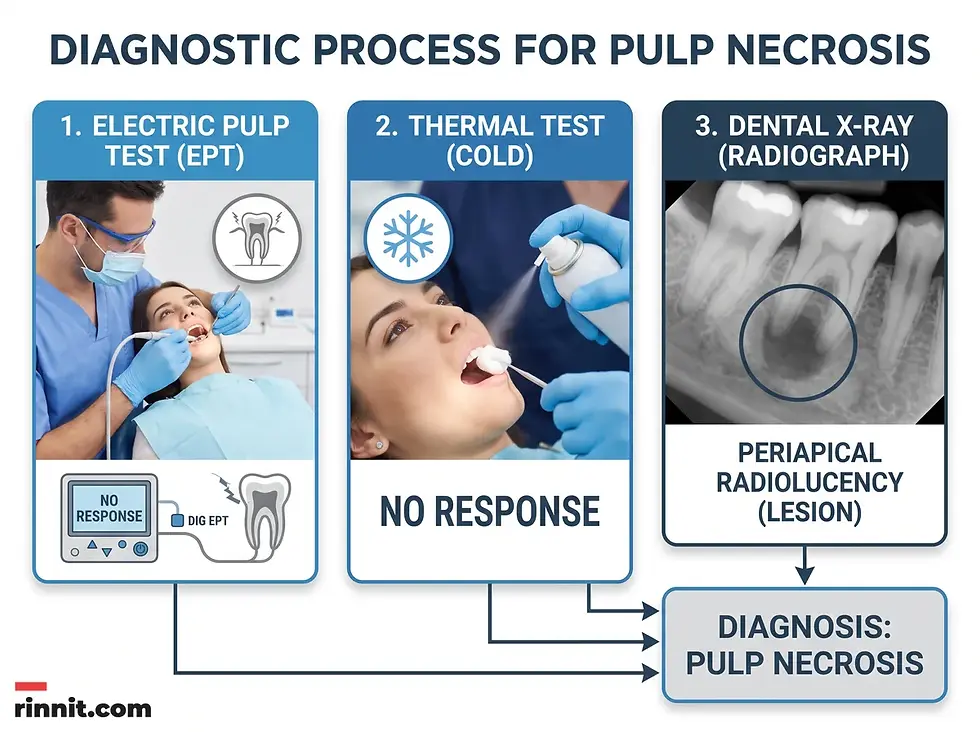
Diagnosing pulp necrosis requires a specialized evaluation, often performed by an endodontist—a dentist who focuses on the internal health of teeth. Several clinical tests are used to determine the vitality of the pulp. Electric pulp testing involves delivering a minute electrical pulse to the tooth; if the patient feels no sensation, it indicates the pulp has died. Thermal tests using hot or cold substances are also employed to gauge the tooth's response compared to healthy surrounding teeth. [1]
In addition to physical tests, dental X-rays are essential for visualizing the internal structure of the tooth and the surrounding jawbone. These images can reveal signs of infection at the root tip or structural defects that may have allowed bacteria to enter. The endodontist may also perform percussion testing, gently tapping on the tooth to assess sensitivity in the supporting tissues.
How is pulp necrosis treated?
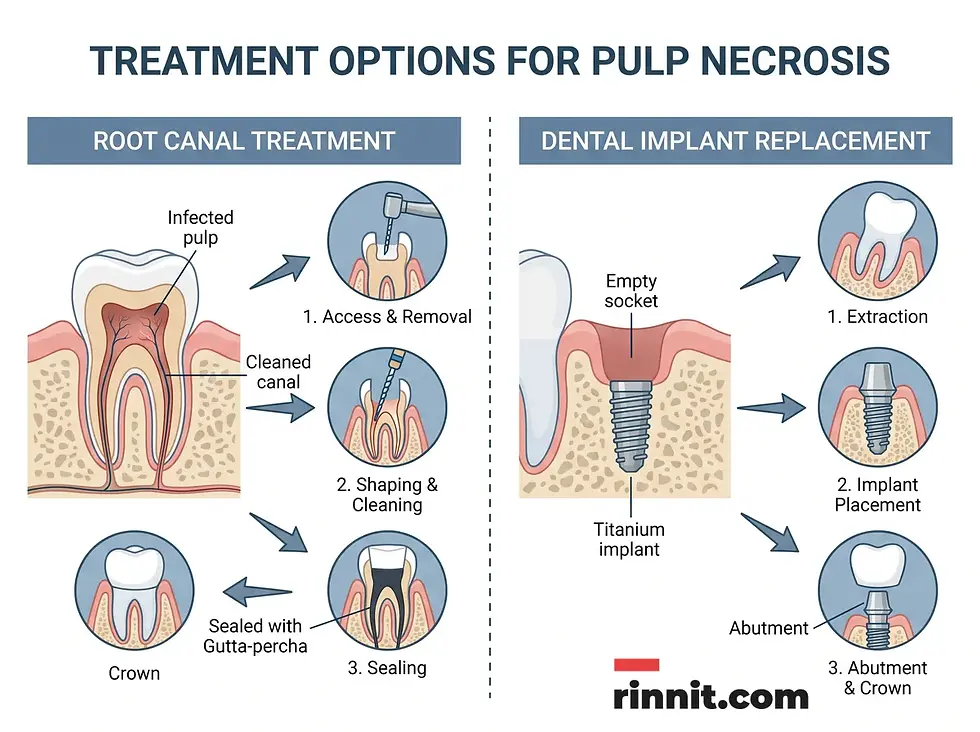
Pulp necrosis treatment starts with removing the dead tissue to stop the spread of infection. There are two primary treatment paths:
Root Canal Therapy: This is the preferred method for saving the natural tooth. The dentist or endodontist removes the necrotic pulp, cleans and disinfects the internal canals, and then fills and seals the space. A crown is typically placed afterward to restore the tooth's strength and appearance.
Tooth Extraction: If the tooth is too severely damaged to be saved, it must be removed entirely. Following an extraction, the missing tooth can be replaced with a dental implant or a bridge to maintain proper alignment and function. [1]
While antibiotics may be prescribed to manage a spreading infection or an abscess, they are not a substitute for mechanical removal of the dead tissue. Prompt treatment is critical to avoid complications such as Ludwig’s angina (a neck infection) or osteomyelitis (a jawbone infection). Go to the emergency room or call 911 for facial or neck swelling with fever, trouble swallowing or trouble breathing.
Conclusion and Next Steps
Pulp necrosis is a serious dental condition, but the outlook is excellent with timely professional care. Maintaining a rigorous oral hygiene routine—including twice-daily brushing and regular flossing—remains the most effective way to prevent the infections that lead to pulp death. If you experience persistent tooth pain or a sudden loss of sensitivity, schedule a dental appointment immediately. Early intervention can often save your natural tooth and prevent the need for more invasive procedures or the risk of systemic complications.
Frequently Asked Questions
Can a dead tooth heal on its own?
No, once the pulp tissue has died (necrosis), it cannot regenerate and must be professionally removed. [1]
Why did my tooth stop hurting if it's still infected?
When the nerve inside the tooth dies, you lose the ability to feel temperature or sharp pain, but the infection can still spread to surrounding tissues. [1]
What is the difference between pulpitis and necrosis?
Pulpitis is the inflammation of the pulp, which may still be alive; necrosis is the actual death of that tissue. [1]
Is a root canal painful?
Modern root canals are performed with local anesthesia and are generally no more uncomfortable than getting a standard filling.
How does an endodontist test if a tooth is dead?
Endodontists use electric pulp testers, thermal (hot/cold) tests, and X-rays to check for nerve response and structural damage. [1]
Can teeth grinding cause pulp necrosis?
Yes, chronic grinding (bruxism) can wear down enamel and allow bacteria to enter the pulp. [1]
What happens if I don't treat pulp necrosis?
The infection can spread to your jaw, neck, or chest, potentially causing life-threatening complications like Ludwig’s angina. [1]
How long does a root canal take to heal?
Most patients feel significant relief immediately, though the area may be tender for a few days while the surrounding tissues heal.
Are antibiotics enough to treat a dead tooth?
No, antibiotics can help control the spread of infection, but they cannot reach or clean the dead tissue inside the tooth. [1]
Can a crown be placed on a necrotic tooth?
A crown is usually placed only after a root canal has been performed to remove the dead tissue and seal the tooth. [1]
Related Reading
Treating decay that reaches the pulp: Pulpotomy: Procedure, Recovery, Benefits and Risks
References
Cleveland Clinic. Pulp Necrosis. Cleveland Clinic Health Library. Accessed October 11, 2026. https://my.clevelandclinic.org/health/diseases/23573-pulp-necrosis
Chien PY-H, Hosseinpour S, Peters OA, et al. Outcomes of root canal treatment performed by undergraduate students: a systematic review and meta-analysis. Int Endod J. 2026;59(6):929-942. PMID: 40304173. DOI: https://doi.org/10.1111/iej.14246
Li J, Zheng L, Daraqel B, et al. Treatment outcome of regenerative endodontic procedures for necrotic immature and mature permanent teeth: a systematic review and meta-analysis based on randomised controlled trials. Oral Health Prev Dent. 2023;21:141-152. PMID: 37195330. DOI: https://doi.org/10.3290/j.ohpd.b4100877
Meschi N, Palma PJ, Cabanillas-Balsera D. Effectiveness of revitalization in treating apical periodontitis: a systematic review and meta-analysis. Int Endod J. 2023;56 Suppl 3:510-532. PMID: 35579093. DOI: https://doi.org/10.1111/iej.13778
Medical disclaimer
This article is for informational purposes only and is not a substitute for professional medical advice, diagnosis, or treatment. Always seek the advice of your physician or other qualified health provider with any questions you may have about a medical condition.



Comments