Prinzmetal Angina: Understanding Coronary Artery Spasms

Updated: 2 days ago
Medically reviewed by Dr. Baraa Alnahhal, MD · Last reviewed: October 2026
Prinzmetal angina, also known as vasospastic or variant angina, is a type of chest pain that occurs at rest, often during sleep. Unlike typical angina, it is caused by sudden spasms in the coronary arteries rather than physical exertion. These spasms temporarily reduce blood flow to the heart muscle. While the condition can be severe and increase the risk of heart attacks, it is highly manageable with calcium channel blockers and targeted lifestyle changes, particularly smoking cessation.
Quick Answer
Prinzmetal angina is chest pain caused by temporary spasms in the heart's arteries, most commonly between midnight and 8:00 a.m. at rest, briefly restricting blood flow to the heart muscle. EKG monitoring and coronary angiography confirm it. Treatment includes daily calcium channel blockers to prevent spasms, nitroglycerin for episodes and managing risk factors like smoking. [1]
What the research says
Smoking stood out as a risk factor for vasospastic angina. In a prospective study of 110 patients with angina and non-obstructive coronary arteries who underwent intracoronary acetylcholine testing, 25.5% (28 of 110) had vasospastic angina, and this type was associated with smoking (OR 9.1, 95% CI 2.21–39.3) (Rehan et al., Heart Lung Circ, 2024).
Over 12 years, most patients with variant angina avoided a heart attack or cardiac death, but smoking tracked with worse outcomes. Among 273 consecutive patients without significant fixed coronary stenosis, total mortality was 24%, cardiac mortality 7.0%, and myocardial infarction 6%; angina was still present in 47% at 140 months, and cardiac death or myocardial infarction (28 patients, 10%) was associated with tobacco smoking (p = 0.004) (Figueras et al., Am J Cardiol, 2012).
Calcium channel blockers are the mainstay of treatment, and the specific drug may matter. A meta-analysis of four studies of 1,997 Japanese patients with positive spasm provocation tests, treated with benidipine, amlodipine, nifedipine, or diltiazem, recorded major adverse cardiovascular events in 143 patients; the risk was lower with benidipine than with diltiazem (adjusted HR 0.41, P = 0.016) (Nishigaki et al., Circ J, 2010).
Research summaries are based on article abstracts retrieved from PubMed.
What is Prinzmetal Angina?
Prinzmetal angina, now more commonly referred to clinically as vasospastic or variant angina, is a distinctive form of chest pain. Named after the cardiologist who first described it in 1959, this condition is characterized by episodes that occur when the heart's arteries briefly tighten (spasm) and then relax. These spasms temporarily reduce blood flow to the heart muscle, resulting in the pain experienced by the patient.
Unlike stable angina, which is typically triggered by physical exercise or emotional stress during the day, Prinzmetal angina almost exclusively happens at rest. Episodes frequently occur overnight, particularly between the hours of midnight and 8:00 a.m. It often affects individuals at a younger age than classic angina caused by plaque buildup. [1]
What causes and triggers Prinzmetal angina?
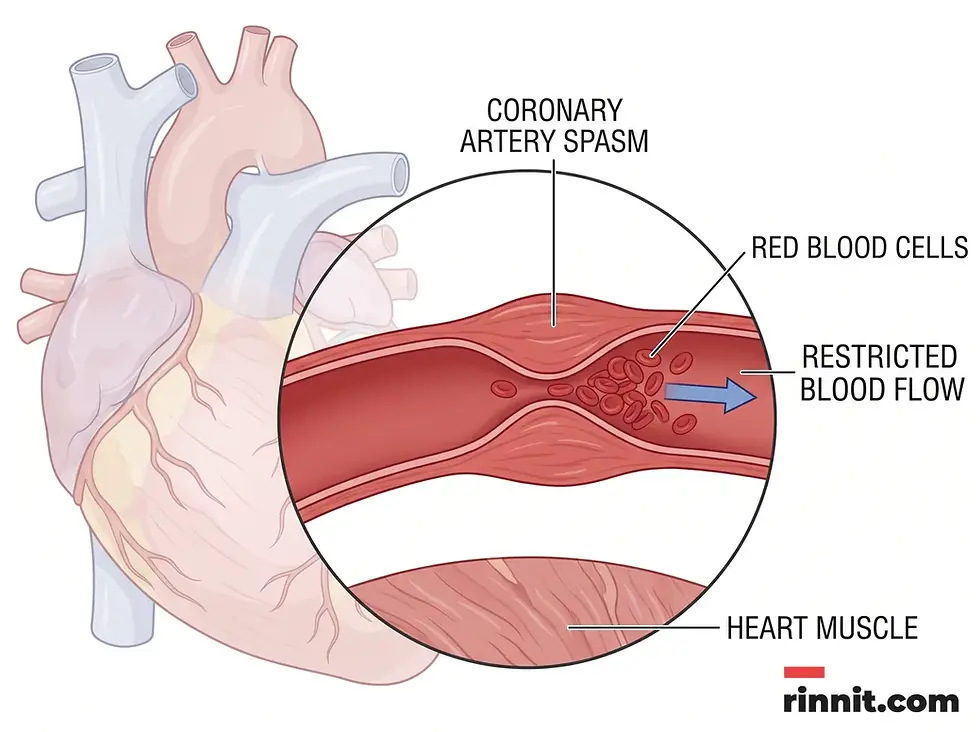
The fundamental cause of Prinzmetal angina is a coronary artery spasm. During a spasm, the walls of one or more heart arteries suddenly tighten, narrowing the space for blood to flow. This is often compared to pinching a straw, making it difficult for oxygen-rich blood to reach the heart. The pain persists as long as the artery is constricted and subsides once it relaxes. [1]
Key Triggers and Risk Factors
While the exact reason for these spasms is not always clear, several factors are known to increase the likelihood of an episode. Smoking remains the most significant risk factor for both the development of the condition and the triggering of individual attacks.
Trigger Category | Examples |
Lifestyle Factors | Smoking (major trigger), excessive alcohol consumption |
Substances | Cocaine, ecstasy, amphetamines |
Medications | Triptans (migraine meds), certain beta-blockers |
Associated Conditions | Migraines, Raynaud’s syndrome |
What are the symptoms of Prinzmetal angina?
The symptoms of Prinzmetal angina can be intense and often follow a recurring pattern. Because the pain typically occurs during sleep, it can wake an individual and cause significant stress or anxiety. An episode usually lasts between five and 15 minutes, though in some cases, it may persist for up to half an hour. [1]
Common symptoms include severe chest pain that may radiate to the back, shoulders, arms, or jaw. This pain is often accompanied by shortness of breath, nausea, or profuse sweating. It is critical to distinguish these episodes from a heart attack, as prolonged spasms can lead to permanent heart damage if blood flow is not restored promptly. [1]

How is Prinzmetal angina diagnosed?
Diagnosing Prinzmetal angina can be complex because healthcare providers must ensure the pain is not caused by obstructive coronary artery disease (blockages from plaque). In many cases, both conditions can exist simultaneously, further complicating the clinical picture.
Confirmation Tests
A healthcare provider will typically use a combination of tests to confirm a diagnosis of vasospastic angina: [1]
Electrocardiogram (EKG/ECG): This test records the heart's electrical activity. Prinzmetal angina often produces unique, identifiable patterns on an EKG during an active spasm.
Ambulatory EKG Monitoring: Patients may wear a portable monitor at home to capture the heart's activity during nighttime episodes.
Coronary Angiography: A specialized imaging test that allows doctors to visualize the blood flow through the heart's arteries and identify areas of spasm or blockage.
How is Prinzmetal angina managed and treated?
The primary goals of treating Prinzmetal angina are to reduce the frequency of spasms and provide immediate relief during an episode. Treatment is essential and can be lifesaving, as unmanaged spasms can lead to dangerous heart rhythms or sudden cardiac death. [1]
Medical Interventions
Several types of medications are used to manage the underlying coronary spasms: [1]
Calcium Channel Blockers: These are the first-line treatment and work by preventing the arteries from tightening.
Long-acting Nitrates: Often prescribed alongside calcium channel blockers to provide additional protection against spasms.
Sublingual Nitroglycerin: A fast-acting tablet placed under the tongue to stop an attack as it is happening. It typically provides relief within one to three minutes. Do not use nitrates if you have recently taken an erectile dysfunction medicine such as sildenafil, tadalafil or vardenafil, because the combination can cause a dangerous drop in blood pressure.
Statins: These may be used to reduce the frequency of spasms and lower the overall risk of other cardiovascular problems.
Essential Lifestyle Changes
Managing Prinzmetal angina requires a commitment to heart-healthy living. Quitting smoking is the most vital step a patient can take. Additionally, following a Mediterranean or DASH diet and aiming for at least 150 minutes of physical activity per week can help protect the heart from plaque buildup, which can worsen the outlook for those with vasospastic angina. [1]

What complications can Prinzmetal angina cause?
When left untreated, Prinzmetal angina poses significant risks to long-term health. If a coronary spasm lasts for an extended period, it can restrict blood flow enough to cause a heart attack. Furthermore, these spasms can trigger ventricular arrhythmias—dangerous heart rhythms in the lower chambers of the heart—which significantly increase the risk of sudden cardiac death. [1]
Frequently Asked Questions
Is Prinzmetal angina the same as a heart attack?
No, but it can lead to one. It is caused by a temporary spasm, whereas a heart attack is usually caused by a permanent blockage. However, both require immediate medical attention.
Why does it happen at night?
The exact reason is unknown, but episodes most frequently occur between midnight and 8:00 a.m. while the body is at rest.
Can I exercise if I have Prinzmetal angina?
Yes. Unlike stable angina, Prinzmetal angina is not usually triggered by exercise. In fact, regular physical activity is encouraged to maintain overall heart health.
Will I need to take medication forever?
Most people with this condition require long-term medication, such as calcium channel blockers, to prevent future spasms and protect their heart.
Can smoking trigger an attack?
Yes. Smoking is a major risk factor for coronary artery spasms and can trigger individual angina episodes.
What should I do during an episode?
If prescribed, use your sublingual nitroglycerin immediately. If the pain is not better or is getting worse 5 minutes after one dose of nitroglycerin, or is different from your usual episodes, call 911.
Are there specific foods I should avoid?
While no specific food triggers spasms, avoiding excessive alcohol is recommended. A heart-healthy diet like the Mediterranean diet is best for long-term management.
Can stress cause Prinzmetal angina?
While it typically occurs at rest, some individuals may find that emotional stress can contribute to the likelihood of a spasm.
Is it a rare condition?
Prinzmetal angina is less common than stable angina but is a well-recognized form of chest pain, particularly in younger patients without significant plaque buildup.
Can migraine medications trigger an attack?
Yes, certain migraine medications like triptans can cause blood vessels to constrict and may trigger a coronary spasm in susceptible individuals.
Conclusion
Prinzmetal angina is a serious but highly manageable heart condition that requires specialized care and a proactive approach to vascular health. By understanding that coronary spasms are the root cause, patients can work with their healthcare providers to implement a treatment plan focused on prevention and rapid response. The combination of modern medications and critical lifestyle changes—most notably quitting smoking—allows most individuals with vasospastic angina to lead full and active lives while minimizing the risk of severe complications.
Emergency Warning: Any unexpected or severe chest pain should be treated as a medical emergency. If you experience pain that spreads to your arm or jaw, or is accompanied by shortness of breath, seek immediate medical care by calling 911.
References
Cleveland Clinic. Vasospastic Angina (Formerly Known as Prinzmetal Angina). Cleveland Clinic Health Library. Last updated May 31, 2026. https://my.clevelandclinic.org/health/diseases/21867-prinzmetal-angina
Rehan R, Wong CCY, Cooke C, et al. Prevalence of Coronary Vasomotor Disorders in Patients With Angina and Nonobstructive Coronary Arteries: A Sydney Experience. Heart Lung Circ. 2024;33(9):1297-1306. PMID: 38925996. DOI: 10.1016/j.hlc.2024.02.020
Figueras J, Domingo E, Ferreira I, et al. Persistent angina pectoris, cardiac mortality and myocardial infarction during a 12 year follow-up in 273 variant angina patients without significant fixed coronary stenosis. Am J Cardiol. 2012;110(9):1249-1255. PMID: 22835410. DOI: 10.1016/j.amjcard.2012.06.026
Nishigaki K, Inoue Y, Yamanouchi Y, et al. Prognostic effects of calcium channel blockers in patients with vasospastic angina--a meta-analysis. Circ J. 2010;74(9):1943-1950. PMID: 20668353. DOI: 10.1253/circj.cj-10-0292
Medical disclaimer
This article is for informational purposes only and is not a substitute for professional medical advice, diagnosis, or treatment. Always seek the advice of your physician or other qualified health provider with any questions you may have about a medical condition.



Comments