Piroxicam Capsules: A Comprehensive Guide to Arthritis Pain Relief

Updated: 2 days ago
Medically reviewed by Dr. Baraa Alnahhal, MD · Last reviewed: October 2026
Piroxicam is a nonsteroidal anti-inflammatory drug (NSAID) used to treat arthritis by reducing pain and inflammation. Taken once daily as an oral capsule, it helps manage chronic joint symptoms but carries risks common to its class, including heart and stomach complications. Patients should take it consistently with food if stomach upset occurs and monitor for signs of liver or kidney issues. Regular medical follow-ups are essential to ensure long-term safety and efficacy.
Quick Answer: What is piroxicam?
Piroxicam is a prescription NSAID medication that treats arthritis pain and inflammation, typically taken once a day by mouth. It requires careful monitoring for serious side effects such as stomach bleeding and cardiovascular risks. Take it exactly as directed by your healthcare provider, and report unusual symptoms such as black stools or chest pain immediately. [1]
What the research says
Piroxicam carries one of the higher stomach-complication risks among NSAIDs. A systematic review and meta-analysis of 28 observational studies found a pooled relative risk of upper gastrointestinal complications of 7.43 (95% CI 5.19 to 10.63) for piroxicam, compared with 1.84 for ibuprofen and 1.45 for celecoxib. High daily doses carried 2 to 3 times the risk of low doses across NSAIDs (Castellsague et al., Drug Saf, 2012).
Heart, kidney, and blood pressure risks differ widely between NSAIDs. A network meta-analysis of 20 articles covering 144,957 arthritis patients and 13 treatments found that ibuprofen had the highest rate of hypertension (OR 3.24 versus placebo) and naproxen the highest rate of edema (OR 2.31), and concluded that clinicians should weigh each NSAID's benefit against its cardiovascular and renal toxicity (Wang & Li, Ann Transl Med, 2022).
Real-world reports link piroxicam to rare skin and blood problems. A pharmacovigilance study of the US FDA adverse event database (2004 to 2024) among osteoarthritis patients found reports of anemia, alveolitis, and erythema multiforme with piroxicam. These are reporting signals that need further study rather than proof of cause (Zhang et al., Inflammopharmacology, 2026).
Research summaries are based on article abstracts retrieved from PubMed.
How does piroxicam help manage arthritis?
Piroxicam is primarily used to address the chronic pain and swelling associated with various forms of arthritis. As a nonsteroidal anti-inflammatory drug (NSAID), it works by blocking the enzymes that cause inflammation in the body. This reduction in inflammatory activity helps to alleviate joint stiffness and improve overall mobility for those living with chronic arthritic conditions. [1]
Unlike some short-acting pain relievers, piroxicam is often prescribed for long-term symptom control. It is frequently recognized by its brand name, Feldene, and remains a foundational therapy for maintaining joint function and quality of life. [1]

How should piroxicam capsules be taken and dosed?
For the medication to be effective, it must be taken exactly as prescribed. Consistency is key to maintaining a steady level of the drug in your system. While it can be taken with or without food, taking it with a meal is often recommended if you experience any digestive discomfort. [1]
Requirement | Instructions |
Form | Oral capsule taken by mouth with water. |
Timing | Take at the same time every day for best results. |
Food | Take with food if it upsets your stomach. |
Missed Dose | Take as soon as possible, unless the next dose is near. |
Restarting | If you miss 14+ days, contact your doctor before resuming. |
Patients over the age of 65 may be more sensitive to the effects of piroxicam and may require a lower starting dose to minimize the risk of complications. [1]
What are the important safety warnings and risks of piroxicam?
Piroxicam carries significant warnings common to many NSAIDs. The most serious risks involve the cardiovascular and gastrointestinal systems. These problems can occur at any time during treatment, even in individuals without a prior history of heart or stomach disease. [1]
Primary Safety Concerns:
Cardiovascular Risks: Increased likelihood of blood clots, heart attack, and stroke.
Stomach Health: Potential for serious bleeding, ulcers, or tears in the stomach or intestines.
Pregnancy Precautions: Not recommended after 30 weeks of pregnancy due to birth defect risks.
Fertility: May cause temporary infertility in some individuals. [1]
Patients should avoid taking other NSAIDs, such as ibuprofen or naproxen, while using piroxicam, as this significantly increases the risk of stomach ulcers and bleeding. [1]

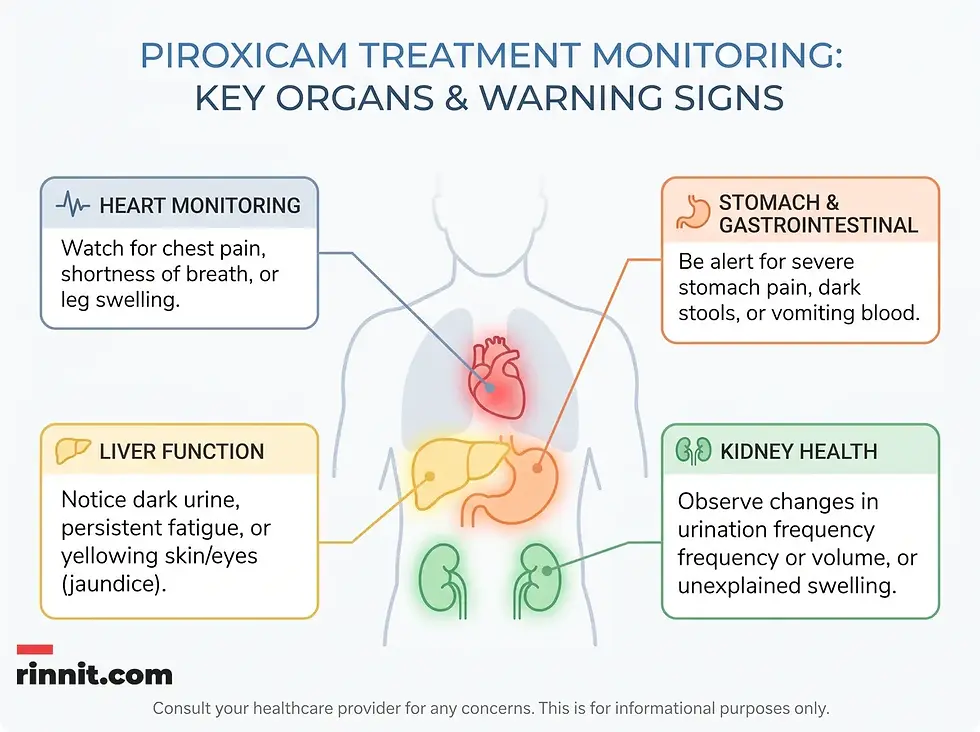
What monitoring and side effects come with piroxicam?
Regular check-ups with your healthcare provider are necessary to monitor your progress and check for internal side effects that may not be immediately visible, such as changes in liver or kidney function. [1]
"Serious skin reactions can occur weeks to months after starting the medication. Contact your care team right away if you develop a red or purple rash, blisters, or flu-like symptoms." [1]
Side Effects Requiring Immediate Medical Attention:
Allergic Reactions: Hives, itching, or swelling of the face and throat.
Liver Injury: Pain in the upper right abdomen, yellowing of the skin/eyes, or dark urine.
Kidney Issues: A noticeable decrease in urine output or swelling in the ankles and feet.
Heart Failure: Sudden weight gain, unusual fatigue, or shortness of breath. [1]
Common side effects that are generally less serious include headaches, mild nausea, and a temporary loss of appetite. If these symptoms persist or become bothersome, they should be discussed with a pharmacist or physician. [1]
How should piroxicam capsules be stored and disposed of?
Piroxicam should be stored at room temperature, ideally between 15 and 30 degrees C (59 and 86 degrees F). It is vital to keep the medication in a secure location away from children and pets to prevent accidental ingestion. [1]
When the medication expires or is no longer needed, it should be disposed of through a dedicated medication take-back program. If such a program is not available, the capsules can be mixed with coffee grounds or cat litter, sealed in a bag, and placed in the household trash. [1]
Conclusion
Piroxicam is a powerful tool for managing the pain and inflammation of arthritis. By following strict administration guidelines and staying vigilant for serious side effects, patients can safely incorporate this medication into their long-term health plan. Open communication with your care team remains the most effective way to ensure that your treatment remains both safe and effective.
Frequently Asked Questions
Can I take Piroxicam with my morning coffee?
Yes, you can take it with or without food. However, if coffee or an empty stomach causes irritation, taking it with a meal is recommended to prevent nausea.
What should I do if I miss a dose of Piroxicam?
Take the missed dose as soon as you remember. If it is almost time for your next dose, skip the missed one. Do not take extra medicine to make up for a missed dose.
Is it safe to drink alcohol while taking this medication?
Alcohol can increase the risk of stomach bleeding and ulcers when combined with NSAIDs like piroxicam. It is best to limit or avoid alcohol during treatment.
Why is there a warning about heart attacks for an arthritis drug?
All NSAIDs, including piroxicam, can increase the risk of blood clots and cardiovascular events. This risk is higher with long-term use and in those with existing heart conditions.
Can I take ibuprofen if my arthritis flares up while on Piroxicam?
No. You should not take other NSAIDs like ibuprofen or naproxen while taking piroxicam, as this greatly increases your risk of serious stomach complications.
How will I know if Piroxicam is affecting my liver?
Signs of liver injury include yellowing of the skin or eyes (jaundice), dark brown urine, right-sided abdominal pain, and extreme fatigue. Report these immediately.
Can Piroxicam affect my ability to get pregnant?
Yes, it may cause temporary infertility. If you are planning to become pregnant, discuss this with your healthcare provider before starting the medication.
What is the "14-day rule" for this medication?
If you stop taking piroxicam for 14 days or longer, you must consult your healthcare provider before restarting, as your dosage or health status may need re-evaluation.
Is Piroxicam safe for older adults?
Adults over 65 may have stronger reactions to the drug and are at a higher risk for side effects. They often require a smaller dose and closer monitoring.
How should I dispose of unused Piroxicam capsules?
The best way is to use a pharmacy take-back program. Otherwise, mix the capsules with an unappealing substance like dirt or coffee grounds before throwing them in the trash.
References
Cleveland Clinic. Piroxicam Capsules. Cleveland Clinic Health Library. Accessed October 11, 2026. https://my.clevelandclinic.org/health/drugs/18783-piroxicam-capsules
Castellsague J, Riera-Guardia N, Calingaert B, et al. Individual NSAIDs and upper gastrointestinal complications: a systematic review and meta-analysis of observational studies (the SOS project). Drug Saf. 2012;35(12):1127-1146. PMID: 23137151. https://doi.org/10.2165/11633470-000000000-00000
Wang K, Li X. Comparison of cardiorenal safety of nonsteroidal anti-inflammatory drugs in the treatment of arthritis: a network meta-analysis. Ann Transl Med. 2022;10(24):1388. PMID: 36660678. https://doi.org/10.21037/atm-22-6181
Zhang K, Ren H, Ren X, et al. Evaluating adverse events reported for non-steroidal anti-inflammatory drugs in osteoarthritis: a real-world pharmacovigilance study. Inflammopharmacology. 2026;34(3):1871-1888. PMID: 41656471. https://doi.org/10.1007/s10787-026-02129-1
Medical disclaimer
This article is for informational purposes only and is not a substitute for professional medical advice, diagnosis, or treatment. Always seek the advice of your physician or other qualified health provider with any questions you may have regarding a medical condition.


Comments