Pinworms: Understanding Enterobiasis Symptoms, Transmission, and Care

Updated: 2 days ago
Medically reviewed by Dr. Baraa Alnahhal, MD · Last reviewed: October 2026
Pinworms, also known as threadworms, are highly contagious parasitic infections that primarily affect children. They live in the intestines and cause intense nocturnal itching as females lay eggs around the anus. While they are common and rarely lead to serious complications, they require a two-dose medication protocol and strict household hygiene to prevent reinfection. Effective management involves oral anti-parasitic drugs and thorough cleaning of linens and hands.
Quick Answer
Pinworms are small, thin, white parasitic worms that cause an infection called enterobiasis, most common in children aged 4 to 11. They spread by accidentally swallowing microscopic eggs from contaminated hands or surfaces. Treatment usually involves two doses of anti-parasitic medication such as pyrantel pamoate, two weeks apart, with all household members treated at the same time. [1]
What the research says
Roughly 13% of children worldwide are estimated to have had pinworms. A systematic review and meta-analysis of 40 publications covering the past 20 years estimated a pooled global prevalence of 12.9% (95% CI 8.2% to 17.7%) among children, although results varied widely between studies (Lashaki et al., Osong Public Health Res Perspect, 2023).
One tape test can miss an infection; testing on three mornings finds most cases. An updated pediatric review reports that the sensitivity of a single cellophane tape test is around 50%, rising to approximately 90% when it is performed on three different mornings. Mebendazole and albendazole kill both adult worms and eggs, while pyrantel pamoate kills adult worms only, and each dose is repeated after two weeks (Leung et al., Curr Pediatr Rev, 2025).
Poor handwashing is linked to more than double the risk of intestinal parasites in children. A meta-analysis of 21 Egyptian studies covering 54,282 preschool and school-aged children found pinworm (Enterobius vermicularis) in 4.9%, and poor handwashing was associated with a risk ratio of 2.1 for intestinal parasitic infection overall (Azzam & Khaled, BMC Public Health, 2025).
Research summaries are based on article abstracts retrieved from PubMed.
What Are Pinworms?
Pinworms, scientifically known as Enterobius vermicularis, are tiny parasitic worms that reside in the human digestive system. These worms are small and thin, typically measuring between a quarter-inch to a half-inch in length, and appear white or light gray. Due to their appearance, they are frequently referred to as threadworms. [1]
Enterobiasis is the most common type of worm infection in the United States, affecting approximately 40 million people domestically and 1 billion worldwide. While anyone can contract the infection, it is most prevalent in children between the ages of 4 and 11. Transmission occurs easily in environments where children are in close contact, such as daycare centers, schools, and institutional settings. [1]

What are the symptoms of pinworms, and how do they spread?
The most hallmark symptom of a pinworm infection is intense anal itching, which typically worsens at night. This occurs because female pinworms migrate to the skin surrounding the anus to lay thousands of microscopic eggs, causing significant irritation. [1]
Symptom | Description | Impact |
Anal Itching | Severe itching around the anus, primarily at night. | Causes restlessness and skin irritation. |
Vaginal Itching | Itching and discharge caused by eggs near the vagina. | Can lead to secondary urinary tract infections. |
Sleeplessness | Difficulty staying asleep due to persistent itching. | Leads to daytime fatigue and poor concentration. |
Asymptomatic | Approximately one-third of infected people show no signs. | Can still spread the infection to others. |
Transmission is remarkably simple. When an infected person scratches the itchy area, microscopic eggs stick to their fingers and beneath their fingernails. These eggs can then be transferred to surfaces like toys, bedsheets, and towels, where they survive for two to three weeks. When another person touches these objects and subsequently touches their mouth, the eggs are swallowed, restarting the cycle in the new host's intestines. [1]
How are pinworms diagnosed with the tape test?
Identifying a pinworm infection can often be done at home. Adult worms are sometimes visible to the naked eye near the anus two to three hours after a person falls asleep, appearing as small, wriggling white threads. However, healthcare providers often use the "tape test" for a definitive diagnosis. [1]
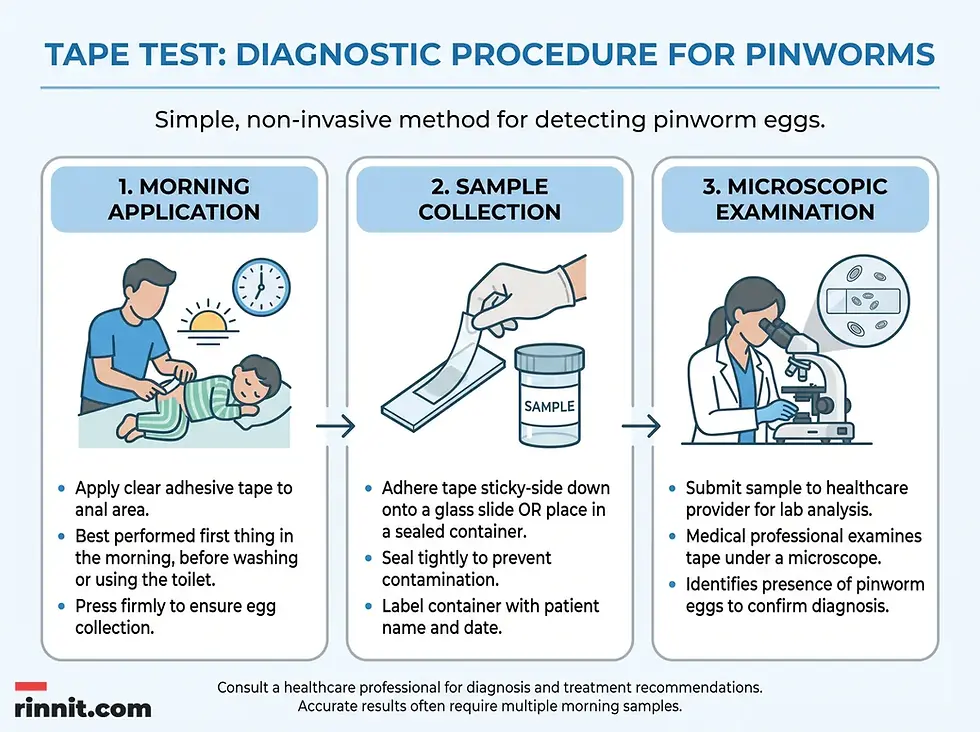
The tape test involves applying a piece of clear adhesive tape to the skin around the anus first thing in the morning, before bathing or using the bathroom. The tape collects any eggs present on the skin, which can then be examined under a microscope by a pediatrician. For the most accurate results, this test should be performed on three consecutive mornings. [1]
How are pinworms treated, and what household care is needed?
Treatment for pinworms is straightforward but requires a specific protocol to ensure the infection is completely cleared. Healthcare providers typically prescribe a two-dose regimen of oral anti-parasitic medication. [1]
Common treatments include:
Pyrantel Pamoate: The most common treatment, available over-the-counter.
Albendazole: A prescription-strength alternative. [1]
The first dose kills the adult worms, while the second dose, taken two weeks later, ensures that any larvae hatched from eggs present during the first treatment are also eliminated. Because pinworms are so contagious, it is highly recommended that all family members and caregivers be treated at the same time, even if they do not show symptoms. [1]
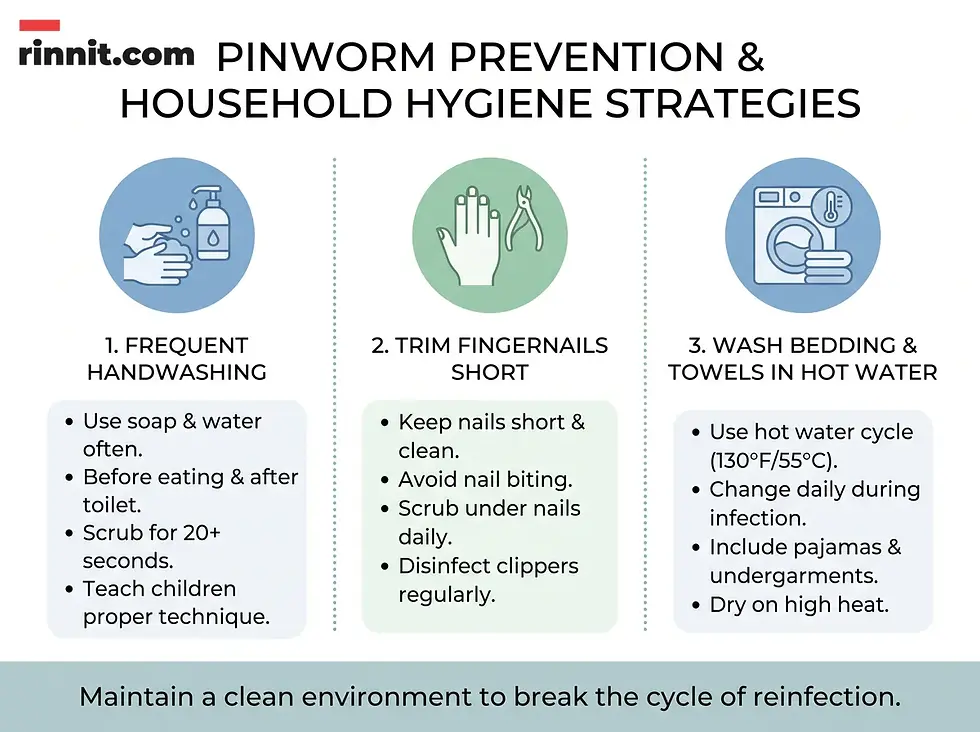
"Preventing reinfection is one of the biggest challenges in getting rid of pinworms. Washing all clothing, bed linens, and towels in as hot water as possible while taking the treatment can help reduce the risk." [1]
How can you prevent pinworms long term?
Maintaining high standards of personal hygiene is the most effective way to prevent future infections. Consistent handwashing, especially after using the bathroom and before handling food, is essential. Keeping fingernails short can also prevent eggs from becoming trapped and transferred. [1]
Conclusion
While the thought of a pinworm infection can be unsettling, it is a manageable condition that responds well to proper treatment. By following the two-dose medication schedule and maintaining strict household hygiene, you can successfully eliminate the infection and protect your family from reinfection.
Frequently Asked Questions
Are pinworms contagious?
Yes, pinworms are highly contagious. They spread easily through contaminated hands, surfaces, clothing, and bedding.
Can adults get pinworms?
Yes. While most common in children, adults can become infected, especially those who are caregivers or live with infected children.
How long do pinworm eggs survive on surfaces?
Pinworm eggs are very resilient and can survive for two to three weeks on surfaces like toys, linens, and towels.
Is the "tape test" painful?
No, the tape test is a painless and non-invasive way to collect egg samples for microscopic diagnosis.
Why do I have to take two doses of medicine?
The first dose kills the adult worms, but not the eggs. The second dose, taken two weeks later, kills any worms that hatched after the first dose.
Should the whole family be treated?
Yes, healthcare providers recommend treating all household members simultaneously to prevent the infection from being passed back and forth.
Can you get pinworms from pets?
No. Pinworms are human-specific parasites; you cannot catch them from or give them to your dogs, cats, or other pets.
What is the best way to relieve itching?
Washing the area with warm water and soap or using a 1% hydrocortisone cream can help soothe the skin during treatment.
Can pinworms be inhaled?
In rare cases, microscopic eggs can become airborne (such as when shaking out contaminated bedding) and be inhaled and then swallowed.
Do pinworms go away on their own?
No. Without medical treatment, the worms will continue to lay eggs and the infection will persist and likely spread to others.
References
Cleveland Clinic. Pinworms. Cleveland Clinic Health Library. Last updated July 12, 2024. https://my.clevelandclinic.org/health/diseases/21137-pinworms
Lashaki EK, Mizani A, Hosseini SA, et al. Global prevalence of enterobiasis in young children over the past 20 years: a systematic review and meta-analysis. Osong Public Health Res Perspect. 2023;14(6):441-450. PMID: 38204424. DOI: 10.24171/j.phrp.2023.0204
Leung AKC, Lam JM, Barankin B, et al. Pinworm (Enterobius vermicularis) infestation: an updated review. Curr Pediatr Rev. 2025;21(4):333-347. PMID: 38288810. DOI: 10.2174/0115733963283507240115112552
Azzam A, Khaled H. Prevalence and risk factors of intestinal parasitic infections among preschool and school-aged children in Egypt: a systematic review and meta-analysis. BMC Public Health. 2025;25(1):2160. PMID: 40495169. DOI: 10.1186/s12889-025-23325-8
Medical disclaimer
This article is for informational purposes only and is not a substitute for professional medical advice, diagnosis, or treatment. Always seek the advice of your physician or other qualified health provider with any questions you may have regarding a medical condition.



Comments