Pellagra: A Comprehensive Guide to Niacin Deficiency

Updated: 3 days ago
Medically reviewed by Dr. Baraa Alnahhal, MD · Last reviewed: October 2026
Pellagra is a systemic condition caused by a severe lack of niacin (vitamin B3), a nutrient the body needs to convert food into cellular energy [1]. It is best known for the “3 Ds” of dermatitis, diarrhea, and dementia, and it can be fatal if left untreated. Historically linked to limited diets, modern cases often stem from health conditions that affect nutrient absorption, and most people recover quickly with niacin supplements and dietary changes [1].
Quick Answer: What is pellagra?
Pellagra is a serious systemic disease caused by a severe deficiency of niacin, or vitamin B3, affecting the skin, brain and digestive tract. Its classic signs are dermatitis, diarrhea and dementia, and untreated it can cause death. Replacing niacin with supplements and diet usually brings rapid improvement, though advanced nerve damage and dementia may become permanent if treatment is delayed. [1]
What the research says
Published studies on pellagra are mostly reviews rather than trials, so the findings below are summaries of what these reviews report.
Anti-tuberculosis therapy has been linked to more pellagra in areas where latent tuberculosis is common. A review of causes and mechanisms describes pellagra as a syndrome caused by a deficiency of niacin and/or its precursor tryptophan, with the cardinal manifestations of dermatitis, diarrhea, dementia, and, in the worst case, death. It notes that increased use of isoniazid prophylaxis along with antiretroviral therapy in countries where latent tuberculosis is common has been associated with more presentations of pellagra (Prabhu et al., Photodermatol Photoimmunol Photomed, 2021).
Pellagra is rare today, so diagnosis is often delayed. A literature review found that pellagra now develops mainly in people who chronically abuse alcohol or are treated with certain medicines, such as immunosuppressive and anti-tuberculosis drugs. Diagnosis rests mainly on the clinical picture, and the disease’s rarity often delays diagnosis and treatment. Therapy is based on niacinamide, and failure to treat in the early stages leads to death (Hołubiec et al., Folia Med Cracov, 2021).
Visible pellagra faded as diets improved, but subclinical deficiency may remain. A scoping review of South African records from 1897 to 2019 found that pellagra was first officially recorded in 1906, was associated with poverty and heavy dependence on maize, and had declined by the late 1980s and early 1990s, with hardly any cases reported by 2000. Studies from the 1960s and 1970s suggested a high prevalence of subclinical niacin deficiency in previously disadvantaged populations, so the absence of visible pellagra does not rule out subclinical deficiency (Viljoen et al., Public Health Nutr, 2021).
Research summaries are based on article abstracts retrieved from PubMed.
What role does niacin play in human health?
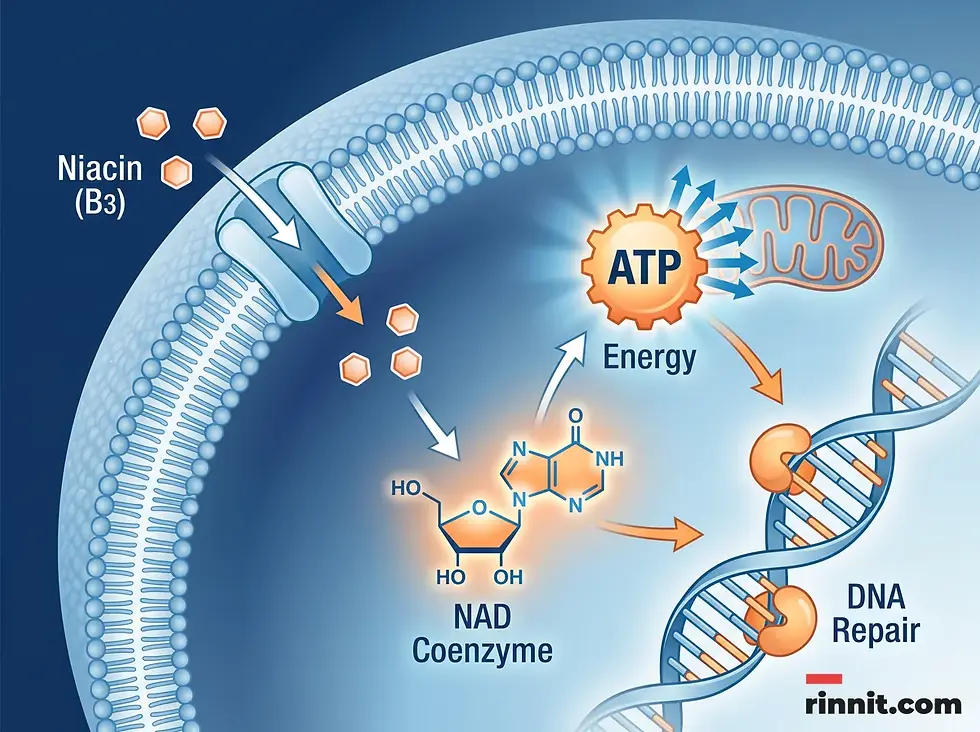
Niacin is a critical micronutrient that the body uses to convert calories from carbohydrates, proteins, and fats into usable energy, known as adenosine triphosphate (ATP). Once absorbed through the small intestine, niacin is converted into a coenzyme called nicotinamide adenine dinucleotide (NAD). More than 400 different enzymes in the body depend on NAD to function, and NAD is also involved in specific cellular functions such as DNA repair and cellular communication [1].
Because the body depends so heavily on NAD for fuel, a deficiency tends to show up first in the systems with the highest energy requirements or the fastest cell turnover rates. That is why the hallmark symptoms appear most prominently in the skin, the nervous system, and the mucous lining of the gastrointestinal tract [1].
What are the symptoms of pellagra?
Healthcare providers describe classic pellagra with the “3 Ds”: dermatitis, diarrhea, and dementia. Some add a fourth “D” for death, which can occur if pellagra is left untreated for several years. The symptoms are diverse and affect multiple body systems at once [1].
System Affected | Common Symptoms |
Skin | Itchy or painful rashes resembling sunburn, scaly plaques, and hyper-pigmentation. |
Gastrointestinal | Chronic diarrhea (sometimes bloody), abdominal pain and indigestion, and nausea. |
Neurological | Confusion, apathy, difficulty concentrating, mood changes, depression, and delusions. |
Oral | Mouth sores and a red, swollen tongue. |
General | Fatigue, weakness, malaise, and loss of appetite. |
Dermatitis and Photosensitivity
The skin symptoms are distinctive and often appear on sun-exposed areas such as the face, neck, arms, legs, hands, and feet. Deprived of energy, skin cells become more sensitive to light. Dermatitis begins with rashes that resemble a sunburn and then progresses to rough, scaly, dark plaques. One telltale sign is a dark, hyper-pigmented collar around the neck called Casal’s collar, named after the Spanish physician Don Gaspar Casal, who first identified pellagra among Spanish peasants in 1735 [1].
Gastrointestinal and Neurological Impact
Gastrointestinal distress occurs when the mucous lining of the intestines fails to replenish itself fast enough, which leads to inflammation and poor digestion, stomach pain, and chronic diarrhea. Neurologically, early symptoms may be vague, such as lethargy, apathy, and difficulty concentrating, or may look like anxiety or depression. If the deficiency continues, symptoms progress to confusion and delusions, and severe cases may lead to permanent dementia, tremors, and balance and coordination problems [1].

What are the primary and secondary causes of pellagra?
The causes of niacin deficiency are grouped into primary and secondary categories. Primary causes relate directly to diet, while secondary causes involve health conditions or substances that interfere with how the body absorbs or uses the vitamin [1].
Primary causes: These occur when the diet is severely limited, particularly where protein is scarce and corn is the staple food. Corn contains niacin, but in a “bound” form that the body cannot easily absorb unless the corn is processed in traditional ways, such as soaking it in limewater [1].
Secondary causes: These are more common in industrialized regions. They include gastrointestinal diseases that cause malabsorption (such as inflammatory bowel disease or cirrhosis), alcohol use disorder, gastric bypass surgery, iron deficiency anemia, Hartnup disease, carcinoid syndrome, HIV infection, and certain drugs, including some antispasmodic and chemotherapy drugs [1]. Isoniazid, used against tuberculosis, has also been linked to pellagra [2].
Where does pellagra occur today?
Historically, pellagra has occurred in poor populations around the world, including Europe, Africa, Asia, and the Southern United States. In the early 1900s it was so common in the Southern United States that Congress asked the Surgeon General to investigate. The research that followed showed it was caused by a poor diet, and by mid-century bread and cereal products in the United States were routinely fortified with niacin, a practice that continues today [1].
Today, pellagra in the United States is rare and is usually due to secondary causes such as alcohol use. Primary pellagra still exists in less developed regions, especially where corn remains the staple food, and it is most commonly found in India, China, and sub-Saharan Africa [1].
How is pellagra diagnosed and managed?
Healthcare providers typically examine the person, review their symptoms, medical history, and diet, and may order a urine test to measure niacin-related chemicals. They may also confirm pellagra with a “therapeutic trial,” in which niacin supplements are given to see whether symptoms improve [1]. Because pellagra is rare, it is sometimes recognized late, so telling your provider about your diet, alcohol use, medicines, and digestive conditions is important [3].
Treatment and Recovery Timeline
Pellagra is cured by replacing the missing nutrient. With niacin supplements, most people begin to improve right away, and some people also need treatment for skin and mouth sores. If a pre-existing health condition caused the pellagra, that condition needs treatment too [1].
Recovery Phase | Expected Improvement |
Initial days | Energy levels improve and malaise begins to lift. |
Week 1 | Digestive symptoms such as diarrhea and pain ease. |
Week 2 | Skin lesions and mouth sores begin to heal. |
Long term | Neurological symptoms improve, unless the damage is severe or long-standing and has become permanent. |

Secondary pellagra can be trickier to treat. Supplements often help but may not be enough if the body cannot use niacin effectively, so recovery depends on finding and treating the underlying condition [1]. Taken as prescribed, niacin supplements should not cause side effects, but an overdose can cause skin flushing, itching and rashes, bloating, headaches, and dizziness [1].
How can pellagra be prevented with nutrition?
Primary pellagra is most simply prevented with a well-balanced diet, while enriched foods and supplements can help when food choices are limited. When food choices are limited, enriched foods and dietary supplements can help. The recommended daily dose of niacin is about 15 milligrams, and a B-complex vitamin supplement provides enough niacin for most healthy adults [1]. Excellent food sources of niacin include:
Poultry and beef liver.
Oily fish such as salmon and tuna.
Peanuts and sunflower seeds.
Enriched bread and cereals, and brewer’s yeast.
Potatoes, beets, and rice.
People with a chronic health condition that predisposes them to malabsorption should talk with their healthcare provider about long-term prevention, which may involve diet, supplements, or changes to medicines [1].
Conclusion
Pellagra shows how much individual micronutrients matter for whole-body health. Although it has been largely eradicated in many parts of the world through food fortification, it remains a risk for people with limited diets or underlying health problems [1]. Early recognition of the “3 Ds” and prompt nutritional treatment are essential for full recovery and for preventing lasting nerve damage.
When should you see a doctor about pellagra?
If you have symptoms such as persistent diarrhea or abdominal pain, a rash on sun-exposed skin, mouth sores, or unexplained confusion, or if you have a condition that affects how your body absorbs nutrients, seek medical care. Even a small vitamin deficiency can have a domino effect on your health [1].
Frequently Asked Questions
What is the "Casal's collar" in pellagra?
Casal's collar is a distinctive, dark, hyper-pigmented rash that forms a collar-like pattern around the neck, often in areas exposed to the sun [1].
Can pellagra be fatal?
Yes. If it is left untreated for several years, the failure of energy production at the cellular level can eventually lead to death [1].
Is pellagra contagious?
No. It is a nutritional deficiency disease and cannot be spread from person to person through contact.
How quickly does treatment work?
Most people begin to improve within a few days of starting niacin supplements. Digestive symptoms usually improve within the first week, and skin and mouth sores begin to heal within two weeks [1].
Why is corn linked to pellagra?
The niacin in corn is in a bound form that is hard for the body to absorb unless the corn is treated first, as in the traditional method of soaking it in limewater [1].
What are the "3 Ds" of pellagra?
The classic symptoms are dermatitis (skin rash), diarrhea (digestive distress), and dementia (neurological changes) [1].
Who is at highest risk for secondary pellagra?
People with alcohol use disorder, gastrointestinal diseases that cause malabsorption, or certain conditions and medicines that interfere with niacin absorption or use [1].
Can nerve damage from pellagra be reversed?
Many symptoms improve with treatment, but severe, long-standing nerve damage and advanced dementia may be irreversible [1].
How much niacin do I need daily?
The recommended daily dose of niacin is about 15 milligrams, which most healthy adults can get from a balanced diet [1].
Related Resources
External resource for deeper reading:
Cleveland Clinic. Pellagra. Cleveland Clinic Health Library. Last updated July 18, 2022. https://my.clevelandclinic.org/health/diseases/23905-pellagra
References
Cleveland Clinic. Pellagra. Cleveland Clinic Health Library. Last updated July 18, 2022. https://my.clevelandclinic.org/health/diseases/23905-pellagra
Prabhu D, Dawe RS, Mponda K. Pellagra a review exploring causes and mechanisms, including isoniazid-induced pellagra. Photodermatol Photoimmunol Photomed. 2021;37(2):99-104. PMID: 33471377. DOI: 10.1111/phpp.12659
Hołubiec P, Leończyk M, Staszewski F, et al. Pathophysiology and clinical management of pellagra - a review. Folia Med Cracov. 2021;61(3):125-137. PMID: 34882669. DOI: 10.24425/fmc.2021.138956
Viljoen M, Bipath P, Tosh C. Pellagra in South Africa from 1897 to 2019: a scoping review. Public Health Nutr. 2021;24(8):2062-2076. PMID: 33769244. DOI: 10.1017/S1368980021001336
Medical disclaimer
This article is for informational purposes only and is not a substitute for professional medical advice, diagnosis, or treatment. Always seek the advice of your physician or other qualified health provider with any questions you may have about a medical condition.



Comments