Parosmia: Understanding Distorted Sense of Smell

Updated: 2 days ago
Medically reviewed by Dr. Baraa Alnahhal, MD · Last reviewed: October 2026
Parosmia is a distorted sense of smell. It happens when smell receptor cells in your nose do not detect odors or transmit them to your brain. It is usually temporary, but in some cases it is permanent [1].
Quick Answer: What is parosmia?
Parosmia is a condition that distorts your sense of smell, so familiar odors may smell wrong or unpleasant. Causes include infections such as COVID-19, head trauma, neurological conditions and smoking. Treatment depends on the cause and may include olfactory training or medication. Most people eventually regain partial or full smell, but a small number never do. [1]
What the research says
Most people with post-COVID smell loss recover at least partly, but not everyone. In a survey of 946 adults with COVID-19 smell loss, 38.7% reported complete recovery, 51.0% partial recovery (from mild complaints to severe phantosmia or dysosmia), and 10.3% no improvement. Among 267 people with at least 2 years of follow-up, 38.2% reported full recovery, 54.3% partial, and 7.5% none. Complete recovery was higher in people under 40 (45.6%) than over 40 (32.9%) (McWilliams et al., Am J Otolaryngol, 2022).
Having parosmia may be a good sign during olfactory training. In a retrospective cohort of 153 adults with post-infectious olfactory dysfunction who received olfactory training, having parosmia at the first visit was associated with clinically relevant improvement in odor discrimination and odor identification (Liu et al., Laryngoscope, 2021).
Olfactory training is the first-line recommended treatment for COVID-19 smell loss. A 2022 review reports that olfactory training remains the first-line recommended treatment, that effective medical treatments are scarce, and that up to 7% of patients remain anosmic (totally without smell) more than 12 months after onset (Karamali et al., Curr Opin Otolaryngol Head Neck Surg, 2022).
Research summaries are based on article abstracts retrieved from PubMed.
What Is Parosmia?
People with parosmia may be unable to experience the full range of scents in their environment, or the odors they detect smell wrong [1]. Parosmia is sometimes confused with other smell and taste disorders, which are common symptoms of COVID-19 [1]:
Term | What it means |
|---|---|
Parosmia | A distorted sense of smell; odors smell wrong |
Anosmia | A total loss of the sense of smell |
Dysgeusia | A distorted sense of taste |
Ageusia | A total loss of the sense of taste |
Source: Cleveland Clinic [1].

Medical illustration of the olfactory system and how damaged receptor cells can lead to distorted signals reaching the brain.
How Common Is Parosmia?
Parosmia is common, and it has become even more prevalent since the onset of COVID-19. One 2007 study found that approximately 3.9% of adults experience parosmia at some point. A 2021 study estimated that 40% to 75% of people with COVID-19 develop it, and the average onset is three months after the initial infection. Parosmia is a common long COVID symptom [1].
What are the symptoms of parosmia?
Parosmia symptoms vary from person to person, often including foul smells around food and pleasant scents becoming overpowering. Some cases are mild and short-lived, while others are severe and long lasting. In most cases, people start to notice symptoms after recovering from an infection [1]. People with parosmia might [1]:
Have trouble detecting certain scents in their environment
Smell a foul odor, particularly when food is present
Find previously pleasant scents overpowering and undesirable
What causes parosmia, a distorted sense of smell?
Several conditions can cause parosmia [1]:
COVID-19
Acute sinusitis, the common cold, and influenza (flu)
Head trauma
Nasal polyps
Certain medications and cancer treatments
Chronic dry mouth (xerostomia)
Smoking and chemical exposure
Temporal lobe seizures
Brain tumors (less common)
Parosmia itself is not spreadable, but the infections that cause it are contagious. To reduce your risk, keep your distance from anyone who is sick and practice good hygiene [1].
How is parosmia diagnosed?
A healthcare provider, usually an otolaryngologist (ENT), will ask about your health history, including recent infections, current medications, and lifestyle factors such as smoking. Next, they will likely ask you to sniff different substances and describe the scent [1].
In some cases, your provider may request additional tests to find the underlying cause, such as an MRI or sinus CT scan, or a biopsy of sinus tissue [1].
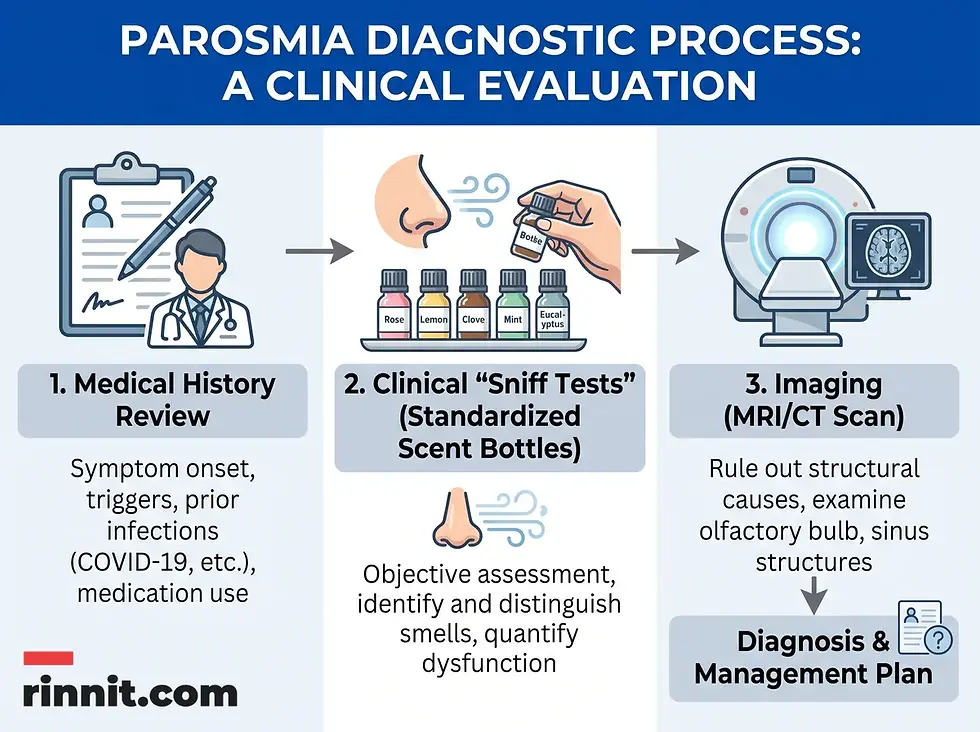
Diagnostic process for parosmia: history review, sniff tests, and imaging when needed.
How is parosmia treated?
Parosmia treatment depends on the cause. The vast majority of people eventually regain a partial or full sense of smell, but a small number never do [1].
Removing triggers. If parosmia results from environmental factors such as smoking, medications, or chemical exposure, your sense of smell will likely return once you remove those triggers. Consult your healthcare provider before stopping any medications [1].
Olfactory training. Also called smell training, this involves sniffing various substances for several seconds at a time, twice a day, for several months. Ask your provider if it is an option for you [1] [4].
Medication. Research is ongoing, but studies suggest that phenytoin, clonazepam, topiramate, and valproic acid may help restore your sense of smell [1].
Surgery. If parosmia is a symptom of nasal polyps or a brain tumor, your provider may recommend surgery. Removing damaged sensory receptors in the nose is a complex procedure whose risks often outweigh the benefits, so explore your options thoroughly [1].

Management strategies for parosmia, including olfactory training and trigger identification.
What is the outlook and recovery for parosmia?
Parosmia is one of the most common long COVID symptoms. According to one research study, people with COVID-related parosmia start to regain their sense of smell approximately 14 to 16 months after infection [1]. In some cases parosmia is permanent, but full recovery is common. Current research suggests COVID-related parosmia is temporary, though symptoms can last for a year or longer [1]. In a large survey, about 38.7% of people with COVID-19 smell loss reported complete recovery and 51.0% partial recovery [2].
How can parosmia be prevented?
Parosmia cannot be completely prevented because it is often the result of trauma, viruses, and other uncontrollable factors. If it is caused by environmental factors such as smoking or chemical exposure, removing those triggers should reduce or eliminate your symptoms. To reduce your risk of bacterial and viral causes, wash your hands frequently and follow CDC recommendations [1].
When should you see a doctor about parosmia?
Schedule an appointment with a healthcare provider any time you notice a distorted or absent sense of smell. They can determine why you have parosmia and whether you need treatment for an underlying condition [1].
What is the bottom line on parosmia?
Parosmia makes familiar smells seem wrong. It is most often triggered by infections such as COVID-19, head injury, or environmental exposures, and it is usually temporary. Because it is a symptom of many conditions, an evaluation by a healthcare provider, usually an ENT specialist, is important. Removing triggers, olfactory training, and treating the underlying cause are the main paths to recovery [1].
Frequently Asked Questions
Is parosmia permanent?
In some cases parosmia is permanent, but full recovery is common. Current research suggests COVID-related parosmia is temporary, although symptoms can last for a year or longer [1].
Is parosmia contagious?
Parosmia itself is not spreadable, but the infections that cause it are contagious [1].
What is the difference between parosmia and anosmia?
Anosmia is a total loss of the sense of smell. Parosmia distorts the sense of smell, so odors you detect smell wrong [1].
How long does parosmia last after COVID-19?
According to one research study, people with COVID-related parosmia start to regain their sense of smell approximately 14 to 16 months after infection [1]. In a large survey, most people reported at least partial recovery [2].
Does smell training help?
Olfactory training involves sniffing various substances for several seconds at a time, twice a day, for several months [1]. It remains the first-line recommended treatment for COVID-19 smell loss [4], and a cohort study found that people with parosmia were more likely to show relevant improvement in odor discrimination and identification after training [3].
What causes parosmia?
Causes include COVID-19, acute sinusitis, head trauma, nasal polyps, the common cold, influenza, certain medications, chronic dry mouth, smoking, chemical exposure, cancer treatments, temporal lobe seizures, and, less commonly, brain tumors [1].
Can smoking or chemical exposure cause parosmia?
Yes. If parosmia results from environmental factors such as smoking, medications, or chemical exposure, your sense of smell will likely return once you remove those triggers. Consult your healthcare provider before stopping any medication [1].
Which doctor treats parosmia?
A healthcare provider, usually an otolaryngologist (ear, nose, and throat specialist), evaluates parosmia by reviewing your health history and asking you to sniff and describe different substances [1].
How common is parosmia?
One 2007 study found that approximately 3.9% of adults experience parosmia at some point. A 2021 study estimated that 40% to 75% of people with COVID-19 develop parosmia, with an average onset of three months after the infection [1].
Can parosmia be prevented?
Parosmia cannot be prevented completely because it is often caused by trauma, viruses, and other uncontrollable factors. Removing environmental triggers such as smoking or chemical exposure should reduce or eliminate symptoms, and frequent handwashing can lower the risk of infections that cause it [1].
Related Resources
External resource for deeper reading:
References
Cleveland Clinic. Parosmia. Cleveland Clinic Health Library. Last updated August 9, 2022. https://my.clevelandclinic.org/health/diseases/23986-parosmia
McWilliams MP, Coelho DH, Reiter ER, et al. Recovery from Covid-19 smell loss: two-years of follow up. Am J Otolaryngol. 2022;43(5):103607. PMID: 35987099. DOI: 10.1016/j.amjoto.2022.103607
Liu DT, Sabha M, Damm M, et al. Parosmia is associated with relevant olfactory recovery after olfactory training. Laryngoscope. 2021;131(3):618-623. PMID: 33210732. DOI: 10.1002/lary.29277
Karamali K, Elliott M, Hopkins C. COVID-19 related olfactory dysfunction. Curr Opin Otolaryngol Head Neck Surg. 2022;30(1):19-25. PMID: 34889850. DOI: 10.1097/MOO.0000000000000783
Medical disclaimer
This article is for informational purposes only and is not a substitute for professional medical advice, diagnosis, or treatment. Always seek the advice of your physician or other qualified health provider with any questions you may have about a medical condition.



Comments