Parkes Weber Syndrome: Symptoms, Causes, and Management

Updated: 2 days ago
Medically reviewed by Dr. Baraa Alnahhal, MD · Last reviewed: October 17, 2026
Parkes Weber syndrome is a rare vascular disorder that is present at birth. A tangled cluster of irregular blood vessels is the main issue, but people also have port wine stains and one limb that is larger than the other. Treatments help with symptoms and slow the disease down, and a few complications can be life-threatening [1].
Quick Answer: What is Parkes Weber syndrome?
Parkes Weber syndrome is a rare congenital vascular disorder with tangled abnormal blood vessels called arteriovenous malformations (AVMs), usually affecting one leg. Signs include port wine stains and one limb being larger. A RASA1 gene variation can cause it, and high-output heart failure is a serious complication. There is no cure, but treatments ease symptoms and require lifelong follow-up. [1]
What the research says
Embolization helps, but it usually needs repeating. In a retrospective review of 14 patients with Parkes-Weber syndrome at one center, 11 (79%) had transcatheter embolization of the AVM's arterial inflow. Ten of those 11 (91%) had a partial response, none had a complete response, and 55% needed multiple or staged procedures, with no periprocedural complications. Two of 3 patients with complex wounds later needed major amputations for gangrene (Conway et al., Ann Vasc Surg, 2020).
Heart failure and ulcers are common complications in reported cases. A systematic review of 36 publications covering 48 patients (median age 23 years) found that 87.5% had the lower extremity affected, 31.3% developed high-output heart failure, 25.0% had chronic venous ulcerations, and 8.3% had distal arterial ischemia. Embolization alone or combined with surgical resection of the AVM nidus reliably led to clinical improvement (Banzic et al., Phlebology, 2017).
A RASA1 gene change is behind the syndrome, and a second "hit" may be involved. A case report of a 2-year-old boy notes that Parkes Weber syndrome is linked to autosomal dominant inheritance caused by germline heterozygous inactivating changes in RASA1. Because severity varies even within families, the authors suggest a somatic "second hit" model, and they found two somatic RASA1 variants in affected tissue (allele fractions 3.6% and 4.2%) (Flores Daboub et al., Cold Spring Harb Mol Case Stud, 2020).
Research summaries are based on article abstracts retrieved from PubMed.
What Is Parkes Weber Syndrome?
Parkes Weber syndrome is a rare congenital vascular disorder. It involves a tangled network of irregular blood vessels that looks like a tumbleweed in diagnostic images. This blood vessel cluster has a hard time circulating blood to the areas that rely on it for their blood (and oxygen) supply [1].
The syndrome typically affects only one limb, usually one leg. The limb may develop skin ulcers (open sores) from a lack of oxygen, and these wounds are hard to heal due to a lack of blood supply [1]. Complications can be life-threatening, but regular monitoring helps catch issues that develop over time, and providers have many treatments to ease symptoms and slow the disease down [1].
What are the signs and symptoms of Parkes Weber syndrome?
Symptoms and signs may show up at birth or during childhood. Symptoms include pain, swelling and fatigue in the affected area, usually one leg [1]. Signs of Parkes Weber syndrome include:
Sign | What it looks like |
Capillary malformations | Salmon-colored port wine stains with pale halos around them on the skin. |
Arteriovenous malformations (AVMs) | Tangled clusters of blood vessels that can happen anywhere in the body but are often in one leg (or sometimes one arm). |
Hemihyperplasia | A noticeable difference in the size of one limb because of more bone and soft tissue growth than in the other limb. |
Source: Cleveland Clinic [1].
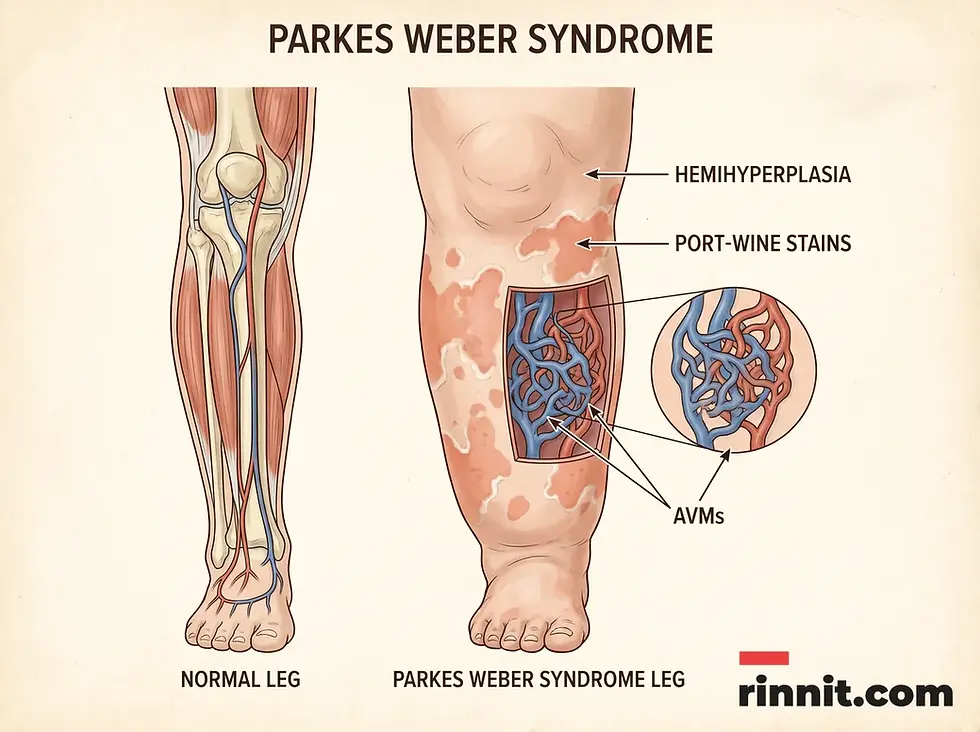
Comparison of a normal leg and a leg with Parkes Weber syndrome, showing limb overgrowth, port-wine stains, and AVMs.
Parkes Weber vs. Klippel-Trenaunay syndrome
Parkes Weber syndrome is like Klippel-Trenaunay syndrome (KTS), which has venous malformations and purple port wine stains [1]. A systematic review notes that Parkes Weber syndrome is still frequently misdiagnosed as KTS, and that the presence of an arteriovenous malformation is the criterion that distinguishes it, which matters for treatment planning [3].
What causes Parkes Weber syndrome?
A variation in your RASA1 gene can cause Parkes Weber syndrome. This gene plays a role in how your vascular system develops. You may inherit the variation from one biological parent, but it can also happen at random, without a biological family history [1]. Researchers have proposed that, in some people, an additional change that arises only in the affected tissue (a somatic "second hit") may also be needed for the disease to develop [4].
What complications can Parkes Weber syndrome cause?
Parkes Weber syndrome can cause serious complications, the most serious being high-output heart failure. It can lead to an enlarged heart and pulmonary edema (fluid buildup in your lungs). Skin infections from skin ulceration are common and require treatment [1]. Other complications may include [1]:
Skin ulcers (wounds).
Rhabdomyolysis (muscle breakdown that can be life-threatening).
Heart disease and hypertrophy (heart muscle thickening).
Tachycardia (an abnormally high resting heart rate).
High blood pressure.
Limb ischemia (low blood flow to the limb).
Aneurysms (weakness in an artery wall).
Blood clots.
Varicose veins.
In published cases, 31.3% of patients developed high-output heart failure and 25.0% had chronic venous ulcerations [3].
How is Parkes Weber syndrome diagnosed?
Parkes Weber syndrome can be hard to diagnose because it is rare, but a provider may suspect it on exam and confirm it with imaging tests. A provider may talk about syndrome stages, from I to IV. Stage I usually doesn't have symptoms, while stages II through IV include symptoms, with IV being the worst [1].
Tests to diagnose Parkes Weber syndrome may include [1]:
Doppler ultrasound.
CT (computed tomography) scan.
CT angiogram.
MRA (magnetic resonance angiogram).
MRI (magnetic resonance imaging).
In some cases, genetic testing of blood or affected tissue is used to look for RASA1 variants, as described in a published case report [4].
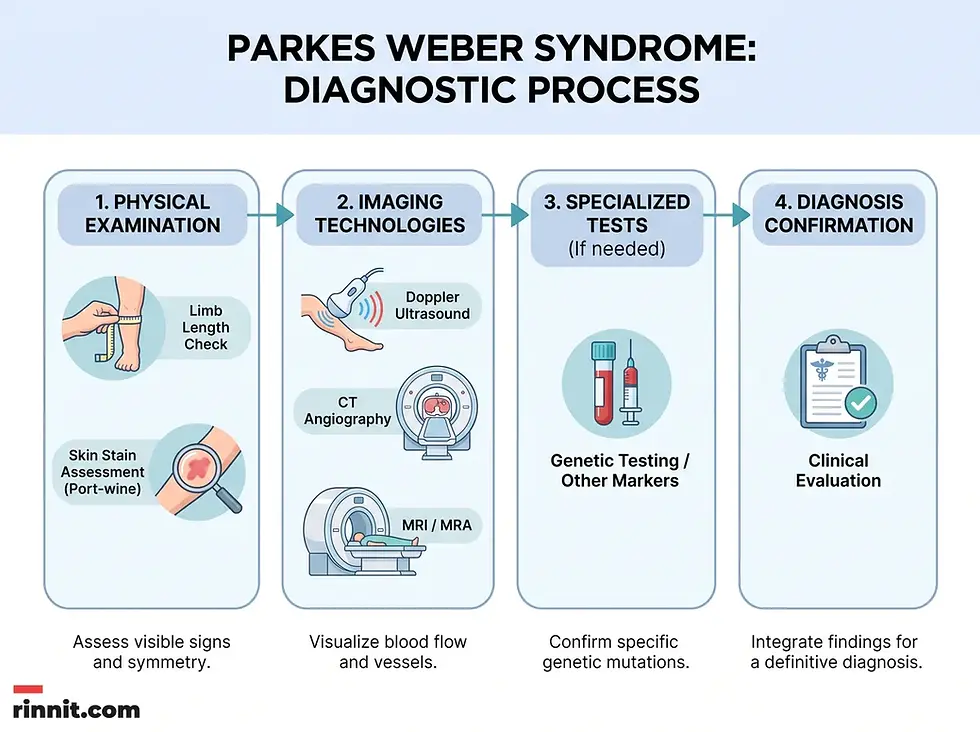
Visual guide to the diagnostic pathway for Parkes Weber syndrome, from physical examination to imaging and confirmation.
How is Parkes Weber syndrome treated?
Parkes Weber syndrome has no cure, but treatments can ease symptoms and keep the syndrome from getting worse. Treatment varies from person to person and ranges from simple, noninvasive measures to procedures that destroy blood vessels. Treatments may include [1]:
Compression stockings to reduce swelling and prevent deep vein thrombosis.
An orthopedic shoe insert for one foot to make up for the difference in leg length.
Wound care for skin ulcers.
Angiogenesis inhibitors to keep new blood vessels from forming.
Diuretics to reduce fluid buildup.
A stent to hold a blood vessel open.
Embolization of AVMs (creating a blockage inside a blood vessel).
Endovascular ablation of AVMs (destroying them with a minimally invasive procedure).
Sclerotherapy of AVMs (an injection to close off a blood vessel).
Surgery.
Amputation (limb removal).
Research suggests that AVMs in Parkes Weber syndrome can be treated with a transcatheter approach, but multiple interventions are usually required, and people with extensive wounds remain at risk of limb loss [2]. A systematic review concluded that the primary goals of management should be improving quality of life and reducing complications [3].

Infographic of management strategies for Parkes Weber syndrome, from compression stockings to specialized vascular procedures.
What is the outlook for Parkes Weber syndrome?
Parkes Weber syndrome is a chronic (long-term) condition. Vascular malformations tend to become more noticeable over time, and a child may develop more port wine stains as they age. Some people need a hospital stay to treat bleeding or infected ulcers. Embolization and other treatments can improve circulation, but a person will most likely need treatment more than once for an AVM, and the condition requires lifelong follow-up [1].
Because the disease is rare, information about prognosis is limited. One study included a few people who had their first treatment in their 40s and even late 60s, but most had their first treatments before age 17, which suggests that most people need treatment during childhood [1].
Can Parkes Weber syndrome be prevented, and does genetic counseling help?
Because this syndrome is present at birth, you can't prevent it. You can talk with a genetic counselor if Parkes Weber syndrome runs in your family and you are planning a pregnancy, but the syndrome can also happen without a biological family history [1].
How can people live well with Parkes Weber syndrome?
Having a child with Parkes Weber syndrome means being extra observant, including watching for signs that the syndrome is getting worse. Helping your child stay at a weight that is healthy for them may also help with symptoms [1]. A team that specializes in vascular issues may be the best option, and regular checkups with several providers are likely, such as a dermatologist, an interventional radiologist, a hematologist or oncologist, and a general surgeon. Your child may have regular tests such as echocardiograms or MRIs to check for complications, and should see their provider whenever they have painful swelling in the affected area [1].
When should someone with Parkes Weber syndrome seek emergency care?
Seek immediate treatment if you or your child have [1]:
Skin breakdown or ulcers.
Chest pain.
Heart palpitations.
Shortness of breath (dyspnea).
Dizziness.
Muscle weakness, pain or stiffness.
Questions to ask your provider include how often checkups are needed, what stage of the syndrome is present, what the best treatment is, and which treatments have worked well for others with this syndrome [1].
What is the bottom line on Parkes Weber syndrome?
Parkes Weber syndrome is a rare vascular disorder present at birth, marked by AVMs, port wine stains and one larger limb, and often linked to a RASA1 gene variation. There is no cure, but treatments ease symptoms and slow progression, and lifelong follow-up with a vascular team helps catch complications such as heart failure early. If you suspect your child has signs of a congenital vascular disorder, ask for an evaluation by a specialized vascular team [1].
Frequently Asked Questions
Can Parkes Weber syndrome be prevented?
No. Because the syndrome is present at birth, it can't be prevented. A genetic counselor can help if it runs in your family and you are planning a pregnancy, but it can also happen without a biological family history.
Is Parkes Weber syndrome the same as Klippel-Trenaunay syndrome?
No, but they are similar. Klippel-Trenaunay syndrome has venous malformations and purple port wine stains, while Parkes Weber syndrome involves arteriovenous malformations and salmon-colored port wine stains with pale halos.
What is the most serious complication?
High-output heart failure is a serious complication. It can lead to an enlarged heart and pulmonary edema (fluid buildup in the lungs).
Does everyone with Parkes Weber syndrome need surgery?
Not necessarily. Treatment varies from person to person and ranges from simple, noninvasive measures such as compression stockings to procedures that block or destroy blood vessels.
How is the RASA1 gene involved?
A variation in the RASA1 gene can cause Parkes Weber syndrome. This gene plays a role in how the vascular system develops. The variation can be inherited from one biological parent or happen at random.
What are the emergency warning signs?
Seek immediate treatment for skin breakdown or ulcers, chest pain, heart palpitations, shortness of breath, dizziness, or muscle weakness, pain or stiffness.
What is the outlook for Parkes Weber syndrome?
Parkes Weber syndrome is a chronic condition. Vascular malformations tend to become more noticeable over time, and more port wine stains may appear with age. It requires lifelong follow-up.
Do the skin ulcers heal easily?
No. Skin ulcers in the affected limb are hard to heal because of a lack of blood supply, and wound care is one of the treatments. Seek immediate treatment for skin breakdown or ulcers.
Is Parkes Weber syndrome always in the leg?
Parkes Weber syndrome typically affects only one limb, usually one leg. The tangled blood vessels are often in one leg or sometimes one arm, but can happen anywhere in the body.
How often are checkups needed?
Regularly. A team that specializes in vascular issues may be the best option, and lifelong follow-ups are needed. Regular tests such as echocardiograms or MRIs may check for complications.
Related Resources
External resource for deeper reading:
References
Cleveland Clinic. Parkes Weber Syndrome. Cleveland Clinic Health Library. Last updated August 11, 2025. https://my.clevelandclinic.org/health/diseases/parkes-weber-syndrome
Conway AM, Qato K, Nguyen Tran NT, et al. Embolization techniques for arteriovenous malformations in Parkes-Weber syndrome. Ann Vasc Surg. 2020;69:224-231. PMID: 32479884. DOI: 10.1016/j.avsg.2020.05.039
Banzic I, Brankovic M, Maksimović Ž, et al. Parkes Weber syndrome-diagnostic and management paradigms: a systematic review. Phlebology. 2017;32(6):371-383. PMID: 27511883. DOI: 10.1177/0268355516664212
Flores Daboub JA, Grimmer JF, Frigerio A, et al. Parkes Weber syndrome associated with two somatic pathogenic variants in RASA1. Cold Spring Harb Mol Case Stud. 2020;6(4):a005256. PMID: 32843429. DOI: 10.1101/mcs.a005256
Medical disclaimer
This article is for informational purposes only and is not a substitute for professional medical advice, diagnosis, or treatment. Always seek the advice of your physician or other qualified health provider with any questions you may have about a medical condition.



Comments