Paranoid Personality Disorder (PPD): Symptoms, Causes, and Management

Updated: 2 days ago
Medically reviewed by Dr. Baraa Alnahhal, MD · Last reviewed: October 2026
Paranoid personality disorder (PPD) is a long-term mental health condition. People with it feel distrust and suspicion toward others without good reason [1]. It usually starts in the late teens or early adulthood. It can lead to isolation, cold relationships and a reluctance to confide in others. The exact cause is unknown, but childhood neglect and biological factors play a role. Treatment centers on talk therapy, such as cognitive behavioral therapy.
Quick Answer: What is paranoid personality disorder?
Paranoid personality disorder (PPD) is a mental health condition with a long-term pattern of intense distrust. People with it believe others mean them harm, without evidence. It is a Cluster A personality disorder that affects about 0.5% to 4.5% of people. It usually does not involve hallucinations. Diagnosis usually comes after age 18, and talk therapy is the main treatment. [1]
What the research says
Building trust is the main therapeutic challenge. A 2024 review of paranoid personality disorder describes attentional and interpretative biases as central to the condition, with feelings of unfamiliarity and mistrust shaping how people experience others. It identifies building a trustful relationship as the main challenge in treatment and concludes that introspection-based therapeutic approaches fit this problem particularly well (Jacobs, Front Psychiatry, 2024).
Early evidence for a new therapy is encouraging but very small. In a 2024 case series of 7 patients with PPD who received 10 months of individual Evolutionary Systems Therapy without medication, all 7 completed treatment with no adverse events, and 6 of 7 no longer met the diagnosis afterward. Personality pathology and paranoid ideation improved reliably and stayed improved at 1-month follow-up, but the authors note that further research is needed to confirm the results (Cheli et al., Bull Menninger Clin, 2024).
Research summaries are based on article abstracts retrieved from PubMed.
What Is Paranoid Personality Disorder?
Paranoid personality disorder changes how a person sees and deals with the world. It belongs to Cluster A, a group of personality disorders marked by unusual or eccentric thinking and behavior. The hallmark of PPD is a constant, unjustified suspicion that others mean harm [1].
It is important to tell PPD apart from other conditions that involve paranoia. People with schizophrenia may have delusions or hallucinations. People with PPD usually do not. Instead, their paranoia is a constant way of reading social situations. They may believe innocent remarks or casual looks carry hidden threats. The condition usually appears in the late teens or early adulthood and affects 0.5% to 4.5% of people.
What are the common signs and symptoms of paranoid personality disorder?
PPD behaviors are often defensive, which makes close relationships very hard. Because people with PPD are always "on guard," they may seem cold, distant or controlling.
Symptom category | Common behaviors |
|---|---|
Social interaction | Reluctance to confide in others; reading hidden meanings into innocent remarks [1]. |
Relationship dynamics | Unjustified suspicion of partner infidelity; holding long-term grudges. |
Emotional response | Hypersensitivity to criticism; persistent hostility or argumentativeness. |
Self-perception | Difficulty seeing their own role in conflicts; believing they are always right. |

The mind in PPD: always on guard and suspicious of others.
What causes paranoid personality disorder and who is at risk?
The exact cause of PPD is unknown. Researchers think it comes from a mix of biological and environmental factors. Childhood experiences seem to play a big part in the disorder developing later in life [1].
Studies show that emotional, physical or supervision neglect in childhood plays a major role in PPD appearing in the teen years. Experts once suspected a strong genetic link between PPD and schizophrenia. Newer research suggests the link is weaker than once thought. Some groups show higher rates of PPD, including people in low-income households and people who are widowed or divorced. The reasons for these links need more study [1].
How is paranoid personality disorder diagnosed?
PPD can be hard to diagnose because people with it rarely see their thinking as a problem. Most seek help only when other problems appear, such as severe anxiety or depression after lost relationships or conflicts at work [1].
Providers usually wait until a person is at least 18 to diagnose PPD, because personality keeps developing through childhood and the teen years. A psychiatrist or psychologist uses the criteria in the Diagnostic and Statistical Manual of Mental Disorders (DSM). They often ask broad, gentle questions about the person's history, relationships and impulse control. This helps avoid a defensive or hostile reaction.
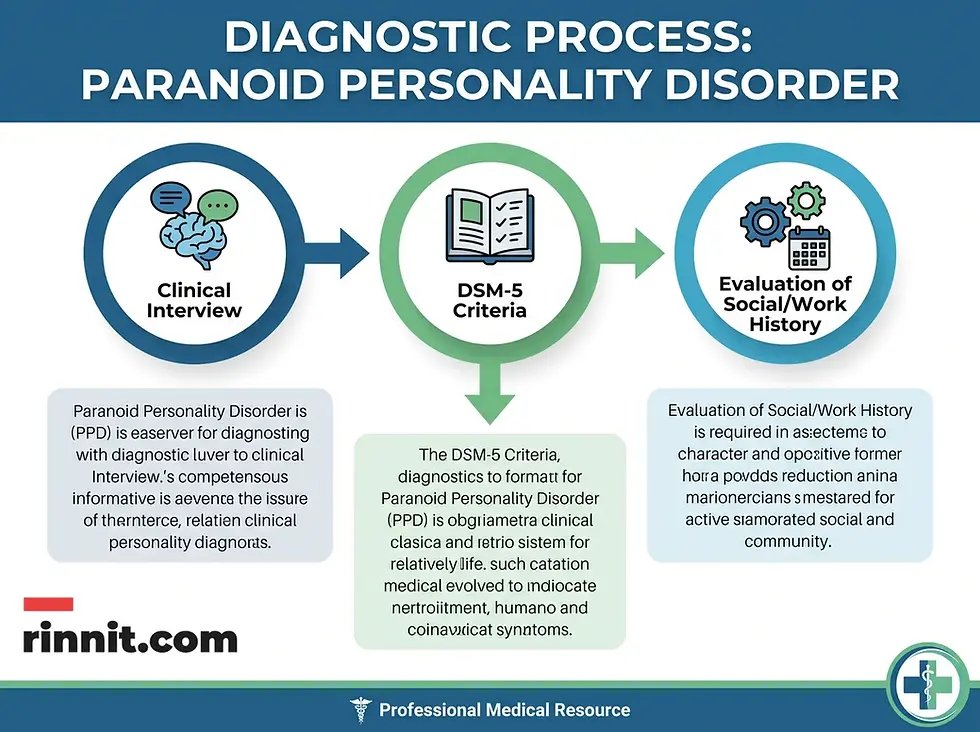
How PPD is diagnosed: clinical history and DSM criteria.
How is paranoid personality disorder managed and treated?
The biggest challenge in treating PPD is the person's distrust, which often extends to the provider. Building trust takes time. Many people struggle to follow their treatment plan if they question the therapist's motives [1].
Psychotherapy
Talk therapy is the main treatment for PPD. Specialized approaches include:
Cognitive behavioral therapy (CBT): helps you spot and change distorted thought patterns and build coping skills.
Dialectical behavior therapy (DBT): aims to improve social skills, communication and self-esteem.
Medication
No medicines are approved specifically for PPD. But a provider may prescribe anti-anxiety, antidepressant or antipsychotic medicine if symptoms are extreme. They may also prescribe it for related conditions such as panic disorder or depression [1].

Managing PPD: talk therapy such as CBT and DBT, and building trust.
What is the bottom line on paranoid personality disorder?
Paranoid personality disorder is a hard condition that can lead to social and work isolation if left untreated. With steady talk therapy, people can learn to manage their suspicions and improve their quality of life. Early help is key to limiting the long-term impact on relationships and daily life.
Your next step: If you or a loved one has lasting distrust that gets in the way of daily life, reach out to a mental health professional. Early support can help manage these thoughts and build healthier relationships.
Frequently Asked Questions
Is PPD the same as schizophrenia?
No. People with PPD generally do not experience the hallucinations or delusions seen in schizophrenia [1].
Can PPD be cured?
PPD is a chronic condition, but talk therapy can significantly reduce paranoia and improve a person's ability to function in daily life.
Why do people with PPD hold grudges?
Their hypersensitivity and tendency to read hidden meanings into actions make it difficult for them to forgive perceived slights.
At what age is PPD usually diagnosed?
PPD is typically diagnosed after age 18, once personality development has stabilized [1].
Do people with PPD seek help on their own?
Rarely. Most are referred by family members or employers, or seek help for associated anxiety and depression [1].
Can PPD lead to aggression?
Yes. It is one of the strongest predictors of aggressive behavior in clinical settings and is sometimes linked to excessive litigation [1].
Is there a genetic link for PPD?
PPD was once thought to be strongly linked to schizophrenia, but recent studies suggest the genetic connection is weaker than previously believed [1].
How does childhood neglect affect PPD?
Research indicates that emotional, physical, or supervision neglect in childhood is a significant risk factor for developing the disorder [1].
Are medications used for PPD?
No medication is specifically approved for PPD. Medications may be used for extreme symptoms or for co-occurring conditions such as anxiety, panic disorder, or depression [1].
What is the outlook for someone with PPD?
The outlook depends heavily on the person's willingness to commit to long-term psychotherapy [1].
Related Resources
External resource for deeper reading:
References
Cleveland Clinic. Paranoid Personality Disorder. Cleveland Clinic Health Library. Last updated April 28, 2022. https://my.clevelandclinic.org/health/diseases/9784-paranoid-personality-disorder
Jacobs KA. Changes of intuition in paranoid personality disorder. Front Psychiatry. 2024;14:1307629. PMID: 38268566. https://doi.org/10.3389/fpsyt.2023.1307629
Cheli S, Goldzweig G, Chiarello F, et al. Evolutionary systems therapy for paranoid personality disorder: a seven cases series. Bull Menninger Clin. 2024;88(1):61-80. PMID: 38527104. https://doi.org/10.1521/bumc.2024.88.1.61
Medical disclaimer
This article is for informational purposes only and is not a substitute for professional medical advice, diagnosis, or treatment. Always seek the advice of your physician or other qualified health provider with any questions you may have about a medical condition.



Comments