Parainfluenza: Symptoms, Causes, and Management

Updated: 2 days ago
Medically reviewed by Dr. Baraa Alnahhal, MD · Last reviewed: October 2026
Parainfluenza refers to a group of viruses, the human parainfluenza viruses (HPIVs), that cause common respiratory infections such as colds, croup, bronchiolitis, bronchitis, and pneumonia. Symptoms are often manageable at home, but the viruses are more likely to cause severe illness in children younger than 5, adults older than 65, and people with weakened immune systems [1].
Quick Answer: What is parainfluenza?
Parainfluenza viruses are germs that cause many respiratory illnesses, such as colds and croup, but not the flu. Infections are very common in infants and children and spread through coughs, sneezes and contaminated surfaces. Most people recover in a few days to a week with rest and fluids. Go to the ER for difficulty breathing or bluish skin. [1]
What the research says
HPIV-3 is the most commonly detected type, and young children are most affected. In U.S. surveillance from July 2011 to June 2019, 5% of 2,700,135 HPIV tests were positive. HPIV-3 accounted for 55% of detections, and 36% of detections were in children aged 2 years or younger. HPIVs were detected year-round, and HPIV-4 showed an annual fall-winter pattern (DeGroote et al., J Clin Virol, 2020).
Most positive cases are in children under 5. In a study of 4,755 people with acute respiratory illness in Guangzhou, China, 3.7% tested positive for HPIV, and 88.9% of those positives were in children younger than 5. Symptoms covered a wide spectrum and were similar across the four virus types (Liu et al., BMC Infect Dis, 2013).
Adults usually have mild illness, but HPIV can aggravate lung disease. A review reports that in adults with healthy immune systems HPIV typically causes mild upper respiratory symptoms and only infrequently severe croup or pneumonia, while it may be associated with flare-ups of asthma and COPD (Pawełczyk and Kowalski, Curr Allergy Asthma Rep, 2017).
Research summaries are based on article abstracts retrieved from PubMed.
What Is Parainfluenza?
Human parainfluenza viruses (HPIVs) cause many types of respiratory illness. The name sounds like “influenza,” the virus that causes the flu, but parainfluenza viruses do not give you the flu. They cause colds and other illnesses with symptoms like sore throat, cough, and congestion, which can be mild or severe [1].
These infections are very common, especially in infants and children. Most adults and kids older than 5 have had one before. You can be infected many times in your life, even if you had one when you were younger, but you are less likely to get severe illness after your first infection, which usually happens in childhood [1].
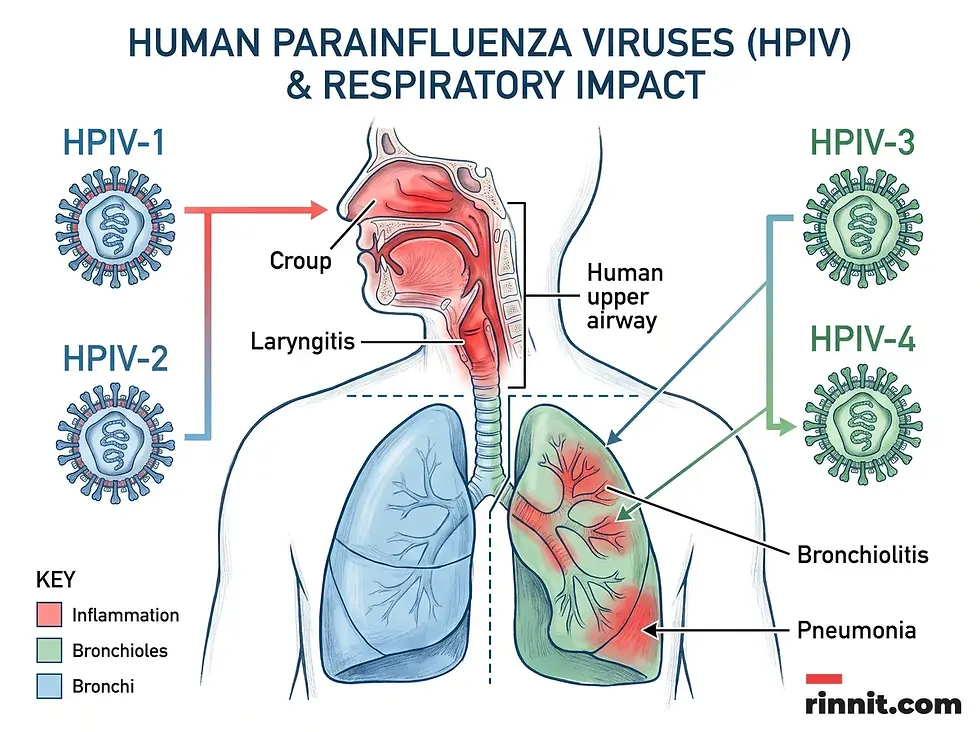
Illustration of the four types of human parainfluenza viruses and their primary impact on the human respiratory system.
What are the types of parainfluenza viruses?
There are four common types, and they tend to affect different parts of the respiratory tract [1]:
Virus type | What it is more likely to cause |
|---|---|
HPIV-1 and HPIV-2 | Colds and croup |
HPIV-3 | Infections of the airways and lungs: bronchiolitis, bronchitis, or pneumonia |
HPIV-4 | Experts know less about it but think it causes illnesses similar to HPIV-3 |
Source: Cleveland Clinic [1].
What are the symptoms of parainfluenza?
Parainfluenza symptoms are usually similar to a cold [1]:
Fever
Cough, which can be mild or barky
Runny or stuffy nose
Sore throat
A high-pitched sound when you breathe (wheezing or stridor)
Hoarse voice
Sneezing
Symptoms are usually mild in adults but can be more severe in children or people with a compromised immune system. Depending on the virus type, you can be sick for a few days to a week, and a cough or tiredness can linger for two weeks or longer [1].
What causes parainfluenza, and how does it spread?
You get parainfluenza viruses through direct or indirect contact with someone who is infected [1]. Common ways include:
Coughing and sneezing: tiny droplets containing the virus can reach your nose or mouth through the air, or land on your hands and then reach your face.
Contaminated surfaces: touching a surface such as a doorknob, computer, or phone and then touching your face, mouth, nose, or eyes.
Contact with someone who is sick: touching the hands or face of an infected person and then touching your own face.
Parainfluenza spreads easily and is particularly contagious in young children, who often put toys and their hands in their mouths and have not yet learned habits such as handwashing. Kids often catch it directly from other kids or from desks, toys, and playground equipment [1].

Visual guide showing the transmission routes of parainfluenza through respiratory droplets and contaminated surfaces.
Who is at higher risk of severe illness?
Parainfluenza usually is not serious in adults without chronic health conditions. You are more likely to become seriously ill or to take longer to recover if you [1]:
Are younger than 5
Are older than 65
Have a compromised immune system, especially after an organ donation
Have a chronic lung condition, such as asthma, COPD, or interstitial lung disease
The most common complications are pneumonia and severe forms of croup. Both can make breathing difficult and can mean a hospital stay, and HPIV infections are one of the most common causes of hospitalization in children with respiratory illnesses [1].
How is parainfluenza diagnosed?
Providers usually diagnose parainfluenza by asking about your symptoms and examining you. They may listen to your heart and lungs, look in your nose and mouth, and check your oxygen level with a clip on your finger. You usually do not need to be tested for the virus; if you are, a provider takes a swab of mucus from your nose or throat and sends it to a lab to test for HPIVs and other viruses or bacteria [1].
How is parainfluenza managed with home care?
There are no specific treatments for parainfluenza, and many people can manage mild symptoms at home [1]. To feel better:
Rest: get plenty of rest.
Hydration: drink fluids such as water or broth.
Humidifier: run one in your room or your child's room to help relieve congestion and cough. Use clean water and keep the device clean.
Over-the-counter medicines (adults): acetaminophen or NSAIDs can lower fever and relieve aches, and decongestants, cough suppressants, expectorants, or throat lozenges may help depending on your symptoms.
Ask your child's healthcare provider before giving them any medication [1]. Antibiotics do not work against viral infections like parainfluenza.

Infographic detailing home care strategies for parainfluenza, including hydration, rest, and the use of humidifiers.
How can parainfluenza be prevented?
These steps can help reduce your risk of getting and spreading parainfluenza [1]:
Wash your hands often with soap and water, or use an alcohol-based hand sanitizer if you cannot.
Avoid touching your face, eyes, nose, and mouth.
Avoid sharing food or eating utensils such as forks, spoons, and cups.
Teach kids how to wash their hands properly and practice other hygiene habits early.
Cover your nose and mouth when you sneeze or cough, using your elbow or a tissue rather than your bare hand.
Avoid being around other people when you or they are sick, and wear a mask if you are sick and cannot avoid others.
When should you see a doctor about parainfluenza?
Go to the ER or seek immediate medical attention if you or your child has signs of severe illness [1]:
High fever (over 103°F or 40°C)
Difficulty breathing or noisy breathing
Not peeing or peeing very little
Chest pain
Persistent dizziness
Severe muscle pain or weakness
Bluish skin, lips, or nails (cyanosis)
Seizures
If your child has a barky cough or trouble breathing, contact your pediatrician immediately or seek emergency care to rule out severe croup or pneumonia.
What is the bottom line on parainfluenza?
Parainfluenza viruses are a common part of the respiratory landscape and affect nearly everyone by early childhood. Most infections look like a cold and can be managed at home with rest, fluids, and symptom relief, but children under 5, adults over 65, and people with weakened immune systems or chronic lung disease need a closer eye. Good hygiene lowers your risk, and prompt care for severe symptoms matters [1].
Frequently Asked Questions
Is parainfluenza the same as the flu?
No. Parainfluenza viruses (HPIVs) are different from the influenza viruses that cause the flu. They cause colds and other respiratory illnesses.
How long does parainfluenza last?
You can be sick for a few days to a week, depending on the virus type. A cough or tiredness can linger for two weeks or longer.
Can parainfluenza cause pneumonia?
Yes. Pneumonia and severe croup are the most common complications, and HPIV-3 is the type most likely to infect the airways and lungs.
What does a barky cough mean?
A barky cough can be a sign of croup, which HPIV-1 and HPIV-2 are more likely to cause. Seek care right away if your child has trouble breathing.
Can adults get parainfluenza more than once?
Yes. You can be infected many times in your life, though later infections are less likely to be severe.
When is parainfluenza season?
HPIVs circulate year-round. In U.S. surveillance from 2011 to 2019, HPIV-4 showed a fall-winter pattern.
Is parainfluenza dangerous for babies?
Parainfluenza can be. Children younger than 5 are more likely to become seriously ill, and HPIV infections are among the most common causes of hospitalization in children with respiratory illness.
Can antibiotics treat parainfluenza?
No. It is a viral infection, and there is no specific treatment. Care focuses on rest, fluids, and relieving symptoms.
Do I need a test for parainfluenza?
Usually not. Providers typically diagnose it from your symptoms and an exam. If a test is needed, a swab of the nose or throat is sent to a lab.
How can I prevent parainfluenza?
Wash your hands often, avoid touching your face, do not share utensils, cover coughs and sneezes, and avoid close contact when you or others are sick.
Related Resources
External resource for deeper reading:
References
Cleveland Clinic. Parainfluenza (Human Parainfluenza Viruses). Cleveland Clinic Health Library. Last updated August 13, 2026. https://my.clevelandclinic.org/health/diseases/24522-parainfluenza
DeGroote NP, Haynes AK, Taylor C, et al. Human parainfluenza virus circulation, United States, 2011-2019. J Clin Virol. 2020;124:104261. PMID: 31954277. DOI: 10.1016/j.jcv.2020.104261
Liu WK, Liu Q, Chen DH, et al. Epidemiology and clinical presentation of the four human parainfluenza virus types. BMC Infect Dis. 2013;13:28. PMID: 23343342. DOI: 10.1186/1471-2334-13-28
Pawełczyk M, Kowalski ML. The role of human parainfluenza virus infections in the immunopathology of the respiratory tract. Curr Allergy Asthma Rep. 2017;17(3):16. PMID: 28283855. DOI: 10.1007/s11882-017-0685-2
Medical disclaimer
This article is for informational purposes only and is not a substitute for professional medical advice, diagnosis, or treatment. Always seek the advice of your physician or other qualified health provider with any questions you may have about a medical condition.



Comments