Ovarian Hyperstimulation Syndrome (OHSS): Symptoms, Causes, and Treatment Explained

Updated: 3 days ago
Medically reviewed by Dr. Baraa Alnahhal, MD · Last reviewed: October 2026
Ovarian hyperstimulation syndrome (OHSS) is a possible complication of fertility treatment. Most cases are mild and settle within a week or two, but severe OHSS can be dangerous, so knowing the warning signs matters. This guide explains the symptoms, causes, risk factors, prevention, and treatment.
Quick Answer: What is OHSS?
Ovarian hyperstimulation syndrome (OHSS) is an exaggerated response to excess hormones, usually from injectable fertility medications used in IVF, that makes the ovaries swell and become painful. Symptoms range from bloating and nausea to rapid weight gain, breathing problems and blood clots. Most cases resolve within a week or two; severe cases need hospital care.
What the research says
Only a few prevention strategies have solid evidence. An umbrella review of 28 systematic reviews of randomized trials found that GnRH agonist triggering (8 trials; odds ratio 0.15, 95% CI 0.05-0.47) and GnRH antagonist co-treatment (36 trials; odds ratio 0.61, 95% CI 0.51-0.72) were the most effective ways to prevent OHSS, with moderate-certainty evidence. Dopamine agonists (10 trials; odds ratio 0.32, 95% CI 0.23-0.44) and mild ovarian stimulation (9 trials; risk ratio 0.26, 95% CI 0.14-0.49) also helped (Palomba et al., Reprod Biol Endocrinol, 2023) [3].
A GnRH agonist trigger without extra HCG nearly eliminated severe OHSS in high-risk women. A meta-analysis found that the pooled incidence of severe OHSS after a GnRH agonist trigger in high-risk women was 0% when no luteal phase support was given (14 data sets, 983 women), and about 1% when HCG was added to standard luteal support (Ioannidou et al., Reprod Biomed Online, 2021) [4].
Mild OHSS can still happen with a GnRH agonist trigger. In a combined analysis of 77 high responders who had a GnRH agonist trigger and a freeze-all approach, 17 (22%) developed mild OHSS lasting 6 to 21 days. No severe OHSS occurred (Fernández-Sánchez et al., Gynecol Endocrinol, 2023) [5].
Study details retrieved from PubMed.
What Is Ovarian Hyperstimulation Syndrome?
OHSS is an exaggerated response to excess hormones. It usually occurs in women taking injectable hormone medications to stimulate the development of eggs in the ovaries, and it makes the ovaries swell and become painful. It may occur in women undergoing in vitro fertilization (IVF) or ovulation induction with injectable medications, and less often with fertility treatments that use medications taken by mouth, such as clomiphene. [1]
Treatment depends on severity. OHSS may improve on its own in mild cases, while severe cases may need hospitalization and additional treatment. [1]
At a glance | Details |
What it is | An exaggerated response to excess hormones from fertility medications |
Who it affects | Mostly women on injectable hormone medications for IVF or ovulation induction, and less often those on oral medications such as clomiphene |
What happens | The ovaries swell and become painful, and fluid may leak into the abdomen |
Typical onset | Within about a week after the hormone injection, sometimes two weeks or longer |
Typical course | Mild cases improve on their own, and severe cases may need hospitalization |

What are the symptoms of ovarian hyperstimulation syndrome (OHSS)?
Symptoms often begin within a week after using injectable medications to stimulate ovulation, though sometimes it can take two weeks or longer. They can range from mild to severe and may worsen or improve over time. [1]
Mild to Moderate OHSS
Symptom | What it looks like |
Abdominal pain | Mild to moderate |
Bloating | Abdominal bloating or increased waist size |
Nausea and vomiting | Feeling sick to your stomach, sometimes with vomiting |
Diarrhea | Changes in bowel habits |
Ovarian tenderness | Tenderness in the area of your ovaries |
Some women who use injectable fertility drugs get a mild form of OHSS, which usually goes away after about a week. If pregnancy occurs, symptoms may worsen and last several days to weeks. [1]
Severe OHSS
Severe symptom | What it looks like |
Rapid weight gain | More than 2.2 pounds (1 kilogram) in 24 hours |
Severe abdominal pain | Intense discomfort beyond mild bloating |
Nausea and vomiting | Severe and persistent |
Blood clots | Increased clotting risk |
Decreased urination | Less urine than normal |
Shortness of breath | Trouble breathing |
Abdominal tightness | A tight or enlarged abdomen |

When should you see a doctor about OHSS?
If you are having fertility treatments and have symptoms of OHSS, tell your healthcare provider. Even with a mild case, your provider will want to observe you for sudden weight gain or worsening symptoms. [1]
Situation | What to do |
Any OHSS symptoms during fertility treatment | Tell your healthcare provider |
Mild OHSS | Your provider will observe you for sudden weight gain or worsening symptoms |
Breathing problems during treatment | Contact your provider right away. This may be urgent. |
Pain in your legs during treatment | Contact your provider right away. This may be urgent. |
What Causes OHSS?
The cause is not fully understood. A high level of human chorionic gonadotropin (HCG), a hormone usually produced during pregnancy, plays a role. Ovarian blood vessels react abnormally to HCG and begin to leak fluid. This fluid swells the ovaries, and sometimes large amounts move into the abdomen. [1]
During fertility treatments, HCG may be given as a "trigger" so that a mature follicle releases its egg, and OHSS usually happens within a week after an HCG injection. If you become pregnant during a treatment cycle, OHSS may worsen as your body begins producing its own HCG. Injectable fertility medications are more likely to cause OHSS than clomiphene, a pill taken by mouth, and occasionally OHSS occurs spontaneously, unrelated to fertility treatment. [1]
What are the risk factors for ovarian hyperstimulation syndrome?
Sometimes OHSS happens in women with no risk factors at all, but these factors are known to increase the risk: [1]
Risk factor | Why it matters |
Polycystic ovary syndrome (PCOS) | A common reproductive disorder that causes irregular periods, excess hair growth, and an unusual appearance of the ovaries on ultrasound |
Large number of follicles | More follicles raise the risk |
Age under 35 | Younger women are at higher risk |
Low body weight | Associated with higher risk |
High or steeply rising estradiol | A high or steeply increasing estrogen level before the HCG trigger shot |
Previous OHSS | A prior episode raises the risk |
What complications can ovarian hyperstimulation syndrome cause?
Severe OHSS is uncommon, but it can be life-threatening. Possible complications include: [1]
Fluid collection in the abdomen and sometimes the chest
Electrolyte disturbances (sodium, potassium, and others)
Blood clots in large vessels, usually in the legs
Kidney failure
Twisting of an ovary (ovarian torsion)
Rupture of an ovarian cyst, which can lead to serious bleeding
Breathing problems
Pregnancy loss from miscarriage or termination because of complications
Rarely, death
How can ovarian hyperstimulation syndrome be prevented?
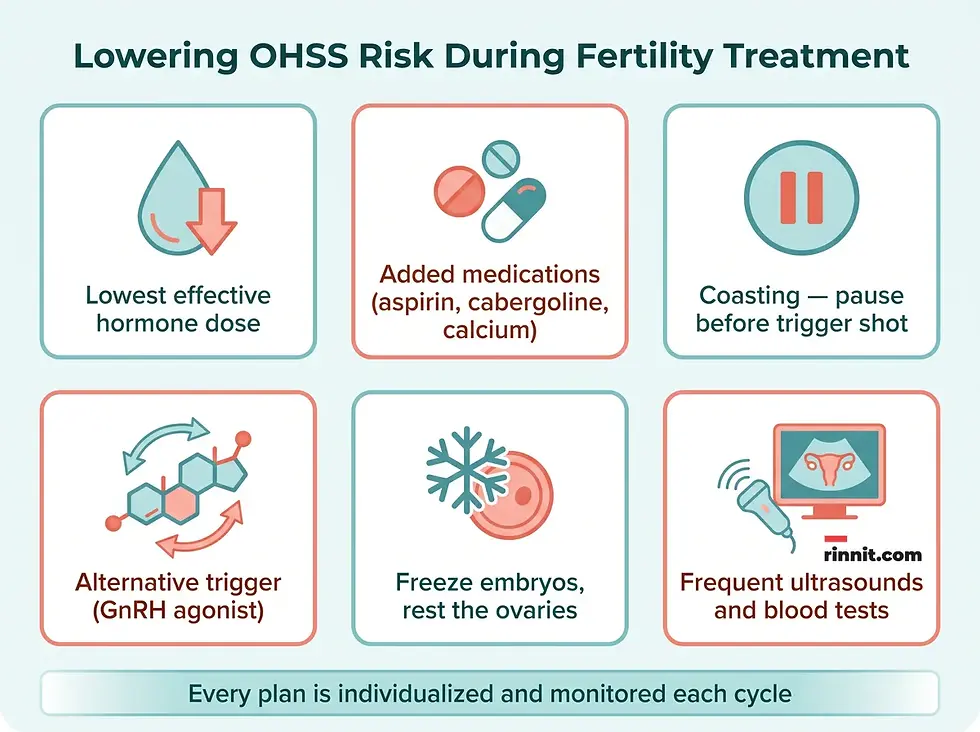
To lower your chances of OHSS, you need an individualized plan for your fertility medications. Expect your provider to monitor each treatment cycle carefully, with frequent ultrasounds to check follicle development and blood tests to check your hormone levels. [1]
Prevention strategy | How it works |
Adjusting medication | Using the lowest possible dose of gonadotropins to stimulate your ovaries and trigger ovulation |
Adding medication | Low-dose aspirin, dopamine agonists such as cabergoline or quinagolide, and calcium infusions seem to reduce OHSS risk without affecting the odds of pregnancy. Metformin during stimulation may help women with PCOS. |
Coasting | If estrogen is high or many follicles have developed, you stop injectable medications and wait a few days before the HCG trigger |
Avoiding the HCG trigger shot | Using a GnRH agonist, such as leuprolide, to trigger ovulation instead of HCG to prevent or limit OHSS |
Freezing embryos | In IVF, removing all follicles, fertilizing and freezing the mature ones, letting the ovaries rest, and resuming IVF later |
How is ovarian hyperstimulation syndrome diagnosed?
Diagnostic step | What it involves |
Physical exam | Your provider looks for weight gain, increases in waist size, and abdominal pain |
Ultrasound | Ovaries are bigger than usual, with large fluid-filled cysts where follicles developed. A vaginal ultrasound is used regularly during fertility drug treatment. |
Blood test | Checks for abnormalities in your blood and whether OHSS is impairing your kidney function |
How is ovarian hyperstimulation syndrome treated?
OHSS generally resolves on its own within a week or two, or somewhat longer if you are pregnant. Treatment aims to keep you comfortable, decrease ovarian activity, and avoid complications. [2]
Mild to Moderate OHSS
Mild OHSS typically resolves on its own. Treatment for moderate OHSS may involve: [2]
Increased fluid intake
Frequent physical exams and ultrasounds
Daily weigh-ins and waist measurements to check for drastic changes
Measurements of how much urine you produce each day
Blood tests to monitor for dehydration, electrolyte imbalance, and other problems
Drainage of excess abdominal fluid with a needle inserted into the abdominal cavity
Medicines to prevent blood clots (anticoagulants)
Severe OHSS
With severe OHSS you may need to be admitted to the hospital for monitoring and aggressive treatment, including IV fluids. Your provider may give you cabergoline to lessen your symptoms, and sometimes other medicines, such as a GnRH antagonist or letrozole, to help suppress ovarian activity. Serious complications may need additional treatment, such as surgery for a ruptured ovarian cyst or intensive care for liver or lung complications, and you may need anticoagulants to lower the risk of blood clots in your legs. [2]
What self-care helps mild ovarian hyperstimulation syndrome?
If you develop mild OHSS, you will probably be able to continue your day-to-day routine. Follow your provider's advice, which may include: [2]
Self-care step | Guidance |
Pain relief | Acetaminophen for abdominal discomfort. Avoid ibuprofen or naproxen sodium if you have recently had an embryo transfer, since they can interfere with implantation. |
Sexual activity | Avoid it. It may be painful and can cause an ovarian cyst to rupture. |
Activity | Keep a light activity level and avoid strenuous or high-impact activities |
Daily tracking | Weigh yourself on the same scale and measure around your abdomen each day, and report unusual increases |
Escalation | Call your provider if your symptoms get worse |
How should you prepare for an OHSS appointment?
Depending on how severe your OHSS is, your first appointment may be with your primary care provider, your gynecologist or infertility specialist, or a treating doctor in the emergency room. [2]
Preparation step | What to do |
Record symptoms | Write down all your symptoms, even ones that seem unrelated |
List medications | Include supplements, doses, and how often you take them |
Bring support | A family member or close friend, if possible, since you may receive a lot of information |
Take notes | Bring a notebook to write down important information |
Prepare questions | List your most important questions first. For example: What is the most likely cause of my symptoms? What tests do I need? Will it go away on its own, or will I need treatment? |
What is the bottom line on ovarian hyperstimulation syndrome?
OHSS is a hormone-driven reaction that most often follows injectable fertility medications. In its mild form it is common, uncomfortable, and usually short-lived. In its severe form it is rare and serious, but treatable if recognized early. An individualized medication plan, close monitoring in each cycle, and clear self-care rules help keep most women safe. If your ovaries feel swollen or painful during fertility treatment, or you notice rapid weight gain, trouble breathing, or leg pain, contact your provider right away, and talk with them about an OHSS prevention plan before your next cycle.
Frequently Asked Questions
What is ovarian hyperstimulation syndrome?
OHSS is an exaggerated response to excess hormones, usually from injectable fertility medications used in IVF and ovulation induction. It causes the ovaries to swell and become painful, and fluid can move into the abdomen. Mild cases improve on their own, while severe cases may need hospital care.
What causes OHSS?
The cause is not fully understood, but a high level of human chorionic gonadotropin (HCG) plays a role. Ovarian blood vessels react abnormally to HCG and leak fluid, which swells the ovaries. OHSS usually happens within a week after an HCG trigger shot, and pregnancy can make it worse because the body starts making its own HCG.
What are the symptoms of OHSS?
Mild to moderate symptoms include abdominal pain, bloating or a bigger waist, nausea, vomiting, diarrhea, and tenderness around the ovaries. Severe symptoms include rapid weight gain of more than 2.2 pounds (1 kg) in 24 hours, severe abdominal pain, severe and persistent nausea and vomiting, blood clots, decreased urination, shortness of breath, and a tight or enlarged abdomen.
How quickly do OHSS symptoms appear?
Symptoms often begin within a week after using injectable medications to stimulate ovulation, though sometimes it can take two weeks or longer. They can range from mild to severe and may worsen or improve over time.
Does OHSS go away on its own?
Generally yes. OHSS usually resolves within a week or two, or somewhat longer if you are pregnant. Mild OHSS typically resolves on its own, while moderate and severe cases need medical care, and severe cases may need hospital admission.
What makes OHSS more likely?
Risk factors include polycystic ovary syndrome (PCOS), a large number of follicles, age under 35, low body weight, a high or steeply increasing estradiol level before the HCG trigger shot, and previous OHSS. But OHSS can also happen in women with no risk factors.
Can OHSS be prevented?
In many cases it can be made less likely. Strategies include the lowest possible dose of gonadotropins, added medications such as low-dose aspirin, cabergoline or quinagolide, or calcium infusions, coasting, a GnRH agonist trigger instead of HCG, and freezing embryos so the ovaries can rest before IVF resumes.
When should I call my doctor during fertility treatment?
Tell your provider about any OHSS symptoms. Contact them right away if you develop breathing problems or leg pain during treatment, since these may signal an urgent situation. Even mild OHSS needs observation for sudden weight gain or worsening symptoms.
Can OHSS be serious?
Severe OHSS is uncommon but can be life-threatening. Complications can include fluid in the abdomen and chest, electrolyte disturbances, blood clots, kidney failure, ovarian torsion, a ruptured ovarian cyst with serious bleeding, breathing problems, and pregnancy loss, and rarely death.
What self-care works for mild OHSS?
You can usually continue your daily routine. Use acetaminophen for discomfort (avoid ibuprofen or naproxen if you have recently had an embryo transfer), avoid sex and strenuous or high-impact activity, weigh yourself and measure your abdomen daily on the same scale, and call your provider if symptoms get worse.
How is OHSS diagnosed?
Diagnosis may be based on a physical exam (weight gain, increased waist size, abdominal pain), an ultrasound showing ovaries bigger than usual with large fluid-filled cysts, and blood tests that check for abnormalities and whether OHSS is impairing kidney function.
Related Resources
Practice Committee of the American Society for Reproductive Medicine. Prevention and treatment of moderate and severe ovarian hyperstimulation syndrome: a guideline. Fertil Steril. 2016;106(7):1634-1647. PMID 27678032. https://doi.org/10.1016/j.fertnstert.2016.08.048
RESOLVE: The National Infertility Association. Home page. RESOLVE. Accessed October 30, 2026. https://resolve.org/
American College of Obstetricians and Gynecologists. Home page. ACOG. Accessed October 30, 2026. https://www.acog.org/
References
Mayo Clinic Staff. Ovarian hyperstimulation syndrome: symptoms and causes. Mayo Clinic. Nov. 9, 2021. https://www.mayoclinic.org/diseases-conditions/ovarian-hyperstimulation-syndrome-ohss/symptoms-causes/syc-20354697
Mayo Clinic Staff. Ovarian hyperstimulation syndrome: diagnosis and treatment. Mayo Clinic. Nov. 9, 2021. https://www.mayoclinic.org/diseases-conditions/ovarian-hyperstimulation-syndrome-ohss/diagnosis-treatment/drc-20354703
Palomba S, Costanzi F, Nelson SM, et al. Interventions to prevent or reduce the incidence and severity of ovarian hyperstimulation syndrome: a systematic umbrella review of the best clinical evidence. Reprod Biol Endocrinol. 2023;21(1):67. PMID: 37480081. DOI: 10.1186/s12958-023-01113-6
Ioannidou PG, Bosdou JK, Lainas GT, et al. How frequent is severe ovarian hyperstimulation syndrome after GnRH agonist triggering in high-risk women? A systematic review and meta-analysis. Reprod Biomed Online. 2021;42(3):635-650. PMID: 33483281. DOI: 10.1016/j.rbmo.2020.11.008
Fernández-Sánchez M, Fatemi H, García-Velasco JA, et al. Incidence and severity of ovarian hyperstimulation syndrome (OHSS) in high responders after gonadotropin-releasing hormone (GnRH) agonist trigger in "freeze-all" approach. Gynecol Endocrinol. 2023;39(1):2205952. PMID: 37156263. DOI: 10.1080/09513590.2023.2205952
Practice Committee of the American Society for Reproductive Medicine. Prevention and treatment of moderate and severe ovarian hyperstimulation syndrome: a guideline. Fertil Steril. 2016;106(7):1634-1647. PMID: 27678032. DOI: 10.1016/j.fertnstert.2016.08.048
Medical disclaimer
This article is for general informational purposes only and is not a substitute for professional medical advice, diagnosis, or treatment. Always consult a qualified healthcare professional about your health.



Comments