Orthostatic Tremor: Symptoms, Types, and Management

Updated: 2 days ago
Medically reviewed by Dr. Baraa Alnahhal, MD · Last reviewed: November 9, 2026
Orthostatic tremor is a rare movement disorder characterized by rapid, often invisible leg muscle contractions that cause significant unsteadiness while standing. These symptoms typically disappear immediately upon sitting, walking, or leaning. While there is no current cure, various medications, most notably clonazepam, and lifestyle modifications like using mobility aids can significantly improve daily function and quality of life.
Quick Answer: What is orthostatic tremor?
Orthostatic tremor is a rare neurological condition that causes high-frequency muscle contractions in the legs when a person stands still, creating a distressing feeling of unsteadiness that is relieved by walking, sitting or lying down. The exact cause is often unknown. It is managed with medications to reduce muscle activity and adaptations to avoid prolonged standing.
What the research says
Most cases are primary, and treatment response is often modest. A review of 45 patients seen over 26 years found a mean age at onset of 59.5 years, and 40 of 45 (89%) had primary orthostatic tremor. Response to medication was modest and inconsistent, and the tremor worsened in 11 of 30 patients followed for an average of 54.4 months (Yaltho & Ondo, Parkinsonism Relat Disord, 2014) [2].
Gabapentin has the most robust drug evidence so far. A systematic review of drug treatments tested in prospective cohorts and randomized trials found the most positive evidence for gabapentin, with positive results for perampanel and levodopa on specific endpoints, and a lack of evidence for levetiracetam and botulinum toxin. The authors call for larger, placebo-controlled studies (Sauthoff et al., Neurol Sci, 2025) [3].
Deep brain stimulation may help in severe cases. A systematic review of 15 studies (32 patients treated with deep brain stimulation, 4 with spinal cord stimulation, and 2 with both) found that median unsupported standing time was 240 seconds one year after surgery, compared with 30 seconds before (p < 0.001). Data were too limited to judge long-term effects or spinal cord stimulation (Boogers et al., Parkinsonism Relat Disord, 2022) [4].
Study details retrieved from PubMed.
What Is Orthostatic Tremor?
Orthostatic tremor is a rare and relatively recently identified movement disorder, first described in medical literature in 1984. It is defined by rapid, rhythmic muscle contractions in the legs that occur specifically during quiet standing. These tremors are so fast, often 13 to 18 cycles per second [5], that they are frequently invisible to the naked eye, though they can be felt as a "rippling" sensation if the hands are pressed against the leg muscles. [1]
While the condition most commonly develops around age 60, it has been documented in individuals ranging from 13 to 85 years old. The primary challenge of this disorder is the profound sense of unsteadiness it creates, which can make simple tasks like standing in a checkout line or taking a shower feel precarious. [1]
Feature | Description |
Primary Symptom | Unsteadiness while standing still |
Relief Factors | Walking, sitting, leaning, or lying down |
Tremor Frequency | Very rapid (often 13–18 Hz) |
Typical Onset | Approximately 60 years of age |
Visibility | Often invisible; felt as a rippling sensation |

What are the symptoms of orthostatic tremor?
The hallmark of orthostatic tremor is a specific pattern of instability. Unlike many other balance disorders, the unsteadiness is strictly positional. Individuals often report that the sensation begins almost immediately upon standing, though for some, it may take several minutes to manifest.
Commonly reported symptoms and signs include:
Positional Unsteadiness: A strong feeling of being unbalanced that only occurs when standing still.
Muscle Rippling: A vibrating or rippling sensation in the calves or thighs that can be felt by touch.
Compensatory Stance: Automatically widening the feet or "grabbing" the floor with the toes to increase stability.
Secondary Tremors: Some individuals may also experience tremors in the hands or the trunk (torso).
Progression: For many, the severity of the unsteadiness and the speed at which it occurs increases over time.
What causes orthostatic tremor?
Medical researchers are still investigating the precise origins of orthostatic tremor. There is ongoing debate as to whether it is a unique condition or a specialized variant of essential tremor. The disorder is categorized into two main types based on its suspected origin. [1]
Primary vs. Secondary Orthostatic Tremor
Primary orthostatic tremor is considered idiopathic, meaning it occurs without a known underlying cause and is not accompanied by other neurological symptoms. In contrast, secondary orthostatic tremor is triggered by an existing medical condition or injury.
Type | Characteristics |
Primary | No known cause; no other neurological signs present. |
Secondary | Linked to conditions like Graves' disease, Parkinsonism, or MS. |
Potential Triggers for Secondary Tremor
Secondary cases have been associated with a variety of neurological and systemic factors:
Neurological Conditions: Multiple sclerosis (MS), Parkinsonism, and restless legs syndrome (RLS).
Structural Issues: Head trauma, spinal cord lesions, or midbrain lesions.
Systemic Factors: Graves' disease (hyperthyroidism) and vitamin B12 deficiency.
Genetic Links: While most cases are random, occurrences in family members suggest a potential genetic component currently under study.

How is orthostatic tremor diagnosed?
Because orthostatic tremor is rare, it is frequently misdiagnosed, often being mistaken for functional (psychogenic) tremor or general balance issues. A definitive diagnosis typically requires a consultation with a movement disorder specialist. [1]
The diagnostic process usually involves:
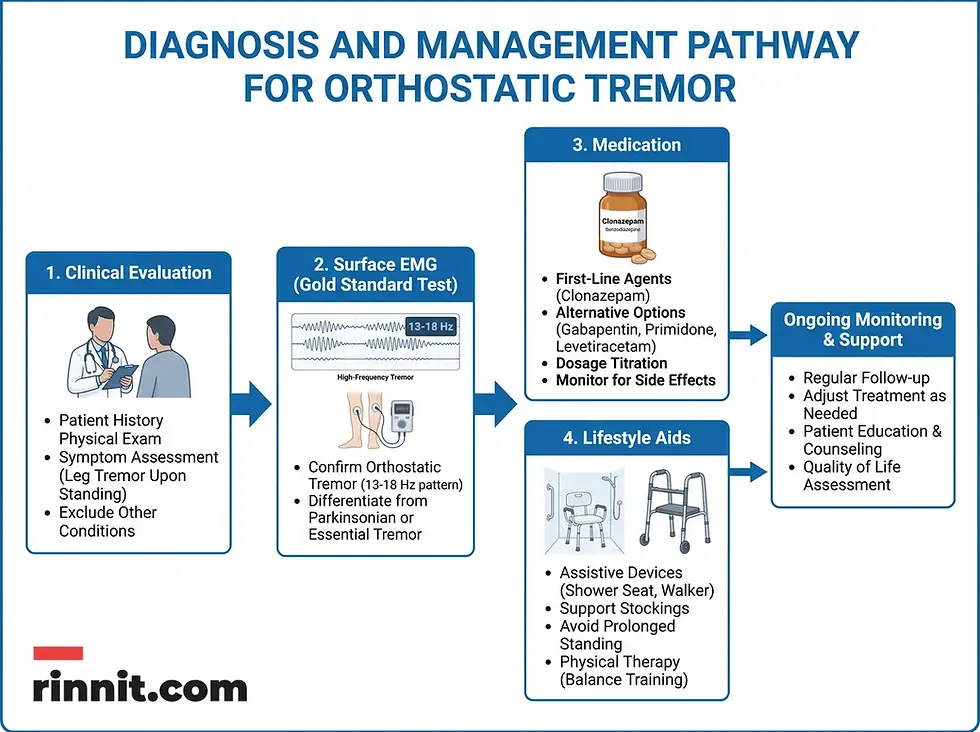
Clinical Evaluation: A thorough review of medical history and a physical exam focusing on the timing of symptoms.
Neurological Exam: Assessing coordination, balance, and the presence of tremors in different positions.
Surface Electromyography (EMG): This is the gold standard for confirmation. Sensors placed on the skin record the high-frequency muscle contractions characteristic of the disorder.
Differential Testing: Blood work and imaging (like MRI) may be used to rule out secondary causes or other neurological conditions.
How is orthostatic tremor managed with treatment and lifestyle changes?
Orthostatic tremor has no cure, but treatment aims to reduce the severity of the tremors and improve daily stability. Management typically involves a combination of pharmaceutical intervention and practical lifestyle changes. [1]
Medical Interventions
Medications are often effective in dampening the muscle contractions. Response to treatment can vary significantly between individuals.
First-Line Therapy: Clonazepam (a benzodiazepine) is the most commonly prescribed and effective medication.
Alternative Options: Gabapentin, primidone, propranolol, and pregabalin may be used if first-line treatments are ineffective or poorly tolerated.
Advanced Procedures: In severe cases, deep brain stimulation (DBS) or spinal cord stimulation may be considered, though research in these areas is still emerging.
Daily Living Strategies
Simple modifications can help individuals navigate environments where standing is required:
Mobility Aids: Using a wheelchair or walker for long lines or extended standing.
Home Safety: Installing a shower seat to avoid the need to stand while bathing.
Occupational Therapy: Working with a therapist to develop energy-conservation and stability techniques for cooking and cleaning.
Mental Health Support: Counseling can be beneficial for managing the anxiety or social isolation that often accompanies chronic movement disorders.
When should you contact a professional about orthostatic tremor?
If you experience persistent unsteadiness that is specifically linked to standing, it is important to consult a healthcare provider. A referral to a neurologist or a movement disorder specialist is often necessary for an accurate diagnosis and to rule out other treatable conditions.
What are the next steps for managing orthostatic tremor?
Managing a rare condition requires both medical support and practical adaptations. By combining the right medication with proactive lifestyle changes, most people with orthostatic tremor can continue to lead active and fulfilling lives. Discuss your symptoms with a specialist today to develop a personalized care plan.
Frequently Asked Questions
Why do my legs feel unsteady only when I stand still?
Leg unsteadiness only when standing still is the defining symptom of orthostatic tremor. The rapid muscle contractions occur specifically when the muscles are engaged in maintaining an upright, stationary posture. Walking or sitting changes the muscle engagement, providing immediate relief.
Is orthostatic tremor the same as Parkinson's disease?
No, they are distinct conditions. While some people with Parkinsonism may develop secondary orthostatic tremor, primary orthostatic tremor involves a much higher frequency of muscle contraction and does not typically include the other motor symptoms of Parkinson's.
Can I see the tremors in my legs?
In most cases, the tremors are too fast to be seen by the naked eye. However, they can often be felt as a vibrating or rippling sensation if you place your hand on your thigh or calf while standing.
Will orthostatic tremor get worse over time?
For many individuals, the condition is progressive, meaning the unsteadiness may become more severe or occur more quickly after standing up as the years pass.
Are there specific exercises that help?
While general leg strengthening is good for balance, there are no specific exercises known to stop the tremors. Management focuses more on medication and using aids like shower seats to stay safe.
Is orthostatic tremor a mental health condition?
No, it is a neurological movement disorder. However, because it is rare and can be difficult to diagnose, it is sometimes misdiagnosed as a psychogenic or functional disorder.
Can children get orthostatic tremor?
While the typical onset is around age 60, the condition has been documented in teenagers as young as 13. It is, however, much rarer in younger populations.
What is the "gold standard" for diagnosing this?
Surface electromyography (EMG) is the most reliable test. It records the specific high-frequency electrical activity in the leg muscles that confirms the diagnosis.
Should I use a wheelchair if I have this?
A wheelchair is not always necessary, but it can be a very helpful tool for situations involving long periods of standing, such as waiting in lines, to prevent falls and reduce fatigue.
References
Cleveland Clinic. Orthostatic tremor. Cleveland Clinic. Medically reviewed; last updated August 6, 2024. https://my.clevelandclinic.org/health/diseases/orthostatic-tremor
Yaltho TC, Ondo WG. Orthostatic tremor: a review of 45 cases. Parkinsonism Relat Disord. 2014;20(7):723-725. PMID: 24736049. DOI: 10.1016/j.parkreldis.2014.03.013
Sauthoff L, Achutegui MI, Ye L, et al. Systematic review of pharmacological treatment options for orthostatic tremor in prospective patient cohorts and randomized controlled trials. Neurol Sci. 2025;46(8):3419-3425. PMID: 40155580. DOI: 10.1007/s10072-025-08129-3
Boogers A, Billet A, Vandenberghe W, et al. Deep brain stimulation and spinal cord stimulation for orthostatic tremor: a systematic review. Parkinsonism Relat Disord. 2022;104:115-120. PMID: 36243552. DOI: 10.1016/j.parkreldis.2022.10.001
Adebayo PB. Orthostatic tremor: current challenges and future prospects. Degener Neurol Neuromuscul Dis. 2016;6:17-24. PMID: 30050365. DOI: 10.2147/DNND.S84742
Medical disclaimer
This article is for general informational purposes only and is not a substitute for professional medical advice, diagnosis, or treatment. Always consult a qualified healthcare professional about your health.



Comments