Ocular Ischemic Syndrome Comprehensive Guide: Symptoms, Causes, and Treatment

Updated: 2 days ago
Medically reviewed by Dr. Baraa Alnahhal, MD · Last reviewed: October 2026
Quick Answer: Ocular Ischemic Syndrome at a Glance
Ocular ischemic syndrome is a rare condition in which reduced blood flow from a narrowed carotid artery damages the eyes, usually because of plaque buildup. [1] [3] It can cause dull eye pain and gradual, sudden or temporary vision loss. [1] It carries a high risk of heart attack or stroke. [1] Treatment includes eye injections, laser and opening the artery. [1]
Feature | Details |
Definition | A rare condition in which reduced blood flow from a narrowed carotid artery damages the eyes. [1] |
Main cause | |
Key symptoms | Dull eye pain, gradual, sudden, or temporary vision loss, and light sensitivity. Some people have no symptoms. [1] |
Risk factors | Age in the 50s to 80s, male sex, smoking, obesity, diabetes, high blood pressure, and heart disease. [1] |
Complications | Neovascular glaucoma, vision loss, and a high risk of heart attack or stroke. [1] |
Treatment | Eye injections, medicated drops, laser, plus medicines and procedures to open the blocked artery. [1] |
What the research says
OIS is hard to spot and often found late. In a review of 42 people with OIS, 71.43% were male, 69.05% were older than 61, and 83.33% had two or more systemic diseases. Only 6 patients had eye symptoms as their first sign when they came to the eye clinic, and 88.10% reported whole-body (constitutional) symptoms. The authors stress that OIS is easy to misdiagnose and needs teamwork with cardiologists and neurologists. (Luo et al., J Ophthalmol, 2018) [2]
OIS comes from reduced blood flow due to carotid narrowing, and it looks like other eye diseases. A systematic review describes OIS as ocular hypoperfusion caused by stenosis or blockage of the common or internal carotid arteries, with atherosclerosis as the main cause. It can look like diabetic retinopathy or a moderate central retinal vein occlusion. Carotid imaging and fluorescein angiography help confirm it, and people should be referred to a neurologist, vascular surgeon, and cardiologist. (Terelak-Borys et al., Med Sci Monit, 2012) [3]
What Is Ocular Ischemic Syndrome?
Ocular ischemic syndrome (OIS) occurs when the eyes do not get enough oxygen-rich blood to work well. The lack of blood flow, called ischemia, is usually caused by atherosclerosis, which is the hardening and narrowing of the carotid arteries in the neck. [1] [3] These two arteries carry blood to the head and neck, including the brain. [1] The ophthalmic arteries, which feed the eyes, branch from the carotid arteries, so a blockage in the neck can starve the eyes of blood. [1]
OIS is more than an eye problem. It is extremely rare, affecting about 8 in 1 million people, and it tends to affect people in their 50s to 80s. [1] It is twice as common in men. [1] Because it can be the first sign of carotid artery disease, vision changes may be the first warning that blood vessels are narrowing, which also raises the risk of stroke and heart attack. [1]

What are the symptoms of ocular ischemic syndrome (OIS)?
OIS does not always cause symptoms. When it does, symptoms most often affect only one eye. [1]
Common Visual Changes
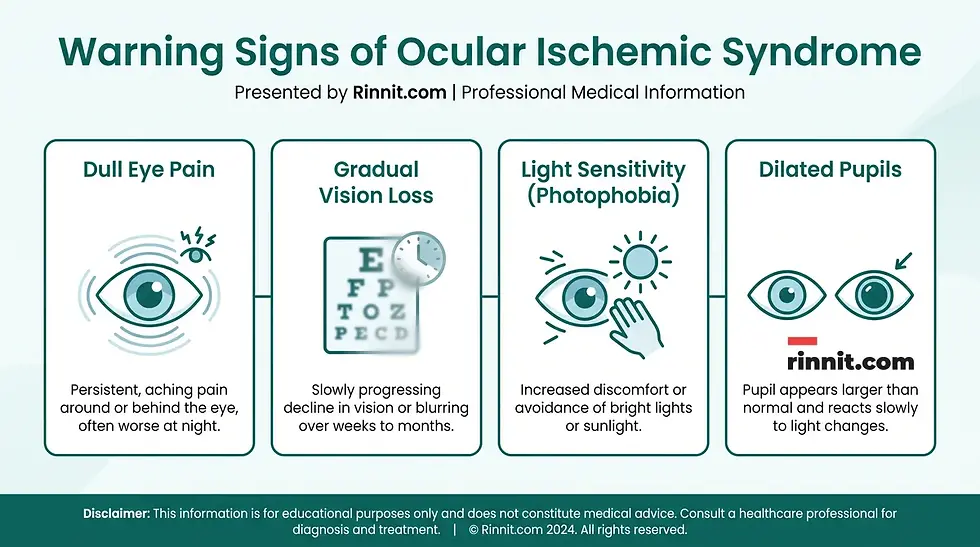
Vision loss: it can be gradual or sudden, or it can come and go (transient vision loss). [1]
Dull, aching eye pain: pain that comes and goes in or around the eye, which can happen when pressure inside the eye rises. [1]
Light sensitivity (photophobia): bright light is uncomfortable. [1]
Floaters and double vision: you may notice eye floaters or double vision (diplopia). [1]
Physical Signs
The pupils may look enlarged (dilated). [1] These symptoms are easy to confuse with other conditions such as diabetic retinopathy and central retinal vein occlusion, so an accurate diagnosis from a specialist is key. [1] [3]
What causes ocular ischemic syndrome and who is at risk?
Carotid artery disease, also called carotid artery stenosis, causes OIS. [1] [3] Plaque deposits made of a fatty substance build up in one or both carotid arteries and restrict blood flow to one or both eyes. [1] Less common causes include carotid artery dissection, vasculitis (including giant cell arteritis, Takayasu's arteritis, and Behçet's disease), fibromuscular dysplasia, scleroderma, and Moyamoya disease. [1]
Who Is Most at Risk?
The risk factors for OIS are much like those for heart and blood vessel disease in general:
How is ocular ischemic syndrome (OIS) diagnosed and treated?
Diagnosing OIS takes teamwork between eye specialists and heart specialists. [1]
Eye evaluation: an ophthalmologist may do a dilated eye exam, optical coherence tomography (OCT), electroretinography, and visual-evoked potentials. [1] A fluorescein angiogram checks how long it takes blood to reach the eye and looks for leaking vessels. [1]
Artery imaging: a cardiologist may order a carotid artery duplex ultrasound, a CT angiogram, a carotid angiogram, or a magnetic resonance angiogram (MRA) to check for carotid artery disease. [1]
Treatment Strategies
Treatment has two goals: protecting the eye and treating the underlying artery disease.
Treatment area | Common interventions |
Eye care | Anti-VEGF or steroid eye injections to treat swelling in the retina, medicated drops to lower eye pressure and inflammation, and laser treatment to prevent high eye pressure. [1] |
Artery care | Blood thinners and medicines for conditions like diabetes and high blood pressure, carotid angioplasty and stenting to open a narrowed artery, or carotid endarterectomy to remove plaque from inside an artery. [1] |
What are the outlook and complications of ocular ischemic syndrome?
OIS does not always cause immediate eyesight problems. However, up to half of the people with this condition will eventually have some degree of vision loss within a year, and nearly 7 in 10 will develop neovascular glaucoma. [1] In neovascular glaucoma, abnormal blood vessels grow in the eye because of poor blood flow and block the drainage system, which causes dangerously high eye pressure. [1]
The carotid artery disease behind OIS can be life-threatening. As many as 4 in 10 people die from a heart attack or stroke within five years after an OIS diagnosis. [1] Prompt medical care and lifestyle changes can help protect your health.
How can ocular ischemic syndrome be prevented, and when should you get help?
You cannot always prevent ocular ischemic syndrome (OIS), but lowering your risk of carotid artery disease with a heart-healthy lifestyle also lowers your risk of OIS. [1]
Call your healthcare provider if you have eye pain or vision problems. [1] If you have any signs of a stroke, such as slurred speech, weakness on one side of the body, or a drooping face, contact your local emergency services right away. [1]

What is the bottom line on ocular ischemic syndrome?
Ocular ischemic syndrome is rare, but it can change your life, and it is an important sign of cardiovascular health. The symptoms show up in the eyes, but the cause usually lies in the arteries of the neck. By recognizing eye pain and vision changes early and by choosing a heart-healthy lifestyle, you can help protect both your vision and your long-term health.
Eye pain or vision changes that won't go away? See a healthcare professional promptly. Because OIS can signal carotid artery disease, a checkup can protect both your eyes and your heart.
Frequently Asked Questions
Is ocular ischemic syndrome the same as a stroke?
No. But it is caused by the same underlying problem, carotid artery disease, and it can be a warning sign that raises the risk of a stroke. [1]
Can OIS affect both eyes?
OIS most often affects one eye, but plaque buildup can restrict blood flow to one or both eyes. [1]
Does OIS cause sudden blindness?
Vision loss from OIS can be gradual or sudden, and it can also be temporary, coming and going. [1]
What does the pain from OIS feel like?
The pain from OIS is usually a dull, aching pain in or around the eye that comes and goes. [1]
Can OIS be prevented?
You can lower your risk of carotid artery disease, and so of OIS, by eating a heart-healthy diet, staying active, controlling diabetes and high blood pressure, keeping a healthy weight, and quitting smoking. [1]
Who treats ocular ischemic syndrome?
Care takes a team. An eye doctor (ophthalmologist) treats the eye problems, and a heart and blood vessel specialist (cardiologist) treats the carotid artery disease. [1]
What is neovascular glaucoma?
Neovascular glaucoma is a severe form of glaucoma in which abnormal blood vessels grow in the eye because of poor blood flow. They block the drainage system and cause dangerously high eye pressure. [1]
Who is most likely to get OIS?
OIS tends to affect people in their 50s to 80s, and it is twice as common in men. [1] It is extremely rare overall. [1]
How does smoking affect OIS?
A history of smoking is a risk factor for OIS, and quitting smoking helps lower the risk of carotid artery disease, the main cause of the condition. [1]
Can medicated eye drops cure OIS?
No. Drops can lower eye pressure and inflammation [1], but they do not fix the narrowed artery that causes OIS.
What is a carotid endarterectomy?
A carotid endarterectomy is a surgery that removes plaque from inside a carotid artery to restore blood flow. [1]
Can OIS be mistaken for other eye diseases?
Yes. Its symptoms are similar to diabetic retinopathy and central retinal vein occlusion [1] [3], so an accurate diagnosis from a specialist is important.
What is a fluorescein angiogram?
A fluorescein angiogram is a test that checks how long it takes blood to reach your eye and looks for leaking blood vessels in the eye. [1] A special dye is used to highlight the vessels.
Does OIS cause floaters?
Yes. Eye floaters are one of the possible symptoms. [1]
How quickly should I see a doctor for eye pain or vision changes?
Call your healthcare provider if you have eye pain or vision problems. [1] Sudden vision changes should be checked right away, and signs of a stroke need emergency care. [1]
References
Cleveland Clinic. Ocular ischemic syndrome. Cleveland Clinic. Last updated August 18, 2023. https://my.clevelandclinic.org/health/diseases/25205-ocular-ischemic-syndrome
Luo J, Yan Z, Jia Y, Luo R. Clinical Analysis of 42 Cases of Ocular Ischemic Syndrome. J Ophthalmol. 2018;2018:2606147. PMID 29713523. https://doi.org/10.1155/2018/2606147
Terelak-Borys B, Skonieczna K, Grabska-Liberek I. Ocular ischemic syndrome - a systematic review. Med Sci Monit. 2012;18(8):RA138-144. PMID 22847215. https://doi.org/10.12659/msm.883260
Medical disclaimer
This article is for general informational purposes only and does not constitute medical advice. Always consult a qualified healthcare professional for diagnosis and treatment decisions.



Comments