Norrie Disease: A Complete Guide to Congenital Blindness and Hearing Loss

Updated: 2 days ago
Medically reviewed by Dr. Baraa Alnahhal, MD · Last reviewed: October 2026
Quick Answer: Key Facts About Norrie Disease
Norrie disease is a rare X-linked recessive genetic eye disease caused by changes in the NDP gene, mainly affecting males. [1] [2] It causes blindness at birth or in infancy, a white pupil and often progressive hearing loss. [1] [3] Vision loss is permanent, and management includes eye comfort care, hearing aids or cochlear implants, speech therapy and lifelong multidisciplinary support. [1]
Feature | Details |
Condition type | Rare X-linked recessive genetic eye disease. [1] |
Primary symptoms | |
Genetic cause | Changes in the NDP gene, which makes a protein called norrin. [3] |
Who is mainly affected | |
Core management | Eye comfort care, hearing aids or cochlear implants, speech therapy, educational support, and regular eye and hearing monitoring. [1] |
Prognosis | A lifelong condition that needs multidisciplinary support. Vision loss is permanent. [1] |
What the research says
Hundreds of different NDP changes can cause eye disease, and each one tends to behave consistently. A systematic review found 201 different disease-causing variants in the NDP gene. Any given variant generally produced the same severity of retinal disease each time it was reported. Earlier reviews linked changes affecting cysteine building blocks of the protein to Norrie disease, and found that vision loss tends to be more severe when a change stops the protein from being made early than when it swaps a single amino acid. (Wawrzynski et al., Front Genet, 2022 [4])
Gene therapy for the hearing loss is promising in mice, but it is early laboratory work. In a mouse model of Norrie disease, a single intravenous injection of a virus carrying the human NDP gene, given in the newborn period, prevented the death of the sensory hair cells in the inner ear and returned retinal blood vessel growth and electrical responses of the retina to normal. Treatment given after inner-ear damage had begun also eased the cochlear damage. The authors say this supports the feasibility of a future clinical treatment for progressive hearing loss. (Pauzuolyte et al., EMBO Mol Med, 2023 [5])
What Is Norrie Disease?
Norrie disease is a rare inherited disorder that affects how a baby's retina (the light-sensing layer at the back of the eye) and inner ear develop. It is an X-linked recessive genetic disease, so it mostly affects males. [1] [2] Babies with Norrie disease are either born blind or lose their sight within the first few months of life. [1] [3]
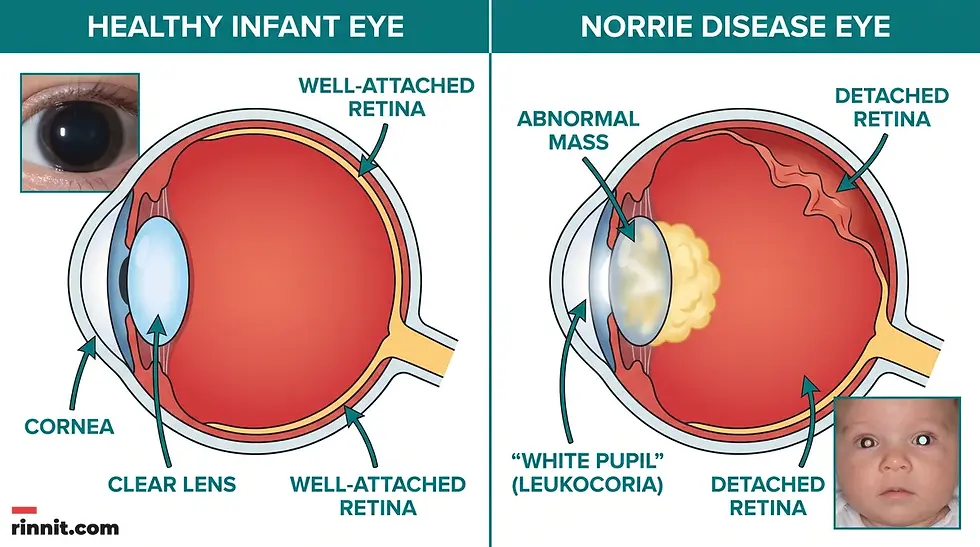
The condition is often first noticed through a sign called leukocoria, or a "white pupil." In a healthy eye the pupil looks black. In a child with Norrie disease the pupil may look white when light shines on it, sometimes called a "cat's eye" reflex. [1] [3] This happens because a mass of immature retinal cells builds up behind the lens.
What Are the Symptoms of Norrie Disease?
Vision loss is the most common symptom, but Norrie disease can affect more than the eyes as a child grows. [1] The mix and severity of symptoms vary from child to child.
Symptom | What it looks like |
Vision loss | Blindness is usually present at birth or develops very early in infancy because the retina forms abnormally or detaches. |
Hearing loss | |
Behavioral changes | About 1 in 4 people with Norrie disease have the pseudobulbar affect, which causes sudden, uncontrollable episodes of laughing or crying. [1] |
Developmental delays | Delays in rolling over, sitting up, and fine motor skills are common. [1] |
Intellectual disability | Some children have difficulty with learning, reasoning, and everyday life skills. [1] |

Related Health Problems
Some people with Norrie disease also have other conditions linked to the same gene change. About 1 in 4 have autism or autism-like symptoms. [1] About 1 in 10 have seizures. [1] Some develop venous ulcers or other problems with blood circulation (peripheral vascular disease). [1] [3]
What Causes Norrie Disease?
Norrie disease happens when the NDP gene changes. This gene holds the instructions for making a protein called norrin. Norrin helps the retina develop and is important for the growth of the blood vessels that supply the retina and the inner ear. [2] When norrin is missing or does not work properly, these delicate structures cannot develop normally, which leads to the symptoms of the disease.
How Is Norrie Disease Inherited?
Norrie disease follows an X-linked recessive pattern. Males have only one X chromosome, so one changed copy of the NDP gene passed down from the mother is enough to cause the disease. [2] Females have two X chromosomes. A female with one changed copy is usually a carrier: she can pass the change on to her children but generally has no symptoms, because her second X chromosome provides a working copy. [2] [3] In rare cases, carrier females have shown mild retinal changes or mild hearing loss. [2]
When the mother is a carrier and the father is unaffected, each pregnancy has a 25% chance of each of four outcomes: an unaffected son, an unaffected daughter, a carrier daughter, or a son with Norrie disease.

Families with a history of Norrie disease are encouraged to talk with a genetic counselor to understand their chance of passing the change on to future children. [1] [3]
How Is Norrie Disease Diagnosed?
Diagnosis usually begins with an eye exam by a pediatric ophthalmologist. The specialist looks for signs such as retinal detachment or a white pupil (leukocoria). [1]
Genetic testing can confirm the diagnosis by finding the change in the NDP gene. [1] [3] A careful review of the family's medical history also helps, because it can reveal the X-linked inheritance pattern. [1] An early diagnosis lets families start a care plan for the child's vision, hearing, and development as soon as possible.
How Is Norrie Disease Treated?
No current treatment restores vision lost to Norrie disease, so care focuses on keeping the eyes comfortable and supporting hearing, communication and development. [1] Care focuses on keeping the eyes comfortable and on supporting hearing, communication, and development.
Vision and Eye Care
Although sight cannot be restored, regular check-ups with an ophthalmologist remain important. Laser treatment or specific surgeries may be recommended to ease eye pain, treat cataracts, or manage retinal detachment. [1]
Hearing and Communication Support
Because hearing loss can get worse over time, early support helps protect communication skills. Options include:
Educational Support
Children with Norrie disease often benefit from educational support services, such as individualized education plans started early, in preschool. Parents are encouraged to talk with school administrators to learn which resources are available locally. [1]
What Is the Outlook for People With Norrie Disease?
Norrie disease is a lifelong condition with permanent vision loss, and the outlook depends largely on how much it affects hearing, development and behavior. The vision loss is permanent, and the outlook depends largely on how much the disease affects other areas of health, such as hearing, development, and behavior. A coordinated care team helps families plan for these needs. Regular monitoring is a key part of care:
Check-up | How often | Why it matters |
Eye exam | Every year, even if the child has no vision [1] | Checks for eye pain, raised pressure, or cataracts |
Hearing test with an audiologist | Every 6 to 12 months [1] | Tracks and manages hearing loss |
Pediatric well-child visits | Routinely | Monitors overall growth, development, and health [1] |
Support for Caregivers
Caring for a child with Norrie disease can be demanding. Caregivers are encouraged to find support groups for families in similar situations, ask relatives and friends to help with daily tasks, and look after their own health. [1] Talk with a healthcare provider if you are coping with exhaustion, anxiety, or depression. [1]
What is the bottom line on Norrie disease?
Norrie disease is a rare and life-changing genetic condition, but early diagnosis and a coordinated care team can make a real difference. Hearing support, developmental and educational help, regular monitoring, and care for the whole family all help children with Norrie disease and their loved ones manage the challenges.
Want more rare-disease and family health guides? Explore more plain-language health information at Rinnit.com.
Frequently Asked Questions
Can Norrie disease affect girls?
It is very rare. Because the condition is X-linked recessive, it mostly affects males. Females are usually carriers without symptoms, although carrier females have rarely shown mild retinal changes or mild hearing loss.
Is there any way to prevent Norrie disease?
The gene change cannot be prevented, but genetic counseling can help families understand their risk before planning a pregnancy.
Does every child with Norrie disease lose their hearing?
Not every child, but many do. Hearing loss is usually progressive and often begins in early childhood. Reported rates vary between sources, and the degree of hearing loss can differ even within the same family.
What is the "white pupil" reflex?
Known as leukocoria, it is when the pupil looks white instead of black when light shines on it. In Norrie disease it is caused by an abnormal mass of tissue behind the lens. Leukocoria has several possible causes, so any child with a white pupil should be seen by an eye doctor.
Can surgery fix the blindness caused by Norrie disease?
No. Current treatments cannot restore vision lost to Norrie disease. Laser treatment or surgery may still be used to ease eye pain or manage cataracts and retinal detachment.
Is Norrie disease linked to autism?
About 1 in 4 people with Norrie disease also have autism or autism-like symptoms.
How often should a child with Norrie disease see a doctor?
Typically a yearly eye exam, hearing tests with an audiologist every 6 to 12 months, and routine pediatric check-ups.
What is the norrin protein?
Norrin is a protein made from the instructions in the NDP gene. It helps the retina develop and supports the growth of the blood vessels in the eyes and inner ears.
What school support do children with Norrie disease need?
Children with Norrie disease usually need educational support, such as individualized education plans started early. Talk with your child's school administrators and care team about the resources available to your family.
Are seizures common in Norrie disease?
Seizures are less common than other features. They affect about 1 in 10 people with the condition.
What is the pseudobulbar affect?
It is a neurological condition that causes sudden, uncontrollable episodes of crying or laughing. About 1 in 4 people with Norrie disease have it.
Can Norrie disease cause pain?
Yes. Eye problems such as cataracts or raised eye pressure can cause pain, which may need laser treatment or surgery.
Is Norrie disease the same as retinopathy of prematurity?
No. They are different conditions, although both involve the blood vessels of the retina. Retinopathy of prematurity is linked to premature birth, while Norrie disease is an inherited condition caused by changes in the NDP gene.
Where can I find support for Norrie disease?
Rare-disease organizations such as the Norrie Disease Association and the National Organization for Rare Disorders (NORD), along with local support groups for families of children who are blind or hearing impaired, can help. Your child's care team can also point you to resources.
References
Cleveland Clinic. Norrie disease. Cleveland Clinic. Last updated July 30, 2025. https://my.clevelandclinic.org/health/diseases/25143-norrie-disease
National Library of Medicine. Norrie disease. MedlinePlus Genetics. Last updated March 1, 2020. https://medlineplus.gov/genetics/condition/norrie-disease/
National Organization for Rare Disorders (NORD). Norrie disease. NORD. Last updated May 29, 2020. https://rarediseases.org/rare-diseases/norrie-disease/
Wawrzynski J, Patel A, Badran A, et al. Spectrum of Mutations in NDP Resulting in Ocular Disease; a Systematic Review. Front Genet. 2022;13:884722. PMID 35651932. https://doi.org/10.3389/fgene.2022.884722
Pauzuolyte V, Patel A, Wawrzynski JR, et al. Systemic gene therapy rescues retinal dysfunction and hearing loss in a model of Norrie disease. EMBO Mol Med. 2023;15(10):e17393. PMID 37642150. https://doi.org/10.15252/emmm.202317393
Medical disclaimer
This article is for general informational purposes only and does not constitute medical advice. Always consult a qualified healthcare professional for diagnosis and treatment decisions. If you think a child is having a medical emergency, call your local emergency number right away.



Comments