Nightmare Disorder: Symptoms, Causes, and Treatment Explained

Updated: 2 days ago
Medically reviewed by Dr. Baraa Alnahhal, MD · Last reviewed: October 17, 2026
A nightmare is a disturbing dream that wakes you with fear or anxiety. Occasional nightmares are common, especially in children aged 3 to 6, and are usually nothing to worry about. Nightmare disorder is different: nightmares happen often, cause distress, disrupt sleep, or create a fear of going to bed. Triggers include stress, trauma, sleep deprivation, and some medications, and treatment, when needed, includes imagery rehearsal therapy, stress management, and bedtime routines [1] [2].
Quick Answer: What is nightmare disorder?
Nightmare disorder is a condition in which vivid, frightening dreams occur often enough to cause distress, disrupt sleep or create a fear of going to bed. It is relatively rare and linked to stress, trauma, sleep deprivation, medications and substance use. Diagnosis relies on history and sometimes a sleep study. Treatment includes imagery rehearsal therapy and stress reduction. [1] [2]
What the research says
Imagery rehearsal therapy cuts trauma-related nightmares and the effect lasts. A meta-analysis of 13 clinical trials found large effects of imagery rehearsal on nightmare frequency, sleep quality, and PTSD symptoms, sustained through 6 to 12 months of follow-up, although effects were small in the one study that used an active-treatment comparison (Casement & Swanson, Clin Psychol Rev, 2012 [3]).
Imagery rehearsal therapy and prazosin work about equally well for trauma nightmares. In a meta-analysis of 15 randomized trials (8 of imagery rehearsal therapy, 7 of prazosin; 1,078 participants), imagery rehearsal therapy had small-to-moderate effects on nightmare frequency (g=0.51), PTSD symptoms (g=0.31), and sleep quality (g=0.51), prazosin had moderate-to-large effects (g=0.61, 0.81, and 0.85), and the two did not differ significantly (Yücel et al., Sleep Med Rev, 2020 [4]).
What Is Nightmare Disorder?
A nightmare is a disturbing dream associated with negative feelings, such as anxiety or fear, that wakes you up. Nightmares are common in children but can happen at any age, and occasional nightmares are usually nothing to worry about [1].
Nightmares may begin in children between 3 and 6 years old and tend to decrease after the age of 10. During the teen and young adult years, girls appear to have nightmares more often than boys. Some people have them as adults or throughout their lives. Although nightmares are common, nightmare disorder is relatively rare. It is diagnosed when nightmares happen often, cause distress, disrupt sleep, create problems with daytime functioning, or create a fear of going to sleep [1].
Aspect | Detail |
What it is | A parasomnia: a sleep disorder with undesirable experiences during sleep |
When dreams occur | Usually during REM (rapid eye movement) sleep, often in the second half of the night |
Who it affects | Children most often; can affect any age; girls more than boys in the teen and young adult years |
How common | Occasional nightmares are common; the disorder itself is relatively rare |
When it starts | May begin between ages 3 and 6; tends to decrease after age 10 |
When it is a disorder | Frequent episodes that cause distress, disrupt sleep, or disrupt daytime life |
What are the symptoms of nightmare disorder?
Nightmare disorder causes vivid, upsetting dreams that wake you up, and you are more likely to have a nightmare in the second half of the night. Nightmares may occur rarely or frequently, even several times a night. Episodes are generally brief, but they wake you up, and returning to sleep can be difficult. A nightmare may include these features [1]:
Your dream seems vivid and real and is very upsetting, often becoming more disturbing as it unfolds.
The storyline usually involves threats to safety or survival, but it can have other disturbing themes.
The dream wakes you up.
You feel scared, anxious, angry, sad, or disgusted because of the dream.
You feel sweaty or have a pounding heartbeat while in bed.
You can think clearly on waking and remember details of the dream.
The dream causes distress that keeps you from falling back to sleep easily.
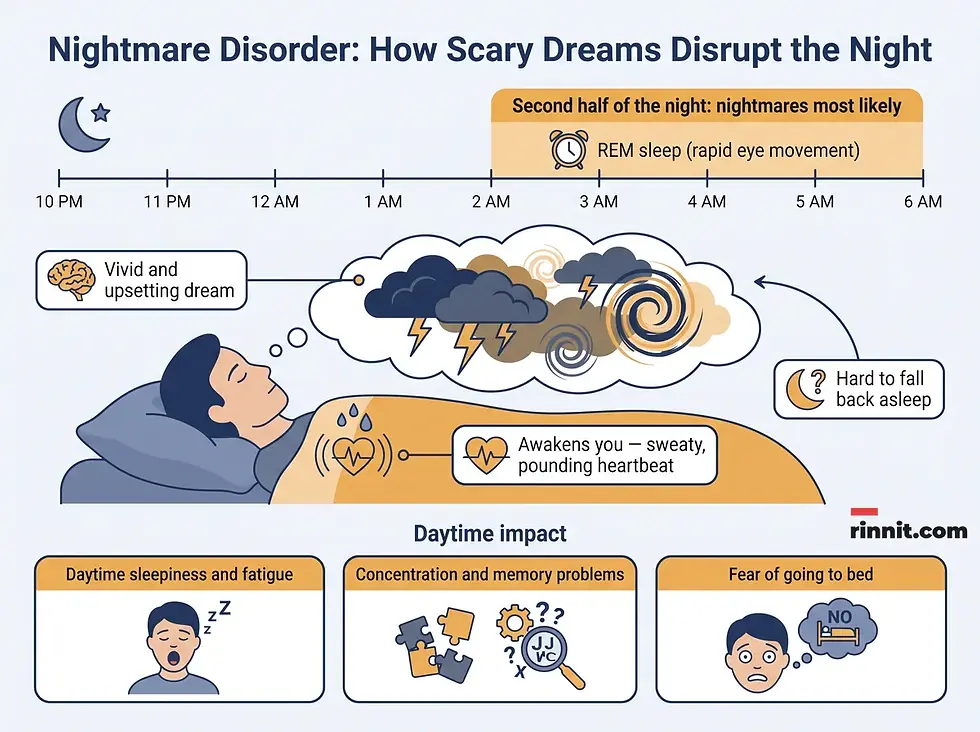
Nightmares occur mostly in REM sleep in the second half of the night and can spill over into daytime life.
Having a child with nightmare disorder can also cause significant sleep disturbance and distress for parents or caregivers [1].
When should you see a doctor about nightmare disorder?
Occasional nightmares are not usually a cause for concern. If your child has nightmares, you can simply mention them at a routine well-child exam. However, consult your doctor if nightmares meet any of the conditions below [1].
Situation | Recommended action |
Nightmares occur frequently and persist over time | Consult your doctor |
Nightmares routinely disrupt sleep | Consult your doctor |
Nightmares cause fear of going to sleep | Consult your doctor |
Nightmares cause daytime behavior problems or difficulty functioning | Consult your doctor |
What Makes Nightmares a Disorder?
Nightmares are considered a disorder only when they meet specific criteria. The frequency and impact on daily life are what separate occasional bad dreams from nightmare disorder.
Criterion | What it looks like |
Frequency | Nightmares occur often, sometimes several times a night |
Distress | Major anxiety, persistent fear, or bedtime anxiety about having another nightmare |
Thinking | Concentration or memory problems, or inability to stop thinking about dream images |
Energy | Daytime sleepiness, fatigue, or low energy |
Daily life | Problems functioning at work, school, or in social situations |
Behavior (children) | Behavior problems related to bedtime or fear of the dark |
What causes nightmare disorder?
Nightmare disorder is classified as a parasomnia, a sleep disorder involving undesirable experiences while falling asleep, during sleep or when waking up. Nightmares usually occur during REM sleep. The exact cause is not known, but many factors can trigger them [1]:
Stress or anxiety: Ordinary daily stresses, such as a problem at home or school, or a major change such as a move or the death of a loved one. Anxiety is associated with a greater risk of nightmares.
Trauma: Nightmares are common after an accident, injury, physical or sexual abuse, or other traumatic event, and in people with post-traumatic stress disorder (PTSD).
Sleep deprivation: Irregular sleep and wake times, or interrupted or reduced sleep, can increase your risk. Insomnia is associated with an increased risk.
Medications: Certain antidepressants, blood pressure medications, beta blockers, and drugs used to treat Parkinson's disease or to help stop smoking can trigger nightmares.
Substance misuse: Alcohol and recreational drug use or withdrawal.
Other disorders: Depression and other mental health disorders, some medical conditions such as heart disease or cancer, and other sleep disorders.
Scary books and movies: For some people, frightening media, especially before bed.

Common nightmare triggers include stress, trauma, sleep loss, medications, alcohol and drugs, other disorders, and scary media.
What are the risk factors for nightmare disorder?
Nightmares are more common when family members have a history of nightmares or other sleep parasomnias, such as talking during sleep [1].
What complications can nightmare disorder cause?
Nightmare disorder can cause problems that reach well beyond bedtime [1]:
Complication | Possible impact |
Excessive daytime sleepiness | Difficulties at school or work; problems with everyday tasks such as driving and concentrating |
Mood problems | Depression or anxiety from dreams that continue to bother you |
Bedtime resistance | Resistance to going to bed or to sleep for fear of another bad dream |
Severe distress | Suicidal thoughts or suicide attempts |
If you or someone you know is having thoughts of suicide or self-harm, contact your local emergency number or a crisis line right away.
How is nightmare disorder diagnosed?
Nightmare disorder is not diagnosed with any routine tests, so evaluation relies on your history and symptoms. Nightmares are considered a disorder only if disturbing dreams cause you distress or keep you from getting enough sleep. Your healthcare professional reviews your medical history and symptoms, and the evaluation may include these steps [2]:
Diagnostic step | What happens |
Symptoms discussion | Diagnosis is based on your description of your symptoms and how much the nightmares affect your sleep and daily life. Your provider may ask other people in your household about your sleep behaviors and about a family history of sleep problems. |
Exam | A physical exam looks for conditions that may be contributing to the nightmares. If you have anxiety, your provider may suggest you talk with a mental health professional. |
Sleep study (polysomnography) | An overnight study does not diagnose nightmare disorder but can help find out whether the nightmares are linked to another sleep disorder. Sensors record brain waves, blood oxygen, heart rate, breathing, and eye and leg movements, and you may be videotaped during sleep. |
How is nightmare disorder treated?
Treatment for occasional nightmares is not usually needed. But if nightmares cause distress, disrupt sleep, and interfere with daytime functioning, treatment can help. The cause of the nightmare disorder helps determine the treatment [2].

Treatment ranges from treating an underlying cause to imagery rehearsal therapy, with medication used rarely.
Medical Treatment
If the nightmares are related to an underlying medical condition, treating that condition may help lessen them [2].
Stress or Anxiety Treatment
If stress or anxiety seems to be contributing, stress-lowering techniques and counseling or therapy with a mental health professional can help [2].
Imagery Rehearsal Therapy
Imagery rehearsal therapy involves changing the ending of a remembered nightmare while awake so that it is no longer threatening. You can write down the new ending or review it in your mind. This approach can lessen how often nightmares happen and how much distress they cause, and it can be especially helpful for people with nightmares caused by PTSD [2] [3] [4].
Medication
Medication is rarely used to treat nightmares, but it can sometimes be used for severe nightmares linked with PTSD [2].
Treatment option | When it is used | How it works |
Medical treatment | When an underlying medical condition is linked to the nightmares | Treats the underlying problem |
Stress or anxiety treatment | When stress or anxiety contributes to the nightmares | Stress-reduction techniques, counseling, or therapy with a mental health professional |
Imagery rehearsal therapy | Often used for nightmares related to PTSD | You change the ending of the remembered nightmare while awake, then rehearse the new ending |
Medication | Rarely used; for severe nightmares associated with PTSD | May reduce nightmare frequency in severe cases |
Which lifestyle and home remedies help nightmare disorder?
If nightmares are a problem for you or your child, practical strategies can help. They work best as a consistent part of your daily routine rather than one-time fixes [2].
Strategy | What to do |
Establish a bedtime routine | Keep a regular sleep and wake schedule and do quiet, calming activities, such as reading or a warm bath, before bed. Meditation, deep breathing, or relaxation exercises may help. Keep the bedroom comfortable and quiet. |
Offer reassurance | If your child struggles with nightmares, be patient, calm, and reassuring. Respond quickly and soothe your child at the bedside after a nightmare. |
Talk about the dream | Ask your child to describe the nightmare: what happened, who was in it, and what made it scary. Remind your child that nightmares are not real and cannot hurt you. |
Rewrite the ending | Imagine a happy ending. Encourage your child to draw it, "talk" to the characters, or write about it in a journal. |
Put stress in its place | If stress or anxiety is an issue, talk about it and practice simple stress-relief activities such as deep breathing or relaxation. A mental health professional can help if needed. |
Provide comfort measures | A favorite stuffed animal, blanket, or other comfort object may help. Leave doors open at night so your child feels connected to others and you can hear if your child calls out. |
Use a night light | A night light in your child's room may be reassuring if your child wakes during the night. |
How can people cope with nightmare disorder?
Living with frequent nightmares affects the whole household. For parents and caregivers, patience and calm responses make a real difference, and soothing a child quickly at the bedside after a nightmare may help prevent future episodes. If stress or anxiety is an issue, talking about it and practicing simple stress-relief activities can reduce the pressure that feeds nighttime dreams, and a mental health professional can help if home strategies are not enough. For adults with nightmares linked to trauma or PTSD, approaches such as imagery rehearsal therapy and counseling with a mental health professional address the root cause rather than only the symptoms [2].
How should you prepare for an appointment about nightmare disorder?
If nightmares disrupt your sleep or you are concerned about an underlying health condition, talk to your doctor, who may refer you to a sleep specialist or a mental health professional. Keeping a sleep diary for two weeks before your appointment can help your doctor understand your sleep schedule, factors affecting your sleep, and when nightmares occur. In the morning, record what you recall about bedtime rituals, sleep quality, and dreams; at the end of the day, record behaviors that may affect sleep, such as schedule changes, alcohol use, and any medicines taken. You may want to bring a family member or friend who can give more information about your sleep habits [2].
Preparation item | Details to include |
Symptoms | Any symptoms you have, including any that may seem unrelated to the reason for the appointment |
Key personal information | Any major stresses or recent life changes |
Medicines | All medicines, vitamins, herbs, or other supplements, with the doses |
Questions to ask | Prepared questions to make the most of your time together |
Questions to ask your doctor may include what is likely causing the symptoms, what other causes are possible, what tests are needed, whether the condition is likely short term or ongoing, what treatment is suggested and what the alternatives are, whether there are things you can try for better sleep, and whether you should see a specialist.
Question you may be asked | Why it matters |
When did symptoms begin? | Establishes the timeline of the problem |
How often do the nightmares occur, and what are they about? | Helps assess frequency and content patterns |
What is the usual bedtime routine? | Identifies habits that may affect sleep |
Is there a history of sleep problems? | Reveals personal sleep history |
Does anyone else in your family have nightmares or sleep problems? | Nightmares are more common with a family history of nightmares or parasomnias |
Conclusion
Nightmare disorder is a relatively rare but disruptive sleep condition in which frequent, frightening dreams cause distress, interrupt sleep, and spill over into daytime life. It usually appears in childhood, can be triggered by stress, trauma, sleep deprivation, medications, and other conditions, and often improves with consistent bedtime routines and stress management. When nightmares become frequent and disruptive, an evaluation by a doctor, and sometimes a sleep study, helps rule out underlying causes and guide treatment [1] [2].
If frequent nightmares are disrupting your sleep or your child's sleep, or creating fear of going to bed, see a doctor. Early evaluation and simple strategies such as a calming bedtime routine can help restore restful nights.
Frequently Asked Questions
What is nightmare disorder?
Nightmare disorder is when nightmares happen often, cause distress, disrupt sleep, create problems with daytime functioning, or create a fear of going to sleep. Although nightmares are common, especially in children, the disorder itself is relatively rare.
What are the symptoms of nightmare disorder?
Symptoms include vivid, upsetting dreams that wake you, fear, anxiety, anger, sadness, or disgust after waking, sweating or a pounding heartbeat, and difficulty falling back asleep. The disorder also causes daytime problems such as fatigue, concentration difficulties, and fear of going to bed.
What causes nightmares?
The exact cause is not known, but nightmares are triggered by stress or anxiety, trauma, sleep deprivation, certain medications, alcohol or recreational drug use or withdrawal, other disorders such as depression, and scary books or movies before bed. They usually occur during REM sleep, often in the second half of the night.
Are nightmares more common in children or adults?
Nightmares may begin in children between 3 and 6 years old and tend to decrease after age 10. During the teen and young adult years, girls appear to have nightmares more often than boys. Some people have them as adults or throughout their lives.
When should I see a doctor about nightmares?
Consult a doctor if nightmares occur frequently and persist over time, routinely disrupt sleep, cause fear of going to sleep, or cause daytime behavior problems or difficulty functioning. Occasional nightmares are not usually a concern.
How is nightmare disorder diagnosed?
There are no routine tests. Diagnosis is based on a review of your medical history and symptoms, your description of the experiences, and sometimes a physical exam or an overnight sleep study (polysomnography) to check for other sleep disorders.
What treatment options exist for nightmare disorder?
Treatment targets the underlying cause: medical treatment for related conditions, stress-reduction techniques or counseling for anxiety, and imagery rehearsal therapy for trauma-related nightmares. Medication is rarely used but may be recommended for severe nightmares associated with PTSD.
What is imagery rehearsal therapy?
Imagery rehearsal therapy involves changing the ending of a remembered nightmare while awake so that it is no longer threatening, then rehearsing the new ending in your mind. It is often used for nightmares related to PTSD and may reduce how often nightmares happen.
What home remedies help with nightmares?
Helpful strategies include a regular, relaxing bedtime routine, reassurance and comfort for children, talking about the dream, rewriting the ending through drawing or journaling, managing daytime stress with deep breathing or relaxation, comfort objects, an open door at night, and a night light for children.
Can medications cause nightmares?
Yes. Certain antidepressants, blood pressure medications, beta blockers, drugs used to treat Parkinson's disease, and drugs used to help stop smoking can trigger nightmares.
What are the risks of untreated nightmare disorder?
Complications can include excessive daytime sleepiness that affects school, work, driving, and concentration; mood problems such as depression or anxiety; resistance to going to bed for fear of another nightmare; and in severe cases, suicidal thoughts or suicide attempts.
Related Resources
External resources for deeper reading:
References
Mayo Clinic. Nightmare disorder: Symptoms and causes. Mayo Clinic. August 25, 2026. https://www.mayoclinic.org/diseases-conditions/nightmare-disorder/symptoms-causes/syc-20353515
Mayo Clinic. Nightmare disorder: Diagnosis and treatment. Mayo Clinic. August 25, 2026. https://www.mayoclinic.org/diseases-conditions/nightmare-disorder/diagnosis-treatment/drc-20353520
Casement MD, Swanson LM. A meta-analysis of imagery rehearsal for post-trauma nightmares: effects on nightmare frequency, sleep quality, and posttraumatic stress. Clin Psychol Rev. 2012;32(6):566-574. PMID 22819998. https://doi.org/10.1016/j.cpr.2012.06.002
Yücel DE, van Emmerik AAP, Souama C, et al. Comparative efficacy of imagery rehearsal therapy and prazosin in the treatment of trauma-related nightmares in adults: a meta-analysis of randomized controlled trials. Sleep Med Rev. 2020;50:101248. PMID 31855732. https://doi.org/10.1016/j.smrv.2019.101248
Medical disclaimer
This article is for informational purposes only and is not a substitute for professional medical advice, diagnosis, or treatment. The clinical information in this guide reflects source material last reviewed in August 2026.



Comments