Niemann-Pick Disease: Symptoms, Causes, and Treatment Explained

Updated: 3 days ago
Medically reviewed by Dr. Baraa Alnahhal, MD · Last reviewed: October 17, 2026
Niemann-Pick disease is a group of rare, inherited conditions that affect how cells break down and use fats such as cholesterol and lipids. The fat buildup damages cells in the brain, nerves, liver, spleen, and bone marrow over time. Symptoms vary by type, from an enlarged liver in infancy to nerve and vision problems that appear later in life. There is no cure, but enzyme replacement therapy, supportive care, and symptom-focused treatment help families manage the condition [1] [2].
Quick Answer: What is Niemann-Pick disease?
Niemann-Pick disease is a rare inherited disorder in which cells cannot properly break down fats such as cholesterol and lipids. The buildup damages cells in the brain, nerves, liver, spleen and sometimes lungs. There are three main types, A, B and C. Diagnosis involves enzyme, cholesterol and genetic testing. There is no cure, but supportive treatments help. [1] [2]
What the research says
Enzyme replacement shrinks the spleen and liver and improves lung function in adults with type B. In the 52-week ASCEND trial of 36 adults with acid sphingomyelinase deficiency, olipudase alfa improved lung diffusing capacity (22% vs. 3.0% increase; P=.0004), reduced spleen volume (39% decrease vs. 0.5% increase) and reduced liver volume (28% vs. 1.5% decrease) compared with placebo (Wasserstein et al., Genet Med, 2022 [3]).
The benefits continue for at least two years. In the open-label extension, 35 of 36 participants continued and 33 completed year 2; after two years of olipudase alfa, spleen volume was down 47.0%, liver volume down 33.4%, and lung diffusing capacity up 28.5%, with 99% of adverse events mild or moderate (Wasserstein et al., Orphanet J Rare Dis, 2023 [4]).
Type C is rarer and is dominated by NPC1 gene changes. A review estimates a minimal incidence of about 1 in 120,000 live births, with NPC1 gene changes in 95% of families; vertical supranuclear gaze palsy is the most characteristic sign, and the outlook largely depends on the age at which nerve symptoms begin (Vanier, Orphanet J Rare Dis, 2010 [5]).
What Is Niemann-Pick Disease?
Niemann-Pick disease is a group of rare conditions passed down in families. The conditions affect the body's ability to break down and use fats, such as cholesterol and lipids, inside cells. Because of the buildup of fats, these cells do not work as they should, and over time the cells die. The disease can affect the brain, nerves, liver, spleen, and bone marrow, and sometimes the lungs [1].
Symptoms relate to worsening function of the nerves, brain, and other organs over time. The disease can happen at different ages but mainly affects children. It has no known cure and is sometimes fatal. Treatment focuses on helping people live with their symptoms [1].
Aspect | Detail |
What it is | A group of rare inherited conditions affecting fat breakdown in cells |
What builds up | Fats such as cholesterol and lipids |
Organs affected | Brain, nerves, liver, spleen, bone marrow, and sometimes lungs |
Who it affects | Mainly children; can appear at any age |
Cure | None known; treatment focuses on symptoms |

Fat buildup inside cells damages the brain, nerves, liver, spleen, bone marrow, and sometimes the lungs.
What are the symptoms of Niemann-Pick disease?
The three main types of Niemann-Pick disease are called A, B, and C. Symptoms differ widely but depend in part on the type and how severe the condition is [1].
Body area | Possible symptoms |
Movement and muscles | Loss of muscle control such as clumsiness and walking problems; muscle weakness and floppiness; stiff and awkward movements |
Senses | Vision problems such as vision loss and uncontrollable eye movements; hearing loss; sensitivity to touch |
Daily functions | Sleep problems; swallowing and eating problems; slurred speech |
Thinking and mood | Learning and memory problems that worsen; depression, paranoia, and behavior problems |
Organs | Liver and spleen that get too large; repeated infections that cause pneumonia |
Timing differs by type. Some infants with type A show symptoms within the first few months of life. Those with type B may not show symptoms for years and have a better chance of living to adulthood. People with type C can start to have symptoms at any age but may not have any until adulthood [1].
When should you see a doctor about Niemann-Pick disease?
If you have concerns about your child's growth and development, talk with your healthcare professional. If your child is no longer able to do some activities that they could do before, see your healthcare professional right away [1].
Situation | Recommended action |
Concerns about your child's growth or development | Talk with your healthcare professional |
Your child can no longer do activities they once could | See your healthcare professional right away |
An enlarged liver or spleen is found on an exam | Ask about testing for rare metabolic conditions |
What causes Niemann-Pick disease?
Niemann-Pick disease is caused by changes in specific genes related to how the body breaks down and uses fats, including cholesterol and lipids. The gene changes are passed from parents to children in a pattern called autosomal recessive inheritance, which means both the mother and the father must pass on a changed gene for the child to have the condition [1].
Types A and B
Types A and B are both caused by changes in the SMPD1 gene, and the condition is sometimes called acid sphingomyelinase deficiency (ASMD). With these changes, an enzyme called sphingomyelinase is missing or does not work well. This enzyme is needed to break down and use a lipid called sphingomyelin inside cells. A buildup of these fats causes cell damage, and over time the cells die [1].
Type C
Type C is caused by changes in the NPC1 and NPC2 genes. With these changes, the body does not have the proteins it needs to move and use cholesterol and other lipids in cells. Cholesterol and other lipids build up in the cells of the liver, spleen, or lungs. Over time the nerves and brain are also affected, causing problems with eye movements, walking, swallowing, hearing, and thinking [1].
Type | Gene changes | Key features |
A | SMPD1 | Most severe form; begins in infancy; enlarged liver, severe brain damage, worsening nerve loss; most children do not live past a few years |
B | SMPD1 | Usually begins later in childhood; no brain damage; nerve pain, walking and vision problems, enlarged liver and spleen, possible lung problems; most live into adulthood |
C | NPC1 and NPC2 | Symptoms at any age, sometimes not until adulthood; problems with eye movements, walking, swallowing, hearing, and thinking; varies widely and worsens over time |
What are the risk factors for Niemann-Pick disease?
Risk factors depend on the type, and all are related to gene changes that are passed down in families. Although the condition can occur in any population, type A occurs more often in people of Ashkenazi Jewish descent, type B in people of North African descent, and type C in many populations but more often in people of Acadian and Bedouin descent. If you have a child with Niemann-Pick disease, your risk of having another child with the condition is higher, and genetic testing and counseling can help you learn about your risks [1].
Type | More common in |
A | People of Ashkenazi Jewish descent |
B | People of North African descent |
C | People of Acadian and Bedouin descent, among many other populations |
All types | Families with an affected child have a higher risk of another affected child |
How is Niemann-Pick disease diagnosed?
Niemann-Pick disease is diagnosed with a physical exam, a review of symptoms and family history, and tests that depend on the type, because its symptoms resemble other conditions. Your healthcare professional will talk with you about symptoms and your family health history. Niemann-Pick disease is rare and its symptoms can be similar to those of other conditions, so testing is needed to get the right diagnosis. The tests depend on the type [2]:
Type | Test approach |
A or B | Using blood or a tiny sample of skin, experts measure how much sphingomyelinase, an enzyme that breaks down and uses fat, is in white blood cells. |
C | A blood sample measures levels of a specific cholesterol called oxysterol. In rare cases, a small skin sample shows how the cells move and store cholesterol. |
Other Tests
Genetic testing: DNA testing of a blood sample may show the specific gene changes that cause types A, B, and C. People who have only one copy of the gene change but do not have the condition are called carriers, and DNA tests can show carriers if the gene changes have been identified in the first person in the family to have the condition [2].
MRI: An MRI of the brain may show loss of brain cells, but in the early stages it may show no changes because symptoms usually appear before cell loss. MRI can also show whether the liver and spleen are large and measure their size [2].
Eye exam: An eye exam may show problems with eye movements in type C and changes inside the eyes in types A and B [2].
Prenatal testing: Ultrasound during pregnancy can show the large liver and spleen caused by type C; they may also be large in type A, but rarely in type B. A sample of amniotic fluid or placental tissue may be taken to diagnose the condition [2].
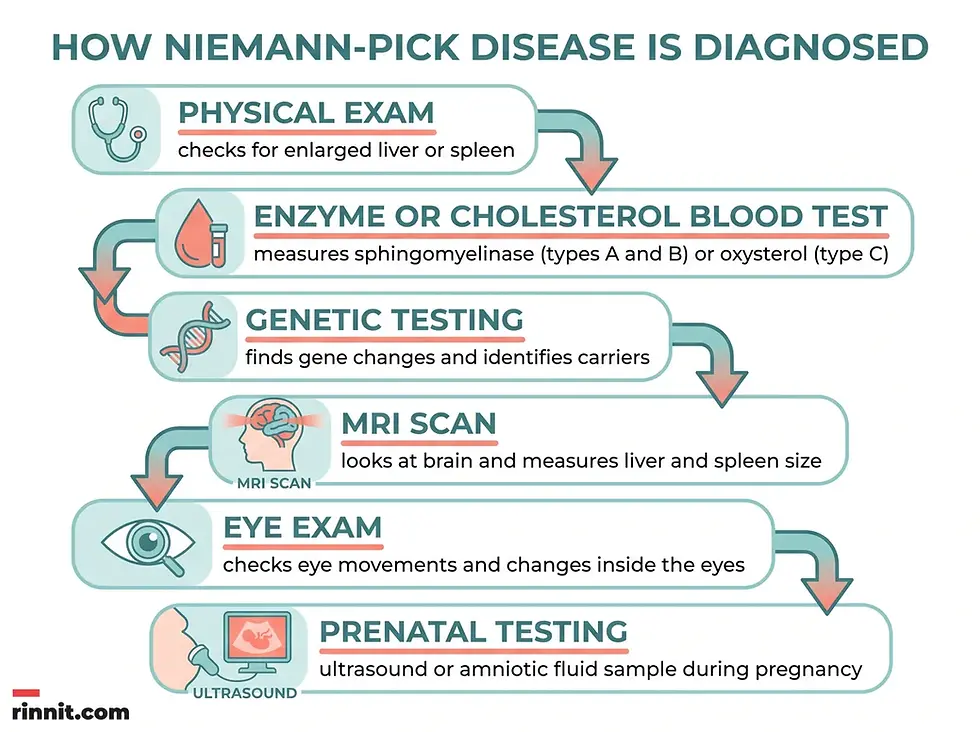
Diagnosis combines a physical exam, enzyme or cholesterol testing, genetic testing, imaging, an eye exam, and sometimes prenatal testing.
Genetic testing and counseling for families with a child with Niemann-Pick disease can give information about risks and family planning options [2].
How is Niemann-Pick disease treated?
No cure exists for Niemann-Pick disease, but supportive care can help manage symptoms [2].
Medicines
For type B, olipudase alfa-rpcp (Xenpozyme) is an enzyme replacement for missing or low levels of the sphingomyelinase enzyme. It may help with lung problems and breathing, lessen the size of the liver and spleen, and help height growth in children. It does not help with nerve-related symptoms. It is given through a vein every two weeks [2] [3].
For people with type C who have mild to moderate nerve symptoms, a drug called miglustat may be an option. Miglustat is approved for neurological symptoms of type C in many countries. In 2024 the U.S. FDA approved two medicines for type C: arimoclomol (Miplyffa), taken with miglustat, and levacetylleucine (Aqneursa). It is a pill taken 1 to 3 times a day and may slow the worsening of nerve symptoms such as hearing, swallowing, and walking problems, and may help slow changes in mental health, learning, and memory [2].
Medicine | Type it treats | How it is given | What it may help |
Olipudase alfa-rpcp (Xenpozyme) | B | Through a vein every two weeks | Lung problems and breathing, liver and spleen size, height growth in children; does not help nerve-related symptoms |
Miglustat | C with mild to moderate nerve symptoms | Pill, 1 to 3 times a day | May slow worsening of hearing, swallowing, and walking problems and changes in mental health, learning, and memory; not FDA-approved in the U.S. for this use |
Discuss medicines, including possible side effects, with your doctor or other healthcare professional.
Supportive Therapies
Therapies for all types depend on symptoms and may include [2]:
Speech, physical, and occupational therapy: Keep the ability to move as long as possible and help with talking and swallowing.
Nutrition therapy: Special foods added to the diet when swallowing becomes difficult.
Oxygen therapy: Helps if the lungs are affected and breathing problems happen.
Treatment of symptoms: Helps with infections, seizures, uncontrollable muscle movements, and sleep problems.
People with Niemann-Pick disease need to see their healthcare professionals regularly, because the disease and its symptoms worsen over time. Research for new treatments is ongoing, and clinical trials may be an option [2].

Treatment includes enzyme replacement for type B, miglustat for type C in many countries, and supportive therapies for all types.
How can families cope with Niemann-Pick disease and find support?
If you or your child is diagnosed with Niemann-Pick disease, your family may face challenges and uncertainties. One of the most difficult things about the condition is that it is not possible to predict how health and development will change over time. You or your child will likely need more care as the condition changes, so ask your healthcare team about supportive resources, and talk with them about when it is time to plan end-of-life care [2].
It may help to connect with others living with Niemann-Pick disease. Depending on your needs, ask for information on organizations that support parents of children with physical conditions that limit their abilities or who have lost children to such conditions. Being part of clinical trials may help in the search for effective treatments [2].
How should you prepare for a Niemann-Pick disease appointment?
Signs of Niemann-Pick disease may be noticed before birth, or you may first share your concerns with a healthcare professional. After an exam, you may be referred to one or more specialists for testing and treatment. Consider asking a trusted family member or friend to join you for emotional support and to help you remember the information [2].
Before your appointment, make a list of any symptoms and how long you have noticed them, your family's key medical information, all medicines, vitamins, herbs, and supplements you use with the doses, your family history (including whether anyone else in the family has Niemann-Pick disease), and your questions.
Questions to ask your healthcare professional | Questions to expect from your doctor |
What is likely causing these symptoms? | What are your or your child's symptoms? |
Are there any other possible causes? | When did you first notice these symptoms? |
What kinds of tests are needed to make a diagnosis? | Have the symptoms changed over time? |
Should I see a specialist? | Does your child's development seem delayed compared with same-age children? |
Is this Niemann-Pick disease? | Does your child no longer do things they used to do? |
What are the treatment options and possible complications? | Have any blood relatives been diagnosed or had symptoms? |
How often are regular appointments needed? | - |
Are my other children or family members at higher risk, and should they be tested for the gene changes? | - |
Are there clinical trials, coping suggestions, or support groups? | - |
Conclusion
Niemann-Pick disease is a group of rare inherited conditions in which cells cannot properly break down and use fats, causing damage to the brain, nerves, liver, spleen, and other organs over time. The three types, A, B, and C, differ in severity, timing, and which organs are affected. There is currently no cure, but enzyme replacement therapy for type B, miglustat for type C in some countries, and a full range of supportive therapies help people live with their symptoms [2].
If your child shows signs of slowed development or loses abilities they once had, see a healthcare professional right away. Early evaluation gives your family the best chance at an accurate diagnosis, care planning, and access to support resources and clinical trials.
Frequently Asked Questions
What is Niemann-Pick disease?
Niemann-Pick disease is a group of rare inherited conditions in which cells cannot break down and use fats such as cholesterol and lipids. The fat buildup damages cells in the brain, nerves, liver, spleen, and bone marrow over time.
What causes Niemann-Pick disease?
Changed genes that affect fat breakdown are the cause, and both parents must pass on a changed gene (autosomal recessive inheritance) for a child to have the condition. Types A and B come from SMPD1 gene changes, while type C comes from NPC1 and NPC2 gene changes.
What are the symptoms of Niemann-Pick disease?
Symptoms can include an enlarged liver and spleen, loss of muscle control, muscle weakness, stiff movements, vision and hearing problems, swallowing and speech difficulties, worsening memory and learning problems, and sleep or mood problems.
How do the three types of Niemann-Pick disease differ?
Type A is the most severe and begins in infancy, usually involving brain damage. Type B begins later in childhood without brain damage and most people live into adulthood. Type C can appear at any age and affects eye movements, walking, swallowing, hearing, and thinking.
Is Niemann-Pick disease inherited?
Yes. It follows an autosomal recessive pattern, meaning both parents must pass on a changed gene. It is more common in certain populations depending on the type, including Ashkenazi Jewish (type A), North African (type B), and Acadian and Bedouin (type C) ancestry.
How is Niemann-Pick disease diagnosed?
Diagnosis combines a physical exam, enzyme testing in white blood cells (types A and B), oxysterol blood testing (type C), genetic testing to identify gene changes and carriers, MRI, eye exams, and sometimes prenatal ultrasound or sampling.
Is there a cure for Niemann-Pick disease?
No cure exists. Treatment focuses on managing symptoms through enzyme replacement, supportive therapies such as speech and physical therapy, nutrition and oxygen support, and treatment of infections, seizures, and sleep problems.
What medicines treat Niemann-Pick disease?
Olipudase alfa-rpcp (Xenpozyme) replaces the missing enzyme in type B and is given through a vein every two weeks. Miglustat is a pill used for type C in many countries. In the U.S., arimoclomol (Miplyffa), taken with miglustat, and levacetylleucine (Aqneursa) were approved for type C in 2024.
Can Niemann-Pick disease be detected before birth?
Yes. Ultrasound during pregnancy can show the large liver and spleen caused by type C, and samples of amniotic fluid or placenta tissue may be taken to diagnose Niemann-Pick disease before birth.
What support is available for families?
Healthcare teams can connect families with supportive resources, organizations for parents of children with limiting conditions, and clinical trials. Genetic counseling can also help families understand risks and family planning options.
Related Resources
External resources for deeper reading:
References
Mayo Clinic. Niemann-Pick disease: Symptoms and causes. Mayo Clinic. January 30, 2024. https://www.mayoclinic.org/diseases-conditions/niemann-pick/symptoms-causes/syc-20355887
Mayo Clinic. Niemann-Pick disease: Diagnosis and treatment. Mayo Clinic. January 30, 2024. https://www.mayoclinic.org/diseases-conditions/niemann-pick/diagnosis-treatment/drc-20355890
Wasserstein M, Lachmann R, Hollak C, et al. A randomized, placebo-controlled clinical trial evaluating olipudase alfa enzyme replacement therapy for chronic acid sphingomyelinase deficiency (ASMD) in adults: one-year results. Genet Med. 2022;24(7):1425-1436. PMID 35471153. https://doi.org/10.1016/j.gim.2022.03.021
Wasserstein MP, Lachmann R, Hollak C, et al. Continued improvement in disease manifestations of acid sphingomyelinase deficiency for adults with up to 2 years of olipudase alfa treatment: open-label extension of the ASCEND trial. Orphanet J Rare Dis. 2023;18(1):378. PMID 38042851. https://doi.org/10.1186/s13023-023-02983-0
Vanier MT. Niemann-Pick disease type C. Orphanet J Rare Dis. 2010;5:16. PMID 20525256. https://doi.org/10.1186/1750-1172-5-16
Medical disclaimer
This article is for informational purposes only and is not a substitute for professional medical advice, diagnosis, or treatment. The clinical information in this guide reflects source material last reviewed in January 2024.



Comments