Mineral Deficiency: Symptoms, Causes, and Prevention

Updated: 2 days ago
Medically reviewed by Dr. Baraa Alnahhal, MD · Last reviewed: October 2026
Editorial note: This article is provided for educational purposes only. It is not medical advice. Always consult a qualified healthcare professional about your individual health situation.
Quick Answer: What Is Mineral Deficiency?
Mineral deficiency is a condition in which the body lacks essential minerals needed by critical biological systems, mainly from poor diet, absorption problems or rapid loss. [1] It can lead to complications such as anemia and heart damage. [1] Symptoms vary by mineral but often include fatigue, brittle bones and muscle cramps. [1] Management uses dietary changes and supervised supplementation.
What the research says
Several trace minerals are commonly under-consumed by older adults. A systematic review of 28 studies found that intakes of zinc fell below the estimated average requirement in 31% of community-living women and 49% of men (50% and 66% in institutional care), and selenium in 49% of women and 37% of men in the community. Significant shares also showed insufficient iron, iodine and copper intake (Vural et al., Nutrients, 2020 [2]).
Iodine deficiency is widespread, and fortification raises iodine status. A Cochrane review reports that iodine deficiency disorders affect close to 1.9 billion people worldwide. Fortifying foods other than salt likely increased urinary iodine concentration (SMD 0.59, 95% CI 0.37-0.81; 6 randomized trials, 2,032 participants), although effects on goitre and growth were uncertain (Santos et al., Cochrane Database Syst Rev, 2019 [3]).
Fortifying salt with iron as well as iodine can reduce anemia. A meta-analysis of 22 studies (N = 52,758) found that double-fortified salt lowered the risk of anemia (RR 0.80, 95% CI 0.70-0.92) and iron deficiency anemia (RR 0.36, 95% CI 0.24-0.55), though only two real-world effectiveness studies existed and they reported low coverage and quality problems (Larson et al., J Nutr, 2021 [4]).
What is a mineral deficiency?
Minerals are inorganic substances found in the soil and water that are absorbed by plants or eaten by animals. Although required in varying amounts, they are critical for the body's structural integrity and physiological processes. A mineral deficiency arises when the body does not obtain or retain a sufficient supply of these key nutrients. [1]
Without an adequate supply, essential systems can begin to fail, leading to illnesses that range from minor concerns to life-threatening conditions. [1] It is important to note that while minerals are necessary, excessive intake can be toxic. [1]
What are the essential minerals involved in mineral deficiency?
Essential minerals are categorized into two groups based on the amount the body requires. [1]
Major Minerals
These are minerals that the body needs in relatively large quantities: [1]
Calcium and Phosphate: Critical for bone health. [1]
Magnesium and Potassium: Essential for muscle and nerve function.
Sodium and Chloride: Important for fluid balance.
Sulfur: Involved in protein structure.
Trace Minerals
Trace minerals are only needed in minute amounts but remain vital for health: [1]
Iron: Essential for oxygen transport in the blood.
Zinc: Important for immune function and wound healing.
Iodine: Necessary for thyroid hormone production.
Copper, Selenium, and Manganese: Act as cofactors for various enzymes.
Fluoride, Chromium, Molybdenum, and Cobalt: Support metabolic and structural functions.

What are the symptoms and warning signs of mineral deficiency?
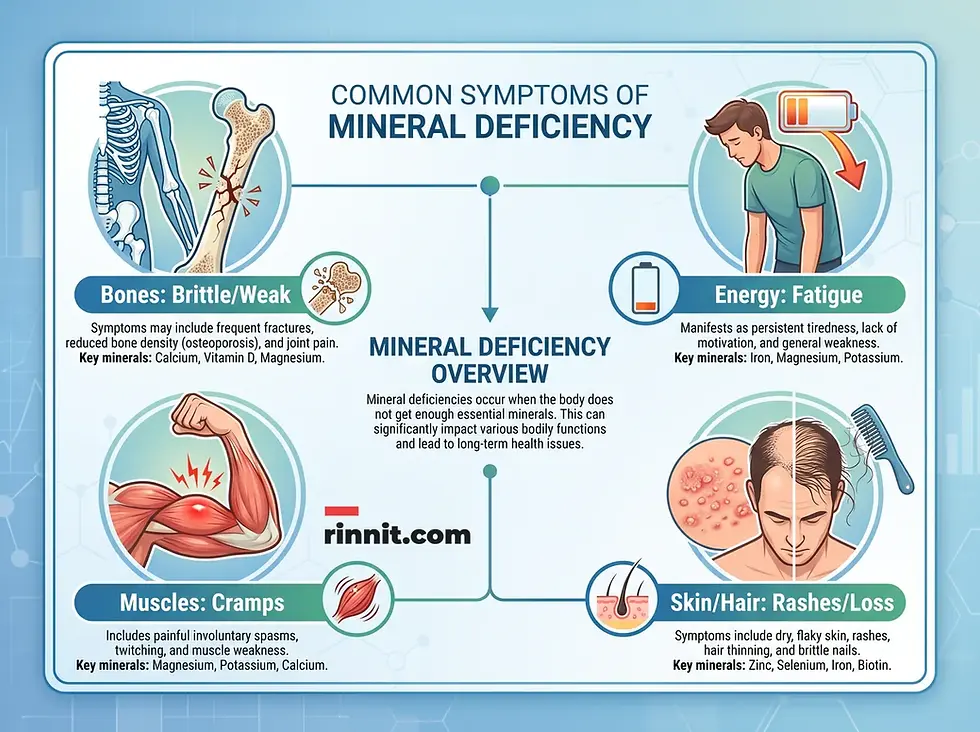
The symptoms of a mineral deficiency are diverse and depend on the specific nutrient lacking, the severity of the depletion, and the individual's age. [1]
Affected System | Common Symptoms | Associated Minerals |
Bones and Teeth | Brittle bones, osteoporosis, cavities | Calcium, Copper, Phosphate |
Energy Levels | Constant fatigue, weakness | Iron, Iodine, Selenium, Cobalt |
Muscles | Cramps, stiffness, weakness | Potassium, Magnesium, Calcium, Iron |
Skin and Hair | Rashes, hair loss, brittle nails | Zinc, Copper, Manganese, Magnesium |
Cognition | Trouble concentrating, memory issues | Iron, Iodine, Chromium, Phosphorus [1] |
Senses | Weakened sense of taste and smell | Zinc [1] |
What causes mineral deficiency, and who is at risk?
Most mineral deficiencies are the result of inadequate intake or impaired absorption. [1]
Common causes include:
Dietary Choices: Poor variety in food or specific patterns like strict vegan or vegetarian diets. [1]
Absorption Issues: Conditions such as genetic diseases or medical procedures like bariatric surgery. [1]
Medication Interference: Certain drugs can block the absorption of specific minerals. [1]
Nutrient Interactions: A deficiency in one nutrient (like Vitamin D) can prevent the absorption of another (like Calcium). [1]
Rapid Loss: Excessive bleeding, chronic dehydration, or high-intensity physical activity.
How is mineral deficiency diagnosed and managed?
Healthcare providers typically diagnose mineral deficiencies through physical examinations, detailed dietary histories, and laboratory tests involving blood or urine samples. [1]
Treatment Strategies
The primary goal of treatment is to restore healthy mineral levels:
Dietary Modification: Increasing the intake of mineral-rich foods.
Supplementation: Taking oral or intravenous supplements as directed by a provider.
Addressing Root Causes: Treating underlying medical conditions that affect nutrient absorption. [1]

Conclusion
Mineral deficiencies are a significant health concern but are often entirely preventable. By maintaining a diverse diet, choosing fortified foods, and attending regular medical checkups, individuals can ensure their bodies receive the essential nutrients needed for long-term health and vitality. [1]
When should you see a provider about a possible mineral deficiency?
If you are experiencing persistent fatigue, muscle cramps, or changes in your hair and skin, consult your primary care provider. Routine blood work can identify nutrient gaps early, allowing for simple and effective management before complications arise.
Related reading: Fluoride: Essential Mineral for Dental Health and Cavity Prevention
Sources: Cleveland Clinic — Mineral Deficiency | Vural et al., 2020 | Santos et al., 2019 | Larson et al., 2021
Frequently Asked Questions
1. What is a mineral deficiency?
A mineral deficiency occurs when your body does not have enough of the essential inorganic nutrients required for its systems to function correctly.
2. Can you have too many minerals?
Yes, most minerals can be toxic if consumed in excessive amounts; balance is critical for health.
3. How does iron deficiency affect the body?
Low iron levels can lead to anemia, causing fatigue, weakness, and spoon-shaped nails.
4. What are the signs of zinc deficiency?
Common signs include hair loss, skin rashes, and a weakened sense of taste or smell.
5. Why is iodine added to salt?
Iodized salt is a primary public health strategy to prevent iodine deficiency, which can cause thyroid issues and goiters.
6. Can a lack of Vitamin D cause mineral issues?
Yes, low Vitamin D levels can prevent your body from properly absorbing calcium, even if you eat enough calcium-rich foods.
7. Are mineral deficiencies common in children?
Yes, and they can be particularly serious, potentially causing growth faltering, rickets, and brain development issues.
8. What causes muscle cramps?
Deficiencies in calcium, iron, magnesium, or potassium are all known to cause muscle cramps.
9. How are these deficiencies diagnosed?
Doctors use physical exams, blood tests, urine tests, and questions about your diet to diagnose a deficiency.
10. Can diet alone prevent mineral deficiencies?
In many cases, a varied and balanced diet is the most effective way to prevent nutrient gaps.
References
Cleveland Clinic. Mineral Deficiency. Cleveland Clinic. November 20, 2025. https://my.clevelandclinic.org/health/diseases/mineral-deficiency
Vural Z, Avery A, Kalogiros DI, et al. Trace mineral intake and deficiencies in older adults living in the community and institutions: a systematic review. Nutrients. 2020;12(4):1072. PMID 32294896. https://doi.org/10.3390/nu12041072
Santos JAR, Christoforou A, Trieu K, et al. Iodine fortification of foods and condiments, other than salt, for preventing iodine deficiency disorders. Cochrane Database Syst Rev. 2019;2(2):CD010734. PMID 30746700. https://doi.org/10.1002/14651858.CD010734.pub2
Larson LM, Cyriac S, Djimeu EW, et al. Can double fortification of salt with iron and iodine reduce anemia, iron deficiency anemia, iron deficiency, iodine deficiency, and functional outcomes? Evidence of efficacy, effectiveness, and safety. J Nutr. 2021;151(Suppl 1):15S-28S. PMID 33582785. https://doi.org/10.1093/jn/nxaa192
Medical disclaimer
The information provided in this article is for educational purposes only and should not be used as a substitute for professional medical advice, diagnosis, or treatment. Always seek the advice of your physician or other qualified health provider with any questions you may have regarding a medical condition. Never disregard professional medical advice or delay in seeking it because of something you have read here.



Comments