Mastering Mobility: A Guide to Hand and Wrist Anatomy

Updated: 2 days ago
Medically reviewed by Dr. Baraa Alnahhal, MD · Last reviewed: September 2026
TL;DR
The hand and wrist are marvels of biological engineering, consisting of a complex network of 27 bones, dozens of muscles, and a sophisticated system of nerves and connective tissues. Together, they enable a wide range of motions, from the power needed to lift heavy objects to the precision required for delicate tasks. Understanding this anatomy is key to maintaining mobility and recognizing early signs of common conditions like carpal tunnel syndrome or arthritis.
Quick Answer
The hand and wrist comprise 27 bones (8 in the wrist, 19 in the hand) supported by 34 muscles and a network of tendons and ligaments. The wrist acts as a pivot point for the hand, which includes the palm, fingers, and thumb. This structure is powered by three main nerves—the radial, median, and ulnar—and supplied by the radial and ulnar arteries. This intricate coordination allows for two primary types of grip: power for strength and precision for fine motor control.
The Structural Foundation: Bones of the Hand and Wrist
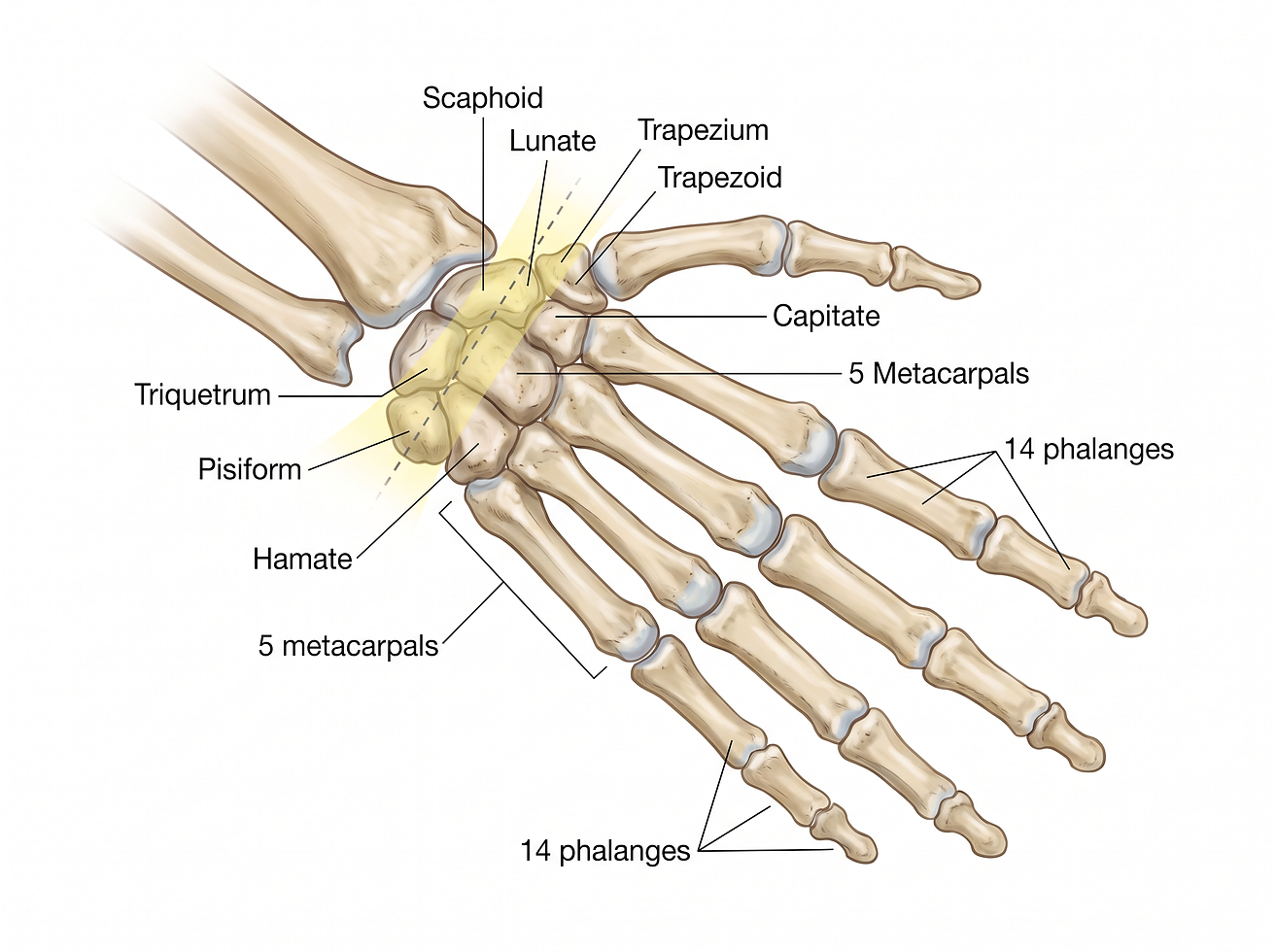
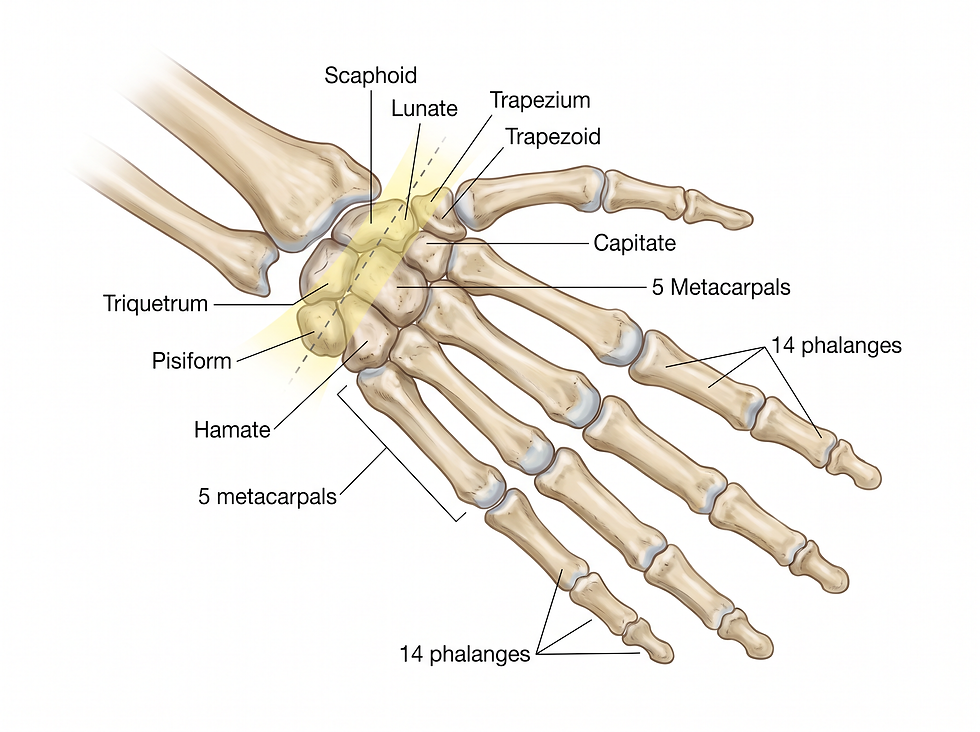
The skeletal structure provides the essential framework and anchors for all other tissues in the hand and wrist. Each hand contains 19 bones, while the wrist is composed of 8 small bones arranged in two distinct rows. These bones work in tandem to provide both stability and a wide range of motion.
The carpal tunnel is a particularly significant anatomical feature, formed by a rounded space between four specific wrist bones. This "tunnel" acts as a protected pathway for nine tendons, four ligaments, and the median nerve as they travel from the forearm into the hand.
Region | Bone Groups | Primary Function |
Wrist (Carpals) | Proximal & Distal Rows (8 bones) | Acts as a pivot point for rotation and reach. |
Palm (Metacarpals) | Metacarpal Bones (5 bones) | Provides the structural shape of the palm. |
Fingers (Phalanges) | Finger & Thumb Segments (14 bones) | Enables flexing and grabbing of objects. |
Connective | Sesamoids | Small bones that help tendons move smoothly. |
The Engine of Movement: Muscles and Nerves
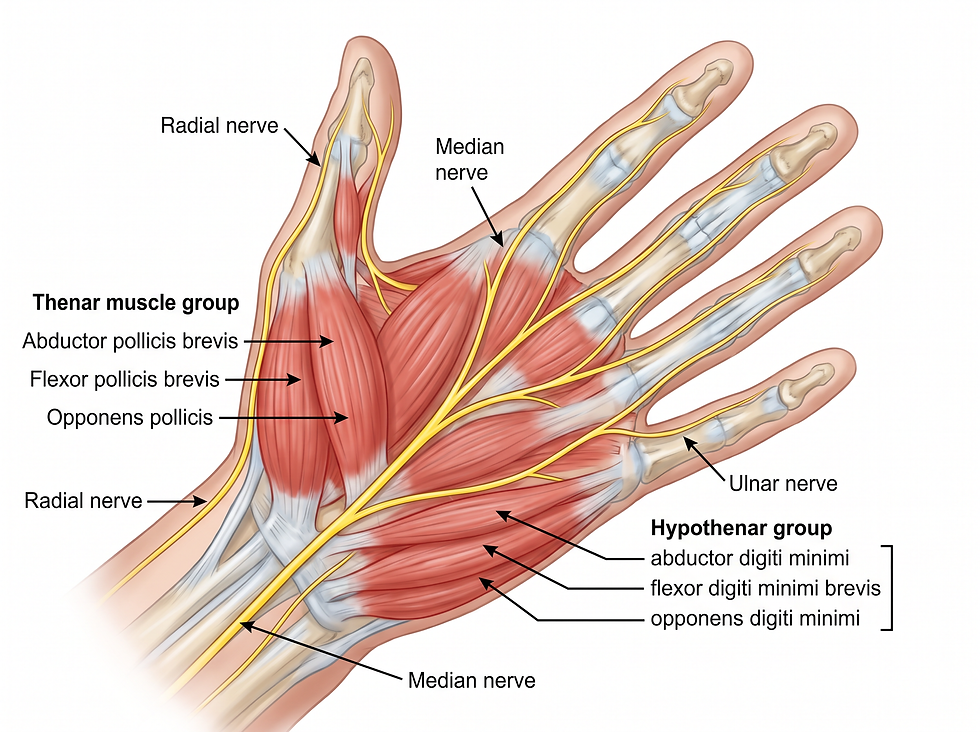
Movement in the hand is the result of coordination between 34 intrinsic muscles within the hand and extrinsic muscles located in the forearm. These muscles are categorized based on their location and the specific movements they control, such as thumb rotation or finger flexion.
The nervous system acts as the control center, with three primary nerves providing sensation and motor signals. The radial, median, and ulnar nerves branch out into a vast network of smaller nerves, allowing us to process touch, temperature, pressure, and pain.
Muscle Group | Location | Primary Action |
Thenar Muscles | Base of the thumb | Controls complex thumb movements. |
Hypothenar Muscles | Outer edge of the palm | Controls the pinkie finger area. |
Interossei Muscles | Between metacarpal bones | Enables side-to-side finger movement. |
Lumbrical Muscles | Base of the fingers | Helps flex the four non-thumb fingers. |
Connective Tissue and Circulation
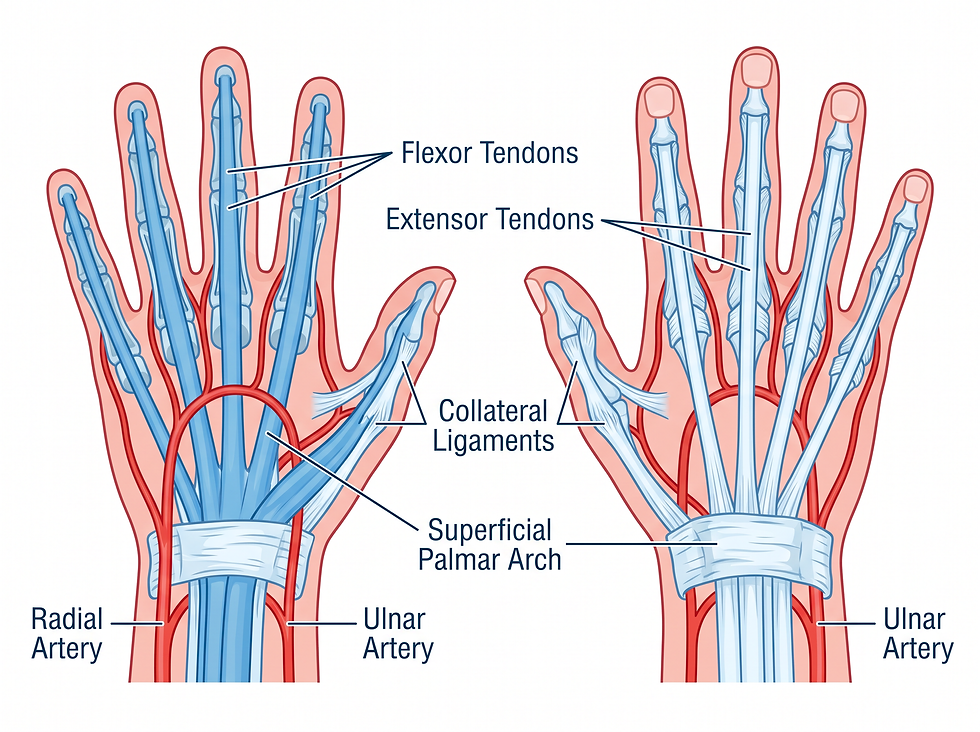
Tendons and ligaments are the "ropes" and "rubber bands" of the hand and wrist. Tendons connect muscles to bones, facilitating movement through flexion and extension. Ligaments, on the other hand, connect bones to other bones, providing the necessary stability to prevent joints from bending too far or moving out of alignment.
Blood supply is delivered through the radial and ulnar arteries, which form superficial and deep arches in the palm. These arches ensure a consistent flow of oxygenated blood to the fingers, even during strenuous activity.
"Your wrist acts like a pivot point that can move in almost any direction as you reach and flex your hand. Think about your hand and wrist like a crane game at an arcade. Your hand is the claw that grabs and holds prizes, and your wrist is the mechanical joint."
Common Conditions and Health
Due to their complexity and constant use, the hand and wrist are susceptible to various disorders. Repetitive strain, aging, and injury can lead to conditions that impair function and cause significant pain (see our guide to ulnar wrist pain).
Common issues include carpal tunnel syndrome, where the median nerve is compressed within the wrist tunnel, and various forms of arthritis that affect the joints. Tendinitis, fractures, and nerve damage are also frequently diagnosed. For overall joint health, healthcare providers recommend seeking professional advice if pain persists or worsens over time, as early intervention can often preserve long-term mobility.
Frequently Asked Questions
How many bones are in the hand and wrist?
There are a total of 27 bones: 19 in the hand and 8 in the wrist.
What is the carpal tunnel?
It is a narrow passageway in the wrist that protects tendons and the median nerve.
What are the three main nerves in the hand?
The radial, median, and ulnar nerves.
What is the difference between tendons and ligaments?
Tendons connect muscle to bone (movement), while ligaments connect bone to bone (stability).
What are thenar muscles?
These are the muscles at the base of your thumb that control its movement.
What is a power grip?
It is a type of grip used for strength, such as picking up a heavy box.
What is a precision grip?
It is a fine-motor grip used for tasks like holding a pen or turning a key.
Where is the radius bone located?
It is the larger forearm bone that connects to the thumb side of the wrist.
What does the palmar fascia do?
It is a thick tissue that helps the hand keep its shape and prevents skin from sliding.
What are sesamoid bones?
Small bones embedded in tendons that help them glide smoothly over joints.
Which arteries supply blood to the hand?
The radial and ulnar arteries.
What is the function of lumbrical muscles?
They are located at the base of the fingers and help them flex.
What causes carpal tunnel syndrome?
It occurs when the median nerve is compressed as it passes through the carpal tunnel.
What is the volar plate?
A ligament that prevents the fingers from bending too far backward.
How does the wrist act as a pivot?
Its complex joint structure allows the hand to rotate and move in multiple directions.
Medical Disclaimer
This content is for informational purposes only and does not constitute medical advice, diagnosis, or treatment. Always seek the advice of a qualified healthcare provider with any questions regarding a medical condition. Never disregard professional medical advice or delay in seeking it because of something you have read here.
Comments