Managing Vulvar Varicosities: Causes, Symptoms, and Pregnancy Care

Updated: 2 days ago
Medically reviewed by Dr. Baraa Alnahhal, MD · Last reviewed: October 2026
Vulvar varicosities are swollen veins on the external female genitals that most often develop around the third or fourth month of pregnancy. They can cause pressure and discomfort, but they should not interfere with labor, and they usually go away on their own about six weeks after delivery [1].
Quick Answer: What are vulvar varicosities?
Vulvar varicosities are varicose veins on the vulva, affecting about 20% of pregnant women. They are caused mainly by increased pelvic blood flow, pressure from the growing uterus and hormone changes. They may cause fullness, pressure, itching or pain, and usually go away after delivery. See your provider right away if a vein becomes painful, red, swollen or hard. [1]
What the research says
Research on vulvar varicosities is limited, and what exists points toward vaginal delivery being an option. A case report with a systematic review of the literature found only 11 similar cases of severe vulvovaginal varicosities in pregnancy (5 vaginal deliveries and 6 cesarean sections). The varicosities were the reason for surgery in 70% of cases, and severe complications occurred in 20% of vaginal deliveries versus 50% of cesarean sections. The varicosities disappeared about 40 days after delivery in the case reported. The authors concluded that the risk-benefit balance suggests a chance of vaginal delivery, though the evidence is limited to a handful of cases (Giannella et al., J Int Med Res, 2022 [2]).
Diagnosis is usually clinical, with ultrasound to confirm and map the veins. In a single-center series of 101 women (61 with pelvic varicose veins and 40 pregnant women with vulvar varicosities), most cases were diagnosed on clinical examination, and duplex ultrasound of the pelvic and leg veins was used to confirm varicose veins, measure vein diameter, and show retrograde flow. Treatment ranged from purely conservative measures during pregnancy to procedures on the ovarian and vulvar veins in women with pelvic varicose veins (Gavrilov, Int J Womens Health, 2017 [3]).
When veins persist, imaging should come before treatment. A review of the literature found a paucity of research on vulvar varicosities. Options include compression, sclerotherapy, embolization, and surgical ligation, but direct sclerotherapy may not be enough if pelvic or leg varicose veins are also present, and women with persistent varicosities should have imaging first. Those with chronic pelvic pain should be evaluated for pelvic congestion syndrome (Kim et al., Dermatol Surg, 2017 [4]).
What are vulvar varicosities?
Vulvar varicosities are varicose veins that appear on the vulva (the external female genitals). They are functionally similar to the varicose veins that appear on the legs. They usually show up during pregnancy, when blood volume increases significantly to support a growing fetus, and they typically appear in the third or fourth month. It is rare to get them when you are not pregnant, and this is more likely if you have varicose veins elsewhere, such as in the pelvic or groin area [1].
The bulging, bluish veins can look alarming, but vulvar varicosities are not life-threatening. They should not affect your labor or delivery, and they usually go away without treatment about six weeks after your baby is born [1].

Vulvar varicosities are swollen veins in the vulvar region of the pelvis.
What are the symptoms and common triggers of vulvar varicosities?
You may not notice any symptoms beyond the swollen veins themselves. Others have a feeling of fullness, pressure, pain, and itchiness in the vulvar region. The veins may look bluish or purplish, twisted, swollen, or bunched into a cluster, and they can appear alone or along with varicose veins in the legs, calves, or upper thighs. Not all of them hurt, but some do, so it is a good idea to tell your provider about them even if they are painless [1].
Trigger | Impact on symptoms |
Prolonged standing | Gravity makes it easier for blood to pool, so swelling and pain can get worse. |
Extended sitting or squatting | Staying in one position too long makes it easier for blood to pool in the veins. |
Sex | Pain or discomfort (dyspareunia) can get worse during sex. |
Salty foods | Salt makes you store more fluid, which stresses already swollen veins. |
Symptoms can also change with the menstrual cycle [1].
What causes vulvar varicosities and who is at risk?
Vulvar varicosities appear when the veins in your vulva struggle to circulate blood, often during pregnancy, which is the biggest risk factor. These veins move blood from the lower body and pelvis up to the heart, against gravity. When there is more blood than they can handle, it pools and the veins swell. Three changes in pregnancy make this more likely [1]:
Increased blood flow to the pelvis, which means your veins have to work harder to carry the extra blood to your heart.
A larger uterus, which adds pressure to the pelvic area and can squeeze the veins in your vulva.
Hormone changes, which can make the lining of your veins stretchier and less able to contain blood, so the veins get bigger and twisted.
Pregnancy is the biggest risk factor, but others can raise your risk [1]:
Family history of varicose veins.
Overweight: a body mass index (BMI) greater than 25 can put extra strain on your veins.
Age: veins tend to be weaker and more prone to varicose veins as you get older.
Pelvic congestion syndrome (PCS).
Standing or spending lots of time on your feet.
Experts know less about the causes in people who are not pregnant. It is likely that genetics influence how well your veins manage blood flow [1].
How are vulvar varicosities diagnosed?
Your healthcare provider will do a physical exam, and may look at your vulva while you are lying down and while you are standing. Comparing the veins without pressure (lying down) and with pressure (standing) helps. Your provider may also order imaging to check the size of your veins, track how well blood circulates, and see whether varicose veins are only in the vulva or also elsewhere in the pelvis, which helps guide treatment [1][3].
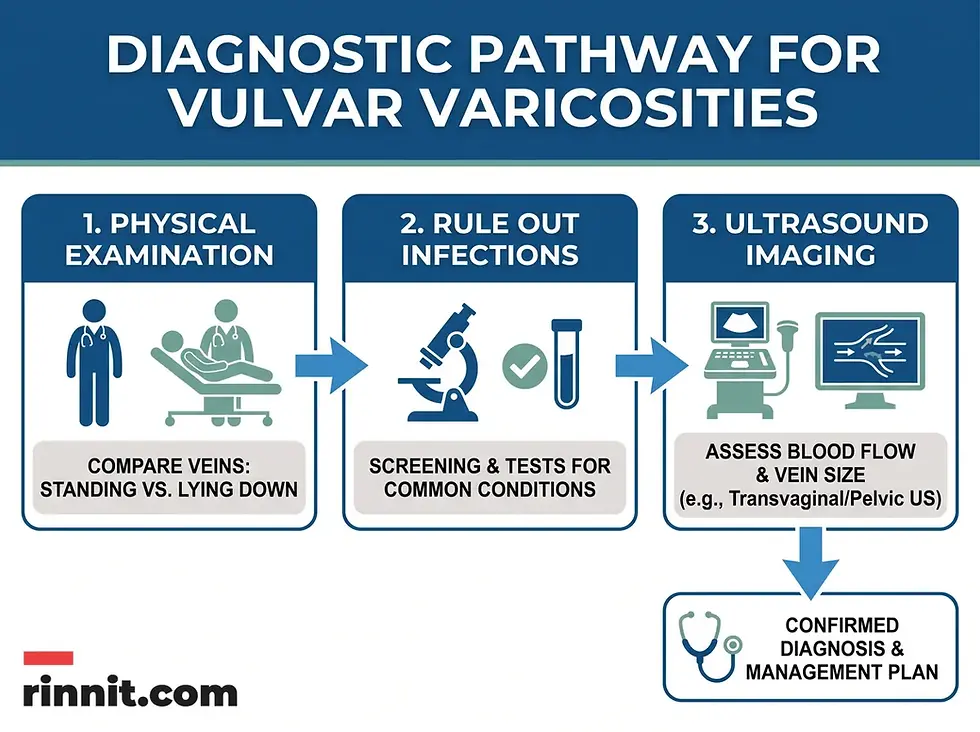
Diagnosis starts with a physical exam and may include ultrasound imaging.
How can you manage and relieve vulvar varicosities?
If you are pregnant, the veins will likely go away after your baby is born, so the best approach is usually to manage symptoms. Usually they go away about six weeks after delivery [1].
At-Home Care Checklist
Hydration: drink lots of water to help improve blood flow, at least 10 to 12 cups a day.
Positioning: lie down with your hips elevated or on your left side to take pressure off the veins in your vulva.
Cold compresses: apply them to your vulva to reduce swelling and soothe itchiness.
Support: wear a pelvic support garment designed for vulvar varicosities. It works like compression socks do for the legs by compressing the veins.
What to avoid: sitting, squatting, or standing for too long, and eating lots of salty foods.
Walking: it helps circulation, but take care not to overexert yourself, because too much activity can make the veins more painful.
Tell your provider about your symptoms so they can monitor you and watch for complications [1].

Pelvic support garments, cold compresses, and good hydration can ease symptoms during pregnancy.
How are persistent vulvar varicosities treated?
If the veins are still there a few months after you give birth, your provider will recommend treatment. If you are not pregnant, your provider will work with you to find what is likely causing the swollen veins, and treatment depends on the cause and whether other veins in the pelvis and legs are also affected. Imaging is usually done first for persistent varicosities [1][4].
Treatment type | Procedure overview |
Sclerotherapy | The most common treatment; a liquid or foam solution is injected into the veins to make them scar, close, and eventually disappear. |
Phlebectomy | Small incisions are made in the skin to remove the affected veins. |
Ligation | Tiny cuts are made to reach the veins and remove small segments of them. |
Transcatheter embolization | A catheter is used to inject materials into the blood vessels to block blood flow to the area. |
What complications can vulvar varicosities cause, and what is the outlook?
Vulvar varicosities that develop during pregnancy usually resolve, with the veins returning to normal about six weeks after delivery. Vulvar varicosities do not cause pregnancy complications, and you should be able to deliver vaginally with no risks to your baby. There are no life-threatening or long-term complications, but potential problems include [1]:
Pain and discomfort, the most common complication, which can intensify with sitting or standing and in some cases cause extreme skin irritation or ulceration.
Blood clots, if you have risk factors such as obesity or a history of blood clots.
Pelvic congestion syndrome, a chronic condition in which the veins in the vulva and genitals become so swollen that blood flow to the area is lost.
When to get help right away. Deep vein thrombosis (DVT) is a serious blood clot that is rare among people with vulvar varicosities. See your provider right away if your veins become especially painful, red, swollen, or hard to the touch [1].
Can You Prevent Them?
You cannot prevent vulvar varicosities, but you can improve your circulation overall: exercise regularly, eat healthy and nutritious foods, stay within the recommended pregnancy weight gain range, wear comfortable shoes (and avoid high heels) if you are on your feet for long periods, do not spend too much of your day seated, avoid clothing that is very tight around the groin, and elevate your feet when possible. Compression socks worn during the day or when on your feet for long periods can also help your circulation [1].
What is the bottom line on vulvar varicosities?
Vulvar varicosities can be uncomfortable and look alarming, but for most people they are temporary. Understanding your triggers and using simple measures such as hydration, left-side or hip-elevated rest, cold compresses, and a pelvic support garment can help you through the discomfort until the veins settle after your baby is born. If they persist, effective treatments are available, so let your healthcare provider know about your symptoms.
Frequently Asked Questions
Are vulvar varicosities permanent?
No. For most people they go away without treatment about six weeks after giving birth. If they are still there a few months after delivery, your provider will recommend treatment.
Can I still have a vaginal delivery?
Yes. Vulvar varicosities should not affect your labor or delivery. Rarely, a vein can burst during a vaginal delivery, but the bleeding is usually mild and your provider can control it.
Why do these veins usually appear during pregnancy?
Pregnancy increases blood flow to the pelvis, the growing uterus presses on pelvic veins, and hormone changes make vein walls stretchier. Together these make it harder for blood to return to the heart, so it pools and swells the veins.
Do I need surgery for vulvar varicosities?
Rarely. If you are pregnant, the veins will likely go away after delivery, so symptom management is usually the best approach. Procedures such as sclerotherapy are considered if the veins persist after pregnancy or cause severe symptoms.
Will compression socks help vulvar varicosities?
Compression socks help circulation in the legs, but for vulvar varicosities choose a pelvic support garment designed for them. These work like compression socks for the legs by compressing the veins, which can ease swelling and discomfort.
Is it normal for vulvar varicosities to itch?
Yes. Skin irritation and itchiness can be a symptom of vulvar varicosities, along with fullness, pressure, and pain.
Can extra weight make vulvar varicosities worse?
Having overweight (a BMI above 25) can put extra strain on your veins and raises your risk of vulvar varicosities.
What is the best sleeping position for relief?
Lying on your left side, or lying down with your hips elevated, takes pressure off the veins in your vulva.
Are there any life-threatening complications?
There are no life-threatening or long-term complications of vulvar varicosities. Pain is the most common complication, and blood clots are a possible but uncommon complication in people with risk factors such as obesity or a history of clots.
Can I prevent vulvar varicosities?
You cannot prevent them, but you can improve your overall circulation by exercising regularly, eating healthy foods, staying within the recommended pregnancy weight gain, avoiding long periods of sitting or standing, and wearing comfortable shoes.
References
Cleveland Clinic. Vulvar Varicosities. Cleveland Clinic. May 28, 2024. https://my.clevelandclinic.org/health/diseases/22127-vulvar-varicosities
Giannella L, Montanari M, Delli Carpini G, Di Giuseppe J, Ciavattini A. Huge vulvar varicosities in pregnancy: case report and systematic review. J Int Med Res. 2022;50(5):3000605221097764. PMID 35635336. https://doi.org/10.1177/03000605221097764
Gavrilov SG. Vulvar varicosities: diagnosis, treatment, and prevention. Int J Womens Health. 2017;9:463-475. PMID 28721102. https://doi.org/10.2147/IJWH.S126165
Kim AS, Greyling LA, Davis LS. Vulvar varicosities: a review. Dermatol Surg. 2017;43(3):351-356. PMID 28005626. https://doi.org/10.1097/DSS.0000000000001008
Medical disclaimer
This article is for informational purposes only and is not a substitute for professional medical advice, diagnosis, or treatment. The clinical information in this guide reflects source material last reviewed in May 2024.



Comments