MALT Lymphoma: Symptoms, Causes, and Treatment

Updated: 3 days ago
Medically reviewed by Dr. Baraa Alnahhal, MD. Last reviewed October 13, 2026. This content is for educational purposes and is not medical advice.

Quick Answer
MALT lymphoma is a slow-growing type of non-Hodgkin lymphoma that starts in B cells of the mucosa, most commonly in the stomach. Symptoms depend on its location. It is usually caused by ongoing inflammation from long-term infections, most notably H. pylori. Treatment depends on location and cause, ranging from monitoring and antibiotics to radiation and chemotherapy.
What the research says
Based on abstracts retrieved from PubMed:
Antibiotics alone can clear many early stomach cases. A meta-analysis of 61 studies (2,936 H. pylori-positive patients with early-stage gastric MALT lymphoma) found a pooled complete remission rate of 75.18% (95% CI 70.45% to 79.91%) after eradicating the bacteria. Results varied considerably between studies (Lemos et al., World J Gastroenterol, 2023).
Eradication works less often when H. pylori is not found. In a meta-analysis of 25 studies of H. pylori-negative gastric MALT lymphoma, the pooled complete remission rate after eradication therapy was 29.3% (95% CI 22.2% to 37.4%), so it can still be an initial option in a subset of patients (Jung et al., Helicobacter, 2021).
About 1 in 5 gastric cases test negative for H. pylori. A meta-analysis of 50 studies (6,033 patients) found that 20.5% (95% CI 17.0% to 24.6%) of gastric MALT lymphoma patients tested negative for H. pylori (Lv et al., Clin Transl Gastroenterol, 2025).
Key Facts at a Glance
Fact | Detail |
What it is | A slow-growing lymphoma; a type of non-Hodgkin lymphoma and, more specifically, a marginal zone lymphoma [1] |
Formal name | Extranodal marginal zone lymphoma of mucosa-associated lymphoid tissue [1] |
Where it starts | B cells in the mucosa, the moist lining inside the nose, mouth, lungs, and digestive system [1] |
Most common site | The stomach (gastric MALT lymphoma) [1] |
Other sites | Lungs, thyroid, salivary glands, eyes; rarely breasts, liver, and genitourinary organs [1] |
Typical age | Most common in people 60 and older, though it can happen at any age [1] |
Outlook | 5-year survival rate is 93% for gastric MALT and 88% for nongastric MALT [2] |
Treatment first step | Often none: monitoring when there are no symptoms [1] [2] |
What is MALT lymphoma, and where does it fit among lymphomas?
Lymphoma is cancer that affects the lymphatic system, which is part of the body's immune system. Lymphomas are usually grouped into two main types: Hodgkin lymphoma and non-Hodgkin lymphoma. MALT lymphoma is a type of non-Hodgkin lymphoma. More specifically, it is a type of marginal zone lymphoma, and it is also called extranodal marginal zone lymphoma [1].
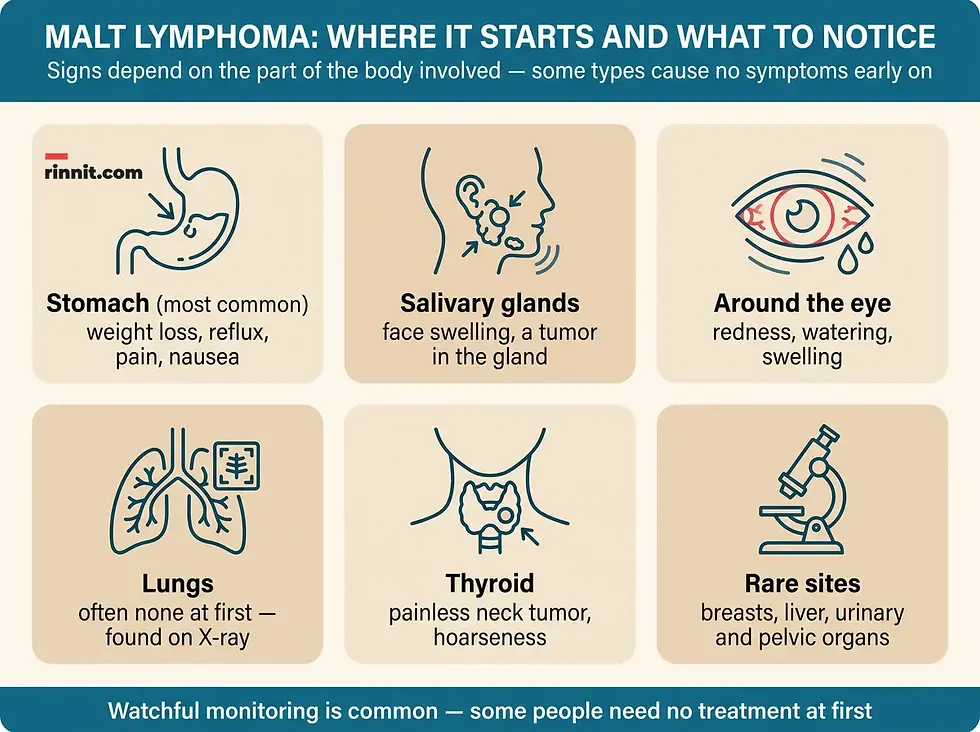
Where in the body can MALT lymphoma start?
Healthcare professionals typically place MALT lymphoma into two categories: stomach-related and not stomach-related [1].
Type | Where it starts | What it is linked to |
Stomach-related (gastric) | The stomach lining | Most common type; typically linked to an H. pylori infection, a bacteria that causes irritation and ulcers in the stomach [1] |
Small intestinal (immunoproliferative small intestinal disease) | The small intestine, sometimes beginning in the duodenum, the first short section just past the stomach | — |
Ocular adnexal | The tissues around the eye, including the tear gland | May be linked to Chlamydia psittaci infection [1] |
Salivary gland | The salivary glands, where saliva forms | Usually linked to Sjogren syndrome [1] |
Pulmonary (BALT) | The lung; also called bronchial-associated lymphoid tissue lymphoma | — |
Thyroid | The thyroid gland | Typically linked to Hashimoto's disease [1] |
Rare types | The breasts, liver, and genitourinary (GU) tract, including the bladder, prostate, kidney, and uterus | — |
What are the symptoms of MALT lymphoma?
Signs and symptoms usually depend on what part of the body is involved. In some MALT lymphoma types, there are no noticeable symptoms early on [1].
Site | Signs and symptoms |
Stomach | Weight loss; reflux (a feeling of sour liquid traveling upward in the throat); discomfort or pain in the stomach; nausea [1] |
Salivary glands | Swelling in the face; a tumor in the gland [1] |
Around the eye (ocular adnexa) | A tumor; eye redness; constant eye watering; swelling around the eye [1] |
Lungs | Often no symptoms at first; a cough or shortness of breath may develop; a small nodule or lump may appear on lung images. It is often found on a chest X-ray or other imaging test before it causes symptoms [1] |
Thyroid | A growing tumor in the neck that may be painless; trouble swallowing, eating, or drinking; hoarseness [1] |
When to See a Doctor
Make an appointment with a healthcare professional if you have symptoms that worry you or are not going away [1].
How can long-term irritation cause MALT lymphoma?
MALT lymphoma usually does not come from one single cause, and what triggers it is not always clear. It is typically linked to ongoing irritation or inflammation caused by infections. Over time, this inflammation can make certain B cells, a type of white blood cell, grow in an irregular way and turn into cancer cells [1].
A well-known example is H. pylori in the stomach. The body sends white blood cells to fight the infection. Over time, this ongoing immune system response can cause changes in some B cells and lead them to grow out of control, forming the lymphoma [1].
What are the risk factors for MALT lymphoma?
Risk factor | Details |
Ongoing infections | Long-lasting infections such as H. pylori, Chlamydia psittaci, Borrelia burgdorferi, Campylobacter jejuni, and hepatitis C [1] |
Autoimmune conditions | Conditions in which the immune system attacks the body by mistake, such as Hashimoto disease and Sjogren syndrome [1] |
Older age | MALT lymphoma can happen at any age but is most common in people 60 and older [1] |
There is no known way to prevent MALT lymphoma [1].
What complications can MALT lymphoma cause?
Complications usually depend on the type. Internal bleeding and organ damage may complicate gastric MALT lymphoma. In rare situations, a slow-growing MALT lymphoma may turn into a faster-growing type, such as diffuse large B-cell lymphoma. MALT lymphoma also might come back after treatment. This is known as a relapse, and repeated relapses can be common depending on where the lymphoma started and how advanced it is [1].
How is MALT lymphoma diagnosed?
MALT lymphoma is diagnosed starting with a physical exam, followed by tests whose samples a lab checks for cancer cell markers and DNA changes. A healthcare professional asks about symptoms, discusses medical history, and usually checks for swollen lymph nodes. From there, several tests may follow [2]:
Test | What it involves |
Blood tests | Sometimes show whether lymphoma cells are present; also check for infections that increase risk, such as hepatitis C [2] |
Imaging tests | CT scans and PET scans show the location and extent of the lymphoma, and whether cells have spread [2] |
Biopsy | Removing a tissue sample from the affected organ and testing it in a lab to confirm MALT lymphoma [2] |
Bone marrow aspiration and biopsy | A needle draws fluid (aspiration) or collects solid tissue (biopsy), usually from the hip bone; in MALT lymphoma this helps determine the cancer's extent [2] |
Upper endoscopy | If stomach MALT lymphoma is suspected: a long, flexible tube with a tiny camera is passed down the throat to examine the esophagus, stomach, and the start of the small intestine (the duodenum) for signs of cancer [2] |
What the Lab Looks For
Cells collected from an endoscopy, lymph node biopsy, or bone marrow procedure go to a lab for specialized testing. Lab professionals look for proteins on the surfaces of the cancer cells, called markers, and changes in the cancer cells' DNA, since those changes can cause the cells to multiply rapidly. The results help confirm whether the cells are MALT lymphoma cells [2].

What are the treatment options for MALT lymphoma?
Not all people with MALT lymphoma need treatment at first. If there are no symptoms, healthcare professionals will typically monitor their patients. MALT lymphoma is often treatable, but it is not always curable. Treatment depends on its stage, the type, and the part of the body where it is located [2].
Treating the Underlying Infection
In certain MALT lymphoma types, medicine is given to treat the underlying infection. In gastric MALT lymphoma, antibiotic medicine is given to treat the H. pylori infection [2].
Radiation Therapy
Radiation therapy treats cancer with powerful energy beams. For MALT lymphoma, the energy beams are most often X-rays or electrons [2].
Medicines
Medicine | How it works |
Chemotherapy | Treats cancer with strong medicines that kill the cancer cells [2] |
Targeted therapy | Uses medicines that attack specific chemicals in the cancer cells; blocking these chemicals can cause the cancer cells to die [2] |
Immunotherapy | Uses medicine that helps the body's immune system kill cancer cells. Cancer cells survive by hiding from the immune system, and immunotherapy helps immune cells find and kill them [2] |
Bone Marrow Transplant
A bone marrow transplant, also called a bone marrow stem cell transplant, involves putting healthy bone marrow stem cells into the body. These cells replace cells hurt by chemotherapy and other treatments. It is not used often, but it might be used when MALT lymphoma is far along or comes back after other treatments [2].
What is the outlook for MALT lymphoma?
MALT lymphoma usually is a slow-growing lymphoma, and it has a better outcome when it is found early. The five-year survival rate for gastric MALT lymphoma is 93%. For nongastric MALT lymphoma, the five-year survival rate is 88%. The cancer typically gets harder to treat as the stage advances, and it can be harder to treat if it turns into a faster-growing type, such as diffuse large B-cell lymphoma [2].
How can people with MALT lymphoma cope and find support?
Learning that you have MALT lymphoma can be hard. With time, you will find ways to cope that work for you. Learn enough about your cancer to feel comfortable making decisions about your treatment and care, and ask your care team to recommend good sources of information. Finding a good listener, such as a friend, family member, counselor, medical social worker, or clergy member, can help, and support groups, including online communities, offer practical information and answers to everyday questions [2].
How should you prepare for a MALT lymphoma appointment?
Start by making an appointment if you have symptoms that worry you or are not going away. Ask whether anything is needed before the visit, for example fasting before a test. Prepare a list of your symptoms including any that seem unrelated and when they began, key personal information such as major stresses and family medical history, all medicines, vitamins, and supplements with doses, and the questions you want to ask. Bring a family member or friend to help remember the information you are given [2].
Conclusion and Next Steps
MALT lymphoma is a slow-growing cancer that begins quietly, in the immune cells of the body's moist linings, often after years of irritation from an infection such as H. pylori. Because it grows slowly, rushing into treatment is not always the answer: monitoring, targeted antibiotics, localized radiation, or modern cell-directed medicines are all part of a plan that depends on where the disease sits and how far it has gone. The outlook is encouraging, as most people with gastric MALT lymphoma and the great majority with MALT lymphoma elsewhere live at least five years beyond diagnosis. The first step, as always, is a conversation with a healthcare professional.
Take action: If you have symptoms that worry you or are not going away, especially unexplained weight loss, persistent stomach discomfort, a growing neck lump, or swelling around an eye, make an appointment with a healthcare professional. Keep up with routine exams, and treat persistent infections such as H. pylori promptly.
Frequently Asked Questions
What is MALT lymphoma?
MALT lymphoma is a slow-growing type of non-Hodgkin lymphoma, specifically a marginal zone lymphoma, that starts in infection-fighting B cells within the mucosa, the moist tissue lining the nose, mouth, lungs, and digestive system.
Is MALT lymphoma curable?
MALT lymphoma is often treatable, but it is not always curable. Many cases can be managed very effectively, especially when found early, and some people need no treatment at all in the early stages.
What is the survival rate for MALT lymphoma?
The five-year survival rate is 93% for gastric (stomach) MALT lymphoma and 88% for nongastric MALT lymphoma. The outlook is better when the disease is found early.
What causes MALT lymphoma?
It is not always clear, but it is typically linked to ongoing irritation or inflammation caused by long-term infections, most notably H. pylori in the stomach. Over time, this inflammation can cause B cells to grow irregularly and turn into cancer cells.
How is MALT lymphoma treated?
Not everyone needs treatment at first, and monitoring is common when there are no symptoms. Treatment may include antibiotics for H. pylori-linked stomach cases, radiation therapy, chemotherapy, targeted therapy, immunotherapy, and, in rare advanced or returning cases, bone marrow transplant.
Trusted External Resources
Blood Cancer United: Marginal Zone Lymphoma
Related Reading
H. pylori Tests: Breath, Stool, Blood and Endoscopy Explained explains the breath, stool, blood and endoscopy tests used to find H. pylori infection.
References
Mayo Clinic Staff. Extranodal marginal zone lymphoma of mucosa-associated lymphoid tissue (MALT) - Symptoms and causes. Mayo Clinic. May 8, 2026. https://www.mayoclinic.org/diseases-conditions/malt-lymphoma/symptoms-causes/syc-20600491
UpToDate. Treatment of extranodal marginal zone lymphoma of mucosa-associated lymphoid tissue (MALT lymphoma); and Clinical manifestations, pathologic features, and diagnosis of extranodal marginal zone lymphoma of mucosa-associated lymphoid tissue (MALT). UpToDate. Accessed October 30, 2026. https://www.uptodate.com/contents/treatment-of-extranodal-marginal-zone-lymphoma-of-mucosa-associated-lymphoid-tissue-malt-lymphoma; https://www.uptodate.com/contents/clinical-manifestations-pathologic-features-and-diagnosis-of-extranodal-marginal-zone-lymphoma-of-mucosa-associated-lymphoid-tissue-malt
Zucca E, Arcaini L, Buske C, et al. Marginal zone lymphomas: ESMO Clinical Practice Guidelines for diagnosis, treatment and follow-up. Ann Oncol. 2020;31(1):17-29. PMID 31912792. https://doi.org/10.1016/j.annonc.2019.10.010
Walewska R, Eyre TA, Barrington S, et al. Guideline for the diagnosis and management of marginal zone lymphomas: A British Society of Haematology Guideline. Br J Haematol. 2024;204(1):86-107. PMID 37957111. https://doi.org/10.1111/bjh.19064
Rossi D, Bertoni F, Zucca E. Marginal-Zone Lymphomas. N Engl J Med. 2022;386(6):568-581. PMID 35139275. https://doi.org/10.1056/NEJMra2102568
Blood Cancer United. Marginal Zone Lymphoma. Blood Cancer United. May 31, 2022. https://bloodcancerunited.org/resources/educational-resources/publications/booklet/marginal-zone-lymphoma
Lemos FFB, de Castro CT, Calmon MS, et al. Effectiveness of Helicobacter pylori eradication in the treatment of early-stage gastric mucosa-associated lymphoid tissue lymphoma: An up-to-date meta-analysis. World J Gastroenterol. 2023;29(14):2202-2221. PMID 37122607. https://doi.org/10.3748/wjg.v29.i14.2202
Jung K, Kim DH, Seo HI, Gong EJ, Bang CS. Efficacy of eradication therapy in Helicobacter pylori-negative gastric mucosa-associated lymphoid tissue lymphoma: A meta-analysis. Helicobacter. 2021;26(2):e12774. PMID 33400830. https://doi.org/10.1111/hel.12774
Lv XH, Lu Q, Liu JH, et al. Proportion and Characteristics of Helicobacter Pylori-Negative Gastric Mucosa-Associated Lymphoid Tissue Lymphoma: A Systematic Review and Meta-Analysis. Clin Transl Gastroenterol. 2025;16(4):e00781. PMID 39450888. https://doi.org/10.14309/ctg.0000000000000781



Comments