Listeria Infection (Listeriosis): Symptoms, Causes, Foods, and Treatment

Updated: 1 day ago
Medically reviewed by Dr. Baraa Alnahhal, MD · Last reviewed: October 2026
Listeria infection (listeriosis) is a foodborne illness caused by bacteria found in soil, water, and animal waste. Most healthy people have only mild stomach symptoms that pass in a few days. But for pregnant women, adults over 65, and people with weakened immune systems, it can cause sepsis, meningitis, and lifelong damage to newborns. The bacteria survive refrigeration and freezing, and they can hide in soft cheeses, deli meats, cold-smoked fish, unpasteurized milk, sprouts, and cut melons. Prompt antibiotics treat serious cases, and careful food-safety habits help prevent infection [1].
Quick Answer: What is listeria infection?
Listeria infection, also called listeriosis, is a bacterial illness spread through contaminated foods such as soft cheeses, deli meats and unpasteurized dairy. Most healthy people have only mild stomach symptoms, but it becomes dangerous when it spreads to the bloodstream or brain. Pregnant women, older adults and people with weakened immunity face the highest risk. Serious cases need antibiotics. [1] [2]
What the research says
Listeriosis is uncommon worldwide but severe, and about a fifth of cases are perinatal. A systematic review and meta-analysis of 87 eligible studies estimated that listeriosis caused 23,150 illnesses (95% credible interval 6,061 to 91,247) and 5,463 deaths (1,401 to 21,497) worldwide in 2010, and that perinatal cases made up 20.7% of the total. Incidence data were missing for several WHO regions, so the true burden is uncertain (de Noordhout et al., Lancet Infect Dis, 2014 [3]).
Pregnant people and older adults account for most invasive cases. In US FoodNet surveillance from 2004 to 2009, 762 invasive listeriosis cases were identified: 17% were pregnancy-associated and 53% were in people aged 65 or older who were not pregnant. Eighteen percent of all cases were fatal, meningitis was diagnosed in 44% of neonates, and the incidence of non-pregnancy-associated listeriosis in adults aged 65 or older was 4 to 5 times the overall rate (Silk et al., Clin Infect Dis, 2012 [4]).
Cancer and organ failure strongly predicted death in invasive listeriosis. In a French national prospective cohort of 818 cases, including 427 with bacteremia and 252 with neurolisteriosis, the strongest 3-month mortality predictors for both bacteremia and neurolisteriosis were ongoing cancer (odds ratio 5.19, 95% CI 3.01 to 8.95) and multi-organ failure (odds ratio 7.98, 95% CI 4.32 to 14.72) (Charlier et al., Lancet Infect Dis, 2017 [5]).
Listeria in pregnancy rarely ends without complications. In the same French national cohort, only 5% of 107 pregnant women had an uneventful outcome, and 24% lost their pregnancy (Charlier et al., Lancet Infect Dis, 2017 [5]).
Pregnancy infections usually occur late. A review covering 487 patients found that listeriosis in pregnancy occurred most often in the third trimester (66%) rather than the first (3%) (Khsim et al., BJOG, 2022 [6]).
What Is Listeria Infection?
Listeria infection is an illness caused by bacteria that can spread through many foods. Another name for the illness is listeriosis [1].
The bacteria behind this illness have an unusual ability: they can survive refrigeration and even freezing. Most foodborne bacteria stop multiplying when food gets cold, but listeria does not, which is why it can hide in chilled deli meats, cold cheeses, and refrigerated spreads [1].
Some foods are more likely to be tainted by the bacteria than others. These include soft cheeses, deli meats, and dairy products that have not been treated to kill bacteria through pasteurization [1].
Key fact: healthy people rarely become very ill from listeria infection. But the disease can be fatal to unborn babies, newborns, and people with weakened immune systems. Prompt antibiotic treatment can help curb the effects [1].
Key point | What the evidence shows |
Common name | Listeriosis |
Source of the bacteria | Soil, water, animal waste, contaminated foods |
Usual effect on healthy people | Rarely severe; mild stomach symptoms |
High-risk groups | Pregnant women, adults over 65, weakened immune systems |
Most dangerous outcomes | Death of unborn babies, newborns, immunocompromised people |
Main treatment | Prompt antibiotics for serious cases |
Unusual trait | Survives refrigeration and freezing |

Listeria is rarely severe in healthy adults but can be life-threatening for high-risk groups.
What are the symptoms of listeria infection (listeriosis)?
Symptoms of a listeria infection partly depend on where in the body the infection happens. The illness behaves very differently in the gut than when the bacteria enter the blood and nervous system [1].
Gut Symptoms
If the infection stays in the gut, you might have:
Diarrhea (loose stools)
Upset stomach
Vomiting
These gut symptoms often start within a day of eating tainted food. They tend to go away within a few days [1].
Bloodstream and Brain Symptoms
The bacteria that cause listeria infection can also spread through the blood and into the brain and spinal cord. When this happens, symptoms can include:
Fever and chills
Flu-like symptoms such as muscle aches and fatigue
Diarrhea or an upset stomach
Headache
Stiff neck
Confusion or changes in alertness
Loss of balance
Seizures
These symptoms often start within two weeks of eating tainted food. But it can take up to two months for symptoms to begin, which makes the connection to a specific meal harder to trace [1].
Symptom group | Typical signs | When symptoms start | How long they last |
Gut infection | Diarrhea, upset stomach, vomiting | Within a day of eating tainted food | A few days |
Blood and brain infection | Fever, chills, muscle aches, fatigue, headache, stiff neck, confusion, loss of balance, seizures | Within two weeks; up to two months | Requires medical treatment |
Pregnancy (mother) | Usually only mild symptoms | Varies | Mild illness in the mother; serious risk to the baby |
Newborn | Little interest in feeding, crankiness, fever or low temperature, vomiting, breathing trouble, low energy, low birth weight | Within days of birth | Can be life-threatening |
Symptoms During Pregnancy and in Newborns
During pregnancy, a listeria infection is likely to cause only mild symptoms in the pregnant person. But the effects on the baby can be devastating. The baby can die in the womb or have a life-threatening infection within a few days of birth [1].
Symptoms of a listeria infection in a newborn can be subtle. They can include [1]:
Little interest in feeding
Crankiness
Fever or low temperature (hypothermia)
Vomiting
Trouble breathing
Little to no energy
Low birth weight
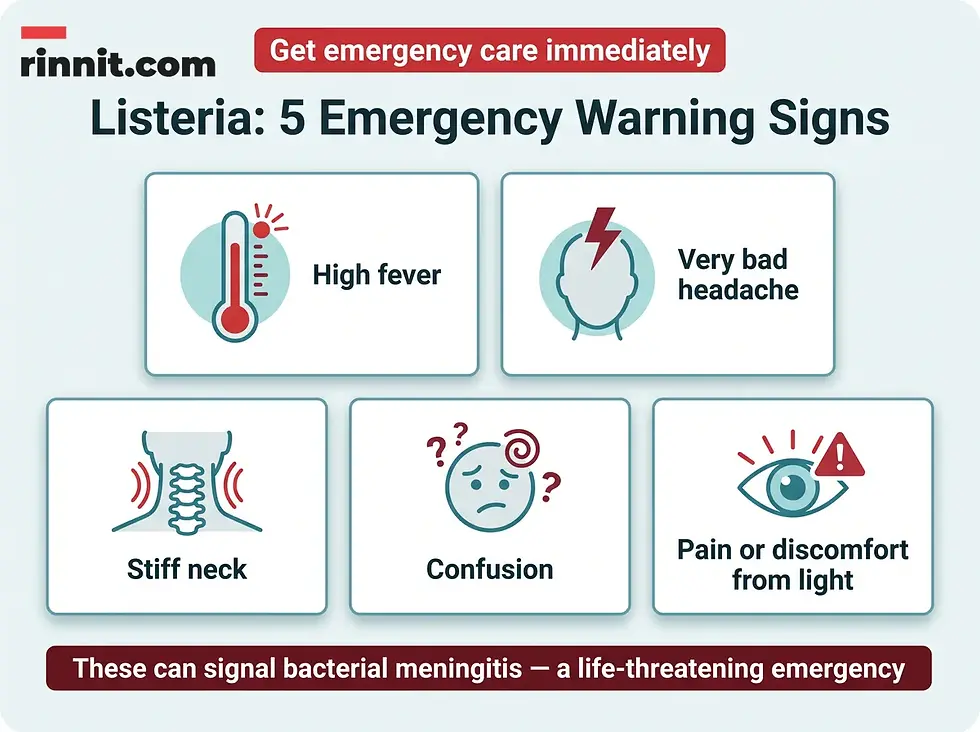
Seek emergency care for these warning signs, which can point to bacterial meningitis.
When should you see a doctor for listeria infection?
If you have eaten a food that was recalled because of a listeria outbreak, watch for symptoms of illness. Call your healthcare professional if you have a fever, muscle aches, upset stomach, or loose stools. The same goes for illness after eating foods that might be tainted, such as foods made with unpasteurized milk or poorly heated hot dogs or deli meats. Tell your healthcare professional what you ate [1].
Emergency Warning Signs
Get emergency care if you have any of the following [1]:
Emergency sign | Why it matters |
High fever | Can signal a systemic blood infection |
Very bad headache | A sign of nervous system involvement |
Stiff neck | A classic sign of meningitis |
Confusion | Shows the brain is affected |
Discomfort or pain due to light | Another meningitis sign |
These could be symptoms of a life-threatening condition that can happen with a listeria infection, called bacterial meningitis [1].
What Causes Listeria Infection?
Listeria bacteria can be found in soil, water, and animal waste (stool). People become infected by eating foods that picked up the bacteria on the way from farm to table [1]. Common infection sources include:
Raw vegetables tainted from the soil or the manure used as fertilizer
Tainted meat
Raw milk or foods made with unpasteurized milk
Processed foods such as soft cheeses, hot dogs, and deli meats that become tainted after processing
Cold-smoked fish such as nova or lox
Sprouts
Melons
Pregnant people with listeria infections can pass the infection to their unborn babies. This is a risk even if the pregnant person has no symptoms of the infection [1].
Food category | Examples | How it gets tainted |
Soft cheeses | Feta, brie, Camembert, blue cheese, queso blanco, queso fresco | Bacteria introduced after processing |
Deli meats and hot dogs | Packaged cold cuts, franks | Contamination after processing |
Unpasteurized dairy | Raw milk, raw-milk cheeses | No heat treatment to kill bacteria |
Cold-smoked fish | Nova, lox, kippered | Cold smoking doesn't cook the fish |
Raw produce | Sprouts, raw vegetables, melons | Soil or manure fertilizer |
Meat | Tainted meat of any kind | Processing environment |

Soft cheeses, deli meats, unpasteurized milk, cold-smoked fish, sprouts, and cut melon are the foods most likely to carry listeria.
Who is at risk of listeria infection?
Pregnant women, people older than 65, and people with weak immune systems are at the highest risk of serious listeria infection [1].
Pregnant Women and Their Babies
Pregnant women are much more prone to listeria infections than other healthy adults. The infection might cause only mild illness in the mother, but the risks to the pregnancy include [1]:
Pregnancy risk | Description |
Miscarriage | Loss of the pregnancy |
Stillbirth | Baby dies in the womb |
Premature birth | Baby born before full term |
Newborn infection | Life-threatening infection within days of birth |
People with Weakened Immune Systems
This group includes people who are older than 65, or who have conditions such as cancer, diabetes, kidney or liver disease, autoimmune diseases, alcohol use disorder, and HIV or AIDS. It also includes people who get chemotherapy to treat cancer, take high-dose steroid medicines, or take treatments that lower the immune system, such as some medicines for rheumatoid arthritis and medicines that block rejection of a transplanted organ [1].
Risk factor | Why it raises danger |
Pregnancy | Much more prone to infection; the bacteria can pass to the baby |
Age over 65 | Naturally weaker immune defense |
Cancer, diabetes, kidney or liver disease | Compromised body defenses |
Autoimmune diseases | Altered immune response |
Alcohol use disorder | Weakens immunity |
HIV or AIDS | Severely reduced immune function |
Chemotherapy | Lowers immune defenses |
High-dose steroids | Suppress immune activity |
Immune-lowering drugs | Rheumatoid arthritis medicines, transplant rejection medicines |
What complications can listeria infection cause?
Many listeria infections are mild, and some infected people do not have any symptoms at all. But sometimes the infection leads to serious medical problems or emergencies. These risks rise if treatment is delayed or not given [1].
A listeria infection of the bloodstream can trigger an improper body reaction called sepsis, which can lead to organ damage or death. A listeria infection of the nervous system can lead to:
Trouble with balance, walking, or coordination
Trouble moving one side of the body
Nerve problems
Hearing loss
Seizures
Death
Babies with life-threatening listeria infections of the blood or brain might develop lifelong conditions, such as:
Intellectual disabilities
Paralysis
Seizures
Blindness
Conditions that affect the brain, kidneys, or heart
Complication type | Possible outcomes |
Sepsis (bloodstream) | Organ damage, death |
Nervous system infection | Balance problems, one-sided weakness, nerve damage, hearing loss, seizures, death |
Newborn blood/brain infection | Intellectual disabilities, paralysis, seizures, blindness, brain/kidney/heart conditions |
How is listeria infection diagnosed?
Healthcare professionals most often do a blood test to find out whether you have the infection. Depending on your symptoms, other samples might be tested as well. If you are pregnant, the fluid that surrounds your baby during pregnancy might also be tested [2].
Test | When it is used |
Blood test | The standard test for most suspected cases |
Spinal fluid test | When symptoms suggest the infection reached the brain and spinal cord |
Amniotic fluid test | For pregnant women, the fluid surrounding the baby might also be tested |
Complete blood count (CBC) | Supporting blood analysis |
Lumbar puncture (spinal tap) | Collects spinal fluid for testing |
How is listeria infection treated?
Treatment of listeria infection varies and depends on how serious the symptoms are [2].
Situation | Treatment approach |
Mild symptoms | No treatment needed for most people; most recover on their own |
Serious infection | Antibiotics to clear the bacterial infection |
Pregnancy | Prompt antibiotics to help keep the infection from affecting the baby |
More-serious infections are treated with medicines that clear up bacterial infections, called antibiotics. During pregnancy, prompt antibiotic treatment might help keep the infection from affecting the baby, which is why early medical attention matters so much for this group [2].
How can you prevent listeria infection?
Food-safety habits are the main defense against listeria infection, because listeria survives refrigeration and freezing. Follow these guidelines [1]:
Keep things clean. Wash your hands with warm, soapy water before and after handling or preparing food. Scrub well for at least 20 seconds. After cooking, wash utensils, cutting boards, and surfaces with hot, soapy water.
Scrub raw vegetables. Clean them with a scrub brush under plenty of running water before eating, peeling, cutting, or cooking.
Do not rinse raw meat or poultry. This helps prevent bacteria from spreading to other kitchen surfaces.
Cook food thoroughly. Use a food thermometer to confirm meat, poultry, and egg dishes reach a safe temperature.
Refrigerate food. Set your refrigerator to 40°F or below and your freezer to 0°F or lower.
Extra Precautions for High-Risk People
If you are pregnant or have a weak immune system, take added safety measures with these foods [1]:
High-risk food | Safe approach |
Soft cheeses (feta, brie, Camembert, blue) | Avoid entirely, even if made with pasteurized milk |
Mexican-style cheeses (queso blanco, queso fresco) | Avoid entirely, even if made with pasteurized milk |
Hot dogs and deli meats | Only eat reheated until steaming hot; use opened hot dog packages within 1 week and closed ones within 2 weeks; use opened deli meats within 3 to 5 days |
Refrigerated meat spreads | Avoid; canned and shelf-stable spreads are OK (refrigerate after opening) |
Smoked seafood (nova, lox, kippered, jerky) | OK in cooked dishes; canned or shelf-stable versions are OK |
Sprouts | Cook thoroughly; never eat raw or lightly cooked |
Cut melon | Eat right away or refrigerate at 41°F or lower and use within 7 days; discard if left out over 4 hours |
Raw (unpasteurized) milk and products | Avoid entirely; only use products labeled "pasteurized" |
Keeping package fluid from hot dogs away from other foods, utensils, and prep surfaces, plus washing your hands after handling these products, adds another layer of protection [1].
How should you prepare for a listeria infection appointment?
If you have eaten food that has been recalled because of listeria contamination, be aware of the symptoms listed above and see a healthcare professional if you have any of them [2].
What You Can Do
Before your checkup, write a list that answers the following questions:
What are your symptoms and when did they start?
Are you pregnant? If so, how far along are you?
Are you being treated for other medical conditions?
What medicines and supplements do you take?
You also might want to write a food diary. List all the foods you have eaten for as far back as you can remember, and tell your healthcare professional if any foods you ate have been recalled [2].
What to Expect From Your Doctor
Your healthcare professional might ask whether you have recently eaten [2]:
Soft cheeses such as brie, Camembert, or feta
Mexican-style cheeses such as queso blanco or queso fresco
Raw milk or cheeses made from raw milk
Processed meats such as hot dogs or deli meats
Any foods that have been recalled
What is the bottom line on listeria infection?
Listeria infection is a rare but serious foodborne illness whose danger depends heavily on who is exposed. Healthy adults typically face only a few days of stomach upset. But for pregnant women, adults over 65, and people with weakened immune systems, the same bacteria can cause sepsis, meningitis, miscarriage, and lifelong disability in newborns. The bacteria's ability to survive cold temperatures makes it a persistent threat in refrigerated foods like deli meats, soft cheeses, and smoked fish.
Know your risk, know your food, and act fast. If you are in a high-risk group, avoid the foods listed above, follow strict kitchen hygiene, and reheat deli meats until steaming. If you develop a fever, stiff neck, severe headache, or confusion after eating a recalled or risky food, seek emergency care immediately. Early antibiotic treatment can make the difference between a mild illness and a life-threatening one.
If you found this guide helpful, share it with someone in a high-risk group: a pregnant friend, an older parent, or a loved one managing a chronic condition. One careful habit can prevent a dangerous infection.
Frequently Asked Questions
What is listeria infection?
Listeria infection, also called listeriosis, is a bacterial illness spread through contaminated foods such as soft cheeses, deli meats, and unpasteurized dairy. The bacteria is found in soil, water, and animal waste, and it can survive refrigeration and freezing.
What are the symptoms of listeria infection?
Gut symptoms include diarrhea, upset stomach, and vomiting starting within a day of eating tainted food. If the bacteria spreads to the brain and spinal cord, symptoms include fever, chills, stiff neck, severe headache, confusion, loss of balance, and seizures.
How long after eating contaminated food do listeria symptoms appear?
Gut symptoms often start within a day and clear within a few days. Symptoms from a bloodstream or brain infection usually begin within two weeks but can take up to two months to appear.
Is listeria infection dangerous?
Listeria infection is rarely severe in healthy people. However, it can be fatal to unborn babies, newborns, and people with weakened immune systems, and it can cause meningitis and sepsis.
Who is most at risk for listeria infection?
Pregnant women, adults over 65, and people with weakened immune systems face the highest risk. Pregnant women are much more prone to infection than other healthy adults.
Can listeria affect my pregnancy?
Yes. While the mother usually has only mild symptoms, the infection can cause miscarriage, stillbirth, premature birth, or a life-threatening infection in the baby within days of birth.
How is listeria infection diagnosed?
Healthcare professionals most often use a blood test. Spinal fluid may also be tested if the infection may have reached the nervous system, and the fluid surrounding the baby may be tested during pregnancy.
How is listeria infection treated?
Most people with mild symptoms need no treatment. Serious infections are treated with antibiotics. During pregnancy, prompt antibiotics may help prevent the infection from reaching the baby.
What foods are most likely to contain listeria?
Soft cheeses, deli meats, hot dogs, unpasteurized milk and products, cold-smoked fish such as lox, sprouts, melons, and raw vegetables contaminated from soil or manure.
How do I prevent listeria infection?
Wash hands and produce thoroughly, cook food to safe temperatures, refrigerate at 40°F or below, avoid unpasteurized milk, reheat deli meats until steaming, and if you are pregnant or immunocompromised, avoid soft cheeses and eat smoked seafood only in cooked dishes or as canned or shelf-stable products.
Trusted External Resources
References
Mayo Clinic. Listeria infection - Symptoms & causes. Mayo Clinic. December 17, 2025. https://www.mayoclinic.org/diseases-conditions/listeria-infection/symptoms-causes/syc-20355269
Mayo Clinic. Listeria infection - Diagnosis & treatment. Mayo Clinic. December 17, 2025. https://www.mayoclinic.org/diseases-conditions/listeria-infection/diagnosis-treatment/drc-20355275
de Noordhout CM, Devleesschauwer B, Angulo FJ, et al. The global burden of listeriosis: a systematic review and meta-analysis. Lancet Infect Dis. 2014;14(11):1073-1082. PMID 25241232. https://doi.org/10.1016/S1473-3099(14)70870-9
Silk BJ, Date KA, Jackson KA, et al. Invasive listeriosis in the Foodborne Diseases Active Surveillance Network (FoodNet), 2004-2009: further targeted prevention needed for higher-risk groups. Clin Infect Dis. 2012;54 Suppl 5:S396-S404. PMID 22572660. https://doi.org/10.1093/cid/cis268
Charlier C, Perrodeau É, Leclercq A, et al. Clinical features and prognostic factors of listeriosis: the MONALISA national prospective cohort study. Lancet Infect Dis. 2017;17(5):510-519. PMID 28139432. https://doi.org/10.1016/S1473-3099(16)30521-7
Khsim IEF, Mohanaraj-Anton A, Horte IB, et al. Listeriosis in pregnancy: An umbrella review of maternal exposure, treatment and neonatal complications. BJOG. 2022;129(9):1427-1433. PMID 34954888. https://doi.org/10.1111/1471-0528.17073
Medical disclaimer
This article is for informational purposes only and is not a substitute for professional medical advice, diagnosis, or treatment. The clinical information in this guide reflects source material last reviewed in December 2025.



Comments