Lichen Nitidus: Understanding Symptoms, Causes, and Skin Care

Updated: 2 days ago
Medically reviewed by Dr. Baraa Alnahhal, MD · Last reviewed: October 2026
Lichen nitidus is a rare, non-contagious skin disorder that causes small, shiny, skin-colored or white bumps. It usually develops in children and young adults, most cases need no treatment, and the bumps often clear on their own within several months to a year, usually without scarring. Doctors don't know what causes it, but corticosteroids or phototherapy are options when symptoms such as itching are bothersome [1].
Quick Answer: What is lichen nitidus?
Lichen nitidus is an uncommon skin disorder that causes tiny, shiny, skin-colored or white bumps, most often on the abdomen, chest, forearms and hands. It is not contagious, usually affects children and young adults, and its cause is unknown. Many people have no symptoms. Most cases last several months to one year and need no treatment. [1]
What the research says
In children, lichen nitidus is often generalized and affects boys more often. In a single-center series of 17 children with biopsy-proven lichen nitidus, the mean age at onset was 9 years, the mean duration of lesions was 13 months, 15 (88.2%) were boys, 7 (41.1%) had a generalized form, and 2 (11.8%) had severe itching; the series is small, so the findings are descriptive (Kundak and Çakır, Pediatr Dermatol, 2019 [2]).
Another light-sensitive rash can look like lichen nitidus. In a retrospective review of 844 people with polymorphous light eruption, the pinpoint papular variant was seen mostly in people with dark skin, and the authors note that it can be mistaken for lichen nitidus, which is one reason a careful diagnosis matters (Maghfour et al., Photodermatol Photoimmunol Photomed, 2023 [3]).
What Is Lichen Nitidus?
Lichen nitidus is an uncommon skin disorder that causes small, shiny papules (bumps) to form on the skin's surface. The bumps are usually skin-colored or white and can develop on any part of the body. It usually develops in children and young adults, but it can also affect mature adults [1].
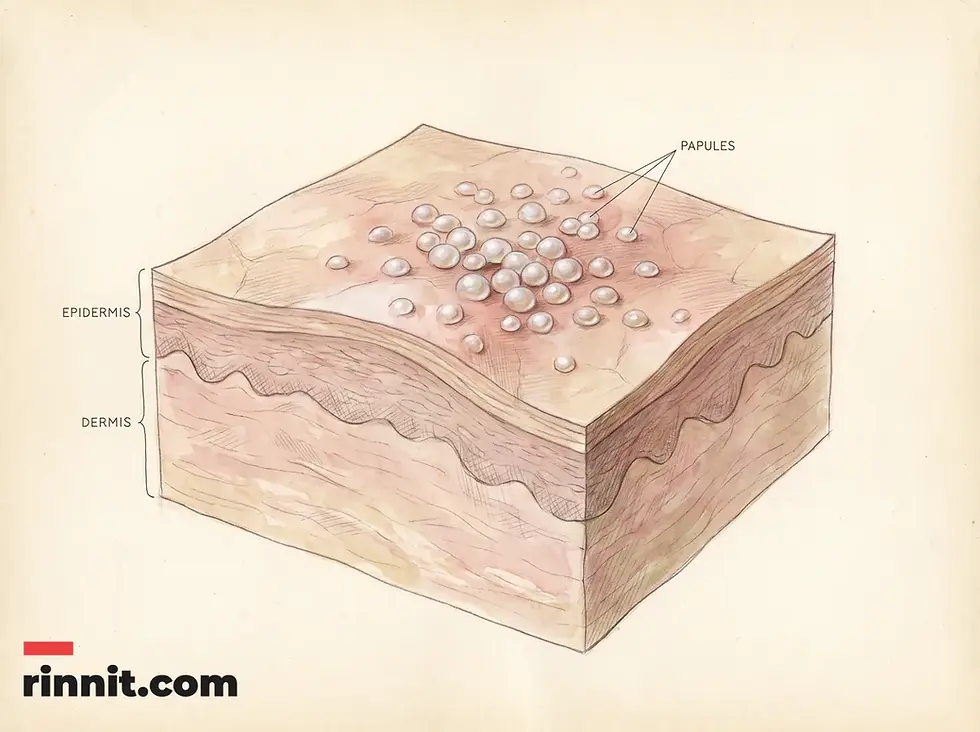
Lichen nitidus papules are tiny, shiny, dome-shaped bumps on the skin's surface.
Lichen nitidus is not contagious and can't be spread by skin-to-skin contact. The bumps may cause worry about appearance, but the condition does not cause medical complications, and most cases don't require treatment [1].
What are the signs and symptoms of lichen nitidus?
The bumps can appear anywhere on the body. They can form in groups or be randomly spaced, and in some cases they appear along the line of a scratch (the Koebner response) [1].
Symptom category | Common manifestations |
|---|---|
Primary sign | Small, shiny, skin-colored or white bumps (papules). |
Distribution | Most often on the abdomen, backs of the hands, buttocks, chest, forearms, and penis. |
Physical sensation | Often no symptoms, but extreme itching can occur. |
Additional changes | Nail pits and ridges, or grey or white papules inside the mouth. |

Common locations for lichen nitidus include the abdomen, chest, and forearms.
What causes lichen nitidus, and who is at risk?
Doctors don't know what causes lichen nitidus, though children and young adults are at higher risk. At one point it was thought to be a type of lichen planus, another inflammatory skin condition [1]. Key points about who gets it:
Age: children and young adults are at higher risk [1].
Demographics: because the condition is rare, conclusions vary. Some sources suggest it affects males more often than females and African Americans more often than Caucasians, while others say ethnicity and sex do not matter [1].
Prevention: lichen nitidus can't be prevented [1].
How is lichen nitidus diagnosed?
A doctor diagnoses lichen nitidus by examining the appearance and location of the skin bumps [1]. To confirm the diagnosis, your doctor or your child's doctor may use a skin biopsy, in which a small sample of skin tissue is removed and studied under a microscope [1].

A skin biopsy removes a small sample of skin for examination under a microscope.
How is lichen nitidus managed and treated?
Most cases of lichen nitidus do not require treatment, and the condition often goes away on its own [1].
Observation and Recovery
Most cases last several months to one year. Lichen nitidus usually does not cause long-term scarring or changes to the color of the skin [1].
Medical Interventions for Symptoms
In some cases, doctors manage symptoms with the following [1]:
Corticosteroids: medicines that lessen swelling.
Phototherapy: a procedure that delivers ultraviolet (UV) light into your skin.
How can people live with lichen nitidus?
Most people with lichen nitidus do not have to change their activities while the bumps are present. The condition rarely causes symptoms and is not contagious [1].
Contact your doctor if you or your child develops skin bumps or a rash without a known cause, such as allergies or poison ivy [1].
What is the bottom line on lichen nitidus?
Lichen nitidus is a harmless but sometimes bothersome skin condition. It is not contagious, it rarely causes symptoms, and most cases clear within several months to a year without treatment [1]. Because other rashes can look similar, a doctor's exam, and a biopsy when needed, is the best way to confirm the diagnosis [3].
Your next step: if your child has unexplained bumps or a rash, especially with intense itching, ask your doctor to take a look. Useful questions are how serious the condition is, what treatment involves, and how long the bumps will last [1].
Frequently Asked Questions
What is lichen nitidus?
Lichen nitidus is an uncommon, non-contagious skin disorder that causes tiny, shiny bumps to form on the skin [1].
Who is most likely to get it?
Lichen nitidus usually develops in children and young adults, but it can also affect mature adults [1].
Is it contagious?
No. Lichen nitidus cannot be passed from one person to another [1].
Where do the bumps usually appear?
The most common areas are the abdomen, backs of the hands, buttocks, chest, forearms, and penis, though bumps can appear anywhere on the body [1].
Does it itch?
Many cases have no symptoms, but some people have extreme itching [1].
How long do the bumps last?
Most cases last for several months to one year, and the condition usually causes no long-term scarring or change in skin color [1].
What causes lichen nitidus?
Doctors don't know what causes it [1].
Can it be prevented?
No. Lichen nitidus can't be prevented [1].
How is it diagnosed?
A doctor examines the appearance and location of the bumps, and may confirm the diagnosis with a skin biopsy [1].
What are the treatment options?
Most cases need no treatment. Some doctors use corticosteroids to lessen swelling, or phototherapy, to manage symptoms [1].
References
Cleveland Clinic. Lichen Nitidus. Cleveland Clinic. October 10, 2019. https://my.clevelandclinic.org/health/diseases/17943-lichen-nitidus
Kundak S, Çakır Y. Pediatric lichen nitidus: a single-center experience. Pediatr Dermatol. 2019;36(2):189-192. PMID 30746752. https://doi.org/10.1111/pde.13749
Maghfour J, Mohney L, Lim HW, et al. Demographics and clinical presentations of 844 patients with light and dark skin types with polymorphous light eruption and chronic actinic dermatitis evaluated over 23 years. Photodermatol Photoimmunol Photomed. 2023;39(2):93-99. PMID 36655819. https://doi.org/10.1111/phpp.12863
Medical disclaimer
This article is for informational purposes only and is not a substitute for professional medical advice, diagnosis, or treatment. The clinical information in this guide reflects source material last reviewed in October 2019.



Comments