Leber Hereditary Optic Neuropathy (LHON): Symptoms and Management

Updated: 3 days ago
Medically reviewed by Dr. Baraa Alnahhal, MD · Last reviewed: October 2026
Leber hereditary optic neuropathy (LHON) is a rare mitochondrial disease that causes rapid, painless vision loss, most often in young men. It is inherited through the mother and leads to deterioration of the optic nerve, and most people become legally blind within about a year. There is no definitive cure, but idebenone and emerging gene therapies offer hope, and low-vision support helps people stay independent [1].
Quick Answer: What is Leber hereditary optic neuropathy?
Leber hereditary optic neuropathy (LHON) is a rare genetic disorder, passed down from the mother through mitochondrial DNA, that causes sudden, painless loss of central vision, usually in the teens or twenties. About 80% to 90% of people with LHON are male, and most become legally blind. There is no definitive cure; idebenone and low-vision support help with management. [1] [4] [2]
What the research says
Treatment works best when it is started early. A clinical-trials review concluded that idebenone should be started early and continued for at least 24 months, with favorable outcomes in eyes with the m.11778G>A mutation, while caution is advised in subacute eyes with the m.3460G>A mutation because idebenone may be associated with worsening there. Pooled data from four gene-therapy studies (RESCUE, REVERSE, RESTORE, and REFLECT) showed that a single intravitreal injection of lenadogene nolparvovec produced sustained bilateral visual improvement in people aged 15 or older with m.11778G>A who were treated within 1 year of onset; the effect was modest, with a final visual acuity of about 1.2 logMAR (Chen & Newman, Curr Opin Neurol, 2025 [2]).
Smoking and heavy drinking are more common in people with LHON. In a Munich cohort study of 71 participants (34 people with LHON, 82% of them male, and 37 asymptomatic mutation carriers), smoking was more frequent in people with LHON than in carriers, and more frequent in both groups than in the general population; excessive alcohol use was more frequent in male patients than in the male general population. Median age at vision loss was 27 years, and 40% of patients still smoked at baseline. This shows an association, not proof that smoking or alcohol cause vision loss (Rabenstein et al., Orphanet J Rare Dis, 2021 [3]).
LHON mainly affects men and usually reaches the second eye within months. A clinical review reports that men are about 4 times more likely to be affected than women, that both eyes are affected at the same time in roughly 25% to 50% of cases, and that when one eye is affected first, the other is usually affected 2 to 3 months later (Stramkauskaitė et al., Acta Med Litu, 2022 [4]).
What is Leber hereditary optic neuropathy (LHON)?
LHON is a painless, subacute condition that targets the optic nerve, the pathway that carries visual signals from the eye to the brain. When the optic nerve deteriorates, the brain can no longer receive and process visual information correctly, which leads to severe vision loss [1]. It is named for Dr. Theodore Leber, who studied the disease. The true incidence is unknown, but estimates suggest it affects roughly 1 in 25,000 to 50,000 people [1].
LHON is a mitochondrial disease, meaning it is inherited through the mitochondria in your cells, which you receive from your birth mother. Mitochondria are the energy generators of the cell, and mutations in genes such as MT-ND1, MT-ND4, MT-ND4L, or MT-ND6 disrupt this energy production. The optic nerve has very high energy demands, so it is one of the first structures to fail when these generators malfunction [1].
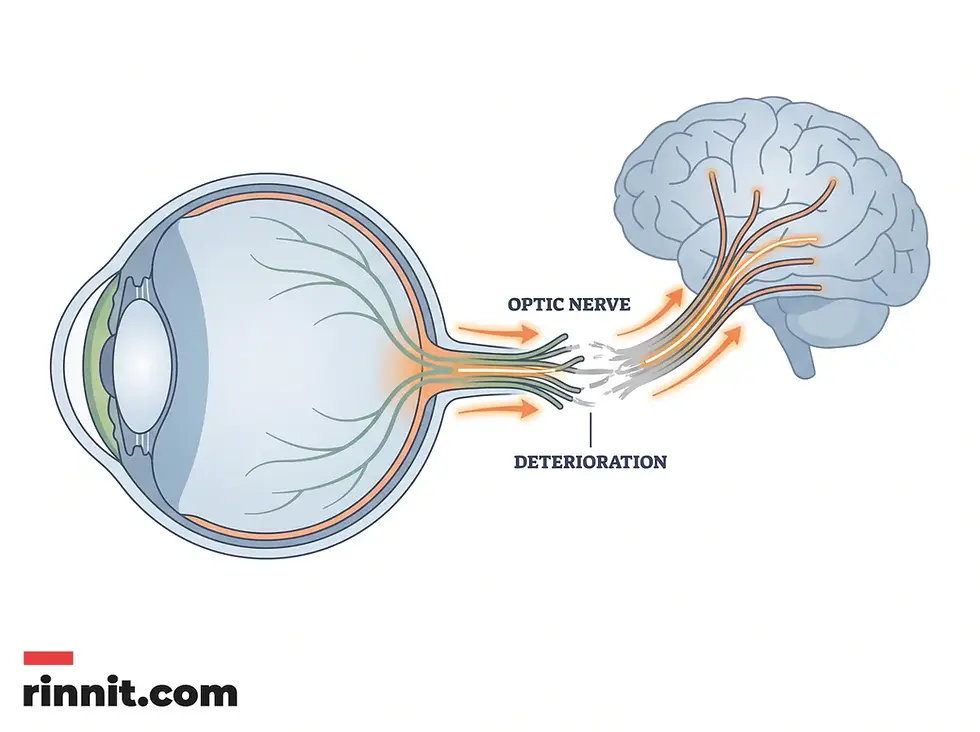
The optic nerve carries visual signals from the eye to the brain; in LHON it deteriorates.
What are the symptoms of Leber hereditary optic neuropathy, and how does it progress?
Vision loss in LHON is painless and develops over several months. Most people notice changes in their central vision first, which is the vision used for reading, driving, and recognizing faces. Color vision may also fade as the condition progresses [1].
Progression stage | Common symptoms and observations |
|---|---|
Initial onset | Painless blurring or a blind spot (scotoma) in the center of vision in one eye. |
Spread to the second eye | Similar vision loss occurs in the other eye, usually within several months. |
Stabilization | Vision loss typically stabilizes between six months and one year after the first symptoms. |
Long-term state | Most people reach a visual acuity of 20/200 or worse, which is classified as legal blindness, with some light perception remaining. |

Central vision loss (scotoma): the center of the field of view is blocked while the surroundings remain visible.
Some people with LHON recover part of their vision unexpectedly after a year of decline, and different gene mutations carry different chances of recovery. Even with some recovery, most people are still left with low vision [1].
In rare instances, a variant known as "Leber plus" occurs. It includes additional symptoms such as movement disorders like tremors, coordination and balance problems (ataxia), cardiac conduction problems such as irregular heartbeats, and symptoms resembling multiple sclerosis [1].
What genetics and risk factors are involved in Leber hereditary optic neuropathy?
LHON is unusual because it is passed down through mitochondrial DNA rather than nuclear DNA. You inherit all of your mitochondria from your birth mother, so only women can pass the mutation to their biological children, and all children of a female carrier inherit it. Not everyone who carries the mutation develops symptoms, and researchers do not yet know exactly why some carriers lose vision while others do not [1].

Mitochondria, and the LHON mutation, are passed from mother to children.
Some evidence suggests that physiological stress and environmental toxins may add to the overall stress on affected body systems until symptoms are triggered. Potential risk factors include [1]:
Smoking and alcohol use: both are associated with a higher risk of vision loss in mutation carriers [1][3].
Environmental toxins: exposure to certain toxins may add stress to the mitochondrial system [1].
Systemic illness and psychological stress: these may act as triggers for the onset of symptoms [1].
How is Leber hereditary optic neuropathy diagnosed?
Diagnosing LHON can be difficult early on. An eye care specialist will run standard eye exams, but the eye and optic nerve may look normal at first, and the damage becomes more obvious after the first six months of symptoms [1].
When LHON is suspected, a specialist will recommend genetic testing to confirm one of the known mitochondrial mutations. Genetic confirmation gives a more accurate prognosis and helps identify relatives who may carry the mutation. Genetic counseling is also helpful for families who want to understand the inheritance risk for future generations [1].
How is Leber hereditary optic neuropathy (LHON) managed, and what future treatments exist?
There is no definitive cure for LHON, so care focuses on protecting remaining vision, using the treatments that exist, and following emerging research [1].
Idebenone: a synthetic form of coenzyme Q10 and the only approved medication for LHON. It is approved by the European Medicines Agency, and in randomized controlled trials it has been associated with improvements in visual acuity in some people, with the best results when it is started early [1][4][2].
Gene therapy: researchers are studying ways to supply a working copy of the affected gene so that retinal cells can restore their energy production, and early trials have shown benefit in selected patients [1][2].
Low-vision support: high-magnification lenses, digital aids, and rehabilitation help people stay independent as they learn to live with low vision [1].
Lifestyle adjustments: avoiding tobacco and heavy alcohol use is generally advised for people who carry the mutation. It has not been proven to prevent vision loss, but both are linked to higher risk [1][3].
What is the bottom line on Leber hereditary optic neuropathy?
Leber hereditary optic neuropathy is a life-altering condition that calls for both medical care and practical support for daily living. Rapid vision loss can be devastating, but ongoing research into gene therapy and other treatments offers hope for better outcomes. Early diagnosis, genetic counseling for families, and avoiding known triggers help people with LHON and their relatives plan ahead.
Your next step: if you or a family member notices sudden, painless changes in central vision, see an ophthalmologist or neuro-ophthalmologist right away. Early genetic confirmation is important for access to treatment and to clinical trials, and low-vision services can help you adapt to changes in sight [1].
Frequently Asked Questions
What is LHON?
Leber hereditary optic neuropathy (LHON) is a rare genetic disease that causes rapid and unexpected vision loss by damaging the optic nerve.
Who is most likely to be affected by LHON?
Approximately 80% to 90% of people with LHON are male, with symptoms typically appearing in their teens or twenties.
How is LHON inherited?
LHON is a mitochondrial disease inherited only from the biological mother. All children of a female carrier inherit the mutation, but not everyone who carries it develops vision loss.
Is the vision loss from LHON permanent?
For most people, the vision loss is severe and permanent, though some individuals may experience partial recovery depending on their specific gene mutation.
What are the first signs of LHON?
The first sign is usually painless blurring or a blind spot in the center of the field of vision in one eye, followed by the other eye within months.
Can smoking trigger LHON?
Smoking is considered a potential risk factor that may contribute to triggering vision loss in people who carry the mutation, but researchers do not know exactly why some carriers develop symptoms and others do not.
What is "Leber plus"?
Leber plus is a rare form of the disease that includes additional symptoms like tremors, balance issues, or heart rhythm problems.
Is there a cure for LHON?
There is no definitive cure yet. Idebenone is the only approved medication, and researchers are developing gene therapies and other treatments to help restore vision.
What is idebenone?
Idebenone is a synthetic form of coenzyme Q10 that may help improve visual acuity in some people with LHON, particularly when started early. It is approved by the European Medicines Agency for LHON.
Does LHON cause total blindness?
Most people become legally blind (visual acuity of 20/200 or worse), but they usually keep some light perception, and because LHON mainly affects central vision, side vision is often preserved.
References
Cleveland Clinic. Leber Hereditary Optic Neuropathy (LHON). Cleveland Clinic. April 2, 2024. https://my.clevelandclinic.org/health/diseases/leber-hereditary-optic-neuropathy-lhon
Chen BS, Newman NJ. Clinical trials in Leber hereditary optic neuropathy: outcomes and opportunities. Curr Opin Neurol. 2025;38:79-86. PMID 39704163. https://doi.org/10.1097/WCO.0000000000001343
Rabenstein A, Catarino CB, Rampeltshammer V, et al. Smoking and alcohol, health-related quality of life and psychiatric comorbidities in Leber's Hereditary Optic Neuropathy mutation carriers: a prospective cohort study. Orphanet J Rare Dis. 2021;16:127. PMID 33706792. https://doi.org/10.1186/s13023-021-01724-5
Stramkauskaitė A, Povilaitytė I, Glebauskienė B, et al. Clinical overview of Leber hereditary optic neuropathy. Acta Med Litu. 2022;29(1):9-18. PMID 36061944. https://doi.org/10.15388/Amed.2022.29.1.19
Medical disclaimer
This article is for informational purposes only and is not a substitute for professional medical advice, diagnosis, or treatment. The clinical information in this guide reflects source material last reviewed in April 2024.



Comments