Understanding Lagophthalmos: Causes, Symptoms, and Management

Updated: 2 days ago
Medically reviewed by Dr. Baraa Alnahhal, MD · Last reviewed: October 2026
Lagophthalmos is the inability to close one or both eyelids completely. It can result from facial nerve damage, structural problems of the eyelids, or as a complication of eyelid surgery. Left untreated, the exposed cornea can become dry, scarred, or ulcerated, and vision can be lost. Treatment ranges from lubricating drops and taping to surgery such as eyelid weights or tarsorrhaphy [1].
Quick Answer: What is lagophthalmos?
Lagophthalmos is the medical term for not being able to close the eyelids completely, leaving the cornea exposed and causing dryness, burning, blurred vision and light sensitivity. It is often caused by facial nerve paralysis, such as Bell's palsy, or eyelid damage. Treatment protects the eye with lubrication, goggles, taping or surgery, and the outlook is generally good. [1]
What the research says
Corticosteroids reduced incomplete recovery from Bell's palsy, a leading cause. In a Cochrane review of 7 trials (895 participants), 17% (79/452) of people given corticosteroids had incomplete recovery of facial movement at six months or more, compared with 28% (125/447) of controls (risk ratio 0.63, 95% CI 0.50 to 0.80); about 10 people needed treatment to avoid one incomplete recovery (Madhok et al., Cochrane Database Syst Rev, 2016 [2]).
Adding an antiviral to corticosteroids made little difference to recovery. A Cochrane review of 14 trials (2,488 participants) found that antivirals plus corticosteroids may have little or no effect on incomplete recovery compared with corticosteroids alone (risk ratio 0.81, 95% CI 0.38 to 1.74; low-certainty evidence), though the combination probably reduced long-term sequelae such as synkinesis (risk ratio 0.56, 95% CI 0.36 to 0.87) (Gagyor et al., Cochrane Database Syst Rev, 2019 [3]).
Lagophthalmos is the main eye complication of facial palsy, and treatment options range from temporary to permanent. A review of the therapeutic options notes that the greater surface exposure raises the risk of keratitis, corneal ulceration, and potentially vision loss, and that some treatments are temporary while others are permanent (Vásquez and Medel, Ophthalmic Res, 2014 [4]).
What Is Lagophthalmos?
Lagophthalmos (pronounced “la-guhp-thal-mowz”) describes a condition in which the eyelids can't close completely over the eye. It can affect one or both eyes and may occur by itself or alongside other eyelid disorders such as ptosis (sagging eyelids). Mild lagophthalmos doesn't usually cause many problems, but when the cornea is exposed to wind, dirt, and other irritants, it can lead to scarring or vision loss [1].
The name means “hare-like eyes,” because hares were once thought to sleep with their eyes open. The condition is grouped into several types, based on its cause [1]:
Type | What happens |
|---|---|
Nocturnal | The eyes close normally when you are awake but not during sleep. About 20% of people sleep with their eyes open. |
Paralytic | Loss of function (paralysis) in the facial nerve prevents the eyelids from closing completely. |
Mechanical | Structural problems or trauma, rather than nerve problems, prevent closure. |
Cicatricial | A type of mechanical lagophthalmos caused by scarring of the eyelid tissue. |
What are the symptoms and common signs of lagophthalmos?
The main sign of lagophthalmos is a visible gap between the upper and lower eyelids when you try to close your eyes. The exposed surface of the eye then causes other symptoms that can affect daily comfort and vision [1].
Symptom | Description |
|---|---|
Dry or watery eyes | A persistent feeling of dryness, or excessive watering as the eye tries to compensate. |
Foreign body sensation | A feeling that something is stuck in the eye, often with burning or pain. |
Blurred vision | Reduced clarity of sight because of an unstable tear film. |
Red eyes | Redness from irritation of the exposed surface. |
Photophobia | Sensitivity to light that makes bright environments uncomfortable. |
Corneal ulcer | A serious sore on the cornea that can develop from prolonged exposure. |
What are the main causes of lagophthalmos?
Lagophthalmos is not contagious. You can't give it to someone else or catch it from anyone. The two main causes are damage to the facial nerve and damage to the eyelids [1].
Nerve damage. Injury to the facial nerve can result from eye injuries in accidents or cuts, Bell's palsy, stroke, tumors such as acoustic neuromas, autoimmune disorders such as Guillain-Barré syndrome, Moebius syndrome, infections, and toxins [1].
Eyelid damage. Eyelids can be damaged or scarred by lax eyelid syndrome (including floppy eyelid syndrome, which mainly affects males with overweight or obesity), conditions such as Stevens-Johnson syndrome that blister the skin, chemical burns, sun damage, and eyelid surgery such as ptosis repair or blepharoplasty [1].
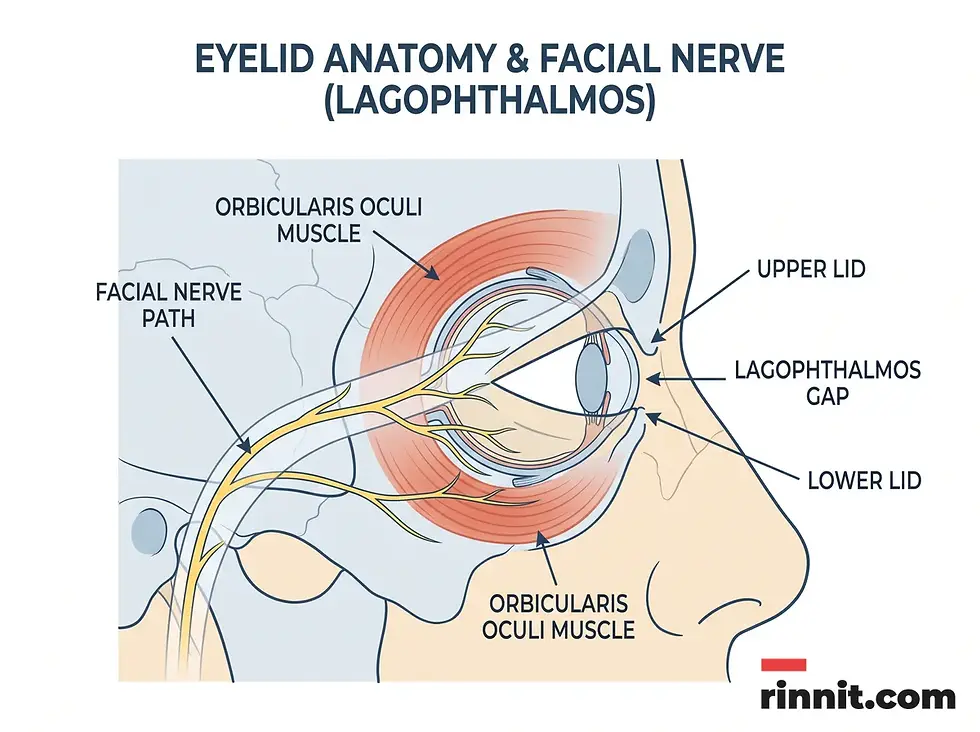
Eyelid anatomy and the facial nerve: the orbicularis oculi muscle closes the eyelids, and when its nerve supply or the lids are damaged, a gap can remain.
How is lagophthalmos diagnosed?
An eye care provider diagnoses lagophthalmos through a series of checks. They will usually ask about your health history, ask you to close your eyes, watch how forcefully you close them, measure your eyelids, and count how often you blink and how completely your eyes close during a blink [1]. These observations help show whether the problem is paralytic or mechanical, which guides the choice of treatment.
What are the treatment options for lagophthalmos?
Treatment depends on the cause and severity. Your provider will want to treat any underlying cause, such as an infection, a tumor, or a skin condition, and the therapy may be nonsurgical or surgical [1].
Nonsurgical Interventions
Eye drops such as artificial tears.
Ointment at night for extra moisture.
Tape to keep the lids closed at night, or patches to keep moisture in.
Special glasses (moisture goggles) that help keep the eyes moist.
Small weights that can be taped to the eyelid.
You can also take care of your eyes at home by keeping them lubricated with eye drops and taping your lids closed at night [1].
Surgical Solutions
Tarsorrhaphy: sewing the eye partly or completely shut, temporarily or permanently, to protect the surface of the eye.
Gold or platinum eyelid weights: small weights placed in the upper eyelid that use gravity to help the eye close in paralytic lagophthalmos.
Upper eyelid surgery: procedures on the retractor muscles of the upper lid, and skin grafts.
Lower eyelid surgery: tightening of “floppy” lower lids and skin grafts to lift the lid.
Facial surgery: procedures such as nerve grafts and moving soft tissue to lift the face in facial paralysis.
Possible complications after treatment include scarring, infection, entropion (eyelashes turning inward), drooping eyelids, and graft site problems [1].

Treatment options range from drops, goggles, and taping to eyelid weights and tarsorrhaphy.
What is the outlook for lagophthalmos, and how can it be prevented?
The outlook for lagophthalmos is generally good, especially for mild cases. Bell's palsy cases usually resolve by themselves, but treatment is important for more advanced cases to prevent vision loss [1].
You can't prevent lagophthalmos itself, but you can protect your eyes [1]:
Wear safety equipment that covers your eyes when you work or play contact sports.
Wear sunglasses to protect your eyes in bright sun.
Avoid touching your eyes unnecessarily, and wash your hands before you touch them.
If you are considering ptosis repair or blepharoplasty, consult an oculoplastic surgeon, an ophthalmologist who specializes in reconstructive surgery around the eyes.

Healthy habits that protect the eyes: UV protection and good hand hygiene.
What is the bottom line on lagophthalmos?
Lagophthalmos is a significant eye condition that needs attention to protect long-term vision. By understanding whether the cause is nerve-related or structural, you and your care team can put effective protective measures in place. Early treatment is the best way to avoid serious complications such as corneal scarring and vision loss.
Your next step: if your eyes don't close completely, or if you have persistent dryness or irritation, see an eye care professional promptly. Contact a provider right away about any change in vision. A proper diagnosis is the first step toward a management plan tailored to you.
Frequently Asked Questions
What is lagophthalmos?
Lagophthalmos is a medical condition in which you can't close one or both eyelids completely.
Is lagophthalmos contagious?
No. It is not contagious and can't be passed from person to person.
What is nocturnal lagophthalmos?
Nocturnal lagophthalmos is a type in which the eyes close normally while you are awake but don't close completely during sleep.
Can Bell's palsy cause this condition?
Yes. Facial nerve paralysis from Bell's palsy is a common cause of paralytic lagophthalmos, and Bell's palsy cases usually resolve on their own.
What are the risks of leaving it untreated?
Untreated lagophthalmos can expose the cornea to dryness, scarring, corneal ulcers, and, in some cases, vision loss.
How is it diagnosed?
An eye care provider reviews your health history, asks you to close your eyes gently and forcefully, measures your eyelids, and counts how often you blink and how completely your eyes close.
What are artificial tears used for?
Artificial tears provide lubrication to the surface of the eye when the lids can't close completely.
What is a tarsorrhaphy?
A tarsorrhaphy is a surgical procedure in which the eyelids are partly or completely sewn shut, temporarily or permanently, to protect the eye.
Are eyelid weights permanent?
Gold or platinum weights implanted in the upper eyelid can be a long-term solution for paralytic lagophthalmos, using gravity to help the eye close.
When should I see a doctor?
Contact a provider if you have dry or watery eyes, a feeling that something is stuck in your eye, or any change in vision, and always seek care promptly for vision changes.
References
Cleveland Clinic. Lagophthalmos. Cleveland Clinic. November 3, 2022. https://my.clevelandclinic.org/health/diseases/24413-lagophthalmos
Madhok VB, Gagyor I, Daly F, et al. Corticosteroids for Bell's palsy (idiopathic facial paralysis). Cochrane Database of Systematic Reviews. 2016;7:CD001942. PMID 27428352. https://doi.org/10.1002/14651858.CD001942.pub5
Gagyor I, Madhok VB, Daly F, Sullivan F. Antiviral treatment for Bell's palsy (idiopathic facial paralysis). Cochrane Database of Systematic Reviews. 2019;9:CD001869. PMID 31486071. https://doi.org/10.1002/14651858.CD001869.pub9
Vásquez LM, Medel R. Lagophthalmos after facial palsy: current therapeutic options. Ophthalmic Research. 2014;52(4):165-169. PMID 25342248. https://doi.org/10.1159/000365519
Medical disclaimer
This article is for informational purposes only and is not a substitute for professional medical advice, diagnosis, or treatment. The clinical information in this guide reflects source material last reviewed in November 2022.



Comments