Knuckle Pads: Symptoms, Causes, and Care

Updated: 2 days ago
Medically reviewed by Dr. Baraa Alnahhal, MD · Last reviewed: October 2026
Quick Answer: Key Facts About Knuckle Pads
Knuckle pads, also called Garrod's nodes, are benign fibromatosis growths that appear as firm, skin-colored, usually painless bumps on the backs of finger joints or tops of toe joints. They are associated with conditions such as Dupuytren's contracture and Ledderhose disease. Treatment options include observation, steroid injections and topical creams, and the growths are noncancerous.
Feature | Details |
Common Names | Garrod’s nodes, Garrod’s pads [1] |
Growth Type | Benign (noncancerous) fibromatosis [1] |
Primary Locations | Backs of finger joints, tops of toe joints [1] |
Key Symptoms | Skin-colored, firm, solid bumps; usually painless [1] |
Associated Conditions | Dupuytren’s contracture, Ledderhose disease [1] |
Primary Treatment | Observation, steroid injections, topical creams [1] |
What the research says
Knuckle pads are the most common finding on the back of the hand in Dupuytren's disease. A systematic review of 17 published articles covering 525 patients with dorsal Dupuytren's disease found that knuckle pads were the most frequently reported lesion (503 patients), most often over the proximal interphalangeal joint, and the condition was bilateral in about half of patients (225). (Carloni et al., J Hand Surg Eur Vol, 2019) [2]
Knuckle pads point to a stronger genetic tendency in people with Dupuytren's disease. In a study of 933 people with Dupuytren's disease, having knuckle pads was linked to a higher genetic risk score based on 9 known risk variants, together with onset before age 50 and a family history of the disease. (Dolmans et al., J Hand Surg Am, 2012) [3]
Radiotherapy has been tried for painful knuckle pads in small studies. In a case series of 9 patients treated with radiotherapy and followed for a median of 9 years, 7 of 9 (78%) reported resolution, flattening or stable knuckle pads, and 8 of 9 (89%) reported improved or resolved symptoms, with minimal side effects reported. The series was small and had no comparison group. (Stark et al., Cureus, 2025) [4]
What are Knuckle Pads?
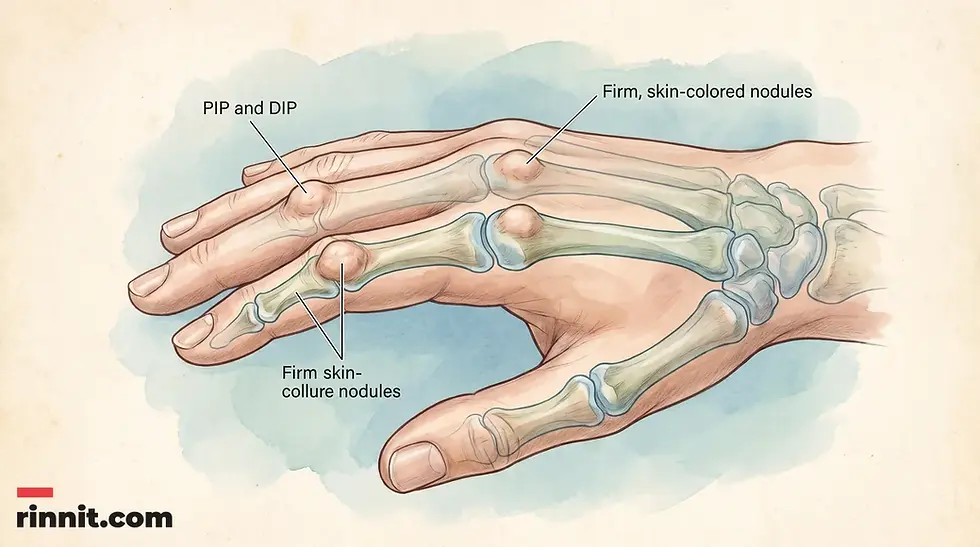
Knuckle pads are small, firm growths that develop under the skin directly over the joints of the fingers or toes. Known medically as Garrod’s nodes, these bumps are a form of fibromatosis—a condition where noncancerous tumors grow in the connective tissue. Although they are benign and do not pose a threat to overall health, their presence can be bothersome due to their appearance or occasional tenderness.
These growths are often mistaken for warts or calluses, but they have distinct characteristics. Unlike warts, which are caused by a virus, knuckle pads are dense tissue formations. They are most commonly found on the backs of the hands and the tops of the feet, and while they can affect anyone, they are frequently seen in individuals with a family history of similar skin conditions.
What are the symptoms of knuckle pads?
Knuckle pads appear as skin-colored, solid bumps on the knuckles, which is their most recognizable sign. These growths are typically firm to the touch and, in most cases, do not cause significant pain. However, as they grow larger, they can lead to specific issues:
Symptom | Description [1] |
Visible Bumps | Solid, firm, skin-colored lumps on the joints of fingers or toes. |
Tenderness | While usually painless, some pads may become tender or sore when pressed. |
Functional Impact | Large pads on the fingers can make it difficult to perform fine motor tasks. |
Irritation | Pads on the toes can rub against shoes, causing discomfort or skin breakdown. |
Emotional Stress | Many individuals feel self-conscious about the appearance of their hands. |
It is important to differentiate these from calluses, which are caused by external friction, whereas knuckle pads develop from within the tissue itself.

What Causes Knuckle Pads?
Knuckle pads are classified as a type of fibromatosis. While the exact trigger is not always clear, they are strongly associated with other fibrotic conditions. If you have been diagnosed with Dupuytren’s contracture (which affects the palms) or Ledderhose disease (which affects the soles of the feet), you are at a higher risk of developing knuckle pads.
Genetic factors play a significant role, as the condition often runs in families. Certain rare genetic syndromes, such as Bart-Pumphrey syndrome, are also linked to the development of these nodes. It is important to note that knuckle pads are not contagious; they cannot be spread from person to person through contact.
How are knuckle pads diagnosed and treated?
A healthcare provider can usually diagnose knuckle pads through a simple physical examination and a review of your medical history. In rare or severe cases, imaging tests like an MRI or an ultrasound may be used to rule out other conditions. A skin biopsy is occasionally performed if the diagnosis is uncertain.
For many people, no treatment is required if the pads are painless. However, if they cause discomfort or significant distress, several options are available:
Topical Medications: Prescription creams can help reduce inflammation or break down excess skin cells.
Steroid Injections: Injecting a small amount of steroid medication directly into the pad can help shrink the growth.
Surgical Removal: This is considered a last resort, as surgery can sometimes lead to scarring that is more prominent than the original pad.
Home Care: Keeping the skin moisturized with fragrance-free emollients like petroleum jelly can reduce irritation and discomfort.

How can people live with knuckle pads?
Knuckle pads can be lifelong for some people, but they are not harmful to the body's internal systems. The focus of care is on maintaining comfort and managing any emotional impact the condition may have. Regular check-ups with a primary care provider or dermatologist can help monitor the growths and ensure that any changes are addressed promptly.
Frequently Asked Questions
Are knuckle pads cancerous?
No. Knuckle pads are benign (noncancerous) growths and do not turn into cancer.
Can I catch knuckle pads from someone else?
No, they are not contagious. They are caused by internal tissue growth and genetics.
Do knuckle pads go away on their own?
Knuckle pads typically do not disappear without treatment, though they may remain stable in size for many years.
How are knuckle pads different from warts?
Warts are caused by a virus (HPV) and can appear anywhere. Knuckle pads are dense tissue and only occur over joints.
Are knuckle pads the same as calluses?
No. Calluses are caused by skin rubbing against a surface. Knuckle pads grow from the tissue under the skin.
Does playing sports cause knuckle pads?
While repetitive use of the hands can sometimes be a factor, they are primarily linked to genetics and other fibrotic conditions.
Can I pop a knuckle pad?
No. They are solid tissue, not fluid-filled cysts, and attempting to pop them will cause pain and potential infection.
Is surgery the best way to remove them?
Not always. Surgery is rare because it can cause scarring, and the pads may even return after removal.
What is Dupuytren’s contracture?
Dupuytren’s contracture is a related condition where the tissue in the palm thickens, sometimes causing the fingers to pull inward.
Can knuckle pads affect the toes?
Yes, they frequently appear on the tops of the toe joints, where they can be irritated by shoes.
What should I put on my knuckle pads to help them?
Fragrance-free moisturizers or petroleum jelly can help keep the skin soft and reduce irritation.
Are knuckle pads related to hearing loss?
In very rare cases, they are part of Bart-Pumphrey syndrome, which includes hearing loss and nail changes.
Do steroid injections hurt?
There may be brief discomfort during the injection, but it is a common and effective way to shrink the pads.
Should I see a dermatologist for knuckle pads?
Yes, a dermatologist is the specialist best equipped to diagnose and treat skin and joint growths like knuckle pads.
Can knuckle pads make it hard to type or write?
If they become very large, they can interfere with finger movement and make fine motor tasks more difficult.
Related Reading
Fasciectomy for Dupuytren's Contracture explains surgery for a related hand condition that bends the fingers.
Plantar Fibromatosis: Understanding Ledderhose Disease covers similar thickened tissue that forms on the sole of the foot.
Corns and Calluses: Symptoms, Causes, Treatment and Prevention explains thick skin caused by rubbing and pressure.
Peyronie's Disease: Symptoms, Causes & Treatment describes a related condition where scar tissue forms in the penis.
References
Cleveland Clinic. Knuckle Pads. Cleveland Clinic. Last updated March 7, 2022. https://my.clevelandclinic.org/health/diseases/22500-knuckle-pads
Carloni R, Gandolfi S, Elbaz B, et al. Dorsal Dupuytren's disease: a systematic review of published cases and treatment options. J Hand Surg Eur Vol. 2019;44(9):963-971. PMID 31184950. https://doi.org/10.1177/1753193419852171
Dolmans GH, de Bock GH, Werker PM. Dupuytren diathesis and genetic risk. J Hand Surg Am. 2012;37(10):2106-11. PMID 23021175. https://doi.org/10.1016/j.jhsa.2012.07.017
Stark A, Sharifzadeh Y, Kahn J, et al. Radiotherapy for Symptomatic Knuckle Pads Associated With Dupuytren's Disease: A Report of a Case Series. Cureus. 2025;17(6):e85796. PMID 40656360. https://doi.org/10.7759/cureus.85796
Medical disclaimer
The information provided in this article is for educational purposes only and should not be considered medical advice. Always consult with a qualified healthcare provider for diagnosis and treatment of any medical condition.



Comments