Juvenile Nasopharyngeal Angiofibroma (JNA): A Comprehensive Guide

Updated: 2 days ago
Medically reviewed by Dr. Baraa Alnahhal, MD · Last reviewed: October 2026
Quick Answer: Key Facts About JNA
Juvenile nasopharyngeal angiofibroma (JNA) is a rare, vascular, noncancerous tumor that grows behind the nose, almost exclusively in males between ages 10 and 25. Main symptoms are frequent, hard-to-stop nosebleeds and difficulty breathing through the nose. Imaging and nasal endoscopy confirm it. Standard treatment is surgical removal, usually after embolization, and recurrence reaches up to 37%.
Feature | Details |
What it is | A rare, vascular, noncancerous tumor that grows behind the nose. [1] |
Who it affects | Almost exclusively males, typically between the ages of 10 and 25. [1] |
Primary symptoms | Frequent nosebleeds that are hard to stop and difficulty breathing through the nose. [1] |
Risk factors | Having a biological family member with familial adenomatous polyposis (FAP). JNA itself is not thought to run in families. [1] |
Diagnosis | Imaging (CT, MRI, sometimes PET) and nasal endoscopy, usually with an ENT specialist. [1] |
Standard treatment | Surgical removal, usually after embolization. Repeat surgery or radiation therapy if the tumor comes back. [1] |
Recurrence |
What the research says
Embolization before surgery reduces blood loss. A meta-analysis of 61 studies and 917 patients found that 79.3% had preoperative embolization. Recurrence was 9.3% in embolized patients versus 14.4% in non-embolized patients (odds ratio 0.61; 95% CI 0.35 to 1.06, so the recurrence difference was not statistically significant). In the six studies that included both groups, embolization reduced mean blood loss by 798 mL. (Diaz et al., Laryngoscope, 2023) [3]
Endoscopic surgery caused less blood loss than open surgery. A systematic review of 1,047 cases reported average blood loss of 544.0 mL for endoscopic, 490.0 mL for endoscopic-assisted and 1,579.5 mL for open surgery in the individual-patient cohort. In the aggregate data, recurrence was 4.7% after endoscopic surgery versus 20.6% after endoscopic-assisted and 22.6% after open surgery, but when tumors of the same stage were compared, recurrence did not differ between open and endoscopic surgery. The authors called for larger studies. (Boghani et al., Laryngoscope, 2013) [4]
JNA in young children may be more aggressive. A systematic review of 34 cases of early-onset JNA (diagnosed before age 10; mean age 8.15 years) found that 31 of 34 patients were male, that nasal obstruction (65.2%) and nosebleeds (60.9%) were the most common symptoms, and that recurrence occurred in 30%. The authors note that these children appeared to have more advanced disease and higher recurrence than reported averages. (Newman et al., J Otolaryngol Head Neck Surg, 2023) [5]
What Is Juvenile Nasopharyngeal Angiofibroma (JNA)?
Juvenile nasopharyngeal angiofibroma, commonly called JNA, is a rare growth that forms behind the nose, in the area where the nasal cavity meets the throat. The name is a roadmap to the condition: “juvenile” means a young person, “nasopharyngeal” refers to the area around the nose and throat, and “angiofibroma” describes a tumor made of blood vessels (angio) and connective tissue (fibroma). [1]
JNA is not cancer, but it is still serious and aggressive. Because it is a vascular tumor, it is mostly filled with blood vessels, which can lead to heavy bleeding. If it grows, it can spread from the nasal cavity into the sinuses, the skull and the brain. Without treatment, JNA may lead to life-threatening complications, which is why prompt medical care matters. [1]
Who Is at Risk?
JNA is very rare. Experts estimate that it occurs in about 1 in every 150,000 to 1,500,000 people. It is most common in males between the ages of 10 and 25 and almost never affects females. Very rarely, it can occur in males over 25 or in boys as young as 7. [1]
The exact cause is not fully understood. Because the tumor occurs almost only in males, hormones likely play a role. StatPearls notes that rising androgen levels at puberty may stimulate tumor growth, although the overall role of sex hormones is still unclear. [2] JNA is not believed to run in families, but you are more likely to develop it if a biological family member has familial adenomatous polyposis (FAP), a separate inherited condition. [1]

What are the symptoms of juvenile nasopharyngeal angiofibroma (JNA)?
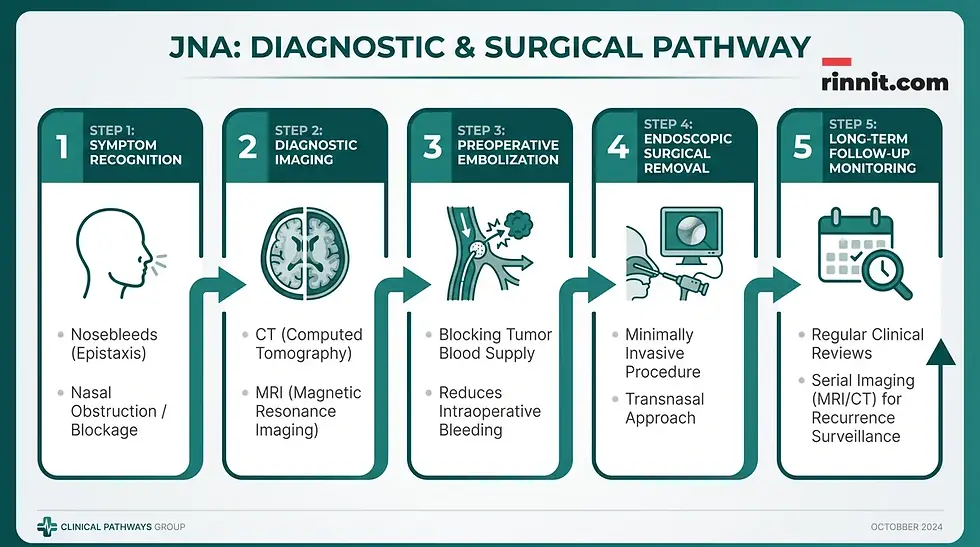
JNA symptoms are not immediate. They often start only once the tumor has grown large enough to interfere with nasal airflow. Symptoms may include: [1]
Frequent nosebleeds that can be heavy and difficult to stop.
Trouble breathing through your nose.
Facial swelling.
Headaches.
Vision or hearing changes.
As the tumor grows, it can press on surrounding facial structures and cause complications such as bulging eyes and vision loss. [1] Because JNA can stay quiet for a long time, people often see a doctor only after the tumor has become larger. [2]
How is juvenile nasopharyngeal angiofibroma (JNA) diagnosed?
A healthcare provider can suspect JNA from an examination of your nose and a review of your symptoms, and will usually refer you to an otolaryngologist, also called an ear, nose and throat (ENT) specialist. Testing may include: [1]
Nasal endoscopy: a thin tube with a camera is used to look at the growth directly. [1]
Imaging tests: CT scans, MRI and sometimes PET scans show the size of the tumor and whether it has grown into the sinuses or skull. [1]
Blood-vessel mapping: because JNA is so vascular, doctors may use angiography to see which arteries feed the tumor before surgery. [2]
Doctors usually avoid taking a biopsy of a suspected JNA because of the risk of serious bleeding. The diagnosis is made from the exam and the characteristic imaging findings. [2]
What are the treatment options for juvenile nasopharyngeal angiofibroma (JNA)?
Surgical removal of the tumor is the standard treatment for JNA. [1]
Surgery: A surgeon can often remove the tumor with an endoscope (a thin tube with a camera) passed through your nostrils, so there are no cuts on the outside of your nose. In some cases, surgeons need to make external incisions, and they keep them as small as possible to minimize scarring. [1]
Embolization: Because the nose and the tumor contain so many blood vessels, providers usually perform embolization before surgery. A specialist blocks the vessels that feed the tumor, which helps prevent blood loss during the operation. [1] In a series of 79 patients, preoperative embolization was successful in every case, with no bleeding or thromboembolic complications, and blood loss during surgery was significantly decreased. [6]
Radiation therapy: It can be hard for surgeons to remove tissue that has grown into surrounding bone or sinuses. If tiny bits of tissue are left behind, the tumor may come back, and your surgeon may recommend repeat surgery or radiation therapy. [1] Radiation can also be used as the main treatment when complete surgical removal is not feasible or safe. [2]
What are recovery, recurrence and long-term monitoring like for JNA?
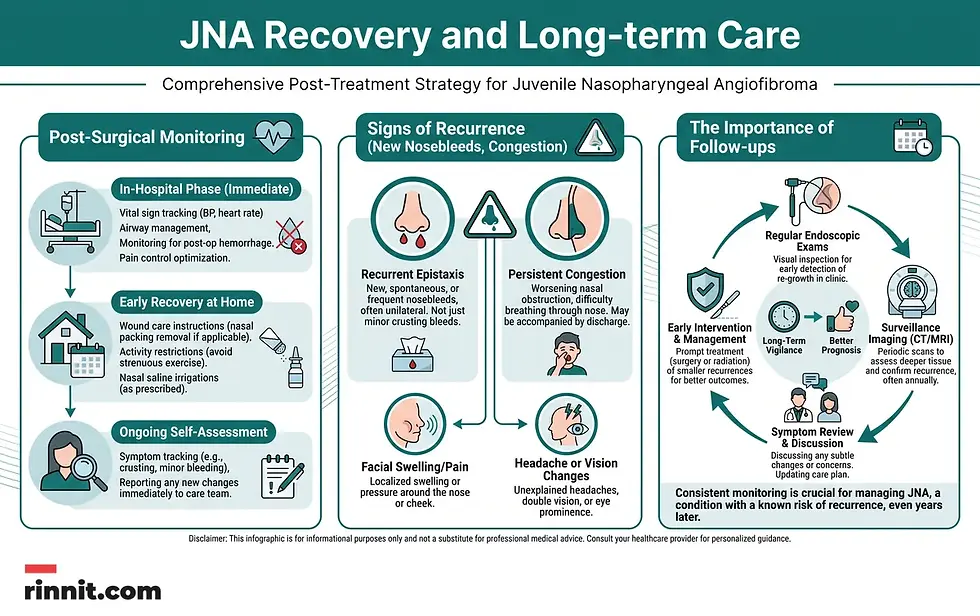
JNA has a high survival rate, and the outlook is good with treatment. Because the tumor can come back, you may need repeat surgery or radiation in the future, and your healthcare provider will check in with you periodically. [1] According to some research studies, JNA comes back in up to 37% of cases. [1] [2]
Most recurrences appear within the first three years after surgery, so StatPearls describes clinical and imaging follow-up once or twice a year for at least four years. [2] Tell your care team right away about new or returning nosebleeds, worsening nasal blockage, facial swelling or pain, headaches or vision changes.
Learn more. For more evidence-based health guides, visit Rinnit.com.
Frequently Asked Questions
Is JNA a type of cancer?
No. JNA is a noncancerous (benign) tumor, but it is considered aggressive because it can grow from the nasal cavity into nearby sinuses, bone, the skull and the brain. [1]
Can girls get JNA?
JNA in girls is extremely rare. JNA almost never affects females and is most common in males between the ages of 10 and 25, although rare cases in females have been reported. [1]
What causes the heavy nosebleeds in JNA?
The tumor is made mostly of blood vessels, and these vessels lack a normal muscular wall, so they can bleed heavily even with minor irritation. [2]
How long does the surgery take?
It depends on the size and location of the tumor. Large tumors can require a staged approach and a specialized surgical team, so ask your surgeon what to expect in your case. [2]
Will there be a scar on the face after surgery?
Most JNA surgery is done with an endoscope through the nostrils, so there are no cuts on the outside of the nose. In some cases, surgeons need to make external incisions, which they keep as small as possible to minimize scarring. [1]
What is embolization?
Embolization is a procedure done shortly before surgery to block the blood vessels that feed the tumor. It helps reduce blood loss during the operation. [1]
How often do I need check-ups after surgery?
Your ENT specialist will set a schedule. Most recurrences appear within the first three years, and StatPearls describes clinical and imaging follow-up once or twice a year for at least four years. [2]
Can JNA affect my vision permanently?
If a tumor grows large enough to press on surrounding facial structures, it can cause bulging eyes and vision loss. Prompt diagnosis and treatment are the best way to prevent this. [1]
Is JNA hereditary?
Experts do not believe JNA tumors run in families. However, you are more likely to develop JNA if a biological family member has familial adenomatous polyposis (FAP), and researchers are still studying how the two conditions are related. [1]
What happens if the tumor comes back?
A returning tumor is usually treated with repeat surgery or radiation therapy. [1]
Are there medications to shrink the tumor?
Surgery and radiation are the established treatments. Hormone-blocking medicines such as flutamide have been shown to reduce tumor size in some cases, but they are not curative on their own and remain investigational. [2]
Can JNA spread to other parts of the body?
JNA is a benign tumor and is not described as spreading to distant organs. It can, however, grow into nearby areas such as the sinuses, the skull and the brain. [1]
Why does it mostly affect teenagers?
The cause is not fully understood, but because JNA occurs almost only in males, hormones likely play a role. Rising androgen levels during puberty are one proposed explanation. [2]
What is the survival rate for JNA?
JNA has a high survival rate, and the outlook is good with treatment. Because the tumor can come back, long-term monitoring remains important. [1]
When should I see a doctor about a nosebleed?
See a healthcare provider if nosebleeds are frequent, hard to stop, or come with a blocked nose that does not go away, especially in a teenage boy or young man. [1]
Conclusion
Juvenile nasopharyngeal angiofibroma is not cancer, but it needs prompt treatment because it can grow into nearby areas. Modern endoscopic surgery and preoperative embolization have made treatment safer, and the outlook is good. Because the tumor can return, regular follow-up with an ENT specialist is an important part of care. [1]
References
Cleveland Clinic. Juvenile Nasopharyngeal Angiofibroma (JNA). Cleveland Clinic. Last updated April 30, 2025. https://my.clevelandclinic.org/health/diseases/21152-juvenile-nasopharyngeal-angiofibroma-jna
Tork CA, Winters R, Simpson DL. Nasopharyngeal angiofibroma. StatPearls. Treasure Island (FL): StatPearls Publishing; last update September 15, 2025. PMID 31424824. https://pubmed.ncbi.nlm.nih.gov/31424824/
Diaz A, Wang E, Bujnowski D, et al. Embolization in Juvenile Nasopharyngeal Angiofibroma Surgery: A Systematic Review and Meta-Analysis. Laryngoscope. 2023;133(7):1529-1539. PMID 36789781. https://doi.org/10.1002/lary.30616
Boghani Z, Husain Q, Kanumuri VV, et al. Juvenile nasopharyngeal angiofibroma: a systematic review and comparison of endoscopic, endoscopic-assisted, and open resection in 1047 cases. Laryngoscope. 2013;123(4):859-69. PMID 23483486. https://doi.org/10.1002/lary.23843
Newman M, Nguyen TBV, McHugh T, et al. Early-onset juvenile nasopharyngeal angiofibroma (JNA): a systematic review. J Otolaryngol Head Neck Surg. 2023;52(1):85. PMID 38115030. https://doi.org/10.1186/s40463-023-00687-w
Giorgianni A, Molinaro S, Agosti E, et al. Twenty Years of Experience in Juvenile Nasopharyngeal Angiofibroma (JNA) Preoperative Endovascular Embolization: An Effective Procedure with a Low Complications Rate. J Clin Med. 2021;10(17):3926. PMID 34501374. https://doi.org/10.3390/jcm10173926
Medical disclaimer
This article is for general educational purposes only and is not a substitute for professional medical advice. Always seek the advice of your physician or other qualified health provider with any questions you may have regarding a medical condition.



Comments