Joubert Syndrome: Causes, Symptoms, and Management

Updated: 2 days ago
Medically reviewed by Dr. Baraa Alnahhal, MD · Last reviewed: October 2026
Quick Answer: Key Facts About Joubert Syndrome
Joubert syndrome is a genetic condition caused by mutations in more than 35 genes, affecting about 1 in 100,000 births worldwide. Its key sign is the molar tooth sign on a brain MRI. Symptoms include low muscle tone, coordination problems and breathing irregularities, with risks to the kidneys, liver and vision. Treatment is supportive, and many live into adulthood.
Feature | Details |
Primary Cause | Genetic mutations in more than 35 different genes. [1] |
Prevalence | Approximately 1 in 100,000 births worldwide each year. [1] |
Key Diagnostic Sign | "Molar tooth sign" visible on a brain MRI scan. [1] |
Main Symptoms | Low muscle tone, coordination issues, and breathing irregularities. [1] |
Associated Risks | Kidney disease, liver issues, and vision impairment. [1] |
Treatment Focus | Supportive therapies (PT, OT, speech) and specialized monitoring. [1] |
Long-term Outlook | Varies; many live into adulthood with lifelong support. [1] |
What the research says
The specific gene often predicts which organs are affected. A review reports more than 40 causative genes, explaining up to 94% of cases. Variants in TMEM67 carry a significantly higher risk of liver fibrosis, variants in NPHP1, RPGRIP1L and TMEM237 are frequently linked to kidney involvement, and variants in CEP290 or AHI1 call for closer watch for retinal dystrophy. (Gana et al., Am J Med Genet C Semin Med Genet, 2022) [2]
Liver involvement was common in a prospective study of 100 people. At the National Institutes of Health, 43% had liver involvement based on elevated liver enzymes, liver hyperechogenicity or splenomegaly, and 13 people had probable portal hypertension. Probable portal hypertension was more common in people with kidney disease, colobomas or TMEM67 mutations. (Strongin et al., J Pediatr Gastroenterol Nutr, 2018) [3]
Breathing and kidney problems were the leading causes of death in one study of people who had died. Among 40 deceased individuals (compared with 525 living individuals), the mean age at death was 7.2 years. The most common causes were respiratory failure (35%, mostly in those younger than 6 years) and kidney failure (37.5%, more common in older individuals). This describes the people in the study who had died and is not a life-expectancy estimate. (Dempsey et al., Am J Med Genet A, 2017) [4]
What Is Joubert Syndrome?
Joubert syndrome is a rare genetic condition that occurs when specific parts of a fetus's brain do not develop as they should. The disorder primarily affects the cerebellum, which manages coordination and movement, and the brainstem, which regulates vital functions like breathing and balance. In individuals with Joubert syndrome, a part of the cerebellum called the cerebellar vermis is either missing or significantly smaller than normal. This structural abnormality creates a distinctive shape on imaging scans known as the "molar tooth sign," which is a primary indicator used by healthcare providers to diagnose the condition. [1]
The syndrome is estimated to affect 1 in 100,000 babies born worldwide each year. While the condition has many subtypes that cause a wide variety of symptoms, it typically manifests as issues with muscle control, muscle tone, and respiratory patterns. Most children inherit the genetic mutations responsible for the syndrome from their parents, though in some cases, the mutations occur sporadically for no known reason. [1]
What are the symptoms of Joubert syndrome?
The symptoms of Joubert syndrome can change as a child grows and vary significantly between individuals. In infants, the most common sign is hypotonia, or decreased muscle tone, which often develops into ataxia, a lack of muscle coordination, as the child ages. Breathing irregularities are also frequent, including tachypnea (fast, shallow breathing) or apnea (episodes where breathing temporarily stops). Developmental delays and intellectual disabilities are common challenges that families face. [1]
Beyond neurological issues, Joubert syndrome often causes distinctive physical and medical conditions. These may include: [1]
Facial Differences: A broad forehead, droopy eyelids (ptosis), widely spaced eyes, and a triangle-shaped mouth where the upper lip turns up in the center.
Physical Abnormalities: Extra fingers or toes (polydactyly), a protruding tongue, or a cleft lip and palate.
Organ Complications: As children grow, they may develop serious conditions affecting the retinas, kidneys, and liver, such as polycystic kidney disease or liver failure.

What causes Joubert syndrome, and how is it inherited?
Joubert syndrome is caused by mutations in more than 35 different genes that are essential for healthy brain development. These mutations affect the cilia, which are tiny, antenna-like structures on the surface of cells that facilitate communication during organ development. When these cilia do not function correctly, it leads to the characteristic brain abnormalities and associated organ issues. Most cases are inherited in an autosomal recessive manner, meaning both biological parents must carry and pass on the mutation for a child to be affected. [1]
In rarer instances, the condition is X-linked, meaning the mutation is located on the X chromosome. The risk for family members depends on the specific inheritance pattern. In autosomal recessive cases, siblings of an affected child have a 25% chance of having the condition and a 50% chance of being asymptomatic carriers. For X-linked mutations, males have a 50% chance of developing the syndrome if their mother is a carrier. [1]
How is Joubert syndrome diagnosed and treated?
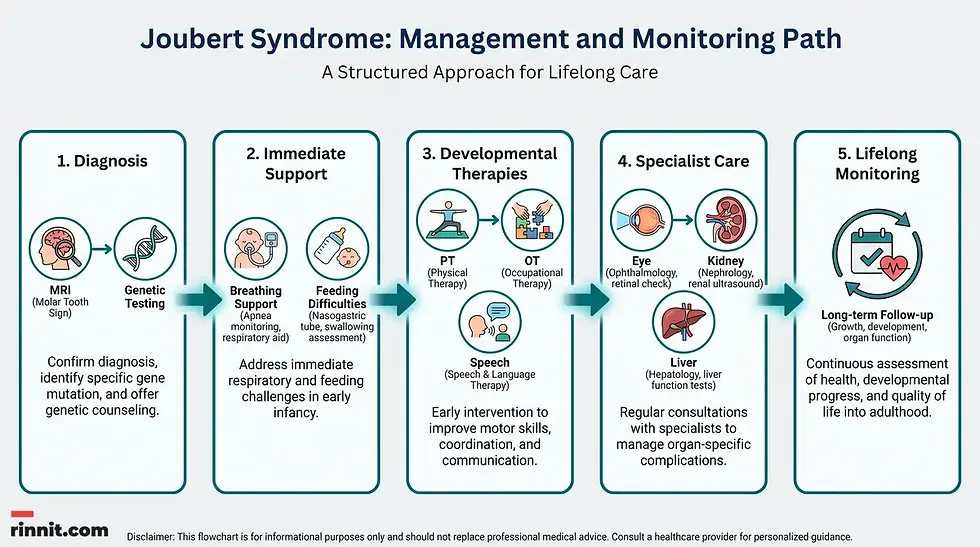
Healthcare providers diagnose Joubert syndrome by evaluating a child's symptoms and imaging results. The definitive criteria include the presence of the molar tooth sign on a brain MRI, symptoms of hypotonia, and developmental delays. Genetic testing is often used to confirm the diagnosis and identify the specific mutation, which helps providers anticipate and treat potential health issues early on. While prenatal tests can sometimes detect brain abnormalities, they are not always conclusive. [1]
Treatment for Joubert syndrome is highly individualized and focuses on managing specific symptoms. For infants with respiratory distress, supplemental oxygen or mechanical ventilation may be necessary. Children with developmental delays typically benefit from a combination of physical, occupational, and speech therapy. Eye conditions like strabismus (crossed eyes) may require surgical correction. Because the syndrome affects multiple systems, regular visits with specialists are required to monitor and manage kidney, liver, and neurological health throughout the child's life. [1]

Learn more. For more evidence-based health guides, visit Rinnit.com.
Frequently Asked Questions
Is Joubert syndrome always fatal?
While it can be fatal in childhood for some, many individuals with Joubert syndrome live well into adulthood with appropriate medical support.
What is the "molar tooth sign"?
The "molar tooth sign" is a distinctive shape seen on a brain MRI that results from an abnormal cerebellar vermis and brainstem, resembling a molar tooth.
Can Joubert syndrome be detected during pregnancy?
Sometimes. Brain abnormalities may show up on a prenatal MRI, but they are not always visible before birth.
Is there a cure for Joubert syndrome?
There is currently no cure, but various therapies and medical treatments can help manage symptoms and improve quality of life.
How common is the condition?
Joubert syndrome is a rare disorder, affecting approximately 1 in 100,000 babies worldwide each year.
Does it affect both boys and girls?
Yes, though the risk and inheritance patterns can vary depending on whether the mutation is autosomal or X-linked.
What kind of specialists will my child need to see?
Depending on their symptoms, they may need to see neurologists, geneticists, ophthalmologists, nephrologists (kidney specialists), and hepatologists (liver specialists).
Are there support groups for families?
Yes, because the condition is rare, connecting with support groups can be a vital resource for families to share experiences and information.
Can parents be tested to see if they are carriers?
Yes, genetic counseling and testing can help parents understand their risk of passing the condition to their children.
What is hypotonia?
Hypotonia is a medical term for decreased muscle tone, often described as "floppiness" in infants.
What are cilia and why do they matter?
Cilia are tiny structures on cells that help them communicate. Abnormal cilia are believed to cause many of the organ issues in Joubert syndrome.
How often does my child need checkups?
Annual checkups are typically required to monitor growth, vision, and the function of the liver and kidneys.
Can Joubert syndrome cause extra fingers or toes?
Yes, a condition called polydactyly (extra digits) is a common physical sign of the syndrome.
Does it affect intelligence?
Many children with Joubert syndrome have some degree of intellectual disability, though the severity varies widely.
What should I do if my child has trouble breathing at night?
You should contact your child's healthcare provider immediately, as they may need specialized breathing support or monitoring.
Conclusion
Joubert syndrome is a complex condition that requires lifelong care and a dedicated support system. While the challenges can be significant, early diagnosis and a proactive treatment plan involving various therapies can help children reach their full potential. Continuous monitoring of vital organs is the best way to ensure long-term health and prevent serious complications.
References
Cleveland Clinic. Joubert Syndrome. Cleveland Clinic. Last updated April 15, 2024. https://my.clevelandclinic.org/health/diseases/6040-joubert-syndrome
Gana S, Serpieri V, Valente EM. Genotype-phenotype correlates in Joubert syndrome: a review. Am J Med Genet C Semin Med Genet. 2022;190(1):72-88. PMID 35238134. https://doi.org/10.1002/ajmg.c.31963
Strongin A, Heller T, Doherty D, et al. Characteristics of liver disease in 100 individuals with Joubert syndrome prospectively evaluated at a single center. J Pediatr Gastroenterol Nutr. 2018;66(3):428-435. PMID 29112083. https://doi.org/10.1097/MPG.0000000000001816
Dempsey JC, Phelps IG, Bachmann-Gagescu R, et al. Mortality in Joubert syndrome. Am J Med Genet A. 2017;173(5):1237-1242. PMID 28371402. https://doi.org/10.1002/ajmg.a.38158
Medical disclaimer
This article is for educational purposes only and is not intended as medical advice. Always seek the advice of your physician, geneticist, or other qualified health provider with any questions you may have regarding a medical condition or genetic disorder.



Comments