Jones Fracture: Symptoms, Causes, and Recovery

Updated: 2 days ago
Medically reviewed by Dr. Baraa Alnahhal, MD · Last reviewed: October 17, 2026
Quick Answer: Key Facts About Jones Fractures
A Jones fracture is a break in the fifth metatarsal bone on the pinkie toe side of the foot, also called a dancer's fracture. It causes pain, swelling and trouble bearing weight, often after sudden impact, twisting or overuse. Imaging confirms it. Treatment ranges from a boot or cast to surgery, and full recovery takes 3 to 4 months.
Feature | Details |
Common Name | Dancer's fracture, 5th metatarsal fracture or metatarsal 5 fracture. [1] |
Location | The fifth metatarsal bone (pinkie toe side of the foot). [1] |
Key Symptoms | Pain, swelling, bruising, and trouble putting weight on the foot. [1] |
Primary Causes | Sudden impact, jumping, twisting, or repeated overuse. [1] |
Diagnosis Tools | Physical examination, X-rays, MRI, or CT scans. [1] |
Main Treatments | Boot or cast immobilization, closed reduction, or ORIF surgery. [1] |
Recovery Time | 3 to 4 months for full return to sports and activity. [1] |
What the research says
Surgery was linked to better union and faster return to play in athletes. A meta-analysis of 22 studies covering 646 Jones fractures in athletes found an overall return-to-play rate of 98.4%. Return to play was 98.8% with intramedullary screw fixation versus 71.6% with nonoperative management, and pooled union was 97.3% with surgery versus 71.4% without. The overall refracture rate was 10.2%, and the authors recommended surgical fixation for all Jones fractures in athletes. (Attia et al., Am J Sports Med, 2021)
A second systematic review found fewer complications and nonunions with surgery. Across 10 studies of 998 patients (787 treated without surgery and 211 with surgical fixation), total complications were 8.5% with surgery versus 15.6% without, and nonunion was 3.3% versus 11.6%. The authors note that nonsurgical treatment also works for many people. (Encinas et al., J Am Acad Orthop Surg, 2026)
What Is a Jones Fracture?
A Jones fracture is a specific type of broken bone located in the foot. Specifically, it involves a break in the fifth metatarsal, which is the long bone that joins the smallest toe to the rest of the foot structure. This injury is recognized as one of the most frequent types of foot fractures. While the bones of the foot are designed to withstand significant daily force, excessive pressure or sudden twisting can cause this relatively small bone to crack or break entirely. In medical circles, this injury may also be referred to as a fifth metatarsal fracture or a dancer's fracture. [1]
The healing process for a Jones fracture is often more complex than for other bone breaks. This is primarily because the foot bones receive a relatively low supply of blood compared to other parts of the body. This limited blood flow can lead to complications such as a nonunion, where the bone fails to heal back together, or a malunion, where it heals in an incorrect position. Because of these risks, healthcare providers often recommend a cautious and structured approach to treatment and recovery. [1]
What are the symptoms and causes of a Jones fracture?
The symptoms of a Jones fracture are usually immediate and localized to the outer edge of the foot. Patients typically experience significant pain, swelling, and tenderness near the base of the pinkie toe. Visible bruising or skin discoloration often follows the injury, and in severe cases, a noticeable bump or deformity may be present. Walking or placing weight on the affected foot becomes difficult or impossible. While some fractures result from a single traumatic event, others develop gradually due to repeated stress, in which case the symptoms may build up over time. [1]
The causes of a Jones fracture are often related to activities that place high stress on the forefoot. Common triggers include: [1]
Sudden Impact: Landing awkwardly from a jump or fall, particularly with the heel lifted and the foot twisted.
Sports Injuries: High-impact activities like basketball, gymnastics, and soccer that involve frequent jumping or rapid changes in direction.
Overuse: Repeated stress from long-distance running or working for extended periods on hard surfaces.
Accidental Slips: Tripping or losing balance on uneven or icy ground.
How is a Jones fracture diagnosed and classified?
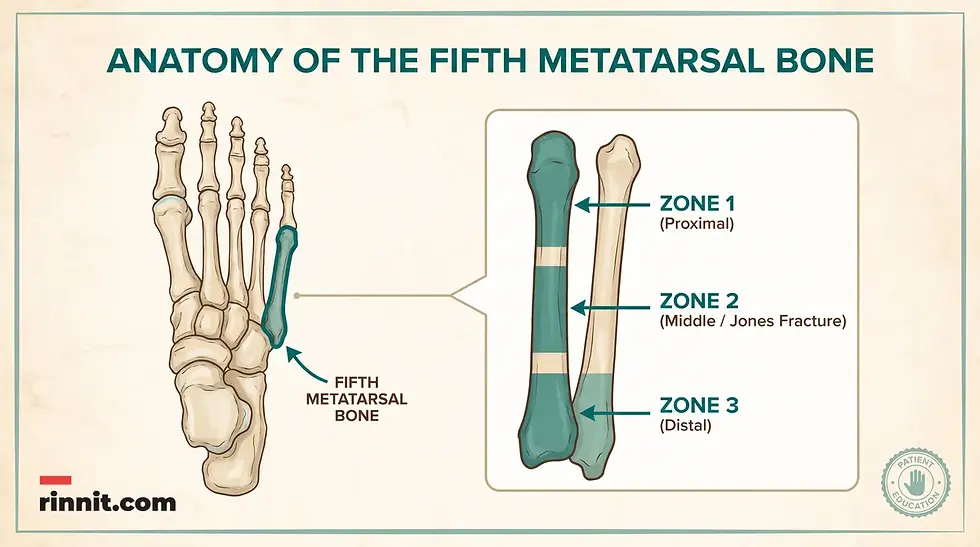
To diagnose a Jones fracture, a healthcare provider will conduct a physical examination and review the patient's activity at the time of injury. Imaging tests are essential for confirming the break and determining its exact location. X-rays are the most common tool, though MRIs or CT scans may be used to provide more detail if a stress fracture is suspected. Providers typically classify these fractures into three distinct zones, which helps determine the best course of treatment. [1]
The three zones of a fifth metatarsal fracture include: [1]
Zone 1: Located at the end of the bone closest to the middle of the foot. These usually heal well with simple immobilization.
Zone 2: The middle section or "body" of the bone. Fractures here usually require surgical intervention to ensure proper alignment.
Zone 3: The section that connects to the pinkie toe bones. These are usually stress fractures that take longer to heal and sometimes need surgery.
How is a Jones fracture treated, and what is recovery like?
The treatment for a Jones fracture depends on the severity and location of the break. For less severe injuries, immobilization in a cast or walking boot for six to eight weeks may be sufficient. In some cases, a procedure called a closed reduction is performed, where a doctor manually realigns the bone under anesthesia. However, due to the high risk of non-healing, many Jones fractures require surgery. The most common surgical method is Open Reduction and Internal Fixation (ORIF), where a surgeon uses pins or screws to hold the bone fragments together. [1]
Recovery is a gradual process that requires patience to prevent re-injury. Following surgery or immobilization, patients typically undergo physical therapy to restore strength and flexibility. While symptoms often improve within a few weeks, full return to sports and high-impact activities usually takes three to four months. It is vital to follow a healthcare provider's guidance on weight-bearing, as returning to activity too soon significantly increases the risk of the bone breaking again. [1]


Learn more. For more evidence-based health guides, visit Rinnit.com.
Frequently Asked Questions
Why is it called a "dancer's fracture"?
A Jones fracture earned this nickname because it often occurs when a person lands on their toes with their heel lifted, a common movement in dance and gymnastics.
Will I always need surgery for a Jones fracture?
Not always. Zone 1 fractures often heal with a boot or cast, while Zone 2 fractures usually need surgery and Zone 3 fractures sometimes do. Your provider will recommend treatment based on which zone is broken and how severe the break is.
How long until I can walk normally again?
Initial healing takes 6 to 8 weeks, but it may take 3 to 4 months before you can resume all normal activities, including sports.
What is a nonunion?
A nonunion occurs when the broken pieces of bone fail to grow back together. Jones fractures carry a higher risk of this because the bones in your feet get less blood than other parts of your body.
Can I re-break the same bone?
Yes. Jones fractures have a high risk of breaking again, especially if you return to physical activity before the bone is fully healed.
What does ORIF stand for?
ORIF stands for Open Reduction and Internal Fixation, a surgical procedure used to set and stabilize broken bones with pins or screws.
Are X-rays enough to see the fracture?
In most cases, yes. However, if it is a stress fracture, an MRI or CT scan might be needed for a clearer view.
Should I use ice for the swelling?
Yes, applying ice and keeping the foot elevated can help manage pain and swelling in the initial stages of the injury.
What happens if the bone doesn't heal?
If a nonunion occurs, a surgeon may need to perform a bone graft, using donor bone tissue to help the bone rejoin.
Can I drive with a Jones fracture?
This depends on which foot is injured and whether you are wearing a boot or cast. You should consult your doctor for safety advice.
Is physical therapy mandatory?
While not always mandatory, it is highly recommended to help you safely regain strength and mobility and prevent future injuries.
What are the signs of a surgical site infection?
Warning signs include new swelling, skin discoloration, heat or warmth near the surgery site, severe pain that does not improve with medication, and draining, pus or a bad smell coming from the incision area. Contact your provider right away if you notice any of these.
Does age affect recovery time?
Generally, yes. Older adults may experience slower healing times, though a full recovery is still expected with proper care.
Can I use a knee scooter instead of crutches?
Many patients find knee scooters more convenient than crutches for maintaining mobility while keeping weight off the injured foot. Ask your provider which option is right for you.
When is it safe to return to the gym?
You should only return to the gym once your healthcare provider has cleared you for weight-bearing and low-impact exercise.
Conclusion
A Jones fracture is a significant injury that requires careful management to ensure a full recovery. By understanding the importance of immobilization and following a structured rehabilitation plan, patients can successfully return to their active lifestyles. Patience is the key to preventing complications and ensuring the long-term health of the foot.
References
Cleveland Clinic. Jones Fracture. Cleveland Clinic. Last updated April 23, 2026. https://my.clevelandclinic.org/health/diseases/22239-jones-fracture
Attia AK, Taha T, Kong G, et al. Return to Play and Fracture Union After the Surgical Management of Jones Fractures in Athletes: A Systematic Review and Meta-analysis. Am J Sports Med. 2021;49(12):3422-3436. PMID 33740393. https://doi.org/10.1177/0363546521990020
Encinas R, Hall Kiriluk S, DePaolo S, et al. Clinical Outcomes and Complications of Surgical and Conservative Treatment for Jones Fractures: A Systematic Review. J Am Acad Orthop Surg. 2026;34(21):e3115-e3124. PMID 42319275. https://doi.org/10.5435/JAAOS-D-25-01516
Medical disclaimer
This article is for educational purposes only and is not intended as medical advice. Always seek the advice of your physician, podiatrist, or other qualified health provider with any questions you may have regarding a medical condition or foot injury.



Comments