Internuclear Ophthalmoplegia (INO)

Updated: 2 days ago
Medically reviewed by Dr. Baraa Alnahhal, MD · Last reviewed: October 2026
Quick Answer: What Is Internuclear Ophthalmoplegia?
Internuclear ophthalmoplegia is an eye movement disorder in which one eye cannot move toward the nose during horizontal gaze. The affected eye moves normally in other directions but stays centered when the person looks toward the opposite side. It results from disrupted communication between the nerves coordinating eye muscles, within the brainstem's medial longitudinal fasciculus.
What the research says
Stroke and multiple sclerosis are the leading causes, and the pattern differs by side. In a retrospective review of 33 patients with INO at a UK tertiary hospital, 69.7% of cases were stroke-related and 30.3% were due to multiple sclerosis; 90% of unilateral cases were attributed to stroke, while 61.5% of bilateral cases were attributed to MS (Simmons & Rhodes, British and Irish Orthoptic Journal, 2022). [4]
Many people recover. A review of 27 reported cases of INO after traumatic brain injury found that 65% regained full function at a median of 3 months, and 91% had at least partial recovery at 4.5 months (Chen et al., World Neurosurgery, 2017). [5]
Surgery can help selected patients with a persistent outward eye turn. Among 7 patients who had strabismus surgery for INO with exotropia, 5 were aligned (orthotropic) at distance at their latest follow-up and all reported relief of double vision in primary gaze, with or without prisms (Nelson & Peragallo, Strabismus, 2022). [6]
Key Takeaways
Feature | Description |
Primary Symptom | One eye remains centered while the other moves to the side. |
Core Cause | Damage to the medial longitudinal fasciculus (MLF) pathway. |
Common Triggers | Multiple sclerosis (MS), stroke, trauma, and brainstem tumors. |
Vision Impact | Double vision (diplopia), blurring, and dizziness. |
Diagnosis | Clinical eye exam supported by MRI or CT imaging. |
Treatment | Addressing the underlying cause; prism glasses or botox for symptoms. |

Understanding Eye Coordination and INO
Eye movement is a complex process requiring perfect synchronization between the brain and the muscles surrounding the eyes. In a healthy system, when you look to the right, your right eye moves outward and your left eye moves inward simultaneously.
Internuclear ophthalmoplegia disrupts this harmony. The condition is named for where the problem lies: "inter-" (between) and "nuclear" (referring to the nerve nuclei). It signifies a break in the connection between the nerves that control horizontal movement.
Unilateral vs. Bilateral INO
Unilateral INO: Only one eye is affected. This is frequently seen in patients who have suffered a stroke.
Bilateral INO: Both eyes are affected. This is a classic sign often associated with multiple sclerosis (MS).
Common Symptoms of INO
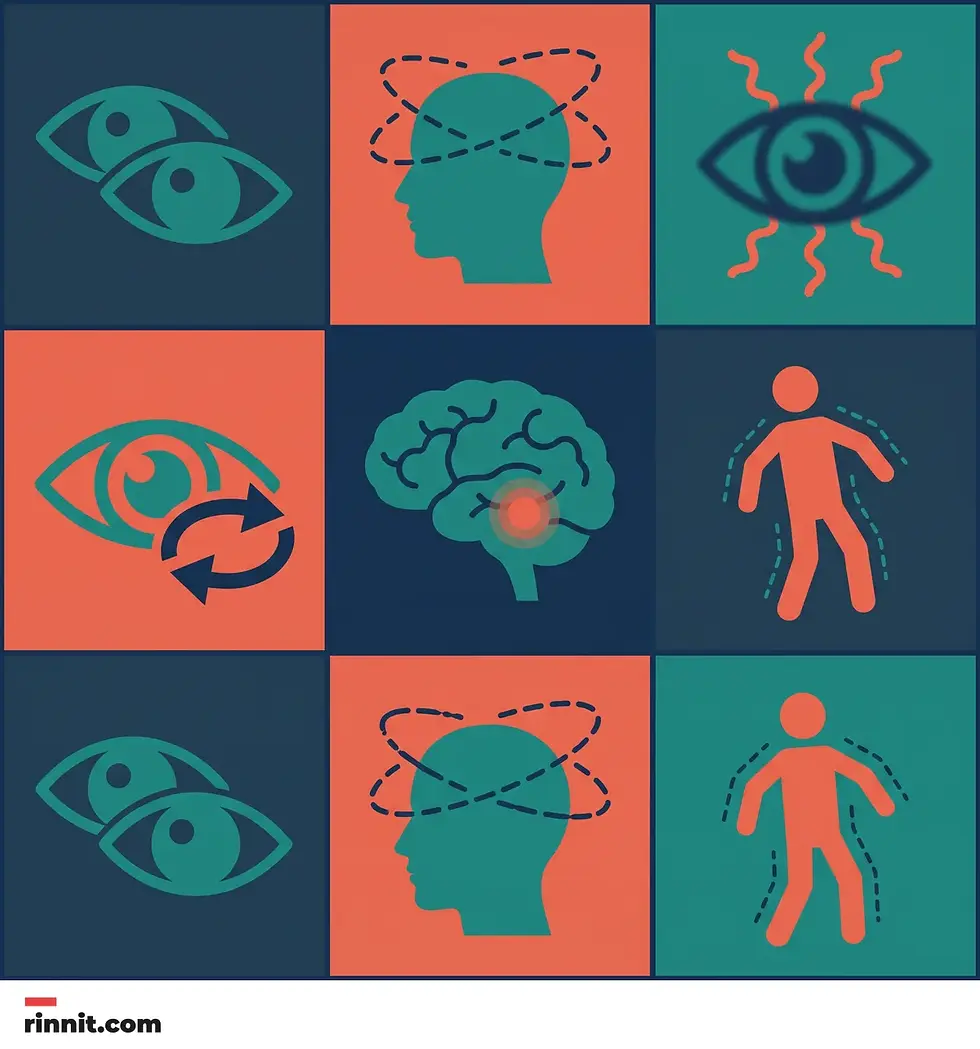
The most distinct sign of INO is the physical misalignment during a side-glance. However, the patient often experiences several internal sensory symptoms.
Symptom | Details |
Horizontal Diplopia | Seeing two images when looking to the side. |
Nystagmus | The "good" eye may shake or jerk quickly when looking to the side. |
Blurred Vision | General loss of visual clarity during movement. |
Dizziness | A sense of vertigo or instability when tracking objects. |
Loss of Depth Perception | Difficulty judging distances due to eye misalignment. |
What Causes MLF Damage?
The medial longitudinal fasciculus (MLF) is a highly myelinated nerve tract. Because it is so rich in myelin, it is particularly susceptible to diseases that attack this protective coating.
Neurological and Vascular Causes
Stroke is a leading cause of INO, particularly when the blood supply to the brainstem is compromised. Multiple sclerosis is the most common cause in younger adults, as the disease causes inflammation and scarring along the MLF.
Other Potential Triggers
Autoimmune Disorders: Conditions like lupus, Sjögren’s syndrome, and sarcoidosis can cause inflammation in the central nervous system. [1]
Infections: Lyme disease, HIV, and syphilis are known to occasionally affect the brainstem pathways. [1]
Trauma: Severe head injuries or concussions can physically damage the delicate nerve fibers. [1]
Tumors: Growth in the brainstem can put pressure on the MLF, blocking signals. [1]
Diagnosis and Testing
Diagnosis typically begins with a thorough clinical examination by a neurologist or neuro-ophthalmologist. The provider will ask the patient to follow a target (like a finger or pen) to observe the eye's range of motion.
Imaging and Laboratory Work
To identify the exact cause of the nerve damage, doctors rely on advanced testing:
MRI (Magnetic Resonance Imaging): The gold standard for visualizing brainstem lesions or MS plaques.
CT Scan: Used in emergency settings to rule out hemorrhage or large tumors.
Lumbar Puncture: A "spinal tap" to check for markers of MS or specific infections.
Blood Panels: Testing for autoimmune markers, Lyme disease, or nutritional deficiencies.
Treatment and Management Strategies
Treatment for INO is almost entirely focused on the underlying condition. There is no single "eye surgery" that fixes the MLF; instead, the nerve must be allowed to heal or the primary disease must be managed.
Addressing the Root Cause
If the cause is an infection, targeted antibiotics or antivirals often lead to a full recovery. For MS or autoimmune issues, steroids and disease-modifying therapies are used to reduce inflammation.
Symptomatic Relief
Treatment | Purpose |
Prism Glasses | Special lenses that align the two images to eliminate double vision. |
Eye Patching | Temporarily covering one eye to stop the brain from receiving conflicting images. |
Botulinum Toxin | Injections to relax overactive eye muscles and improve alignment. |
Vision Therapy | Exercises designed to help the brain adapt to eye movement changes. |

Recovery and Outlook
The prognosis for internuclear ophthalmoplegia varies significantly based on the etiology. Patients with INO caused by infection or minor trauma often see a complete resolution of symptoms within weeks or months.
For those with chronic conditions like MS or those recovering from a major stroke, some degree of eye weakness may persist. However, many patients learn to compensate for the vision changes, and modern assistive devices like prisms significantly improve quality of life.
Conclusion
Internuclear ophthalmoplegia is a complex neurological sign that requires immediate medical attention to identify the underlying cause. Whether it is a temporary hurdle or a sign of a long-term condition, early diagnosis is key to protecting both vision and overall neurological health.
For more resources on managing health conditions visually, explore our infographic templates.
FAQ
What is the main sign of INO?
One eye stays in the middle while the other moves to the side.
Is INO a stroke?
It can be a symptom of a stroke in the brainstem.
Does MS always cause INO?
No, but INO is a common sign of MS, especially if it affects both eyes.
Can INO be cured?
It often resolves if the underlying cause is treated.
What is the MLF?
The medial longitudinal fasciculus, a nerve pathway for eye coordination.
Why do I see double with INO?
Because the eyes are not looking at the same point simultaneously.
Is INO painful?
The condition itself isn't usually painful, though the cause might be.
How is INO diagnosed?
Through a physical eye movement exam and brain imaging.
What is nystagmus in INO?
A jerking motion in the eye that is moving outward.
Can children get INO?
Yes, though it is more common in adults due to stroke and MS.
Is INO a permanent condition?
Not always; it can be temporary depending on the cause.
Do I need surgery for INO?
Usually no; treatment focuses on the underlying disease.
What are prism glasses?
Lenses that bend light to help align double vision.
Can Lyme disease cause INO?
Yes, it is a known infectious cause.
What is unilateral INO?
When only one eye is unable to move inward.
What is bilateral INO?
When both eyes are unable to move inward.
How does a brainstem tumor cause INO?
By pressing on the MLF pathway.
Can trauma cause INO?
Yes, a severe head injury can damage the nerve tracts.
What is the difference between INO and a lazy eye?
INO is a neurological coordination issue, not a muscle strength issue.
Can botox help INO?
Yes, it can relax muscles to improve alignment.
Does an eye patch help?
It can stop double vision but doesn't fix the nerve.
How long does recovery take?
Weeks to months, depending on the cause.
Is INO an emergency?
Yes, it can signal a stroke or acute neurological event. If double vision or eye misalignment starts suddenly, especially with weakness, numbness, slurred speech, severe dizziness or trouble walking, call 911 or your local emergency number.
Can lupus cause INO?
Yes, through central nervous system inflammation.
What is the oculomotor nerve?
One of the nerves that coordinates with the MLF.
What is the abducens nerve?
The nerve that moves the eye outward, which jerk in INO.
Can Sjögren’s syndrome cause INO?
Yes, it is a rare but possible cause.
Does INO affect vertical vision?
Usually no, it primarily affects horizontal gaze.
Can I drive with INO?
Only if double vision is corrected with prisms or a patch.
What is the "adducting" eye?
The eye that is supposed to move toward the nose.
What is the "abducting" eye?
The eye that moves away from the nose.
Why is the MLF myelinated?
To allow for rapid signal transmission for fast eye movements.
Can syphilis cause INO?
Yes, as part of neurosyphilis.
Is INO visible to others?
Yes, someone looking at you can see the eye misalignment.
Does INO cause headaches?
Eye strain from double vision can lead to headaches.
Can vitamin deficiency cause INO?
It is rare but theoretically possible.
What is a lumbar puncture?
A test that checks spinal fluid for MS markers.
Is a CT scan enough to see INO?
An MRI is usually better for seeing the small MLF tract.
Can a hemorrhage cause INO?
Yes, if it occurs in the brainstem.
What is vision therapy?
Exercises to help the brain process visual information.
Can sarcoidosis cause INO?
Yes, if it affects the nervous system.
Does INO affect reading?
Yes, double vision makes reading very difficult.
Is INO related to vertigo?
It can cause a similar feeling of dizziness.
Can herpes zoster cause INO?
Yes, it is a potential infectious trigger.
What is the brainstem?
The part of the brain where the MLF is located.
Can INO happen suddenly?
Yes, especially if caused by a stroke or trauma.
Does age matter for INO?
Causes vary by age (MS in young, stroke in old).
Can I exercise with INO?
Generally yes, but dizziness may limit activity.
Will my eyes ever move together again?
Many patients see full or significant recovery.
Who treats INO?
A neurologist or a neuro-ophthalmologist.
Related Reading
Sources
Cleveland Clinic. Internuclear ophthalmoplegia: symptoms, causes & treatment. Cleveland Clinic. Last updated March 16, 2026. https://my.clevelandclinic.org/health/diseases/24818-internuclear-ophthalmoplegia
Feroze KB, Wang J. Internuclear ophthalmoplegia. In: StatPearls [Internet]. Treasure Island (FL): StatPearls Publishing; updated 2023 Jun 26. PMID 28722999. https://www.ncbi.nlm.nih.gov/books/NBK441970/
American Academy of Ophthalmology. Internuclear ophthalmoplegia. EyeWiki. Up to Date as of August 9, 2026. https://eyewiki.org/Internuclear_Ophthalmoplegia
Simmons J, Rhodes M. Conservative and surgical management of unilateral and bilateral internuclear ophthalmoplegia (INO): a retrospective analysis. British and Irish Orthoptic Journal. 2022;18(1):152-158. PMID 36420121. https://doi.org/10.22599/bioj.280
Chen KT, Lin TK, Hsieh TC. Isolated internuclear ophthalmoplegia after massive supratentorial epidural hematoma: a case report and review of the literature. World Neurosurgery. 2017;100:712.e5-712.e13. PMID 28143728. https://doi.org/10.1016/j.wneu.2017.01.071
Nelson DG, Peragallo JH. Strabismus surgery outcomes for internuclear ophthalmoplegia with exotropia. Strabismus. 2022;30(2):65-71. PMID 35438603. https://doi.org/10.1080/09273972.2022.2061528
Disclaimer
The information provided in this article is for educational purposes only and should not be considered medical advice. Always consult with a qualified healthcare professional for diagnosis and treatment of any medical condition.



Comments