Internal Stye: Recognizing Symptoms and Effective Treatments

Updated: 2 days ago
Medically reviewed by Dr. Baraa Alnahhal, MD · Last reviewed: October 2026
Quick Answer
An internal stye is an infection of a meibomian gland on the inner side of the eyelid, usually caused by Staphylococcus aureus. Symptoms include pain, tenderness and swelling in one area of the eyelid, redness and watery eyes. Warm compresses for 10 to 15 minutes about three times a day help, and it usually clears within a week or two. [1]
What the research says
There are no trials proving that home treatments work for internal styes. A Cochrane systematic review searched for randomized or quasi-randomized trials of non-surgical treatments (warm compresses, lid scrubs, antibiotics or steroids) for acute internal hordeolum and found none. The authors reported no evidence for or against these treatments, and noted that in many cases the lesion drains spontaneously, but it can spread to other glands or tissues, recur, or turn into a chalazion. (Lindsley et al., Cochrane Database Syst Rev, 2017)
Acupuncture studies are small and low certainty. A Cochrane review of 6 randomized trials (531 participants, all from China) found low to very low certainty evidence that acupuncture, with or without conventional treatment, may give short-term benefit in acute hordeolum. For example, in one trial of 120 participants resolution was more likely with acupuncture than with oral antibiotics plus warm compresses (risk ratio 1.45, 95% CI 1.18 to 1.78). The trials had no valid sham control and follow-up was 7 days or less, so acupuncture is not a standard recommendation. (Cheng et al., Cochrane Database Syst Rev, 2017)
What is an internal stye?
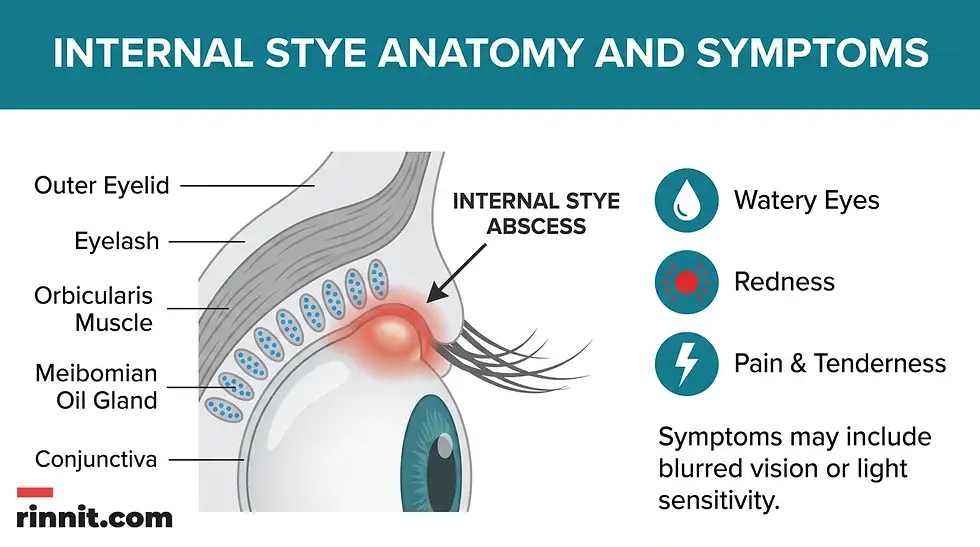
An internal stye (hordeolum) is an inflamed oil gland on the inner edge of your eyelid. A bacterial infection is the usual cause. The gland swells and forms an abscess (a pocket of pus), which leads to pain and other symptoms. While the stye may go away on its own, some people need a minor procedure to drain the pus and clear the inflammation. [1]
Primary care providers often see and diagnose styes. Your provider may refer you to an ophthalmologist or optometrist if your stye isn't going away or is getting worse. [1]
Who gets internal styes?
Children and adults of all ages can develop internal styes, and they are especially common among school-age children and adults age 30 to 50. A stye overall is one of the most common eye conditions, but internal styes aren't as common as external ones. [1]
Internal vs. external stye
The main difference is where the stye sits on the eyelid. An external stye forms on the outer edge of the eyelid, faces outward and looks a bit like a small pimple. An internal stye develops on the inner side of the eyelid, faces your eyeball and looks like a small bump that may be yellowish or white. [1]

Feature | Internal stye | External stye |
Location | Inner side of the eyelid, facing the eyeball [1] | Outer edge of the eyelid [1] |
Appearance | Small bump, may be yellowish or white [1] | Looks like a small pimple [1] |
Pain and duration | Usually more painful and lasts longer [1] | Usually less painful and shorter [1] |
How common | Less common [1] | More common [1] |
Symptoms
An internal stye is painful. Symptoms often appear suddenly, such as when you first wake up in the morning. [1]
Pain, tenderness and swelling in one area of the eyelid
Red skin on the eyelid
Watery eyes
A feeling that there's something in your eye
Causes and risk factors
An internal stye forms when one of your meibomian glands becomes infected. You have dozens of these glands along the edges of your eyelids, and they make oils that help protect and lubricate your eyes. Usually the bacterium Staphylococcus aureus is responsible. The infection may happen if you: [1]
Touch your eyes without washing your hands first
Don't properly clean your contact lenses, or put them in without washing your hands
Use old or contaminated makeup
Have another eye condition that makes you more susceptible to infection
A main risk factor is having had a stye before, because in many people styes keep coming back. You also face a higher risk if you have blepharitis (inflammation of the eyelid), diabetes, hyperlipidemia, rosacea or seborrheic dermatitis. [1]
Is an internal stye contagious?
A stye usually isn't contagious. However, the pus that drains from a stye contains a small amount of bacteria that could potentially spread to others, so wash your hands after touching your eye area and wash your pillowcase and towel or washcloth daily. Unless a provider tells you otherwise, it's OK to go to work or school. [1]
How an internal stye is diagnosed
Providers diagnose an internal stye by examining your eye and talking with you about your symptoms. Usually you don't need any testing. Rarely, a provider will recommend a biopsy to rule out serious conditions such as sebaceous carcinoma. [1]
Treatment and recovery
Treatment usually starts with the same home remedies used for external styes: [1]
Warm compress: apply a clean, soft washcloth soaked in warm water to your eyelid for 10 to 15 minutes about three times a day. You may want to use boiled or distilled water, and make sure the compress isn't too hot, because your eyelids are delicate and can be burned.
Gentle massage: massage your eyelid gently with your fingertips.
These remedies may relieve your symptoms and may help the stye soften and drain. Ask a provider before using any over-the-counter treatments such as drops, eyelid scrubs or ointments. [1]
Be aware that home remedies typically help external styes but may not help internal styes, and as the research above shows, there are no trials proving them for internal styes. So you may need other treatment, including: [1]
A minor procedure to cut and drain the stye, performed by an ophthalmologist
Oral antibiotics, if the infection spreads to the skin around your eye (periorbital cellulitis)

What not to do
Outlook
Yes, your stye should go away with treatment, usually within a week or two, and most people have an excellent outlook. [1]
How to prevent styes
Keep your eye area clean: make a gentle soap by mixing baby shampoo with water and use it to wash your closed eyelids and eyelashes. [1]
Avoid touching your eyes: if you must, wash your hands first. [1]
Contact lens care: wash your hands before putting in or removing contacts and disinfect them with cleaning solution made for that purpose. [1]
Makeup habits: remove eye makeup with a gentle remover every day, throw out mascara or eyeliner two to three months after you start using it, and never share eye makeup. [1]
When to see a healthcare provider
Seek medical care right away if: [1]
You have a fever or chills
There are changes to your vision
The eyelid swelling is getting worse or your eyelid is swollen shut
Home remedies are making the pain worse
Your eyelid feels hot to the touch
There's thick pus or blood coming out of the stye
You have blisters on your eyelid
If you keep getting styes, talk to an eye care provider. In some cases, simple changes such as switching from contacts to glasses or keeping the eye area extra clean can help. [1]
Related reading
Frequently Asked Questions
Is an internal stye contagious?
Generally no. However, pus that drains from a stye contains a small amount of bacteria, so wash your hands after touching your eye area and wash your pillowcase and towel or washcloth daily.
Can I go to work or school with a stye?
Yes. Unless a provider tells you otherwise, it's OK to go to work or school.
How long does an internal stye last?
An internal stye should go away with treatment, usually within a week or two. If it doesn't go away in about a week, you may need a minor procedure to drain it.
What is the best way to clean my eyelids?
Mix baby shampoo with water to make a gentle soap and use it to wash your closed eyelids and eyelashes.
Why do I keep getting styes?
Having had a stye is the main risk factor, and conditions such as blepharitis, diabetes, hyperlipidemia, rosacea and seborrheic dermatitis raise the risk. An eye care provider can help find the cause.
Can I use over-the-counter eye drops, scrubs or ointments?
Ask a provider first before using any over-the-counter treatment for a stye.
Does a warm compress really help?
A warm compress may relieve symptoms and may help the stye soften and drain, and it's the standard first step. But there are no clinical trials proving it for internal styes, and home remedies may not help internal styes as much as external ones.
What happens if a stye doesn't drain?
An ophthalmologist can perform a minor procedure to cut and drain it. If the infection spreads to the skin around the eye, oral antibiotics may be needed.
Can I pop or squeeze a stye?
No. Don't try to pop or squeeze it. Let it drain on its own or have a provider drain it.
Should I see an optometrist or an ophthalmologist?
Your primary care provider can often diagnose a stye and may refer you to either one. An ophthalmologist performs the minor procedure to drain a stye.
Can children get internal styes?
Yes. Internal styes are especially common among school-age children.
Is an internal stye the same as a chalazion?
No. A stye is an acute infection of an oil gland, while a chalazion is a lump from a blocked oil gland that isn't infected. An unresolved internal stye can develop into a chalazion.
Can a stye be a sign of cancer?
Rarely. If a stye doesn't behave like a typical stye, a provider may recommend a biopsy to rule out serious conditions such as sebaceous carcinoma.
Can I wear contact lenses or makeup with a stye?
No. Avoid contact lenses and eye makeup until the stye has cleared. Switching to glasses is a sensible alternative.
When is a stye an emergency?
Seek care right away for fever or chills, vision changes, worsening swelling or a swollen-shut eyelid, a hot eyelid, thick pus or blood, blisters, or pain that gets worse with home remedies.
References
Cleveland Clinic. Internal Stye. Cleveland Clinic. Last updated November 28, 2022. https://my.clevelandclinic.org/health/diseases/24478-internal-stye
Lindsley K, et al. Non-surgical interventions for acute internal hordeolum. Cochrane Database Syst Rev. 2017;1(1):CD007742. PMID 28068454. https://doi.org/10.1002/14651858.CD007742.pub4
Cheng K, et al. Acupuncture for acute hordeolum. Cochrane Database Syst Rev. 2017;2(2):CD011075. PMID 28181687. https://doi.org/10.1002/14651858.CD011075.pub2
Medical disclaimer
This article is for general educational purposes only and is not a substitute for professional medical advice, diagnosis, or treatment. If you think you may have a medical emergency, call your doctor or 911 immediately.



Comments