Inherited Metabolic Disorders: Symptoms, Causes, and Treatment

Updated: 1 day ago
Medically reviewed by Dr. Baraa Alnahhal, MD. Last reviewed October 13, 2026. This content is for educational purposes and is not medical advice.

Quick Answer
Inherited metabolic disorders are a group of hundreds of rare conditions caused by gene changes that disrupt metabolic enzymes, so substances build up or go missing in the body. [1] [2] Most are inherited from both parents. [1] They may be found before birth, through newborn screening or when symptoms appear. [2] [3] Treatment varies by type and includes special diets, enzyme replacement and medicines. [2]
What the research says
Lifelong treatment protects thinking skills in PKU. An evidence-based American College of Medical Genetics and Genomics (ACMG) guideline, built on a systematic review, found that people whose phenylalanine (Phe) levels stay at or below 360 μmol/L for life have better intellectual outcomes, and it strongly recommends lifelong treatment to keep Phe at or below that level, plus genetic testing for PAH variants at birth to confirm the diagnosis (Smith et al., Genetics in Medicine, 2025). [6]
Most patients in one large review inherited changes from both parents. A systematic review of 218 articles on 13 inborn-error genes in Chinese patients found biallelic variants in 525 of 575 patients (91.3%); 231 patients (40.17%) were identified through newborn screening and 344 (59.83%) after symptoms appeared (Guo et al., Orphanet Journal of Rare Diseases, 2023). [7]
Evidence for some add-on treatments is still thin. A Cochrane review of tyrosine supplements for PKU found only three suitable trials with 56 participants in total; blood tyrosine rose (mean difference 23.46, 95% CI 12.87 to 34.05), but no differences were found in the other outcomes measured, and the authors could not recommend routine use (Remmington & Smith, Cochrane Database of Systematic Reviews, 2021). [8]
Newborn screening found about 1 in 2,600 babies affected. In a 7-year study of 245,194 newborns screened by tandem mass spectrometry in eastern coastal China, 95 were diagnosed with an inborn error of metabolism, an overall incidence of 1 in 2,581. Phenylketonuria was the most common disorder (1 in 7,211) (Men et al., Molecular Genetics & Genomic Medicine, 2023). [9]
Fast treatment of a metabolic crisis matters. A meta-analysis of 37 studies (642 children) on dialysis for inborn errors of metabolism found pooled mortality of 24.84% with continuous kidney replacement therapy, 34.42% with peritoneal dialysis, and 34.14% with hemodialysis. Mortality was higher when plasma ammonia before continuous kidney replacement was 1,000 µmol/L or more (31.94%) than when it was lower (15.04%) (Raina et al., Pediatric Nephrology, 2025). [10]
A liver transplant can bring metabolic stability in urea cycle disorders. One analysis found that liver transplantation prevented further hyperammonemic events and was associated with better growth than medical management, but it was not linked to better neurocognitive outcomes (Posset et al., Genetics in Medicine, 2024). [11]
Key facts at a glance
Fact | Detail |
Also called | Inborn errors of metabolism [1] |
Number of types | Hundreds, each caused by a different gene change [1] |
Typical inheritance | Most often from both parents; sometimes from one parent, usually the mother [1] |
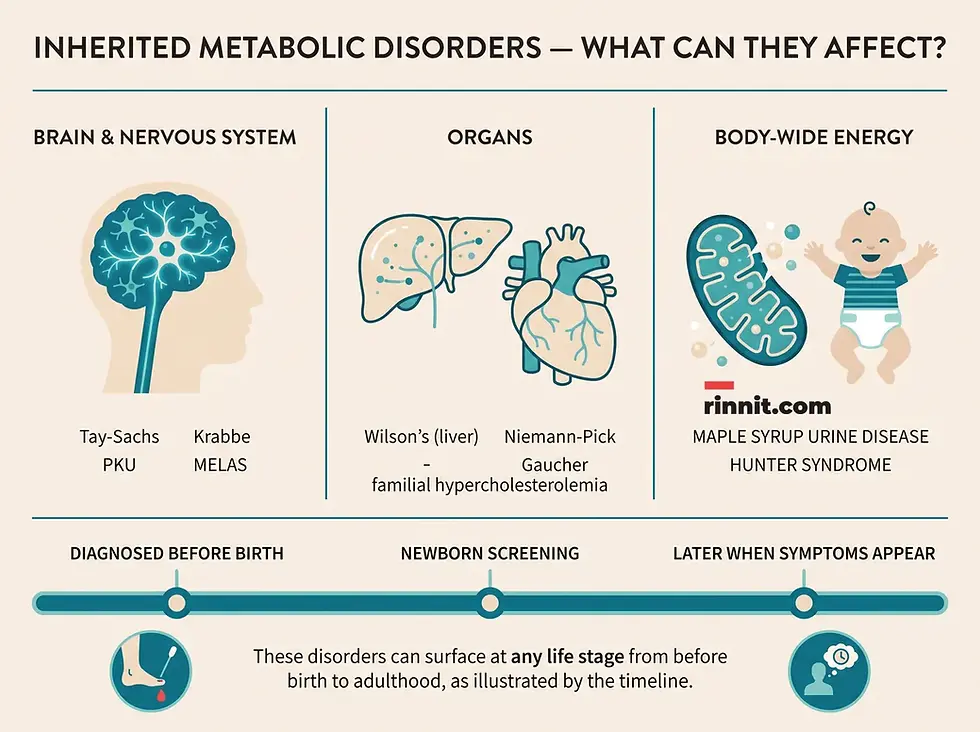
When diagnosed | Before birth, at newborn screening, or later when symptoms appear [2] |
Examples | Phenylketonuria (PKU), Wilson's disease, Tay-Sachs disease, Gaucher disease, maple syrup urine disease [1] |
Treatment | Special diets, enzyme replacement, vitamin therapy, medicines, liver transplant — varies by type [2] |
Care model | Multi-specialist team; life-long care with regular visits [2] |
What are inherited metabolic disorders?
Inherited metabolic disorders are medical conditions caused by changes in specific genes that affect metabolism. [1] Different gene changes cause different types of these disorders. Because so many types exist, doctors often refer to the whole group as inborn errors of metabolism.
Inborn errors of metabolism affect an estimated 1 out of every 2,500 births worldwide. [12]
Metabolism is the complex set of chemical reactions your body uses to maintain life. [1] These reactions do two main jobs. First, they make energy: special enzymes break down food or certain chemicals so the body can use them right away for fuel or store them for later use. Second, they make or get rid of substances: some chemical processes create substances the body needs, while others break down substances the body no longer needs. [1]
When these processes don't work properly, a metabolic disorder occurs. It may be due to an enzyme that's too low or missing, or to another problem. [1] Disorders are grouped by the substance affected and by whether that substance builds up too much because it can't be broken down, or whether it's too low or missing altogether. [1]
Symptoms
There are hundreds of inherited metabolic disorders caused by different genes, so there is no single set of symptoms. Symptoms depend on the type of disorder and how severe it is. [1]
Common symptoms include developmental delays, weight loss, growth challenges, seizures, poor appetite, low energy, unusual odors of urine, sweat or breath, and abdominal pain. Symptoms range from mild to severe and can be life-threatening if left untreated. Anyone who has a seizure needs emergency care right away. [12]
Well-known examples of inherited metabolic disorders include the following. [1]
Disorder | Brief note |
Phenylketonuria (PKU) | An amino acid builds up; usually detected by newborn screening |
Wilson's disease | Copper builds up, especially in the liver |
Tay-Sachs disease | Affects the brain and nervous system |
Gaucher disease | A substance builds up in organs such as the spleen and liver |
Maple syrup urine disease | Branched-chain amino acids build up; name comes from the odor |
Familial hypercholesterolemia | Very high cholesterol inherited in families |
Hunter syndrome | A substance builds up throughout the body |
Krabbe disease | Affects the nervous system |
MELAS | Mitochondrial encephalopathy, lactic acidosis, stroke-like episodes |
Metachromatic leukodystrophy | Affects the nervous system's myelin |
Niemann-Pick | A substance builds up in organs |
Porphyria | Affects enzymes involved in making heme |
Common groups include lysosomal storage disorders, in which waste products are not broken down and toxins build up; glycogen storage disease, in which the body cannot store sugar and blood sugar runs low; mitochondrial diseases, in which cells cannot make enough energy; metal metabolism disorders such as hemochromatosis, in which iron builds up; and urea cycle disorders, in which ammonia builds up in the blood. [12]
When to see a doctor
If you have concerns about your child's growth and development, or about your own health, talk to your doctor or another healthcare professional. Many of these disorders surface in early childhood, so unexplained developmental delays, feeding problems, or unusual symptoms in an infant or child are worth raising with a clinician.
Causes
Inherited metabolic disorders are caused by changes in specific genes that affect metabolism. [1] Different gene changes cause different types of inherited metabolic disorders.
These gene changes are most commonly passed down from both parents. [1] But sometimes the gene change comes only from one parent, most often from the mother. [1] With hundreds of different gene changes involved across the group, each inherited metabolic disorder has its own inheritance pattern and its own way of disrupting the body's chemistry.
Risk factors
The risk of an inherited metabolic disorder is higher if one or both parents have the gene change that can cause the condition. [1]
In some cases, future parents may decide to have carrier testing before pregnancy. This test can identify some gene changes in parents that may raise the risk that future children will have certain types of inherited metabolic disorders. [1] [3]
How are inherited metabolic disorders diagnosed?
Some inherited metabolic disorders may be diagnosed before birth. Others can be diagnosed by routine newborn screening tests done at birth. Still others are identified only after a child or adult shows symptoms of a disorder. [2] [3]
To find out if you or your child has an inherited metabolic disorder, healthcare providers may use the following steps.
Step | What it involves |
Physical exam | Discussion of symptoms and medical history, including any family history [2] |
Blood and urine tests | Check how the metabolism is working [2] |
Genetic testing | Can identify the specific type of inherited metabolic disorder [2] |
Genetic counseling | Discussion of newborn screening or other genetic testing, plus the risk of a disorder for future children [2] |
Specialist exams | Some disorders raise the risk of other conditions, such as heart, vision, or hearing problems, and may require referral to other specialists [2] |
Other tests can include amniocentesis during pregnancy to look for genetic changes in the fetus, a blood sugar check when there is lethargy or seizures, and an eye exam, because some of these disorders affect vision. [12]
If one person in the family has an inherited metabolic disorder, specialists often recommend genetic testing and counseling for other family members as well. [2]
How are inherited metabolic disorders treated?
Treatment depends on the type of inherited metabolic disorder and how severe it is. [2] Because there are so many types, treatment can vary a great deal. [2]
Examples of treatments include the following.
Treatment | How it helps |
Special diets | Limits or removes the substance the body cannot process |
Enzyme replacement | Supplies the missing enzyme |
Vitamin therapy | Gives vitamins that support the affected metabolic pathway |
Medicines | Manages buildup or supports the missing process |
Liver transplant | Used for some types of disorders |
Sometimes care begins with a stay in the hospital. [2] For some types of inherited metabolic disorders, there are no treatments currently available. [2]
Medicines can include amino acid supplements and drugs that lower toxin levels, and dialysis can remove toxins from the blood. There is no cure for inborn errors of metabolism, and when toxic substances build up they can cause seizures, organ failure or brain damage. [12]
A team approach for rare, complex conditions
Inherited metabolic disorders are rare and complex. [2] Depending on the type and severity of the disorder and the patient's age, several experts may be involved in care. [2]
Specialist | Role in care |
Medical genetics | Diagnoses and coordinates the metabolic workup |
Nutrition | Designs and adjusts special diets |
Pediatrics / developmental pediatrics | Follows growth and development in children |
Nervous system (neurology) | Manages disorders affecting the brain and nerves |
Endocrine and metabolic disorders | Manages chemical and hormone imbalances |
Heart and blood vessels | Monitors heart-related complications |
Ear, nose and throat (ENT) | Addresses hearing and ENT complications |
Eyes and vision | Monitors vision-related complications |
Digestive system | Manages liver and gut involvement |
Kidneys | Monitors kidney-related complications |
Life-long care with regular healthcare visits is important. [2] These visits catch problems early and adjust treatment as needed. [2]

Conclusion
Inherited metabolic disorders are a large family of rare, gene-driven conditions that disrupt the chemical reactions of life itself. The symptoms, severity, and outlook depend on which disorder is involved, and some types are found at birth while others surface later in childhood or adulthood.
If a metabolic disorder is suspected — in a newborn screening result, in family history, or in unexplained symptoms — the most important step is to connect with a healthcare professional who can arrange testing and, when needed, genetic counseling. Treatment today ranges from special diets and enzyme replacement to liver transplant, and a multi-specialist team supports life-long care.
Take action
If a metabolic disorder runs in your family, ask your doctor about carrier testing before pregnancy and genetic counseling. If your child's newborn screening flags a concern, follow up promptly with the recommended testing. And if you're living with a metabolic disorder, keep every specialist visit — regular check-ins are what catch problems early and keep treatment tuned.
Frequently Asked Questions
What is the difference between an inherited metabolic disorder and a regular metabolic problem? An inherited metabolic disorder is caused by a specific gene change passed down from parents, which disrupts an enzyme of metabolism. Other metabolic problems — like diabetes or thyroid disease — usually develop from other causes rather than being directly inherited as a single-gene condition.
What are the symptoms of an inherited metabolic disorder? There is no single symptom list, because there are hundreds of types. [1] Symptoms depend on the specific disorder and how severe it is. [1] Some types are found before birth or at routine newborn screening, while others are identified after a child or adult shows symptoms such as developmental delays, unusual feeding or growth patterns, or organ problems.
How are inherited metabolic disorders inherited? The gene changes are most commonly passed down from both parents. [1] Sometimes the gene change comes from only one parent, most often the mother. [1] The risk is higher if one or both parents carry the gene change that can cause the condition. [1]
How are inherited metabolic disorders diagnosed? Some types are diagnosed before birth or through routine newborn screening tests done at birth. [2] Diagnosis for others involves a physical exam, blood and urine tests that check how the metabolism is working, and genetic testing, which can identify the specific type of disorder. [2] Genetic counseling often accompanies testing.
Can inherited metabolic disorders be treated? Treatment depends on the type and severity, and can vary a great deal. [2] Options include special diets, enzyme replacement, vitamin therapy, medicines, and liver transplants. [2] For some types, there are no treatments currently available. [2] Because these disorders are rare and complex, care usually involves several specialists and life-long follow-up visits. [2]
Trusted External Resources
References
Mayo Clinic Staff. Inherited metabolic disorders: Symptoms and causes. Mayo Clinic. January 12, 2024. https://www.mayoclinic.org/diseases-conditions/inherited-metabolic-disorders/symptoms-causes/syc-20352590
Mayo Clinic Staff. Inherited metabolic disorders: Diagnosis and treatment. Mayo Clinic. January 12, 2024. https://www.mayoclinic.org/diseases-conditions/inherited-metabolic-disorders/diagnosis-treatment/drc-20561225
Kruszka P, Regier D. Inborn Errors of Metabolism: From Preconception to Adulthood. Am Fam Physician. 2019;99(1):25-32. PMID 30600976. https://pubmed.ncbi.nlm.nih.gov/30600976/
Saudubray JM, Garcia-Cazorla À. Inborn Errors of Metabolism Overview: Pathophysiology, Manifestations, Evaluation, and Management. Pediatr Clin North Am. 2018;65(2):179-208. PMID 29502909. https://doi.org/10.1016/j.pcl.2017.11.002
Ferreira CR, Rahman S, Keller M, et al. An international classification of inherited metabolic disorders (ICIMD). J Inherit Metab Dis. 2021;44(1):164-177. PMID 33340416. https://doi.org/10.1002/jimd.12348
Smith WE, Berry SA, Bloom K, et al. Phenylalanine hydroxylase deficiency diagnosis and management: A 2023 evidence-based clinical guideline of the American College of Medical Genetics and Genomics (ACMG). Genet Med. 2025;27(1):101289. PMID 39630157. https://doi.org/10.1016/j.gim.2024.101289
Guo Y, Jiang J, Xu Z. Chinese genetic variation database of inborn errors of metabolism: a systematic review of published variants in 13 genes. Orphanet J Rare Dis. 2023;18(1):148. PMID 37308883. https://doi.org/10.1186/s13023-023-02726-1
Remmington T, Smith S. Tyrosine supplementation for phenylketonuria. Cochrane Database Syst Rev. 2021;1(1):CD001507. PMID 33427303. https://doi.org/10.1002/14651858.CD001507.pub4
Men S, Liu S, Zheng Q, et al. Incidence and genetic variants of inborn errors of metabolism identified through newborn screening: A 7-year study in eastern coastal areas of China. Mol Genet Genomic Med. 2023;11(6):e2152. PMID 36787440. https://doi.org/10.1002/mgg3.2152
Raina M, Doshi K, Myneni A, et al. Inborn errors of metabolism in neonates and pediatrics on varying dialysis modalities: a systematic review and meta-analysis. Pediatr Nephrol. 2025;40(7):2177-2188. PMID 39523291. https://doi.org/10.1007/s00467-024-06547-7
Posset R, Garbade SF, Gleich F, et al. Severity-adjusted evaluation of liver transplantation on health outcomes in urea cycle disorders. Genet Med. 2024;26(4):101039. PMID 38054409. https://doi.org/10.1016/j.gim.2023.101039
Cleveland Clinic. Inborn Errors of Metabolism (IEM). Cleveland Clinic. Last updated January 30, 2024. https://my.clevelandclinic.org/health/diseases/17962-inherited-metabolic-disorders



Comments