Ingrown Toenails: A Comprehensive Guide to Prevention and Treatment

Updated: 2 days ago
Medically reviewed by Dr. Baraa Alnahhal, MD · Last reviewed: October 17, 2026
Quick Answer
An ingrown toenail is a nail edge that grows into the skin, most often on the big toe, from cutting nails too short or rounded, tight shoes or injury. Symptoms include redness, swelling and a tender nail edge, while pus and warmth suggest infection. Warm soaks help, but people with diabetes or poor circulation should see a provider promptly. [1]
What the research says
Surgery prevents recurrence better than conservative care. A clinical review reports that ingrown toenails account for approximately 20% of foot problems in primary care and most often affect the great toe, mainly in young men. Nonsurgical measures such as soaking, topical steroids, cotton or floss under the nail edge, and gutter splints suit mild to moderate cases, whereas surgical approaches are superior for preventing recurrence. Partial avulsion of the lateral nail edge is the most common operation, and matrixectomy further prevents recurrence. (Mayeaux et al., Am Fam Physician, 2019)
Phenol matricectomy is a widely used option. A review describes the current standard of care as conservative treatment, such as the gutter splint technique, in early stages, with surgery for resistant or recurrent cases. Lateral nail plate avulsion with lateral matricectomy using phenol is commonly used and reported to be more effective at reducing recurrences. (Khunger & Kandhari, Indian J Dermatol Venereol Leprol, 2012)
When infection is present, the nail itself is the target. A review of toenail paronychia (inflammation of the tissue beside the nail) notes that treatment of paronychia associated with an ingrowing toenail is aimed at treating the causal toenail. (Lomax et al., Foot Ankle Surg, 2016)
What is an ingrown toenail?

An ingrown toenail is a foot condition that develops when the corner of your toenail grows down into your skin. It usually affects your big toe, but it can affect any toe. [1] It often happens when people cut their toenails by rounding (tapering) the corners: if the nail curves with the shape of your toe, it can grow into the skin. Ingrown toenails are common and usually do not pose a health risk to healthy people. [1]
Who is at higher risk?
Anyone can get an ingrown toenail. People at a higher risk include adolescents, athletes and people who have: [1]
Diabetes
Severe nerve damage in the leg or foot
Poor blood circulation
A nail infection (paronychia)
Recognizing symptoms and signs of infection
An ingrown toenail grows into the skin around the nail bed, and you may see redness and swelling there. A mild ingrown toenail can feel hard and swollen. [1] If the nail grows into the skin, or the skin grows over the nail edge, bacteria can enter and the nail may become infected. Signs of infection include: [1]
Liquid or pus coming out of the toe
Pain
Redness or darkening of the area
Swelling
A toe that feels warm or hot
In healthy people complications are uncommon. You may develop an infection around the nail or scarring of the nail fold, and in rare, chronic cases an infection can spread through the toe and into the bone. [1]
What causes a toenail to grow inward?
Incorrect trimming: cutting the nail too short or rounded.
Improperly fitting shoes.
Tearing the corner of the nail.
Toe trauma, such as banging your toe or getting stepped on.
Toe shape: for example, a nail that is large compared with the toe, or surrounding tissue that naturally grows around the nail border.
Repetitive trauma to the sides of the nails, as athletes may experience, can also contribute. [1]
How is it diagnosed?
You can often diagnose the condition yourself from your symptoms and how your toe looks and feels. A provider, which may be your regular provider or a podiatrist, usually diagnoses it by inspecting the nail and the skin at its edge. You typically do not need tests or X-rays; in rare severe infections a provider may take a sample for culture, and X-rays may be needed for more serious infections. [1]
Home treatment
Most mild cases can be managed at home with these steps: [1]
Soak: warm water mixed with Epsom salt, or soapy water, twice daily; keep the foot dry the rest of the time.
Lift the nail edge: gently place a small piece of clean cotton, or dental floss, between the nail and the skin and change it every day so the nail grows above the skin edge.
Protect: use an antibiotic cream and a bandage.
Relieve pressure: wear roomy shoes or sandals.
Manage pain: use ibuprofen or acetaminophen if needed.
Important safety note: if you have diabetes, severe nerve damage, poor circulation or a nail infection, see a healthcare provider as soon as possible rather than treating it yourself. If you have signs of infection or a severe ingrown toenail, do not try to cut the nail yourself. [1]
Professional and surgical treatment
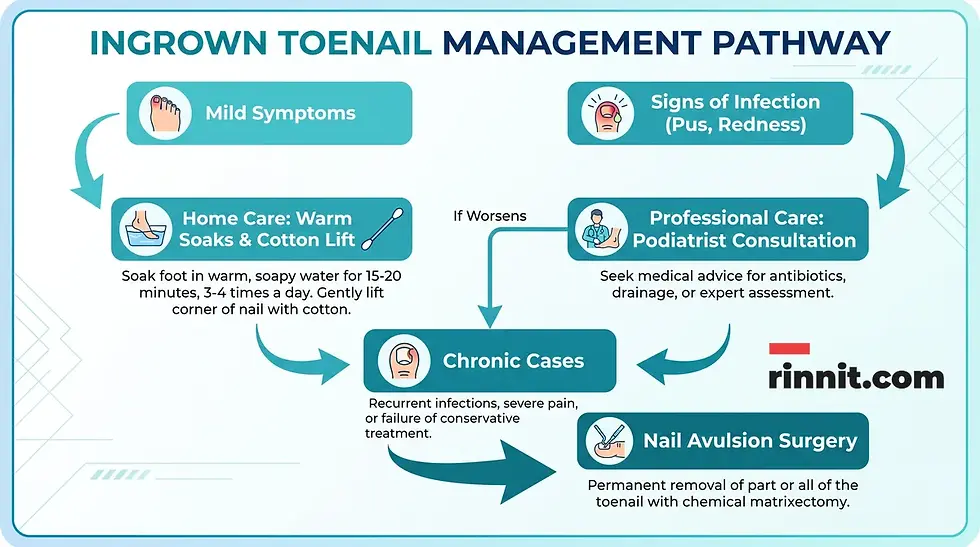
Most mild ingrown toenails can be treated by a provider with the same techniques you would use at home, using sterile and more professional instruments, and this foot condition usually heals without surgery. [1]
In severe cases, a provider may remove part of the nail through a procedure called nail avulsion, which keeps the edge of the nail from growing inward. The provider injects a numbing medicine into the toe and cuts away part (partial avulsion) or all (complete avulsion) of the toenail. It can take a few months for the nail to regrow. If the problem keeps recurring, the provider can use a chemical to kill the nail root for a permanent solution. [1] Evidence suggests surgery is better than non-surgical care at preventing recurrence. [2]
Outlook
Most of the time this is not a serious health problem, and treatment usually works. The nail will not grow back into the skin if you practice good foot care. People with conditions that cause foot problems, such as nerve damage or diabetes, may need regular foot care exams. [1]
How to prevent ingrown toenails

Trim straight across: cut across the top and do not round the corners.
Soften first: soak your nails in warm water before cutting, or cut them after a shower or bath.
Clean your tools: clean your nail trimmer before using it.
Do not tear or rip your nails.
Wear shoes that fit: not too loose and not too tight around your toes.
Avoid repetitive trauma to the sides of your nails.
Follow diabetes foot care recommendations and seek medical help early if you have diabetes.
Questions to ask your provider
Is the nail infected? How can I best treat it? Do I need surgery or medication? How can I keep it from coming back? How should I cut my nails to avoid this condition? [1]
Frequently Asked Questions
Can I cut out the ingrown part of my nail myself?
No. If you have signs of infection or a severe ingrown toenail, do not attempt to cut it yourself, because cutting the nail can make the condition worse. If home remedies are not helping, see a healthcare provider.
How long does an ingrown toenail take to heal?
Soaking often improves symptoms within a few days. If your symptoms have not improved within a few days, or the nail looks worse, call your provider. After a nail avulsion, it can take a few months for the nail to regrow.
When should I see a provider about an ingrown toenail?
See a provider if you have diabetes with complications, signs of infection such as pus or liquid drainage, extreme pain or redness, poor circulation, or if soaking and self-care have not relieved the pain.
Why does my big toe keep getting ingrown nails?
Common reasons include nails cut too short or rounded, shoes that fit poorly, tearing the corner of the nail, toe injuries, and toe shape, such as a nail that is large compared with the toe.
What is the best way to soak an ingrown toenail?
Soak your foot in warm water mixed with Epsom salt, or in soapy, sudsy water, twice daily, and keep the foot dry the rest of the time.
What is a podiatrist?
A podiatrist is a foot specialist who diagnoses and treats foot problems, including ingrown toenails.
Who is most at risk of ingrown toenails?
Anyone can get one, but adolescents, athletes, and people with diabetes, severe nerve damage in the leg or foot, poor blood circulation or a nail infection (paronychia) are at higher risk.
What is a nail avulsion?
A nail avulsion is a procedure in which a provider numbs the toe and cuts away part (partial avulsion) or all (complete avulsion) of the toenail so the edge cannot grow inward and cut into the skin.
Will the nail grow back after surgery?
Yes, it can take a few months for the nail to regrow. If ingrown toenails keep recurring, a provider can use a chemical to kill the nail root for a permanent solution.
How should I use cotton or dental floss under the nail?
After soaking, gently lift the edge of the nail and place a small piece of clean cotton or dental floss between the nail and the skin to help the nail grow above the skin edge. Change it every day.
Can an ingrown toenail infection spread?
Usually not in healthy people, but in rare, chronic cases an infection can spread through the toe and into the bone, which is why signs of infection should be checked.
Which shoes help prevent ingrown toenails?
Choose shoes that fit correctly, neither too loose nor too tight around the toes, with room for the toes. Roomy shoes or sandals also relieve pressure while an ingrown toenail heals.
Can I use pain relievers?
If needed, pain relievers such as ibuprofen or acetaminophen can be used as part of home care.
What if I have diabetes?
Follow all foot care recommendations from your healthcare provider and see them as soon as possible if you develop an ingrown toenail. People with diabetes, severe nerve damage or poor circulation should not self-treat.
References
Cleveland Clinic. Ingrown Toenails. Cleveland Clinic. Last updated August 7, 2023. https://my.clevelandclinic.org/health/diseases/17664-ingrown-toenails
Mayeaux EJ, et al. Ingrown Toenail Management. Am Fam Physician. 2019;100(3):158-164. PMID 31361106. https://pubmed.ncbi.nlm.nih.gov/31361106/
Khunger N, et al. Ingrown toenails. Indian J Dermatol Venereol Leprol. 2012;78(3):279-289. PMID 22565427. https://doi.org/10.4103/0378-6323.95442
Lomax A, et al. Toenail paronychia. Foot Ankle Surg. 2016;22(4):219-223. PMID 27810017. https://doi.org/10.1016/j.fas.2015.09.003
Medical disclaimer
This article is for general educational purposes only and is not a substitute for professional medical advice, diagnosis, or treatment. If you have diabetes, poor circulation or signs of infection, consult a healthcare professional.



Comments