Hypertropia: A Comprehensive Guide to Symptoms, Causes, and Clinical Management

Updated: 2 days ago
Medically reviewed by Dr. Baraa Alnahhal, MD · Last reviewed: October 2026
Quick Answer
Hypertropia is a form of strabismus in which one eye looks upward, causing double vision and eye strain. Causes include cranial nerve damage, muscle weakness and stroke, and risk factors include family history, thyroid eye disease and eye trauma. It is diagnosed with a comprehensive eye exam, and treatments include prism glasses, eye patching, Botox and muscle surgery. [1]
What the research says
Thyroid eye disease can cause vertical misalignment, and newer drugs can reduce it. In a series of 31 patients with thyroid eye disease–related strabismus (mean age 63), treatment with teprotumumab cut the vertical deviation by an average of 6 prism diopters (39%), but 35% still went on to have strabismus surgery. (Dallalzadeh et al., Ophthalmic Plastic and Reconstructive Surgery, 2024)
Botulinum toxin may be less likely than surgery to fully correct strabismus. A Cochrane review of 4 randomized trials (242 participants, all horizontal strabismus) found low-certainty evidence that surgery was more likely to correct the misalignment than botulinum toxin (risk ratio 0.72, 95% CI 0.53–0.99). (Bort-Martí et al., Cochrane Database of Systematic Reviews, 2023)
Prisms or surgery can remove double vision in adults with age-related vertical strabismus. A review of age-related strabismus, including vertical misalignment from the "sagging eye" syndrome, reports that prisms and/or surgery can improve quality of life by eliminating double vision in the primary position and main gazes. (Cioplean & Nitescu, Romanian Journal of Ophthalmology, 2016)
What is hypertropia?

Hypertropia is a clinical condition characterized by the vertical misalignment of the eyes. Specifically, it involves one eye pointing upward while the other eye remains focused straight ahead. This is a subset of strabismus, a broader category of conditions affecting ocular alignment. In a healthy visual system, six distinct muscles in each eye work in perfect synchronization to point both eyes in the same direction. In patients with hypertropia, this control is lost, and the affected eye pulls away from the center of the face. [1]
This condition is most noticeable when an individual attempts to look straight ahead. The affected eye will appear to look slightly up, regardless of the direction the person is trying to focus. While approximately 5% of the U.S. population experiences some form of strabismus, hypertropia is a specific vertical variant that requires specialized diagnostic tools to manage effectively. [1]
Recognizing the symptoms
The most prominent sign of hypertropia is the visible upward drift of one eye. However, the condition often presents with several secondary symptoms that can impact daily life and visual comfort.
Visual disturbance: Double vision (diplopia) and blurry vision are common, especially in adults who develop the condition suddenly. Sudden new double vision or eye misalignment, especially with a drooping eyelid, severe headache, weakness or trouble speaking, can signal a stroke or brain aneurysm: call 911.
Physical discomfort: Chronic eye strain, tired eyes, and frequent headaches often result from the brain's attempt to reconcile two different images.
Compensatory behaviors: Children, in particular, may not realize their eyes are misaligned. Instead, they might frequently tilt their heads to one side to improve their vision without being aware of the habit.
Intermittent presence: Some individuals only experience these symptoms when they are particularly tired or under high levels of stress, a state known as intermittent hypertropia. [1]
Causes and risk factors

The movement of the eyes is controlled by a complex interplay between the brain, cranial nerves, and muscles. Any disruption to this system can result in hypertropia.
Neurological factors: Damage to cranial nerve III (oculomotor) or cranial nerve IV (trochlear) can cause it. These nerves are responsible for vertical eye movements. Strokes or other damage to the brain can also impair the brain's ability to coordinate these signals.
Underlying health conditions: Certain autoimmune and systemic diseases are closely linked to eye misalignment. Graves' disease and thyroid eye disease can cause the eye muscles to become too tight or too weak. Conditions like myasthenia gravis and Brown syndrome are also known triggers.
Physical trauma: Direct injuries to the eye or complications following eye surgery can damage the delicate muscles and nerves required for alignment.
Horizontal strabismus: People who already have horizontal strabismus (where eyes turn in or out) sometimes develop hypertropia. [1]
Diagnosis and clinical testing
Diagnosing hypertropia begins with a comprehensive eye examination by a specialist. The provider will observe the eyes both while they are moving and while the patient is looking at a fixed point. Because hypertropia can be a symptom of a larger neurological issue, doctors may also order an MRI or specific blood tests to rule out systemic diseases or recent strokes. [1]
Management and treatment pathways
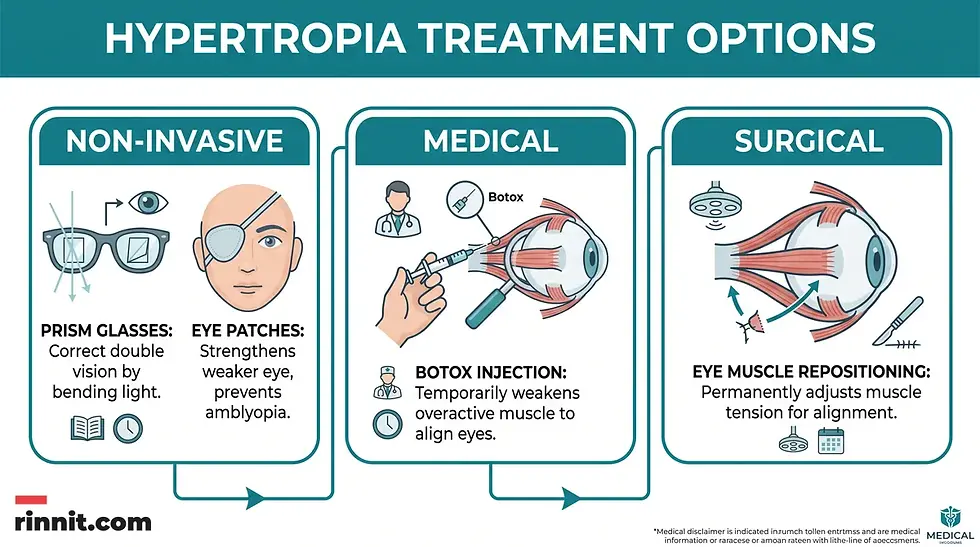
The goal of treatment is to restore ocular alignment and eliminate double vision. The specific approach depends heavily on the root cause and the severity of the misalignment.
Corrective lenses: For some, simple eyeglasses can correct refractive errors that contribute to the drift.
Prism therapy: Special prism lenses can be added to glasses. These prisms shift the incoming light so that the images from both eyes align, effectively preventing double vision.
Eye patching: This is a common strategy for children. By patching the "strong" eye, the brain is forced to use and strengthen the weaker, misaligned eye. This helps prevent permanent vision loss, known as amblyopia.
Botulinum toxin (Botox): In some cases, a small dose of Botox is injected into the eye muscles to relax them, allowing the eyes to return to a more natural alignment.
Surgical intervention: When non-invasive methods are insufficient, surgery can be performed to tighten, weaken, or reposition the eye muscles. This physical adjustment helps permanently realign the eyes. [1]
Learn more at Rinnit.com.
Frequently Asked Questions
Can hypertropia be prevented?
In most cases, no. It is usually caused by underlying health conditions or sudden trauma. However, wearing protective eyewear during high-risk activities can prevent injury-related cases.
Is hypertropia the same as a "lazy eye"?
No, but it can lead to one. Hypertropia is a physical misalignment (strabismus), while a "lazy eye" (amblyopia) is a decrease in vision that occurs because the brain is ignoring one eye.
Do adults get hypertropia?
Yes. While often diagnosed in childhood, adults can develop it due to strokes, thyroid disease, or head injuries.
Will I need surgery for hypertropia?
Not necessarily. Many cases are managed with prism glasses or patching. Surgery is typically reserved for cases where other treatments have failed.
Why does my child tilt their head to the side?
Head tilting is a common way for children to compensate for vertical misalignment. By tilting their head, they can sometimes align the two images their eyes are seeing.
Can stress make hypertropia worse?
Yes. Intermittent hypertropia often flares up when a person is fatigued, ill, or under significant emotional stress.
Is hypertropia hereditary?
There is a genetic component, and strabismus often runs in families, though it does not guarantee a child will develop the condition.
How long does it take to recover from eye muscle surgery?
Most patients return to normal activities within a few days, though complete healing and final alignment results can take several weeks.
Can hypertropia cause permanent vision loss?
If left untreated in young children, it can lead to amblyopia (lazy eye), which can cause permanent vision loss in the affected eye.
Are there exercises to fix hypertropia?
While "vision therapy" exists for some types of eye issues, hypertropia usually requires physical correction like prisms or surgery because it involves muscle or nerve imbalances.
What is the difference between hypertropia and hypotropia?
Hypertropia is when the eye looks upward. Hypotropia is the opposite, where the affected eye looks downward.
Can a stroke cause my eye to look up?
Yes, a stroke can damage the parts of the brain or the cranial nerves that control eye movement, leading to sudden hypertropia.
Is double vision always present with hypertropia?
Not always. Children's brains are very adaptable and may learn to ignore the second image. Adults are much more likely to experience persistent double vision.
Should I see a regular doctor or a specialist?
You should see an ophthalmologist or a pediatric ophthalmologist, as they have the specialized equipment to measure the degree of misalignment.
Can thyroid problems affect my eyes?
Yes, Graves' disease and thyroid eye disease are major causes of eye muscle inflammation and misalignment.
Related Reading
References
Cleveland Clinic. Hypertropia: Causes, Symptoms & Treatment. Cleveland Clinic. Last updated October 18, 2022. https://my.clevelandclinic.org/health/diseases/24307-hypertropia
Dallalzadeh LO, Villatoro GA, Chen L, et al. Teprotumumab for thyroid eye disease-related strabismus. Ophthalmic Plast Reconstr Surg. 2024;40(4):434-439. PMID 38319994. https://doi.org/10.1097/IOP.0000000000002611
Bort-Martí AR, Rowe FJ, Ruiz Sifre L, et al. Botulinum toxin for the treatment of strabismus. Cochrane Database Syst Rev. 2023;3(3):CD006499. PMID 36916692. https://doi.org/10.1002/14651858.CD006499.pub5
Cioplean D, Nitescu Raluca L. Age related strabismus. Rom J Ophthalmol. 2016;60(2):54-58. PMID 29450323. https://pubmed.ncbi.nlm.nih.gov/29450323/
Medical disclaimer
The information provided in this article is for educational purposes only and should not be considered medical advice. If you notice a change in your vision or eye alignment, consult an eye care specialist immediately.



Comments