Hyperthermia: Understanding Heat-Related Illnesses and Safety

Updated: 2 days ago
Medically reviewed by Dr. Baraa Alnahhal, MD · Last reviewed: October 2026
Quick Answer
Hyperthermia is any core body temperature that rises above your personal baseline, happening when sweat evaporation cannot keep up with environmental or metabolic heat. It ranges from heat rash and heat cramps to heat exhaustion and heatstroke, a severe emergency. Unlike a fever, it is an uncontrolled failure to cool. Athletes, outdoor workers and older adults are most vulnerable. [1] [4]
What the research says
Cold-water immersion cools fastest in heatstroke. A systematic review and meta-analysis of 63 studies found that water immersion (water at 1 to 17 °C) lowered core temperature in hyperthermic adults faster than passive cooling, with no single temperature range clearly better than another. The authors concluded that immersion can rapidly reduce core body temperature wherever it is feasible. (Douma et al., Resuscitation, 2020)
Current critical-care guidelines agree, and warn against fever drugs. The Society of Critical Care Medicine heat stroke guideline strongly recommends active over passive cooling, with cold- or ice-water immersion achieving the fastest cooling rate and prioritized where available. The panel found no evidence supporting drugs that affect temperature control in heat stroke and advised avoiding them. (Barletta et al., Crit Care Med, 2025)
Speed matters, and recovery takes time. A review in American Family Physician reports that heat stroke patients who are adequately cooled within 30 minutes have excellent outcomes, and that people who have had heat stroke should avoid physical activity for at least seven days after leaving medical care, then return gradually over two to four weeks. It names acclimatization, hydration and avoiding activity in extreme heat as the most effective ways to prevent heat illness. (Gauer & Meyers, Am Fam Physician, 2019)
What is hyperthermia?
Hyperthermia is a broad medical term used to describe a core body temperature that is higher than normal. While the standard baseline is 98.6°F (37°C), hyperthermia technically refers to any temperature that exceeds an individual's normal resting state. It is most commonly used interchangeably with "heat-related illness," as the most serious forms of these conditions typically involve a spike in internal temperature. [1]
Normally, the human body is remarkably efficient at maintaining a constant temperature. When you get too hot, your sweat glands produce sweat, and as it evaporates from your skin it carries away excess heat. However, when the environment is extremely hot or humid, or when your body generates too much internal heat from vigorous exercise, this cooling system can become overwhelmed and fail. [1]
Condition type | Severity | Primary symptoms | Recommended action |
Heat rash | Mild | Itchy, tiny red bumps on the skin. | Keep skin cool and dry; wear loose clothing. |
Heat cramps | Mild | Painful muscle spasms in legs, arms, or abdomen. | Rest in a cool area; replenish fluids and electrolytes. |
Heat exhaustion | Moderate | Dizziness, nausea, vomiting, and headache. | Seek immediate medical care; cool the body; sip water. |
Heatstroke | Severe | Confusion, slurred speech, temperature above 104°F. | Emergency: call 911 immediately. |
Hyperthermia vs. fever: the critical difference
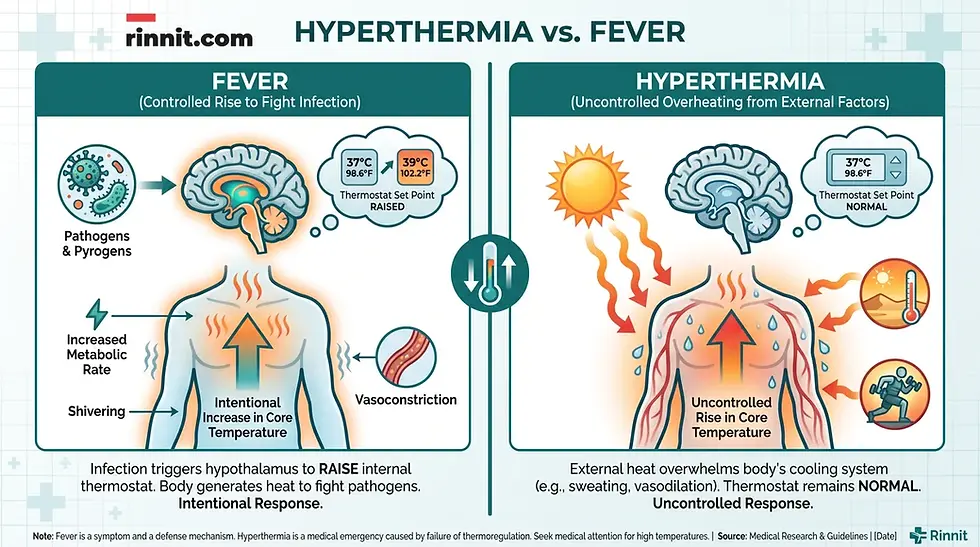
It is a common misconception that hyperthermia and fever are the same thing. While both result in a high reading on a thermometer, the underlying biological mechanisms are different.
A fever is an intentional action taken by the body's immune system. When you are fighting a virus or bacteria, the hypothalamus intentionally "turns up the thermostat" to create an environment that is less hospitable to invaders. The body remains in control of this process. [1]
In contrast, heat-related hyperthermia is an uncontrolled event. The hypothalamus has not changed the temperature setting; instead, the body's cooling mechanisms simply cannot keep up with the amount of heat being absorbed from the environment or generated by physical activity. It is the difference between intentionally turning up the heater in your home versus your air conditioner struggling on a 100-degree day. [1]
Strictly speaking, hyperthermia is the broad term for any raised body temperature, so a fever is technically one form of it, but a fever is not a heat illness. [1]
The spectrum of heat-related illnesses

Heat-related illnesses exist on a spectrum. Understanding where your symptoms fall is crucial for determining the necessary level of care. [1]
Mild conditions: heat rash and cramps
Heat rash, often called "prickly heat," occurs when sweat becomes trapped under the skin, creating small, itchy bumps. Heat cramps are painful muscle contractions that typically strike the legs, arms, or abdomen during intense exercise. While both are uncomfortable, they are generally considered warning signs rather than emergencies, although cramps are a warning that more severe illness could occur if you do not cool down. [1]
Moderate to severe: heat exhaustion and heatstroke
Heat exhaustion is a serious condition that develops when the body loses excessive amounts of water and salt, with a body temperature that is elevated but below 104°F (40°C). If not treated immediately with rest and cooling, it can rapidly progress to heatstroke. Heatstroke is a life-threatening emergency characterized by a core temperature typically above 104°F (40°C) and brain dysfunction, such as confusion, behavior changes, or loss of consciousness. [1]
Risk factors and heat-sensitive diseases
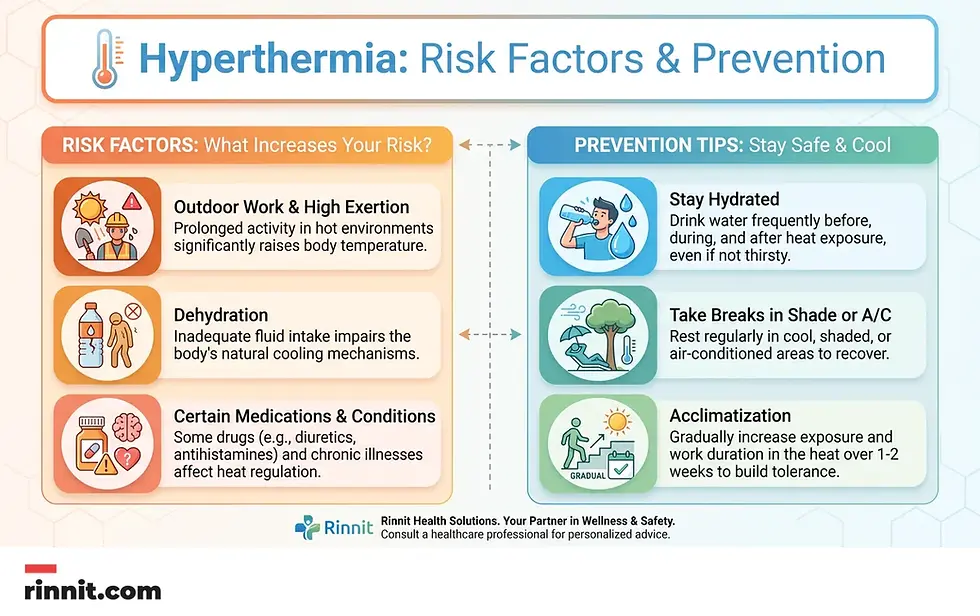
Certain individuals are more susceptible to hyperthermia due to their environment, occupation, or underlying health. Outdoor and indoor workers in construction, farming, firefighting, and military duty, as well as athletes, face the highest risk due to prolonged exertion in the heat. Dehydration, medications that affect the body's ability to cool itself, and conditions that interfere with sweating also raise the risk. [1] [4]
Furthermore, several "heat-sensitive diseases" can be triggered or significantly worsened by high temperatures. These include: [1]
Cardiovascular conditions: Arrhythmia and coronary artery disease.
Respiratory issues: Asthma, COPD, and respiratory tract infections.
Metabolic and kidney disorders: High blood sugar (hyperglycemia) and kidney failure.
Prevention and safety strategies
Preventing hyperthermia is largely a matter of preparation and awareness. Staying hydrated, wearing loose-fitting breathable clothing, keeping your home cool with fans or air conditioning, and limiting physical activity in hot conditions are the core defenses. Replenishing electrolytes is also important during heavy sweating. [1]
If you must be active in the heat, experts recommend "acclimatization," gradually increasing your exposure to hot conditions to allow your body to become more efficient at cooling itself. Avoid physically taxing activity during extreme heat, and take frequent breaks in the shade or a cool indoor location. [1] [4]
Conclusion
Hyperthermia is a serious but often preventable condition. By understanding the spectrum of heat illnesses and recognizing the difference between a normal fever and an environmental heat emergency, you can take the necessary steps to protect yourself. Whether you are an athlete pushing your limits or someone enjoying a summer day, staying cool and hydrated is the key to long-term health.
Stay safe this summer. For more expert advice on hydration and heat safety, visit Rinnit.com.
Frequently Asked Questions
What temperature is considered hyperthermia?
Any core body temperature above your normal baseline (typically 98.6°F or 37°C) is considered hyperthermia. Heat exhaustion involves a temperature below 104°F (40°C), and temperatures typically above 104°F indicate heatstroke, a severe emergency.
Can medications make me more sensitive to heat?
Yes. Some medications can interfere with your body's ability to cool itself. Many types, including diuretics, antihistamines, and certain antidepressants, can affect sweating or hydration, so ask your healthcare provider whether yours raise your risk.
Is heat rash dangerous?
Heat rash itself is mild, but it is a sign that your body is struggling to stay cool and dry. If the rash shows signs of infection, such as warm-feeling skin or pus, see a doctor.
Why are electrolytes important for heat cramps?
Heat cramps happen during heavy sweating, and treatment includes resting in a cool place and replenishing both fluids and electrolytes.
How long should I rest after having heat cramps?
Cleveland Clinic recommends avoiding anything physically taxing in the heat for at least two days after heat cramps.
Can I get hyperthermia indoors?
Yes. Hot environments can occur indoors, including non-air-conditioned or poorly ventilated spaces and workplaces such as kitchens, and heat-related illness can affect people who are in a hot environment for too long.
What should I do if I suspect heat exhaustion?
Seek immediate medical attention. In the meantime, move to a cool area, loosen or remove excess clothing, lie down with your legs elevated, sip water slowly, and cool your skin with water, fanning, or ice packs or cold wet towels.
Why is heatstroke considered a brain emergency?
Heatstroke causes signs of brain dysfunction, such as confusion, behavior changes, slurred speech, or loss of consciousness, which is why it is life-threatening and needs emergency care.
Can a fan alone prevent heatstroke?
No. A fan can help cooling when combined with water on the skin, but it is not enough on its own for heat exhaustion or heatstroke, which need prompt medical attention.
What is the best way to cool someone with heatstroke?
Call 911 first. While waiting, move the person out of the heat and cool them by any available means. Evidence and critical-care guidelines favor cold-water immersion where it is available, and ice packs or wet towels are alternatives. Do not give fluids to a confused person, and do not give fever-reducing medicines, which will not help.
Does humidity make hyperthermia worse?
Yes. In hot and humid weather the body's natural cooling system, mainly sweating, is more easily overwhelmed.
Are infants at higher risk?
Yes. Infants and young children cannot regulate their temperature as efficiently as adults, so they need extra protection in hot weather.
Can a sunburn cause hyperthermia?
A severe sunburn may interfere with the skin's ability to dissipate heat, which can add to the overall risk of heat-related illness in hot conditions.
What are the signs of dehydration?
Common signs include extreme thirst, dark-colored urine, dizziness, and dry mouth. Dehydration is a recognized risk factor for heat-related illness.
Is it safe to exercise during a heat wave?
It is best to move your workout indoors to an air-conditioned space or wait until the cooler early morning hours, and to take frequent breaks if you cannot avoid being active in the heat.
References
Cleveland Clinic. Hyperthermia (Heat-Related Illnesses) Symptoms, Causes & Treatment. Cleveland Clinic. Last updated August 26, 2024. https://my.clevelandclinic.org/health/diseases/22111-hyperthermia
Douma MJ, Aves T, Allan KS, et al. First aid cooling techniques for heat stroke and exertional hyperthermia: a systematic review and meta-analysis. Resuscitation. 2020;148:173-190. PMID 31981710. https://doi.org/10.1016/j.resuscitation.2020.01.007
Barletta JF, Palmieri TL, Toomey SA, et al. Society of Critical Care Medicine guidelines for the treatment of heat stroke. Crit Care Med. 2025;53(2):e490-e500. PMID 39982186. https://doi.org/10.1097/CCM.0000000000006551
Gauer R, Meyers BK. Heat-related illnesses. Am Fam Physician. 2019;99(8):482-489. PMID 30990296. https://pubmed.ncbi.nlm.nih.gov/30990296/
Medical disclaimer
This article is for general educational purposes only and is not a substitute for professional medical advice, diagnosis, or treatment. If you think you may have a medical emergency, call your doctor or 911 immediately.



Comments