Hyperpituitarism: A Comprehensive Guide to Overactive Pituitary Disorders

Updated: 3 days ago
Medically reviewed by Dr. Baraa Alnahhal, MD · Last reviewed: October 2026
Quick Answer: 5 Key Facts About Hyperpituitarism
Hyperpituitarism is an overactive pituitary disorder caused mainly by noncancerous pituitary tumors called adenomas. It is associated with Cushing's syndrome, acromegaly, prolactinoma and hyperthyroidism, and may cause fat accumulation, bone fragility, vision loss and menstrual changes. It affects all ages, and prolactinomas are the most common type. It is serious if untreated but manageable with surgery, medication or radiation.
Feature | Details |
Primary Cause | Noncancerous (benign) pituitary tumors known as adenomas. |
Associated Disorders | Cushing's syndrome, acromegaly, prolactinoma, and hyperthyroidism. |
Core Symptoms | Fat accumulation, bone fragility, vision loss, and menstrual changes. |
Demographics | Affects all ages; prolactinomas are the most common type in both adults and children. |
Clinical Outlook | Serious if untreated, but manageable through surgery, medication, or radiation. |
What the research says
Pituitary adenomas are more common than most people think. A review of the epidemiology reports that pituitary adenomas are diagnosed at about 3.9 to 7.4 new cases per 100,000 people per year, with a prevalence of 76 to 116 cases per 100,000 (roughly 1 in 1,000 people). Most newly diagnosed cases are prolactinomas and non-secreting adenomas (Daly & Beckers, Endocrinol Metab Clin North Am, 2020).
Surgery works best when the tumor has not invaded the cavernous sinus. In a meta-analysis of 14 studies and 972 patients with growth hormone–secreting adenomas (acromegaly), transsphenoidal surgery produced biochemical remission in 74.2% of patients with non-invasive microadenomas and 76.4% with non-invasive macroadenomas, versus 47.6% with invasive macroadenomas (Briceno et al., Neurol Res, 2017).
For giant prolactinomas, cabergoline normalized prolactin more often than bromocriptine. In a systematic review of 104 patients from 10 articles, prolactin levels normalized in 69.4% of patients on cabergoline versus 31.7% on bromocriptine, while tumor shrinkage and visual-field improvement were similar between the two drugs. The authors describe this as preliminary evidence (Huang et al., Metab Brain Dis, 2018).
What Is Hyperpituitarism?
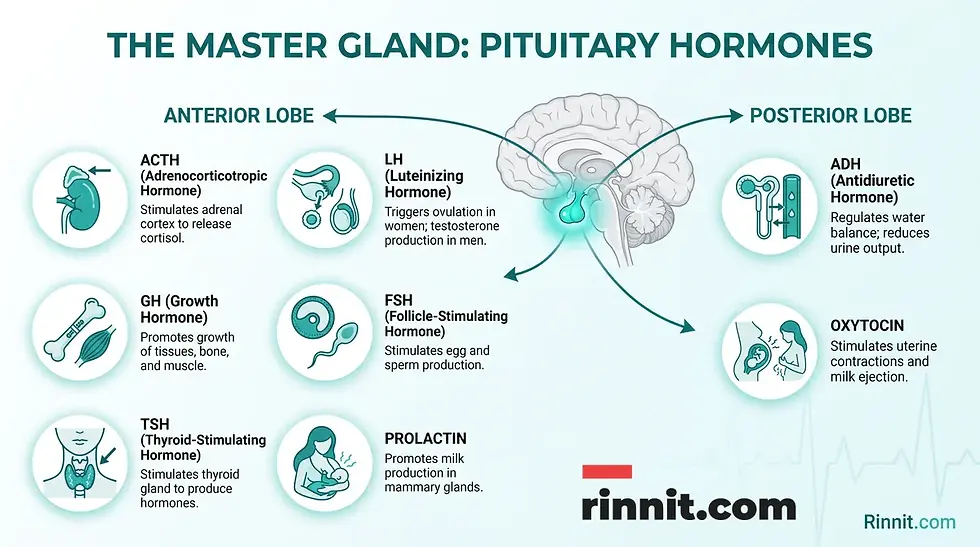
Hyperpituitarism occurs when the pituitary gland becomes overactive and releases excessive amounts of specific hormones into the bloodstream. Located at the base of the brain, the pituitary gland is often called the "master gland" because it regulates other major endocrine organs, including the thyroid, adrenal glands, and gonads. It functions much like a biological thermostat, constantly monitoring and adjusting the body's growth, metabolism, and reproductive systems to maintain a steady internal environment. [1]
The gland is divided into three lobes, each responsible for different hormonal functions. The anterior lobe, which comprises 80% of the gland, produces vital hormones like growth hormone (GH) and adrenocorticotropic hormone (ACTH). The intermediate lobe affects skin pigmentation, while the posterior lobe manages water balance and childbirth through hormones like oxytocin. When a benign tumor develops in these areas, it can disrupt this delicate balance, leading to systemic health issues. [1]
Common Disorders and Their Symptoms
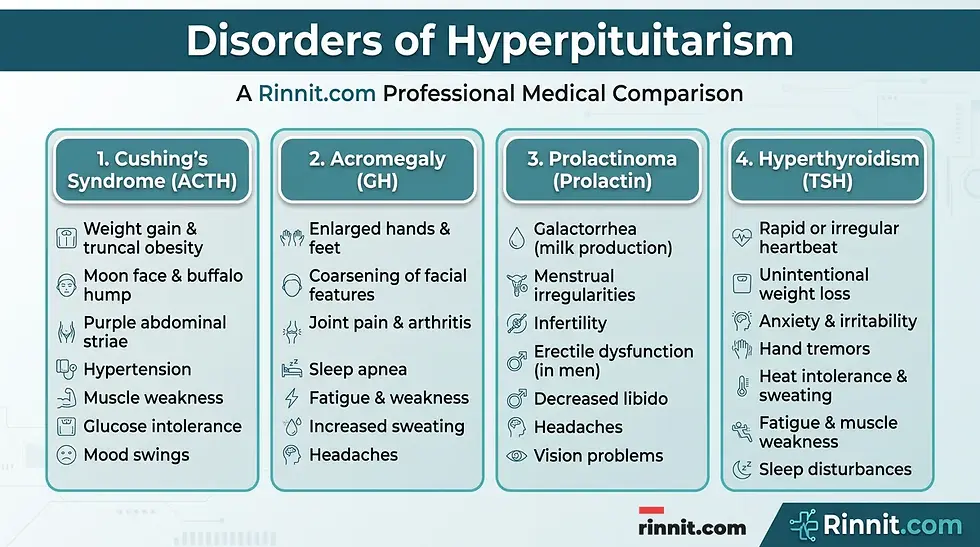
Because the pituitary gland controls so many functions, hyperpituitarism can manifest as several distinct clinical disorders. The symptoms a patient experiences depend entirely on which hormone the gland is overproducing. While some small tumors (microadenomas) may not secrete hormones or cause symptoms, larger tumors (macroadenomas) can press on nearby nerves, leading to headaches and vision loss. [1]
Primary Clinical Disorders
Cushing’s Syndrome: Caused by excess ACTH, leading to an overproduction of cortisol. Symptoms include fat accumulation in the upper body, purple stretch marks on the abdomen, and fragile bones that break easily.
Acromegaly: A serious condition resulting from excess growth hormone (GH) in adults, causing abnormal growth of bones and soft tissues.
Prolactinoma: The most common type of pituitary tumor, which secretes excess prolactin. This can disrupt reproductive health, leading to infertility or menstrual irregularities.
Hyperthyroidism: A rare result of excess thyroid-stimulating hormone (TSH), causing a rapid heartbeat, anxiety, and increased metabolism. [1]
Causes and Risk Factors
The overwhelming majority of hyperpituitarism cases are caused by pituitary adenomas. These are noncancerous growths that originate within the gland itself. While the exact reason these tumors form is not always clear, they are fairly common, with approximately 10,000 new cases diagnosed in the United States every year. In children, hyperpituitarism is rare and is often linked to inherited genetic syndromes such as Multiple Endocrine Neoplasia type 1 (MEN1) or Carney complex. [1] [2]
Risk factors vary by the specific disorder. For example, Cushing's syndrome is most prevalent in adults between the ages of 20 and 50, while acromegaly is typically diagnosed in the early 40s. In pediatric cases, the symptoms can differ by sex; girls may experience delayed puberty and low estrogen, while boys are more prone to larger tumors that cause neurological issues and vision loss due to "mass effect"—where the tumor physically presses on the cranial nerves. [1]
Diagnosis and Complications
Diagnosing an overactive pituitary gland requires a combination of hormonal blood tests and advanced imaging. Healthcare providers measure the levels of specific hormones in the blood to determine which part of the gland is malfunctioning. If a tumor is suspected, an MRI or CT scan is used to visualize the base of the brain and assess the size and location of the adenoma. [1]

If left untreated, hyperpituitarism can lead to life-altering complications. Chronic overproduction of cortisol can cause severe hypertension and diabetes, while excess growth hormone can lead to heart enlargement and joint destruction. Furthermore, large tumors that go undetected can cause permanent vision loss by damaging the optic nerves. Because the endocrine system is so interconnected, a failure to manage the pituitary gland can eventually lead to the failure of the thyroid and adrenal systems as well. [1]
Management and Treatment Options
The goal of treating hyperpituitarism is to return hormone levels to normal and reduce the size of any existing tumors. Treatment plans are highly personalized and may include:
Surgery: The most common approach for secreting tumors is the surgical removal of the adenoma, which can often be performed through the nose (transsphenoidal surgery). [3]
Medication: Certain drugs can block hormone production or shrink tumors, particularly in cases of prolactinomas. [4]
Radiation Therapy: Used when surgery is not possible or if the tumor returns after initial treatment.
Hormone Replacement: If treatment causes the gland to become underactive, patients may need lifelong hormone supplements to maintain health. [1]
Learn more. Learn More at Rinnit.com
Frequently Asked Questions
Is a pituitary adenoma a brain tumor?
While the pituitary gland is located at the base of the brain, an adenoma is technically a tumor of the endocrine system, not the brain tissue itself. They are almost always noncancerous.
Can hyperpituitarism be cured?
Yes, many patients are cured through surgery or managed effectively with long-term medication, allowing them to lead normal, healthy lives.
What is the "master gland"?
The pituitary gland is called the master gland because it produces hormones that control the functions of other glands, such as the thyroid and adrenals.
Can stress cause hyperpituitarism?
No, hyperpituitarism is caused by physical growths or genetic factors, not emotional stress, though the condition itself can make the body's stress response (cortisol) hyperactive.
Why does hyperpituitarism cause vision problems?
The pituitary gland sits directly below the optic nerves. If a tumor grows large enough, it can press on these nerves, causing blurred vision or loss of peripheral sight.
Are there any lifestyle changes that help?
While lifestyle changes cannot shrink a tumor, a healthy diet and regular exercise can help manage the symptoms of associated disorders like Cushing's syndrome or diabetes.
How common is acromegaly?
Acromegaly is very rare, affecting only about 3 out of every 1 million people each year.
Can children get hyperpituitarism?
Yes, though it is rare. In children, it often presents as gigantism (excessive height) or delayed puberty.
What is the difference between a microadenoma and a macroadenoma?
A microadenoma is less than 10 millimeters in size, while a macroadenoma is 10 millimeters or larger.
Do all pituitary tumors need surgery?
No. Some small, non-secreting tumors may only require regular monitoring (active surveillance), and some secreting tumors respond well to medication alone.
Can hyperpituitarism cause weight gain?
Yes, specifically Cushing's syndrome, which causes fat to accumulate in the face, neck, and abdomen.
Is hyperpituitarism hereditary?
Most cases are sporadic, but some are linked to inherited syndromes like MEN1.
What happens if the tumor is not removed?
The tumor may continue to grow, leading to worsening hormonal imbalances, permanent vision loss, and severe metabolic disorders.
How is the surgery performed?
Most pituitary surgeries are performed endoscopically through the nasal passages, avoiding the need for a traditional craniotomy.
Can hyperpituitarism affect fertility?
Yes, excess prolactin or disruptions in LH/FSH can stop ovulation in women and lower sperm count in men.
References
Cleveland Clinic. Hyperpituitarism (Overactive Pituitary Gland). Cleveland Clinic. Last updated May 23, 2022. https://my.clevelandclinic.org/health/diseases/15173-hyperpituitarism
Daly AF, Beckers A. The Epidemiology of Pituitary Adenomas. Endocrinol Metab Clin North Am. 2020;49(3):347-355. PMID 32741475. https://doi.org/10.1016/j.ecl.2020.04.002
Briceno V, Zaidi HA, Doucette JA, et al. Efficacy of transsphenoidal surgery in achieving biochemical cure of growth hormone-secreting pituitary adenomas among patients with cavernous sinus invasion: a systematic review and meta-analysis. Neurol Res. 2017;39(5):387-398. PMID 28301972. https://doi.org/10.1080/01616412.2017.1296653
Huang HY, Lin SJ, Zhao WG, et al. Cabergoline versus bromocriptine for the treatment of giant prolactinomas: A quantitative and systematic review. Metab Brain Dis. 2018;33(3):969-976. PMID 29546691. https://doi.org/10.1007/s11011-018-0217-3
Medical Disclaimer: The information provided in this article is for educational purposes only and should not be considered medical advice. Always consult with a qualified healthcare professional for concerns regarding your hormonal health or pituitary function.



Comments