Hypermagnesemia: A Complete Guide to Causes, Symptoms, and Management

Updated: 2 days ago
Medically reviewed by Dr. Baraa Alnahhal, MD · Last reviewed: October 2026
Quick Answer
Hypermagnesemia is a rare condition in which blood magnesium rises above 2.6 mg/dL, compared with a normal 1.7 to 2.3 mg/dL. The main cause is kidney failure, often with long-term use of magnesium-containing antacids or laxatives. Signs include low blood pressure, nausea, confusion and weakness. Treatment includes stopping magnesium products, IV fluids, diuretics, calcium gluconate and dialysis. [1]
What the research says
High magnesium in chronic kidney disease predicts worse outcomes. In 746 people with chronic kidney disease followed for a mean of 42.6 months, hypermagnesemia was linked to a higher risk of death from any cause (adjusted hazard ratio 1.54, 95% CI 1.00–2.32) and of cardiovascular events (adjusted hazard ratio 1.34, 95% CI 1.02–1.77). Serum magnesium rose as kidney function fell, and the authors advise caution with magnesium supplements in these patients. This was an observational study, so it shows an association, not a cause. (Galán Carrillo et al., J Ren Nutr, 2021)
Mildly raised levels are common in some hospital settings and are not always harmful. In a single-center retrospective study of 200 critically ill children, 32% had hypermagnesemia at admission and 44.5% during their stay. It was linked to heart surgery (p < 0.001) but not to higher mortality (p = 0.702). (Amar et al., Sci Rep, 2025)
What is hypermagnesemia?

Hypermagnesemia is a rare condition in which there is too much magnesium, an electrolyte, in the blood. Normally the blood holds only a small amount of magnesium. The body keeps most of the magnesium it absorbs and stores it in the muscles and bones, where it supports functions such as using energy, repairing DNA and forming bones. [1]
The kidneys filter most of the magnesium in the blood, and a small amount leaves in the urine. When the kidneys work well, they can clear a lot of magnesium. People with kidney failure who also take medicines that contain magnesium can end up with this electrolyte disorder. [1]
Magnesium levels are not routinely checked, and early symptoms can look like those of other conditions, so hypermagnesemia can be hard to catch. Early diagnosis and treatment are best, because severe hypermagnesemia can be fatal without prompt care. Mild cases typically do not need treatment. [1]
Severity levels and diagnosis

Providers use a blood test to check for hypermagnesemia. A level above 2.6 mg/dL counts as high, and the severity is then graded by the level of magnesium in the blood. [1]
Category | Blood magnesium level |
Normal | 1.7 to 2.3 mg/dL |
High (diagnostic threshold) | Above 2.6 mg/dL |
Mild hypermagnesemia | Above 2.6 and below 7 mg/dL |
Moderate hypermagnesemia | 7 to 12 mg/dL |
Severe hypermagnesemia | More than 12 mg/dL |
A provider may also order blood and urine tests (urinalysis) to check kidney function, and an electrocardiogram (EKG) to look for abnormal heart rhythms. [1]
Causes and risk factors
Kidney failure is the most common cause of hypermagnesemia. The main risk factors are acute or chronic kidney disease and ingesting products that contain magnesium. [1]
Other causes and triggers
Magnesium-containing products: Long-term use of antacids or laxatives with magnesium, enemas with magnesium, and over-the-counter products with a lot of magnesium, such as Epsom salts. [1]
Hormone and metabolic conditions: Addison's disease, adrenal insufficiency (not producing enough cortisol), hypothyroidism and hypercalcemia (high calcium). [1]
Other medical conditions: Inflammatory bowel disease and hemolysis (red blood cell destruction). [1]
Injury: Trauma, shock or burns. [1]
Medicines and treatments: Lithium-based psychotropic drugs and treatment for eclampsia during pregnancy. [1]
Symptoms and complications
A mild case may cause no symptoms. Low blood pressure (hypotension) that does not respond to medicine may be one of the first signs. With a moderate or severe case, symptoms can include dizziness, nausea, confusion, weakness and difficulty breathing. [1]
More severe magnesium toxicity can cause drowsiness, headache, constipation, paralyzed muscles or bladder, coma, and abnormal heart rhythms (arrhythmia) that can lead to cardiac arrest. [1]
Management and treatment
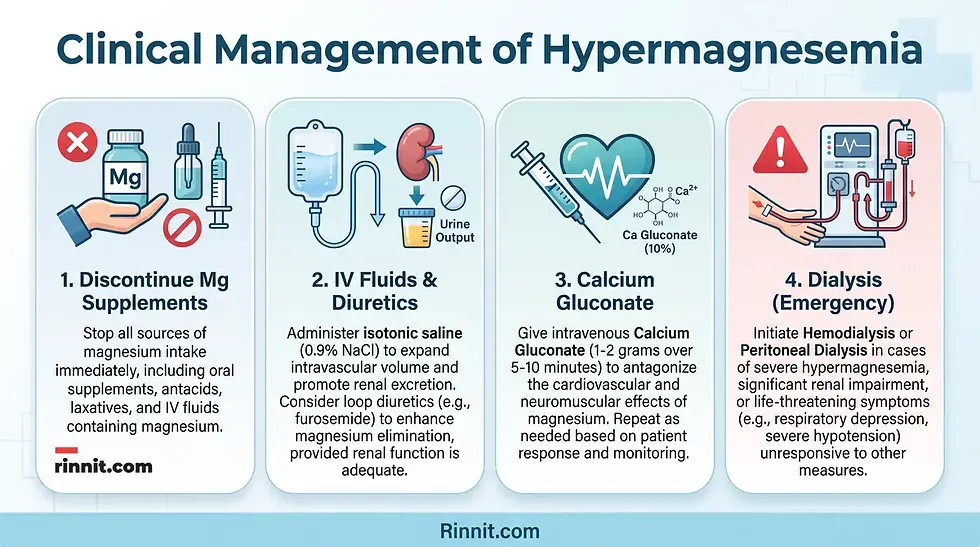
If your kidneys work well and you have no symptoms, you probably do not need treatment beyond stopping medicines that contain magnesium and discussing alternatives with your provider. Otherwise, treatment is based on how severe the condition is and how well the kidneys are working. [1]
Stop magnesium-containing products: This includes supplements, antacids, laxatives and enemas that contain magnesium. [1]
IV fluids and diuretics: Diuretics such as furosemide help the kidneys get rid of magnesium. [1]
Calcium gluconate: An IV medicine that can help with breathing in people with high magnesium. [1]
Dialysis: Can quickly remove magnesium from the body in severe cases or when the kidneys are failing. [1]
Intensive care: If the heart and lungs need support, care may be given in an intensive care unit. [1]
When to get medical help: Contact a provider if you have symptoms such as dizziness, nausea, confusion, weakness or difficulty breathing, especially if you have kidney disease or use magnesium-containing antacids, laxatives, enemas or Epsom salts. Tell your provider about every over-the-counter supplement and medicine you use. Difficulty breathing is an emergency.
Prevention and questions for your provider
Pharmacists and other providers can help prevent hypermagnesemia by checking that your medicines do not put you at risk. Knowing the signs of magnesium toxicity can help you alert a provider as soon as symptoms start. [1]
Questions to ask your provider
Am I at risk for a magnesium overdose?
Do I need treatment?
What should I use in the future instead of antacids or laxatives that contain magnesium?
Can I still eat foods that contain a lot of magnesium?
Conclusion
Magnesium is a vital nutrient, but hypermagnesemia is a reminder that too much of a good thing can cause harm. It is a particular risk for people with kidney problems, so it is important to review all over-the-counter supplements and medicines with a healthcare provider. Mild cases are often harmless, and with prompt diagnosis and the right treatment, most people can be treated successfully. Severe cases need urgent care. [1]
Frequently Asked Questions
What is the most common cause of high magnesium?
Kidney failure. The kidneys filter and remove excess magnesium, so when they fail, magnesium can build up.
Can I get hypermagnesemia from food alone?
Hypermagnesemia from food alone is uncommon in people with healthy kidneys. The risk comes mainly from kidney problems combined with magnesium-containing medicines or supplements.
Is hypermagnesemia a common condition?
No. It is considered a rare electrolyte disorder.
What are the early warning signs?
Low blood pressure that does not respond to medicine, dizziness and nausea. Mild cases often cause no symptoms.
How is high magnesium diagnosed?
With a blood test. A level above 2.6 mg/dL is considered high.
Can Epsom salts cause hypermagnesemia?
Over-the-counter products with a lot of magnesium, such as Epsom salts, are a recognized cause, particularly when used heavily or by someone with kidney problems.
What is the normal range for blood magnesium?
A normal level is 1.7 to 2.3 mg/dL.
How do diuretics help treat high magnesium?
Diuretics such as furosemide help the kidneys get rid of magnesium in the urine.
Is hypermagnesemia fatal?
Mild cases are often harmless, but severe cases can be fatal, which is why prompt treatment is important.
Should I avoid magnesium-rich foods if I have this condition?
Talk to your provider about which foods are safe for you. Magnesium-rich foods include bananas, black beans, broccoli, brown rice, green vegetables, meat and seafood, nuts, seeds and whole grains.
What is calcium gluconate used for?
Calcium gluconate is an IV medicine that can help with breathing in people with dangerously high magnesium levels.
Can pregnancy-related treatments cause high magnesium?
Treatment for eclampsia during pregnancy is a recognized cause of hypermagnesemia, so levels need to be monitored.
Does Addison's disease cause high magnesium?
Yes. Addison's disease and other causes of adrenal insufficiency are recognized causes of hypermagnesemia.
Can lithium medicines affect magnesium levels?
Yes. Lithium-based psychotropic drugs are a recognized cause of high magnesium.
Does mild hypermagnesemia always need treatment?
No. If your kidneys work well and you have no symptoms, you may only need to stop medicines that contain magnesium.
Can hypermagnesemia be prevented?
Yes. Pharmacists and other providers can check that your medicines do not put you at risk, and knowing the signs of magnesium toxicity helps you get help early.
References
Cleveland Clinic. Hypermagnesemia. Cleveland Clinic. Last updated April 24, 2025. https://my.clevelandclinic.org/health/diseases/hypermagnesemia
Galán Carrillo I, Vega A, Goicoechea M, et al. Impact of Serum Magnesium Levels on Kidney and Cardiovascular Prognosis and Mortality in CKD Patients. J Ren Nutr. 2021;31(5):494-502. PMID 33309408. https://doi.org/10.1053/j.jrn.2020.09.004
Amar S, Acedo SM, Rodríguez-Tubio S, et al. Magnesium disturbances in critically ill children. Sci Rep. 2025;15(1):17620. PMID 40399454. https://doi.org/10.1038/s41598-025-02288-1
This article is for general educational purposes only and is not a substitute for professional medical advice, diagnosis, or treatment. Always seek the advice of your physician or other qualified healthcare provider with any questions you may have about a medical condition. Never disregard professional medical advice or delay seeking care because of something you have read here. If you think you may have a medical emergency, call your doctor or emergency services immediately.



Comments