Hymenal Tag: Symptoms, Causes, and Treatment Guide

Updated: 2 days ago
Medically reviewed by Dr. Baraa Alnahhal, MD · Last reviewed: October 2026
Quick Answer
A hymenal tag is a small, benign extension of extra tissue from the edge of the hymen. It may be present from birth or result from hymenal tearing or childbirth. It often causes no symptoms but can cause irritation during penetration or tampon use. A pelvic exam confirms it; observation is standard, with removal if discomfort persists. [1]
What the research says
Most newborn hymenal tags fade, but some persist. A pediatric case report and literature review noted that hymenal tags are not uncommon in newborn girls and that roughly 30% may still be present at 3 years of age. (Leung & Lam, Cureus, 2021)
Hymenal polyps are benign and resolve on their own. A report of 2 infants with hymenal polyps described them as benign growths arising from the hymenal rim that disappear spontaneously within a few weeks. (Frikha et al., Pediatric Dermatology, 2018)
Surgical excision of troublesome hymenal tissue rarely causes lasting problems. ACOG's committee opinion on hymenal variants (which focuses mainly on imperforate hymen) states that surgical management of clinically significant variations involves excision of the hymenal tissue and rarely results in long-term sequelae. (ACOG Committee Opinion No. 780, Obstetrics & Gynecology, 2019)
What is a hymenal tag and how does it form?

A hymenal tag is a small, typically harmless piece of extra tissue that protrudes from the edge of the hymen. [1] The hymen itself is a thin, flexible membrane located at the vaginal opening, and its size and shape vary significantly between individuals. Much like a common skin tag found elsewhere on the body, a hymenal tag is a benign growth that usually blends in with the surrounding tissue, though it may occasionally appear slightly lighter or darker in color. Because these tags are often very small, many people do not realize they have one until it causes physical irritation or is identified during a routine medical examination.
The development of a hymenal tag can occur at different stages of life. Many infants are born with these tags as a result of normal variations during fetal development. In other cases, a tag may form later in life following the natural tearing of the hymen, which can occur during physical activities, the use of tampons, or sexual intercourse. Additionally, the intense pressure and pushing involved in vaginal childbirth can lead to the formation of a tag, although some pre-existing tags actually disappear following delivery. [1]
Recognizing symptoms and when to seek care
For most individuals, a hymenal tag remains asymptomatic and does not require medical intervention. However, the location of the tag makes it susceptible to friction and pressure, which can lead to localized discomfort. You might notice irritation during sexual intercourse, particularly with penetration, or when inserting a tampon. Physical activities that cause underwear to rub against the area can also cause irritation, and the tag may sometimes swell or become discolored. If you experience persistent pain, itching, or a noticeable change in the appearance of tissue around the vaginal opening, it is important to consult a healthcare provider for an accurate diagnosis. [1]
Potential triggers for discomfort | Description of irritation |
Sexual activity | Pain or pinching during penetration or masturbation. |
Menstrual care | Difficulty or discomfort when inserting or removing tampons. |
Daily friction | Irritation caused by tight clothing or underwear rubbing against the tag. |
Physical changes | Occasional swelling or changes in the color of the extra tissue. |
Diagnosis and professional management
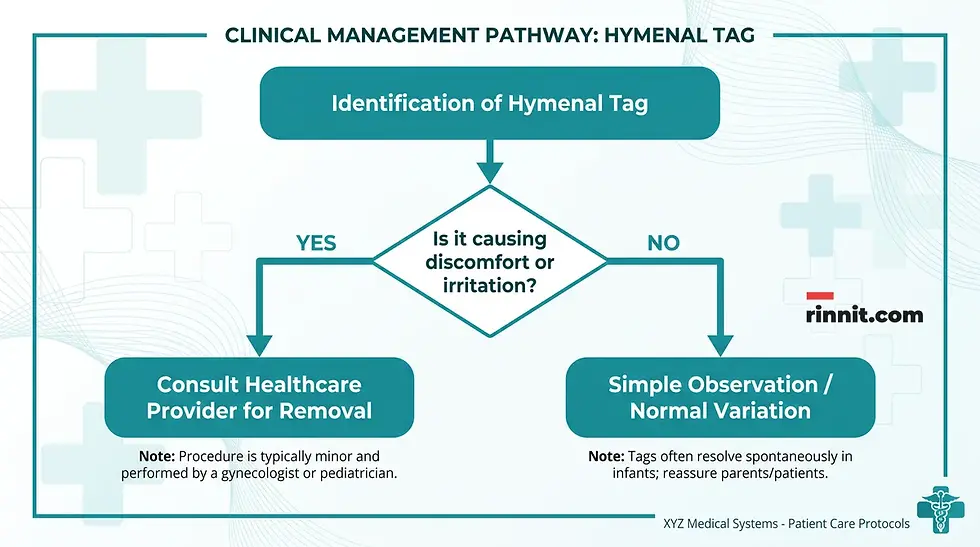
Diagnosing a hymenal tag is a straightforward process that typically involves a visual examination by a healthcare professional. During a consultation, a provider may also perform a pelvic exam or a Pap test to rule out other conditions that could cause similar symptoms. In very rare instances where the diagnosis is unclear, a small biopsy might be taken to ensure the tissue is benign. It is crucial to remember that while a hymenal tag may look like something you can handle yourself, you should never attempt to remove a hymenal tag on your own. Removal should only be done by a healthcare provider. [1]
Treatment for a hymenal tag is entirely optional and is usually only recommended if the growth is causing physical distress or emotional concern. If removal is desired, a healthcare provider can perform a simple procedure in their office using surgical scissors or a scalpel to excise the extra tissue. For hymenal tags present at birth, doctors often recommend a "wait and see" approach, as many of these tags naturally recede and disappear by the time a child reaches three years of age. [1]
Hymenal tags vs. hymenal polyps

It is common to confuse hymenal tags with hymenal polyps, but they have distinct characteristics. Hymenal polyps are small, stalk-like growths that are almost always present at birth and typically disappear within a few weeks. While both are generally benign, polyps are more prone to minor bleeding or spotting if they become torn. Understanding these differences helps healthcare providers determine the best course of action, which for both conditions is usually simple observation unless complications arise. [1]
Conclusion
A hymenal tag is a common and harmless anatomical variation that rarely poses a threat to your health. Whether you were born with one or developed it later in life, the decision to treat it depends entirely on your comfort level. If a tag is interfering with your daily life or causing pain during intimate moments, a quick and simple professional procedure can provide lasting relief.
For more information on reproductive health and wellness, visit Rinnit.com.
Frequently Asked Questions
Is a hymenal tag a sign of an underlying disease?
No, a hymenal tag is not a disease. It is simply extra tissue and is considered a normal anatomical variation. [1]
Can a hymenal tag be cancerous?
Hymenal tags are benign, meaning they are not cancerous. However, any new or changing lump should be evaluated by a doctor to rule out other issues. [1]
Does having a hymenal tag mean I am not a virgin?
No. Many hymenal tags are present from birth, so having one does not by itself indicate sexual activity. [1]
Will a hymenal tag grow back after it is removed?
Removal is a simple procedure that a healthcare provider can do in the office. If you notice new tissue afterward, see your provider to have it checked. [1]
Can I use over-the-counter skin tag removers on a hymenal tag?
Absolutely not. The tissue in the vaginal area is extremely sensitive. You should only seek removal from a qualified healthcare provider. [1]
How long does the removal procedure take?
Removal is a simple office procedure in which a provider cuts away the extra tissue with surgical scissors or a scalpel. [1]
Is the removal procedure painful?
Removal is a simple procedure done in the provider's office. Ask your provider beforehand how the area will be numbed and how pain will be managed. [1]
Can a hymenal tag cause bleeding?
Bleeding is more typical of hymenal polyps, which may bleed or spot if they tear. If you notice bleeding from the area, see a healthcare provider. [1]
Are hymenal tags common in children?
Yes, many girls are born with them, and they often disappear by age three. [1]
Can a hymenal tag interfere with pregnancy or birth?
Hymenal tags typically don't cause health problems. Pushing during a vaginal birth can sometimes cause a tag to form, and sometimes an existing tag goes away after vaginal birth. [1]
Does insurance cover the removal of a hymenal tag?
Coverage varies, but if the tag is causing documented pain or irritation, it is often considered a medically necessary procedure.
What should I do if my hymenal tag changes color?
You should see a healthcare provider to ensure the change is not a sign of infection or another condition. [1]
Can a hymenal tag be caused by an STI?
Hymenal tags are either present at birth or form after the hymen tears or after vaginal childbirth. Any new bump around the vaginal opening should be checked by a healthcare provider. [1]
Is there any way to prevent hymenal tags?
There is no known way to prevent them, as they are often congenital or a result of normal physical changes. [1]
What is the recovery like after removal?
Recovery is usually very fast, with most people returning to normal activities within a day or two, though you may be advised to avoid intercourse for a short period.
Related Reading
References
Cleveland Clinic. Hymenal Tag. Cleveland Clinic. Last updated May 12, 2025. https://my.clevelandclinic.org/health/diseases/22720-hymenal-tag
Leung AK, Lam JM. Hymenal Tags in Girls: Not to Be Mistaken for Sexual Abuse. Cureus. 2021;13(9):e17931. PMID 34660122. https://doi.org/10.7759/cureus.17931
Frikha F, Boudaya S, Sellami K, et al. Hymenal polyps in two infants. Pediatr Dermatol. 2018;35(6):e412-e413. PMID 30152554. https://doi.org/10.1111/pde.13650
American College of Obstetricians and Gynecologists. Diagnosis and Management of Hymenal Variants: ACOG Committee Opinion, Number 780. Obstet Gynecol. 2019;133(6):e372-e376. PMID 31135763. https://doi.org/10.1097/AOG.0000000000003283
The information provided in this guide is for educational purposes only and should not be used as a substitute for professional medical advice, diagnosis, or treatment. Always seek the advice of your physician or other qualified health provider with any questions you may have regarding a medical condition.



Comments