Hürthle Cell Carcinoma: Symptoms, Stages, and Treatment Options

Updated: 2 days ago
Medically reviewed by Dr. Baraa Alnahhal, MD · Last reviewed: October 2026
Quick Answer
Hurthle cell carcinoma is a rare, aggressive thyroid cancer affecting the gland's metabolism-regulating cells. Symptoms include neck lumps, difficulty swallowing and voice changes, and risk factors include age 55+, female sex and prior radiation. Treatment is thyroidectomy followed by hormone therapy or radioactive iodine. About 9 in 10 people with localized or regional disease live at least five years. [1]
What the research says
Most people with Hürthle cell carcinoma live for years after diagnosis, but survival falls over time. A systematic review and meta-analysis of 9,638 patients in 27 articles found a mean age of 57.6 years, a mean tumor size of 30 mm, extrathyroidal extension in 24% and lymph node metastasis in 9%. Mean overall survival was 91% at 5 years and 76% at 10 years. Radioiodine was used in 54% of patients, though there is no consensus on its benefit. (Coca-Pelaz et al., Adv Ther, 2021)
Whether radioactive iodine helps is still unsettled. In a SEER database analysis of 2,279 patients who had a total thyroidectomy, radioactive iodine was not significantly associated with better cancer-specific survival, including in older patients and those with larger or more advanced tumors. This was an observational analysis, not a trial. (Wang et al., J Clin Endocrinol Metab, 2022)
Other data point the opposite way for intermediate-risk disease. In a National Cancer Database study of 65,736 patients with intermediate-risk differentiated thyroid cancer, the 10-year overall survival for Hürthle cell cancer was 78.5%, and surgery plus radioiodine plus thyroid-hormone suppression was linked to lower mortality than surgery alone (hazard ratio 0.520, p = 0.006). This was a retrospective study, so confounding is possible. (Abiri et al., Eur Arch Otorhinolaryngol, 2023)
What is Hürthle cell carcinoma and how does it develop?

Hürthle cell carcinoma is a rare malignancy that arises in the thyroid gland, a small, butterfly-shaped organ located at the base of the neck. This gland plays a vital role in human health by producing hormones that regulate metabolism, heart rate, and body temperature. While many thyroid cancers are slow-growing, Hürthle cell carcinoma, also known by its updated medical name, oncocytic thyroid carcinoma, is considered more aggressive and has a higher tendency to spread to nearby tissues and distant organs. [1]
The condition is named after Karl Hürthle, a researcher who originally identified the specific cell types involved. However, modern medical science has clarified that the tumors are actually formed by cells called oncocytes. These cells undergo genetic changes, sometimes triggered by factors like iodine deficiency or radiation exposure, leading to the formation of tumors that can interfere with vital functions like breathing and swallowing. [1]
What are the primary symptoms and risk factors?
In its early stages, Hürthle cell carcinoma often produces no noticeable symptoms. Many cases are discovered incidentally during a routine physical examination when a healthcare provider feels a small lump or nodule on the thyroid. As the tumor grows, it may begin to press against the esophagus or trachea, leading to more significant physical changes. [1]
Common symptoms to monitor
The most frequently reported symptoms include a painful lump in the front of the throat, often located just below the Adam's apple. Patients may also experience a persistent feeling of choking, difficulty breathing, or trouble swallowing solid foods. Swollen lymph nodes in the neck, unexplained fatigue, and unintentional weight loss are also common indicators that the disease may be progressing. [1]
Identifying those at higher risk
While the exact cause remains unknown, researchers have identified several demographic and environmental factors that increase the likelihood of developing this rare cancer. [1]
Risk factor | Impact on risk |
Age | Most common in individuals aged 55 and older. |
Sex | Statistically more prevalent in females than in males. |
Family history | Higher risk if immediate biological relatives have had thyroid cancer. |
Iodine levels | Severe iodine deficiency may trigger genetic mutations in thyroid cells. |
Radiation | Prior exposure to medical X-rays or radiation therapy to the neck area. |
How is Hürthle cell carcinoma staged and diagnosed?
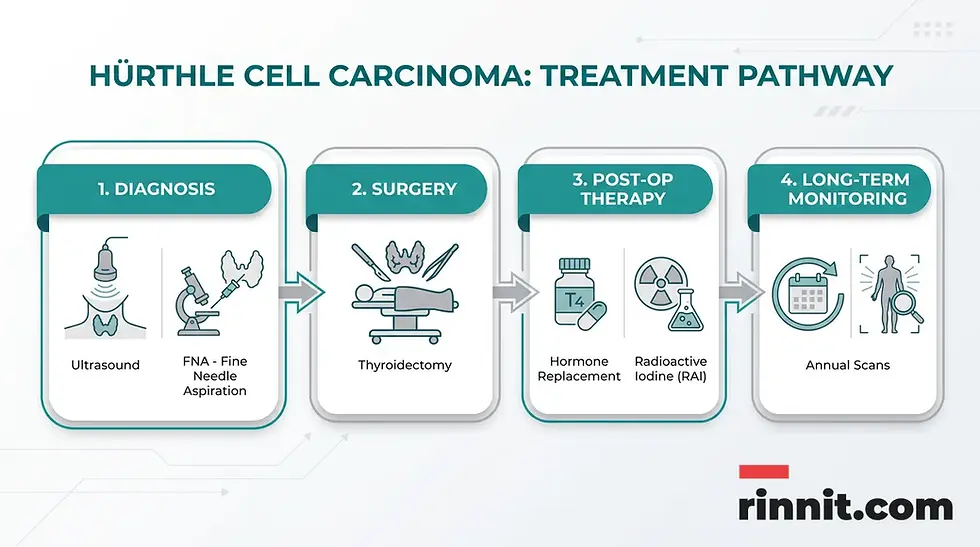
Diagnosis typically begins with a physical exam and a neck ultrasound to visualize any thyroid nodules. If a suspicious mass is found, a fine needle aspiration (FNA) is performed, where a thin needle collects a tissue sample for laboratory analysis. Advanced imaging, such as CT scans, MRIs, or PET scans, may be used to determine if the cancer has spread beyond the thyroid gland. [1]
Because Hürthle cells can look abnormal even in benign nodules, an FNA often cannot confirm cancer on its own. The diagnosis is usually settled after surgery, when a pathologist checks whether the tumor has invaded its surrounding capsule. [2]
Medical professionals use a staging system from I to IV to categorize the severity of the disease and plan appropriate treatment. [1]
Stage I: The tumor is between 2 and 4 centimeters and is contained entirely within the thyroid.
Stage II: The tumor remains the same size but has spread to nearby lymph nodes.
Stage III: The cancer has invaded nearby neck structures, such as the voice box (larynx), windpipe (trachea), or esophagus.
Stage IV: The most advanced stage, where the cancer has spread to distant areas, including the spine, brain, lungs, or large blood vessels.

Formal TNM staging also takes age into account. Patients diagnosed before age 55 are stage I regardless of tumor size or lymph node involvement, or stage II if the cancer has spread to distant sites. [2]
What are the current treatment and management strategies?
The primary goal of treatment is the complete removal of cancerous tissue. Because Hürthle cell carcinoma can be aggressive, doctors often recommend a combination of surgical and medical therapies to minimize the risk of recurrence. [1]
Surgical intervention
A thyroidectomy is the most common treatment, involving the partial or total removal of the thyroid gland. For small tumors confined to the thyroid, removing one lobe may be enough, while larger tumors or those that have spread usually need a total thyroidectomy. If the cancer has spread to the lymph nodes, those may also be removed during the same procedure. Surgery offers the best chance for a cure, especially when the cancer is caught in its early stages. [1] [2]
Post-surgical therapies
After surgery, patients typically require ongoing medical management to replace thyroid hormones and ensure any remaining cancer cells are destroyed.
Hormone therapy: Patients take medication to replace the hormones the thyroid used to produce. This also helps suppress the production of thyroid-stimulating hormones that could encourage new cancer growth. [1]
Radioactive iodine therapy: This specialized treatment involves ingesting radioactive iodine, which is naturally absorbed by thyroid cells. The radiation then kills any remaining cancerous thyroid cells throughout the body. Hürthle cell cancers tend to absorb radioactive iodine less well than other thyroid cancers, and its benefit in this cancer is still debated. [1] [2]
Conclusion
Hürthle cell carcinoma is a serious diagnosis, but advancements in surgical techniques and post-operative care have significantly improved patient outcomes. While the disease has a tendency to recur, regular monitoring through annual ultrasounds and blood tests allows for early detection and intervention. By understanding the symptoms and working closely with an oncology team, patients can effectively manage this rare condition. [1]
Stay informed. For more resources on thyroid health and managing rare cancers, visit Rinnit.com.
Frequently Asked Questions
Is Hürthle cell carcinoma the same as other thyroid cancers?
Hürthle cell carcinoma is closely related to follicular thyroid cancer and is often grouped with it in statistics, but it is generally considered more aggressive and tends to take up radioactive iodine less well.
Can I live a normal life without a thyroid?
Yes. While you will need to take daily hormone replacement medication for the rest of your life, most people maintain a high quality of life.
How often will I need follow-up appointments?
Most doctors recommend a neck ultrasound and blood tests at least once a year to check for signs of recurrence.
Does Hürthle cell carcinoma spread quickly?
Hürthle cell carcinoma is more aggressive than common thyroid cancers, which is why early diagnosis and staging are critical for successful treatment.
What is the survival rate for this cancer?
For follicular thyroid cancer, the group that includes Hürthle cell carcinoma, about 9 in 10 people with localized or regional disease were alive five years after diagnosis, falling to about 6 in 10 with distant spread. In a meta-analysis of 9,638 patients with Hürthle cell carcinoma, mean overall survival was 91% at 5 years and 76% at 10 years.
Why was the name changed to oncocytic thyroid carcinoma?
The name was updated to reflect the actual cell type (oncocytes) that forms the tumors, rather than the researcher who first studied them.
Are voice changes a common symptom?
Yes, if the tumor presses against the voice box or nearby nerves, it can cause hoarseness or other voice changes.
Can iodine deficiency cause this cancer?
The exact cause is unknown. Low iodine levels are listed as a possible risk factor that may contribute to genetic changes in thyroid cells.
Is surgery always necessary?
Surgery is the primary treatment and may cure Hürthle cell carcinoma, especially when it is found early.
What are the side effects of radioactive iodine?
Common side effects include temporary dry mouth, taste changes, or mild neck tenderness.
Can children get Hürthle cell carcinoma?
Hürthle cell carcinoma is extremely rare in children; it most commonly affects adults over the age of 55.
Is this cancer hereditary?
Having a parent or sibling with thyroid cancer increases your risk, suggesting a possible genetic component.
What imaging tests are best for diagnosis?
Ultrasound is the first step, but CT, MRI, and PET scans are used to check for spread to other organs.
What is a fine needle aspiration?
A fine needle aspiration is a simple procedure where a thin needle is used to take a small sample of cells from a thyroid lump for testing.
Can I prevent Hürthle cell carcinoma?
There is no guaranteed way to prevent it. Radiation exposure and low iodine are listed risk factors, so avoiding unnecessary radiation and keeping adequate iodine intake is reasonable, but this has not been proven to prevent the cancer.
References
Cleveland Clinic. Hürthle Cell Carcinoma (Oncocytic Thyroid Carcinoma). Cleveland Clinic. Last updated February 6, 2026. https://my.clevelandclinic.org/health/diseases/21055-hurthle-cell-carcinoma
American Association of Endocrine Surgeons. Differentiated Thyroid Cancer. Endocrine Diseases (AAES Patient Education). Updated December 11, 2023. https://endocrinediseases.org/thyroid/differentiated-thyroid-cancer/
Boucai L, Zafereo M, Cabanillas ME. Thyroid cancer: a review. JAMA. 2024;331(5):425-435. PMID 38319329. https://doi.org/10.1001/jama.2023.26348
Coca-Pelaz A, Rodrigo JP, Shah JP, et al. Hürthle cell carcinoma of the thyroid gland: systematic review and meta-analysis. Adv Ther. 2021;38(10):5144-5164. PMID 34423400. https://doi.org/10.1007/s12325-021-01876-7
Wang X, Zheng X, Zhu J, et al. Radioactive iodine therapy does not improve cancer-specific survival in Hürthle cell carcinoma of the thyroid. J Clin Endocrinol Metab. 2022;107(11):3144-3151. PMID 35908290. https://doi.org/10.1210/clinem/dgac448
Abiri A, Nguyen T, Goshtasbi K, et al. A comparative analysis of treatment efficacy in intermediate-risk thyroid cancer. Eur Arch Otorhinolaryngol. 2023;280(5):2525-2533. PMID 36651960. https://doi.org/10.1007/s00405-023-07832-1
Medical disclaimer
This article is for general educational purposes only and is not a substitute for professional medical advice, diagnosis, or treatment. Always seek the advice of your physician or other qualified healthcare provider with any questions you may have about a medical condition.



Comments