High-Altitude Pulmonary Edema (HAPE): Symptoms, Causes, and Emergency Treatment

Updated: 3 days ago
Medically reviewed by Dr. Baraa Alnahhal, MD · Last reviewed: October 2026
Quick Answer
High altitude pulmonary edema (HAPE) is a condition that happens at or above 8,200 feet (2,500 meters), mainly from ascending too quickly. Warning signs include a cough that can bring up pink, frothy mucus and breathlessness even at rest. Treatment is supplemental oxygen and descending at least 1,000 feet. Untreated, it is fatal in 50% of cases. [1]
What the research says
Real-world HAPE care centers on descent and oxygen, but extra drugs are not proven. A review of 56 HAPE cases at a Himalayan aid post (4,240 m) found that 83% received oxygen and 87% received nifedipine, and 93% descended after treatment. Some patients also received sildenafil (44%), dexamethasone (32%) or acetazolamide (39%). The authors found no adverse effects but said using multiple medicines is not supported by current evidence. (Jones et al., Wilderness Environ Med, 2013)
Slow ascent is the strongest prevention. One review recommends that above 3,000 m climbers gain no more than 600 m net elevation per day and take 1 rest day every 1 to 2 ascent days. When that is not practical, prophylactic medicines may be prescribed, and with a plan most recurrent high-altitude illness can be prevented. (Deweber & Scorza, Sports Health, 2010)
Acclimatization largely prevents these illnesses. A 2021 review concludes that slowly raising the hypoxic stimulus, for example with a slow ascent, will largely prevent acute mountain sickness and life-threatening high-altitude brain and lung edema. (Burtscher et al., Sports Med Health Sci, 2021)
What Is High-Altitude Pulmonary Edema?

HAPE is when fluid collects in your lungs at high altitudes. It makes it hard to breathe and, in serious cases, can cause bleeding in the lungs. This can prevent your tissues and organs from getting enough oxygen. [1]
It usually starts the second to fourth night after you reach a high altitude. You do not need to summit Everest to be at risk, because many ski resorts in the U.S. and Canada have base elevations at or above 8,200 feet. [1]
Types of HAPE
Classic HAPE: Someone who usually lives at a lower altitude ascends above 8,200 feet too rapidly.
Re-entry HAPE: Someone who normally lives at a high altitude stays at a lower altitude, then re-ascends without taking time to reacclimate.
How Common Is It?
According to studies, about 6% of people who ascend 14,800 feet (4,500 meters) over one to two days get HAPE. If you have had HAPE before, the likelihood of it happening again is high: with the same rate of ascent, about 60% of people experience it again. [1]
What Causes HAPE?
As you go higher, air pressure and oxygen levels fall. Your body can adjust, but it takes time. If part of your lungs is not getting enough oxygen, the blood vessels in your lungs narrow to push blood toward parts that work better. This raises the pressure in the vessels and makes them leak fluid, which sits in your lungs and makes breathing hard. Eventually blood may leak in, causing blood-tinged mucus. [1]
Risk Factors
Being physically fit does not protect you. The biggest risk factor is ascending too quickly, and HAPE is more common in males. Other risk factors include: [1]
A history of HAPE
Preexisting pulmonary hypertension
Differences in heart structure, including intracardiac shunts and blood vessel abnormalities
Cold temperatures
Respiratory infections
Symptoms of HAPE

Symptoms of high-altitude pulmonary edema include: [1]
Cough: It can progress from a dry cough to coughing up pink, frothy mucus.
Shortness of breath: It may start as getting tired or winded easily during activity, and eventually you become breathless even at rest.
High heart rate (tachycardia)
Fast breathing (tachypnea)
Low fever
Blue skin, lips or nails (cyanosis)
You may also have symptoms of other forms of altitude sickness, such as high-altitude cerebral edema. [1]
When to Seek Help
Seek medical attention at the first signs of altitude sickness. Tell someone you are traveling with about your symptoms in case you cannot communicate them later. If you have symptoms of HAPE, get help immediately and move to a lower altitude. [1]
How Is HAPE Diagnosed?
A healthcare provider diagnoses HAPE based on your symptoms. They check your breathing, blood pressure, blood oxygen level and heart rate. At a medical facility, a chest X-ray can confirm fluid in your lungs, and other tests may rule out other conditions. [1]
How Is HAPE Treated?
Supplemental oxygen is the first treatment for HAPE. You should also move to a lower altitude as soon as possible, usually at least 1,000 feet (300 meters) and as much as 3,300 feet (1,000 meters). You may need emergency personnel to evacuate you. Stay warm and keep hydrated. [1]
Oxygen and descent: The core of treatment.
Hyperbaric therapy: Once at a lower altitude, or while waiting to be moved, a provider might use a portable hyperbaric chamber (Gamow Bag).
Medicines: Providers sometimes use nifedipine or phosphodiesterase (PDE) inhibitors such as sildenafil or tadalafil, but they are not typically used if oxygen and descent are available.
Outlook and Recovery
Without immediate treatment, HAPE can quickly be fatal, and it is fatal in 50% of untreated cases. Expect to be evacuated to a lower elevation for medical treatment. HAPE can take up to two weeks to fully resolve. Your provider can tell you if it is safe to complete your ascent once you feel better, but that is usually not recommended right away because the recurrence rate is high. [1]
How to Prevent HAPE
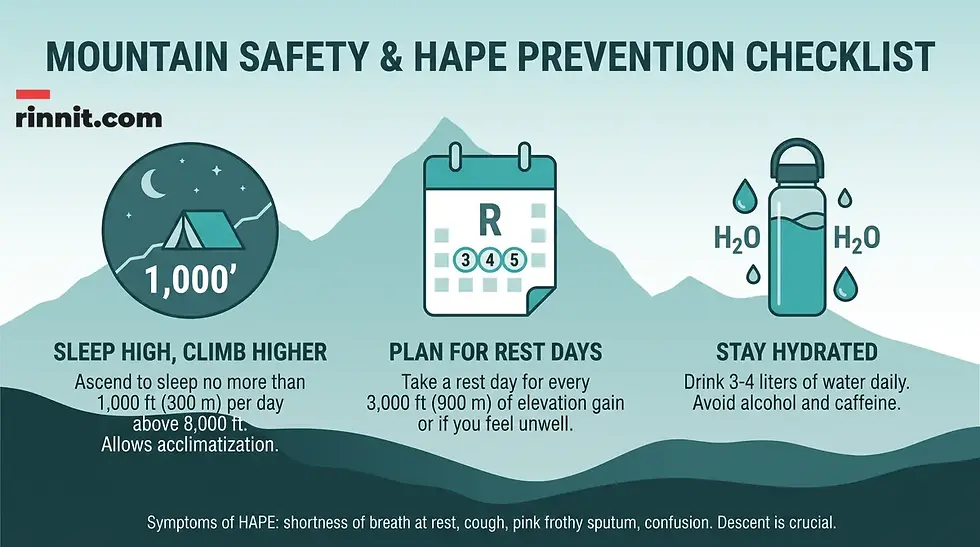
Ascending to high altitudes gradually is the best way to prevent altitude sickness, including HAPE. If you start to feel symptoms, stop and acclimate before going higher, or descend until you feel better. Do not wait until symptoms get worse. [1] Other guidelines include: [1]
Plan your trip carefully, following guidance on how much to increase your altitude each day.
Factor in air travel that can take you quickly to a higher altitude. You still need to acclimate even if you did not get there on foot.
Plan rest days to acclimate. Above about 10,000 feet (3,000 meters), take a rest day every three to four days and raise the altitude where you sleep by no more than about 1,600 feet (500 meters) a day.
Talk to your provider about any health conditions that might affect you at altitude.
If you might be at risk for HAPE, ask your provider about preventive medicine (prophylaxis).
Never travel alone, and check in with your companions about how they feel.
Conclusion
HAPE is a reminder that mountains demand respect, whatever your fitness. Ascend gradually, know the warning signs, and act at once if they appear. Oxygen and a quick descent are what save lives.
Looking for clear answers on tough health questions? Browse plain-language health guides at Rinnit.com.
Frequently Asked Questions
Can being in good shape prevent HAPE?
No. Being physically fit does not protect you from HAPE. The biggest risk factor is ascending too quickly, no matter how healthy or fit you are. [1]
Is HAPE the same as altitude sickness?
HAPE is a severe form of altitude sickness (mountain sickness) in which fluid collects in the lungs. It can get worse fast and is fatal if not treated quickly. [1]
At what altitude does HAPE start?
HAPE happens at or above 8,200 feet (2,500 meters). Many ski resorts in the U.S. and Canada have base elevations at or above that height. [1]
Can I keep climbing if the symptoms go away?
Your provider can tell you whether it is safe to complete your ascent once you feel better. It is usually not recommended right away because the recurrence rate is high. [1]
What does pink, frothy mucus mean?
Pink, frothy mucus is a sign of advanced HAPE. Blood may leak into the lungs and cause you to cough up blood-tinged mucus. [1]
How long does HAPE take to resolve?
HAPE can take up to two weeks to fully resolve. [1]
Can HAPE happen while skiing?
Yes. HAPE can occur at or above 8,200 feet, and many ski resorts have base elevations at or above that height. [1]
What is a Gamow Bag?
A Gamow Bag is a portable hyperbaric chamber that a provider may use once you are at a lower altitude or while you wait to be moved. [1]
Is HAPE more common in men or women?
HAPE is more common in males. [1]
What is re-entry HAPE?
Re-entry HAPE happens when someone who normally lives at a high altitude stays at a lower altitude and then re-ascends without taking time to reacclimate. [1]
Should I take medicine to prevent HAPE?
Ask your provider if you might be at risk. Providers sometimes prescribe the same medicines used to treat HAPE as prevention. Never start one without medical advice. [1]
Why do I need rest days?
Your body needs time to adjust to the lower oxygen level at altitude. Planned rest days are part of acclimatizing safely. [1]
Related Reading
References
Cleveland Clinic. High-Altitude Pulmonary Edema (HAPE). Cleveland Clinic. Last updated October 21, 2024. https://my.clevelandclinic.org/health/diseases/high-altitude-pulmonary-edema
Jones BE, Stokes S, McKenzie S, et al. Management of high altitude pulmonary edema in the Himalaya: a review of 56 cases presenting at Pheriche medical aid post (4240 m). Wilderness Environ Med. 2013;24(1):32-6. PMID 23062320. https://doi.org/10.1016/j.wem.2012.07.004
Deweber K, Scorza K. Return to activity at altitude after high-altitude illness. Sports Health. 2010;2(4):291-300. PMID 23015950. https://doi.org/10.1177/1941738110373065
Burtscher M, Hefti U, Hefti JP. High-altitude illnesses: Old stories and new insights into the pathophysiology, treatment and prevention. Sports Med Health Sci. 2021;3(2):59-69. PMID 35782163. https://doi.org/10.1016/j.smhs.2021.04.001
This article is for general educational purposes only and is not a substitute for professional medical advice, diagnosis, or treatment. Always seek the advice of your physician or other qualified healthcare provider with any questions you may have about a medical condition. Never disregard professional medical advice or delay seeking care because of something you have read here. If you think you may have a medical emergency, call your doctor or emergency services immediately.



Comments