Hepatitis E: Understanding the Risks, Transmission, and Pregnancy Safety

Updated: 3 days ago
Medically reviewed by Dr. Baraa Alnahhal, MD. Last reviewed October 13, 2026. This content is for educational purposes and is not medical advice.

Quick Answer
Hepatitis E is a liver infection caused by the hepatitis E virus, most commonly spread through unclean drinking water or raw or undercooked pork and shellfish. Most healthy people clear the virus within two to six weeks. Pregnant women and people with weakened immune systems face the highest danger. Prevention focuses on safe water, handwashing and well-cooked meat.
What the research says
Hepatitis E is far deadlier in pregnancy in endemic regions, especially late in pregnancy. A meta-analysis of 47 studies covering 3,968 people in Africa and Asia found a pooled maternal case-fatality risk of 20.8% (95% CI 16.6-25.3) and a fetal case-fatality risk of 34.2%, rising to 61.2% in women who developed fulminant hepatic failure. Risk was higher in the third trimester and in hospital-based studies; community-based surveys gave a lower pooled maternal figure of 12.2% (Jin et al., Epidemiology and Infection, 2016).
A hepatitis E vaccine gives durable protection in adults. In the 10-year follow-up of a randomized, placebo-controlled phase 3 trial of 112,604 adults in China, 13 vaccinated people developed hepatitis E compared with 77 in the placebo group, a vaccine efficacy of 83.1% (95% CI 69.4-91.4) in the modified intention-to-treat analysis and 86.6% in the per-protocol analysis. Vaccine-induced antibodies persisted for at least 8.5 years (Huang et al., The Lancet, 2024).
Vaccine data in women of childbearing age support efficacy, but the safety picture near conception is not fully settled. A systematic review of three studies (over 23,000 participants) found the HEV239 vaccine effective at preventing infection, with no significant increase in stillbirth or elective termination. It also found a possible higher risk of miscarriage (odds ratio 1.60, 95% CI 0.99-2.57; the interval includes 1), so the authors advise caution when vaccinating near conception (Jotautis and Sarantaki, Vaccines, 2025).
What is Hepatitis E?
Hepatitis E is a liver infection caused by the hepatitis E virus (HEV). It is a significant public health issue in areas with poor sanitation and limited access to clean water. Unlike some other forms of hepatitis, HEV is often an acute infection, meaning it appears suddenly and lasts for a short duration. However, in rare cases, particularly among those with compromised immune systems, it can become a chronic, long-term condition that requires specialized medical intervention [1].
How does the virus spread?
The transmission of Hepatitis E is primarily linked to the ingestion of the virus, which is excreted in the feces of infected humans and animals. This creates several common pathways for infection that are important for travelers and residents in high-risk areas to understand.
Transmission Route | Description |
Contaminated Water | The most frequent cause, involving drinking water containing microscopic amounts of infected waste [1]. |
Undercooked Meat | Eating raw or undercooked pork, venison, boar, or shellfish that carries the virus [1]. |
Vertical Transmission | The passing of the virus from a pregnant person to the fetus during gestation [1]. |
Blood Transfusion | A very rare occurrence where the virus is transmitted through donated blood products [1]. |
What are the symptoms of Hepatitis E?
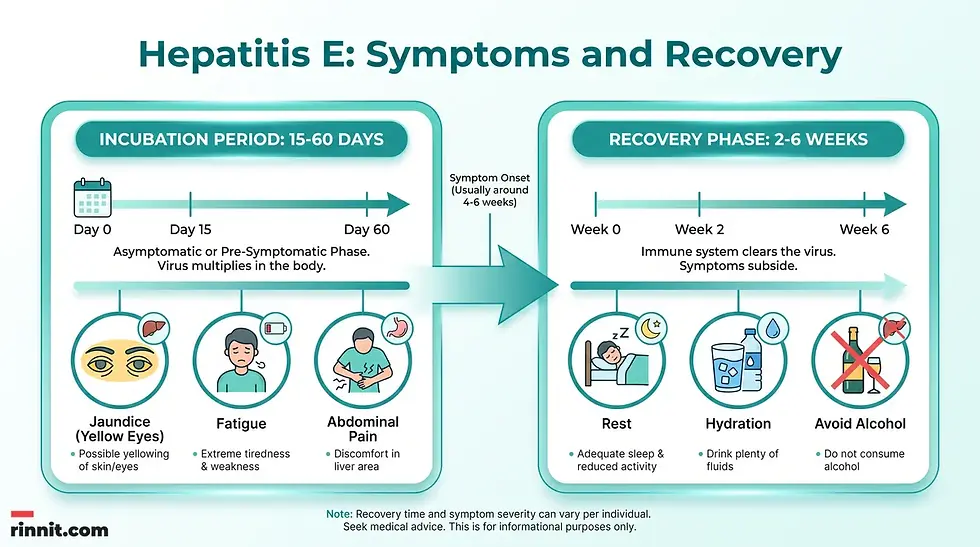
Symptoms typically emerge between 15 and 60 days after the initial exposure. It is important to note that many people infected with HEV may experience only mild symptoms or none at all. When symptoms do occur, they often mimic other common viral illnesses before showing signs of liver distress.
Common indicators include jaundice (a yellowing of the skin and eyes), extreme fatigue, and a loss of appetite. Patients may also report abdominal pain, particularly in the upper right side, along with nausea, vomiting, and fever. In less common cases, individuals might experience diarrhea, joint pain, itchy skin, or hives [1].
Why is Hepatitis E dangerous during pregnancy?
For most people, Hepatitis E is a temporary illness, but for pregnant women, the risks are dramatically higher. The virus can lead to acute liver failure, a life-threatening condition where the liver suddenly stops functioning. In certain regions, the mortality rate for pregnant women in their third trimester can be as high as 25% [1].

Beyond the risk to the mother, Hepatitis E can cause significant pregnancy complications. These include preterm labor, low birth weight, and stillbirth. Because of these severe risks, any pregnant person experiencing symptoms of hepatitis must seek immediate medical evaluation. It is also critical to note that standard antiviral treatments like ribavirin are not safe for use during pregnancy [1].
How is it diagnosed and managed?
Healthcare providers typically diagnose the infection through blood tests that look for specific antibodies produced by the immune system in response to the virus. In some cases, a stool test may be used to detect the presence of the virus directly [1].
There is no specific cure for acute Hepatitis E; instead, management focuses on supportive care to help the body recover. This includes significant rest, staying hydrated with plenty of fluids, and avoiding alcohol or medications that might further stress the liver. For chronic cases in immunocompromised patients, doctors may reduce immunosuppressant dosages or prescribe specific antiviral medications [1].
Prevention and Safety Tips
Preventing Hepatitis E is largely a matter of maintaining strict food and water safety standards, especially when traveling to areas where the virus is common.
Water safety: Drink only bottled or treated water. Use bottled water even for small tasks like brushing your teeth or making ice [1].
Food preparation: Avoid raw or undercooked shellfish and meat, particularly pork and wild game. Wash all produce thoroughly with treated water [1].
Personal hygiene: Wash hands frequently with soap and water, especially before handling food and after using the bathroom [1].
Vaccination: While a vaccine (Hecolin®) exists and is used in China, it is currently not available in the United States [1].
Conclusion
Hepatitis E remains a preventable but potentially serious threat to liver health. While most healthy individuals will recover without lasting damage, the extreme risks to pregnant women and the immunocompromised cannot be ignored. By prioritizing clean water, safe food practices, and early medical consultation, the impact of this virus can be significantly minimized.
Take action for your health: If you are planning to travel or are currently pregnant and experiencing symptoms, consult a healthcare provider immediately. For more information on liver health and travel safety, explore the health guides on Rinnit.com.
Frequently Asked Questions
Can I get Hepatitis E from another person? It is very rare for Hepatitis E to spread directly from person to person; it is almost always through contaminated food or water [1].
How long does it take to recover? Most people recover fully within two to six weeks [1].
Is there a vaccine in the U.S.? No, the only available vaccine is currently used in China and is not approved for use in the U.S. [1].
What is the most common symptom? Jaundice (yellowing of the skin and eyes) is one of the most recognizable signs of liver infection [1].
Can undercooked pork cause Hepatitis E? Yes, undercooked pork is a known source of the virus in the United States [1].
Is Hepatitis E chronic? Usually it is acute, but it can become chronic in people with weakened immune systems [1].
What should I avoid if I have the virus? You should avoid alcohol and consult your doctor before taking any new medications or supplements [1].
Can I get it from a blood transfusion? While possible, this is rare [1].
Is it safe to eat street food in high-risk areas? It is generally recommended to avoid street food in areas with poor sanitation to reduce your risk [1].
Does the virus stay in your body forever? In most cases, the body clears the virus completely after the acute phase [1].
What are the emergency warning signs? Seek emergency care for confusion, dark urine, severe belly pain, or vomiting blood [1].
Can children get Hepatitis E? Yes, anyone exposed to the virus can become infected, though symptoms are often milder in children [1].
Is there a cure? There is no specific cure; the body usually fights off the virus with supportive care [1].
How do I know if my water is safe? When in doubt, stick to sealed bottled water or water that has been properly boiled or treated [1].
Can Hepatitis E lead to liver failure? Yes, especially in pregnant women or those with pre-existing liver disease [1].
References
Cleveland Clinic. Hepatitis E. Cleveland Clinic. Last updated March 9, 2026. https://my.clevelandclinic.org/health/diseases/hepatitis-e
Jin H, et al. Case-fatality risk of pregnant women with acute viral hepatitis type E: a systematic review and meta-analysis. Epidemiol Infect. 2016;144(10):2098-106. PMID 26939626. https://doi.org/10.1017/S0950268816000418
Huang S, et al. Long-term efficacy of a recombinant hepatitis E vaccine in adults: 10-year results from a randomised, double-blind, placebo-controlled, phase 3 trial. Lancet. 2024;403(10429):813-823. PMID 38387470. https://doi.org/10.1016/S0140-6736(23)02234-1
Jotautis V, et al. Evaluating the Efficacy and Safety of Hepatitis E Vaccination in Reproductive-Age Women: A Systematic Review and Meta-Analysis. Vaccines (Basel). 2025;13(1). PMID 39852832. https://doi.org/10.3390/vaccines13010053
Medical Disclaimer
The information provided in this guide is for educational purposes only and should not be considered medical advice. Always consult with a qualified healthcare professional for diagnosis and treatment of any medical condition, especially during pregnancy.



Comments