Hemopneumothorax: Understanding Combined Air and Blood in the Lungs

Updated: 2 days ago
Medically reviewed by Dr. Baraa Alnahhal, MD · Last reviewed: October 2026
Quick Answer
Hemopneumothorax is the combination of blood and air in the pleural space, which makes it hard or impossible for the lung to fully inflate. Chest trauma, such as a car accident or a stab or gunshot wound, is the most common cause. Warning signs include chest pain and trouble breathing; seek help immediately. Treatment removes the air and blood. [1]
What the research says
In trauma, blood and air in the chest often occur together, and small cases may be watched closely. The authors note that traumatic hemothorax and pneumothorax occur together in about 70% of cases. In a single-center study of 353 trauma patients with a small CT-confirmed hemopneumothorax (hemothorax up to 300 mL, pneumothorax up to 35 mm), 261 (74%) were observed first. The observed group had lower pulmonary morbidity (9% vs 14%) and a shorter hospital stay (7 vs 10 days), but 68 (26%) failed observation, most often because the hemothorax worsened on repeat imaging (45%). (Al Tannir et al., J Surg Res, 2024)
Spontaneous hemopneumothorax is rare but can be dangerous. In a hospital series of 488 patients with spontaneous pneumothorax, 27 (5.5%) developed spontaneous hemopneumothorax, and 9 of those 27 (33.3%) had hypovolemic shock on arrival. In a literature review of 6,396 patients with spontaneous pneumothorax, 201 (3.1%) had hemopneumothorax. (Hsu et al., Ann Thorac Surg, 2005)
Size thresholds help guide drainage after trauma. A 2025 review reports that thoracic trauma occurs in about 25% of all traumas and that one third of these patients have a pneumothorax, a hemothorax or both. It states that a pneumothorax larger than 35 mm on CT, and a hemothorax larger than 300 mL, should be drained with a chest tube. (Blank & de Moya, J Trauma Acute Care Surg, 2025)
What Is Hemopneumothorax?

Hemopneumothorax means you have blood (hemothorax) and air (pneumothorax, or collapsed lung) in your pleural space at the same time. [1] The pleural space is the hollow area between your lungs and the inside of your chest wall. Together, the blood and air put pressure around the lung and make it difficult or impossible for the lung to fully inflate. [1]
It usually occurs after a sudden physical injury to the chest, such as a car accident, a fall from a height, or a knife or gunshot wound. [1] If you have symptoms of hemopneumothorax, seek medical help immediately. [1]
Is It Serious?
Yes. Hemopneumothorax requires immediate medical attention. Without treatment, air and blood can put so much pressure on your lungs that they cannot inflate. This can lead to: [1]
Inability to breathe
Heart failure
Death
How Common Is It?
Spontaneous hemopneumothorax (without injury) is rare, but after chest injury blood and air often occur together. Experts estimate there are about 300,000 cases of hemothorax each year, and about 5% of people who have a pneumothorax also have a hemothorax. [1]
Types of Hemopneumothorax
Cleveland Clinic describes two types. [1]
Type | Description | Common triggers |
Traumatic | The most common type. It usually follows a traumatic injury to the chest. In rare cases, another condition such as lung cancer or rheumatoid arthritis may be behind it. | Car accidents, falls, sports impacts, puncture wounds |
Spontaneous | Happens without any apparent reason. It is rare. | No obvious cause |
Medical care can also be involved. Puncture wounds can come from a medical procedure such as a biopsy, and chest (thoracic) surgery, including heart surgery, is listed as another possible cause. [1]
What Causes Hemopneumothorax?
Traumatic hemopneumothorax is the most common type. Causes usually involve chest trauma, such as something hitting or piercing the chest. [1]
Traumatic Causes
Other Causes
Lung cancer
Rheumatoid arthritis
Thoracic (chest) surgery, including heart surgery
A blood clotting disorder
Pleural mesothelioma
In rare cases, spontaneous hemopneumothorax develops without any obvious cause. [1]
Symptoms of Hemopneumothorax

Symptoms can start suddenly, especially after an injury. They may include: [1]
Chest pain
Difficulty breathing, especially when trying to take deep breaths
Rapid breathing (hyperventilation)
Shortness of breath (dyspnea)
Fatigue
Rapid heart rate (tachycardia)
Anxiety
Possible Complications
Hemopneumothorax can also cause problems elsewhere in the body. These may include: [1]
Respiratory failure, when you cannot breathe on your own
Cardiac arrest, when your heart stops pumping blood
An infection such as pneumonia, or empyema (pus collecting in the space around the lung)
Scarring in the pleural tissue or lung tissue
Recurrence, because it can come back
When to Get Emergency Help
Go to the nearest emergency room as soon as possible if you have symptoms of hemopneumothorax, especially trouble breathing or intense chest pain. [1] In many places you can also call your local emergency number. Do not drive yourself.
How Is Hemopneumothorax Diagnosed?
A healthcare provider will do a physical exam and listen to your lungs with a stethoscope. They will also order imaging tests to confirm the diagnosis and to see where blood and air are collecting around your lungs. [1]
How Is Hemopneumothorax Treated?
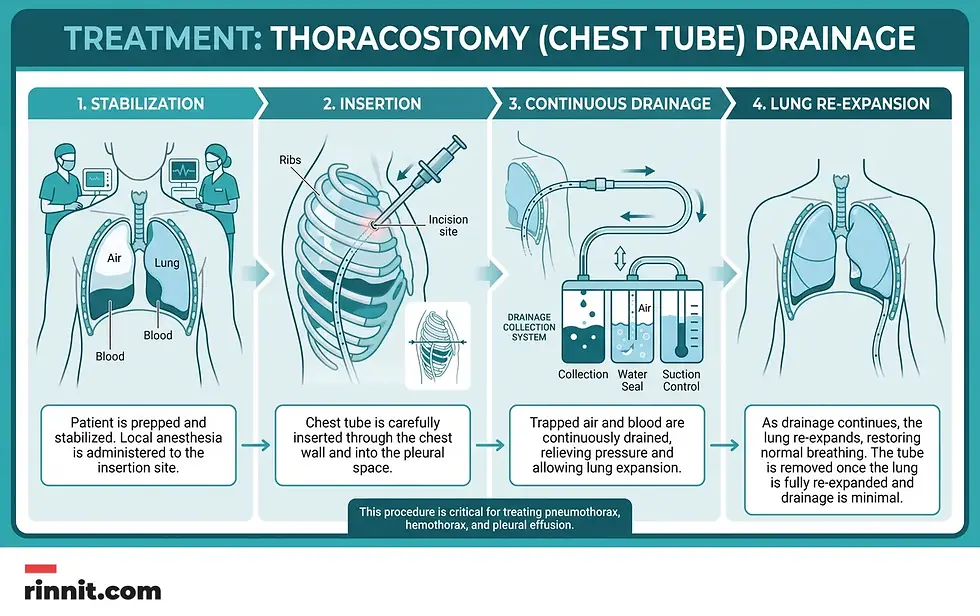
Treatment focuses on removing the blood and air from your pleural space. [1]
Breathing Support
Your provider may first need to support your breathing with oxygen therapy. In severe cases you may need mechanical ventilation, a device that breathes for you when you cannot breathe on your own. [1]
Draining the Air and Blood
Depending on how severe the condition is, the team may use a thin needle (needle aspiration) or place a larger chest tube (thoracostomy) between your ribs to remove blood and air from the pleural space. The needle or tube is removed once the air and blood are gone. [1]
If blood and air keep filling the pleural space, a surgeon makes an incision in your chest to treat the damaged tissue. This procedure is called a thoracotomy. You may also need a blood transfusion if you lose a lot of blood. [1]
Care After Drainage
After treatment, your provider will prescribe antibiotics to help prevent infection and pain relievers to reduce discomfort as you heal. [1] Treatment itself carries risks, including pain, bleeding, lung infection and fluid buildup in the lungs (pulmonary edema). [1]
Recovery and Outlook
You may need to stay in the hospital for a few days after chest tube placement or surgery. Puncture wounds or other chest trauma can take weeks or months to heal. [1] With proper diagnosis and prompt treatment, the outlook is good. [1] There is a small chance that hemopneumothorax can come back, so regular appointments to monitor your lungs are a good idea. [1]
Protect Your Lungs While Healing
Avoid activities that can damage or put pressure on your lungs, including: [1]
Smoking
Intense workouts, including heavy lifting
Contact sports
Scuba diving and deep-sea diving
Air travel
Schedule follow-up appointments. Your provider may order imaging tests to make sure you are healing as expected. [1]
Can It Be Prevented?
You cannot prevent every cause, but these steps can lower your chances: [1]
Wear protective padding while playing high-impact sports.
Always wear a seatbelt in a car.
Clear clutter at home that could cause you to trip and fall.
Use a cane, walker or crutches if you need more stability.
Use a step ladder or grabber tool to reach high places. Never stand on chairs, stools or tables.
Stop smoking.
Avoid or limit activities with drastic changes in air pressure, such as flying or scuba diving.
Conclusion
Hemopneumothorax is a medical emergency in which air and blood collect around the lung. Most cases follow chest trauma, and quick care matters. With prompt drainage, treatment of the cause and careful follow-up, the outlook is good. Knowing the warning signs, and using seatbelts and protective gear, helps protect you.
Looking for clear answers on tough health questions? Browse plain-language health guides at Rinnit.com.
Frequently Asked Questions
Can you survive a hemopneumothorax?
Yes. With proper diagnosis and prompt treatment, the outlook is good. Without treatment, the pressure on the lungs can lead to inability to breathe, heart failure or death. [1]
Is hemopneumothorax the same as a collapsed lung?
No. A collapsed lung (pneumothorax) is air in the pleural space. Hemopneumothorax is a pneumothorax combined with a hemothorax, which is blood in the pleural space. [1]
How long will I stay in the hospital?
You may need to stay for a few days after chest tube placement or surgery, sometimes longer. It depends on the cause and the type of treatment. [1]
Can hemopneumothorax happen twice?
There is a small chance that it can come back, so regular appointments to monitor your lungs are a good idea. [1]
Does it always require surgery?
No. Many people are treated with needle aspiration or a chest tube. Surgery (a thoracotomy) is used if blood and air keep filling the pleural space. [1]
What is a spontaneous hemopneumothorax?
A spontaneous hemopneumothorax is a rare type that happens without any apparent reason, with no injury behind it. [1]
Can a sports injury cause hemopneumothorax?
Yes. Cleveland Clinic lists sports with impact risks, such as football, hockey, lacrosse, boxing, wrestling and martial arts. Weightlifting is also listed. [1]
What tests are used to diagnose it?
A chest X-ray, a CT scan and an ultrasound can show where blood and air are collecting around your lungs. [1]
What is a thoracostomy?
A thoracostomy is the placement of a chest tube between your ribs to remove blood and air from the pleural space. [1]
Why should I avoid flying and scuba diving while I recover?
Cleveland Clinic advises avoiding activities that can damage or put pressure on your lungs, including air travel and scuba or deep-sea diving. [1]
What is empyema?
Empyema is a collection of pus in the space around the lung that can develop as a complication. Antibiotics are given after treatment to help prevent infection. [1]
How can I lower my risk?
Wear protective padding in high-impact sports, always wear a seatbelt, prevent falls at home and stop smoking. [1]
Related Reading
Learn more in our guide to Decortication: Freeing a Trapped Lung, Open vs. VATS Surgery, Risks and Recovery.
References
Cleveland Clinic. Hemopneumothorax. Cleveland Clinic. Last updated August 13, 2023. https://my.clevelandclinic.org/health/diseases/25199-hemopneumothorax
Al Tannir AH, et al. Can Concurrent Traumatic Hemopneumothorax be Safely Observed? J Surg Res. 2024;304:400-407. PMID 39455348. https://doi.org/10.1016/j.jss.2024.09.085
Hsu NY, et al. Spontaneous hemopneumothorax revisited: clinical approach and systemic review of the literature. Ann Thorac Surg. 2005;80(5):1859-1863. PMID 16242469. https://doi.org/10.1016/j.athoracsur.2005.04.052
Blank JJ, et al. Traumatic pneumothorax and hemothorax: What you need to know. J Trauma Acute Care Surg. 2025;100(1):12-17. PMID 40604368. https://doi.org/10.1097/TA.0000000000004692
Medical disclaimer
This article is for general educational purposes only and is not a substitute for professional medical advice, diagnosis, or treatment. Always seek the advice of your physician or other qualified healthcare provider with any questions you may have about a medical condition. Never disregard professional medical advice or delay seeking care because of something you have read here. If you think you may have a medical emergency, call your doctor or emergency services immediately.



Comments