Hemiplegic Migraine: Symptoms, Causes, and Emergency Management

Updated: 2 days ago
Medically reviewed by Dr. Baraa Alnahhal, MD · Last reviewed: October 2026
Quick Answer
Hemiplegic migraine is a type of migraine defined by muscle weakness on one side of the body, typically starting during the aura phase [1] [2]. Because it can cause trouble speaking, confusion and vision changes, it is often mistaken for a stroke [1]. Many cases are linked to gene mutations [1] [3]. If you have one-sided weakness for the first time, seek emergency care immediately [1].
What the research says
Inherited forms tend to be more severe. Comparing 208 patients with a CACNA1A, ATP1A2 or SCN1A mutation against 73 patients without one, mutation carriers had an earlier age of onset, more affected relatives, and more attacks triggered by mild head trauma or marked by extensive weakness, confusion and brain edema, while most patients without a mutation had a milder course closer to common migraine (Pelzer et al., Neurology, 2018) [6].
A fourth gene, PRRT2, belongs on the list. Among 860 people with hemiplegic migraine, PRRT2 variations were found in 30, including 12 of 163 who had tested negative for the three main genes, and the authors advise screening PRRT2 alongside the other three (Riant et al., Neurology, 2022) [7].
Evidence for preventive treatment is still thin. In a review of 13 patients treated with anti-CGRP antibodies, median monthly aura days fell from 3 to 0.6 and the MIDAS disability score fell from 88 to 28, but the certainty of the evidence was rated very low (Romozzi et al., J Headache Pain, 2026) [8].
What is a hemiplegic migraine?
A hemiplegic migraine is a rare subtype of migraine characterized by the presence of motor weakness as part of the aura [3] [5]. Unlike typical migraines that may cause visual disturbances or tingling, this condition involves actual muscle weakness on one side of the body. This weakness usually occurs before or during the headache phase and is often accompanied by other sensory, vision, or speech changes [5].
The condition is categorized into two primary types based on its origin. Familial hemiplegic migraine is diagnosed when at least one first- or second-degree relative also suffers from the condition, often linked to specific genetic mutations [3]. Sporadic hemiplegic migraine occurs randomly in individuals with no family history of the disorder [1] [3].
Feature | Hemiplegic Migraine | Traditional Migraine with Aura |
Motor Weakness | Present (One-sided) | Absent |
Prevalence | Rare (approx. 1 in 10,000) | Common |
Genetic Link | Often linked to specific mutations | Polygenic and complex |
Duration | Hours to days (rarely weeks) | Typically 20–60 minutes for aura |
Emergency Risk | High mimicry of stroke | Low mimicry of stroke |
Recognizing the symptoms
The symptoms of a hemiplegic migraine can be profound and distressing. The one-sided muscle weakness is the hallmark sign, but the attack often involves a wide range of neurological disruptions.
Common Neurological Signs
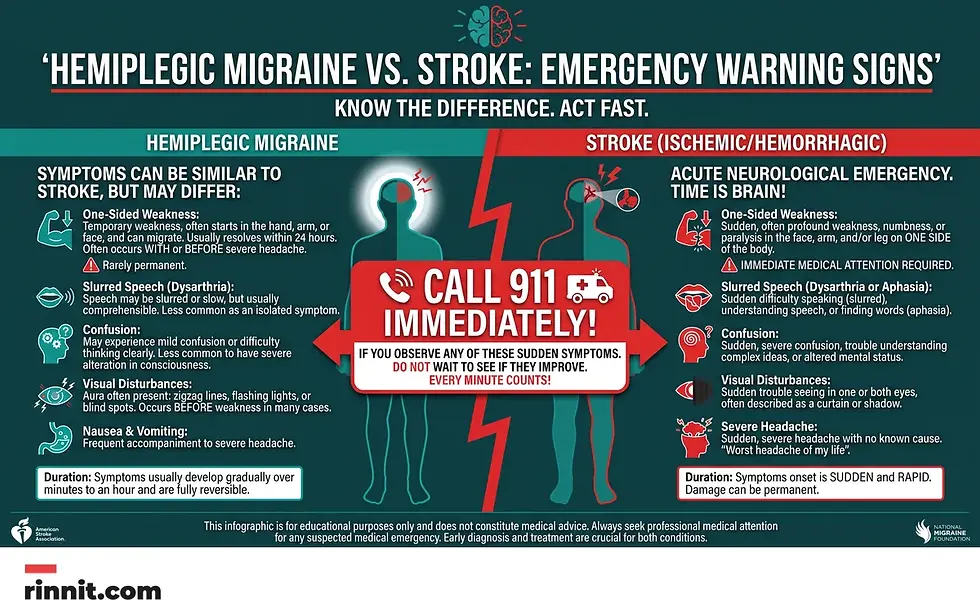
Hemiplegia: Muscle weakness on one side [1]. A common test is lifting both arms; one will feel significantly heavier or impossible to keep upright.
Visual Disturbances: Blind spots (scotomas), flashing lights, zig-zag patterns, or double vision [1].
Sensory Changes: Numbness or a "pins and needles" sensation in the face, arms, or legs [1].
Speech Difficulties: Slurred speech or difficulty finding words, similar to aphasia [1].
Cognitive Impact: Confusion, fatigue, and in rare cases, memory loss or personality changes [1].
Understanding the causes and triggers
At the cellular level, hemiplegic migraines are caused by a phenomenon known as cortical spreading depression [1] [3]. This is a slow-moving wave of electrical depolarization that travels across the brain, disrupting the normal communication between nerve cells.

The Role of Genetics
Research has identified several specific gene mutations that affect how ions (charged particles) move through nerve cells, leading to these electrical disruptions:
Common Triggers
While the underlying cause is genetic or neurological, individual attacks are often set off by external factors. Common triggers include emotional stress, changes in sleep patterns, physical exertion, head trauma, and exposure to bright lights [1] [3]. Interestingly, some attacks have been reported following a cerebral angiogram, a specific type of brain imaging test [1] [5].
Diagnosis and emergency management
Because the symptoms of a hemiplegic migraine are virtually identical to those of a stroke, the primary goal of diagnosis is to rule out life-threatening emergencies.
The "Stroke Rule"
If you experience one-sided weakness, confusion, or difficulty speaking, you must call 911 or your local emergency services immediately [1]. Even if you have a history of hemiplegic migraines, a new attack should be evaluated by a professional to ensure it is not a stroke. Time is the most critical factor in stroke treatment, and you should never attempt to self-diagnose the difference [1].
Diagnostic Tools
Once a stroke is ruled out, a neurologist may use several tests to confirm the diagnosis and rule out other conditions like seizures or brain tumors:

Treatment and long-term outlook
While there is no permanent cure for hemiplegic migraines, the condition is highly manageable. Most patients find that the frequency and severity of attacks decrease as they get older [1].
Medication Strategies
Treatment is generally divided into two categories:
Preventive Care: Medications taken daily to reduce the number of attacks. These include antidepressants (tricyclics), beta-blockers, calcium channel blockers, and antiseizure medications [1] [5].
Acute Treatment: Medications used to stop an attack once it begins. However, certain common migraine drugs (like triptans) are often avoided in hemiplegic cases due to concerns about blood vessel constriction [3] [5].
Conclusion
Living with hemiplegic migraines requires a combination of vigilance and professional medical support. While the symptoms are frightening, the prognosis is generally positive, with most attacks resolving completely without permanent damage [1]. By identifying personal triggers and working closely with a neurologist, patients can significantly reduce the impact of this rare condition on their daily lives.
For more information on rare neurological conditions and migraine management, visit Rinnit.com.
Frequently Asked Questions
Q: Is a hemiplegic migraine a stroke?
A: No, but it looks like one. A stroke is caused by a blood clot or bleed in the brain, while a hemiplegic migraine is an electrical disruption. You must treat it as a stroke until a doctor proves otherwise.
Q: How long does the weakness last?
A: Most often, the weakness lasts for a few hours to a few days. In rare, severe cases, it can persist for several weeks.
Q: Can children get hemiplegic migraines?
A: Yes. In fact, most people experience their first attack between the ages of 12 and 17.
Q: Does it cause permanent brain damage?
A: In the vast majority of cases, the symptoms resolve completely with no lasting effects.
Q: Are there specific foods I should avoid?
A: Triggers vary, but some people find that missing meals or eating certain foods can set off an attack. Keeping a headache diary can help identify your specific triggers.
Q: Can I drive if I have hemiplegic migraines?
A: You should consult your neurologist. If your attacks are frequent or include sudden confusion or vision loss, driving may be unsafe during those times.
Q: Is it hereditary?
A: It can be. The "familial" type is passed down through genes, while the "sporadic" type occurs without a family history.
Q: What is an aura?
A: An aura is a group of sensory or motor symptoms that happen just before or during a migraine attack.
Q: Why are triptans sometimes avoided?
A: Triptans constrict blood vessels, and because hemiplegic migraines involve complex vascular and electrical changes, some doctors avoid them to prevent potential complications.
Q: Can stress cause an attack?
A: Yes, emotional stress is one of the most common triggers for all types of migraines, including the hemiplegic variety.
Q: What is hemiplegia?
A: Hemiplegia is the medical term for paralysis or severe weakness on one side of the body.
Q: Will I need a genetic test?
A: Your doctor may recommend one if you have a family history, as it can help confirm the specific subtype of the condition.
Q: What should I do if my child has one-sided weakness?
A: Seek emergency medical care immediately. Do not wait to see if it passes.
Q: Are hemiplegic migraines common?
A: No, they are considered rare, affecting approximately 1 in 10,000 people.
Q: Does the severity change with age?
A: For many people, both the frequency and the severity of attacks decrease as they reach adulthood.
Related Reading
Sources
Cleveland Clinic. Hemiplegic Migraine. Cleveland Clinic. Last updated December 22, 2023. https://my.clevelandclinic.org/health/diseases/hemiplegic-migraine
American Migraine Foundation. Hemiplegic Migraine: Symptoms and Treatments. American Migraine Foundation. Accessed October 15, 2026. https://americanmigrainefoundation.org/resource-library/hemiplegic-migraine/
Kumar A, Samanta D, Emmady PD, Arora R. Hemiplegic Migraine. StatPearls [Internet]. Treasure Island (FL): StatPearls Publishing. Last updated July 4, 2023. https://www.ncbi.nlm.nih.gov/books/NBK513302/
National Library of Medicine. Sporadic hemiplegic migraine. MedlinePlus Genetics. Last updated October 1, 2017. https://medlineplus.gov/genetics/condition/sporadic-hemiplegic-migraine/
National Organization for Rare Disorders. Hemiplegic Migraine. NORD (National Organization for Rare Disorders). Last updated July 24, 2023. https://rarediseases.org/rare-diseases/hemiplegic-migraine/
Pelzer N, et al. Clinical spectrum of hemiplegic migraine and chances of finding a pathogenic mutation. Neurology. 2018;90(7):e575-e582. PMID 29343472. https://doi.org/10.1212/WNL.0000000000004966
Riant F, et al. Hemiplegic migraine associated with PRRT2 variations: a clinical and genetic study. Neurology. 2022;98(1):e51-e61. PMID 34649875. https://doi.org/10.1212/WNL.0000000000012947
Romozzi M, et al. Effectiveness and safety of anti-CGRP monoclonal antibodies in hemiplegic migraine: an individual patient quantitative analysis. J Headache Pain. 2026;27(1):56. PMID 41618146. https://doi.org/10.1186/s10194-026-02283-5
Medical disclaimer
The information provided in this guide is for educational purposes only and should not be considered medical advice. Always seek the advice of a physician or other qualified health provider with any questions you may have regarding a medical condition. If you think you may have a medical emergency, call your doctor or 911 immediately.



Comments