Hemihyperplasia: Understanding Asymmetrical Growth and Pediatric Health

Updated: 2 days ago
Medically reviewed by Dr. Baraa Alnahhal, MD · Last reviewed: October 2026
Quick Answer
Hemihyperplasia is a rare condition in which one side of the body appears larger than the other, often becoming more noticeable as a child grows [1]. Affected children have a higher chance of kidney and liver cancers, so regular abdominal ultrasounds and blood tests are required until at least age 7 [1] [3]. There is no cure, but specialists can correct limb differences [1] [3].
What the research says
Tumors are uncommon, but the risk is real. In a 10-year review, 3 of 250 children (1.2%) with idiopathic hemihyperplasia developed an abdominal tumor (two Wilms tumors and one adrenal carcinoma), and 1 of 10 children with a syndromic form (10%) developed a hepatoblastoma (Dempsey-Robertson et al., J Pediatr Orthop, 2012) [5].
Genetic testing cannot tell which children are at risk. A practice guideline found that tumors have developed in children with and without molecular abnormalities, so all children with isolated hemihyperplasia should undergo tumor screening (Clericuzio & Martin, Genet Med, 2009) [6].
Surveillance ultrasound picks up abnormalities. Among 63 children in a hemihyperplasia and Beckwith-Wiedemann surveillance protocol, 25 (40%) had an abnormal ultrasound, most often an enlarged kidney or a size difference, and 2 (3.2%) had a tumor or tumor precursor detected by ultrasound (Zarate et al., Am J Med Genet A, 2009) [7].
What is hemihyperplasia?
Hemihyperplasia is a congenital condition characterized by the overgrowth of one side of the body relative to the other [1] [3]. This asymmetry is not merely cosmetic; it can affect the skin, muscles, bones, and internal organs. While the size differences may be subtle at birth, they typically become more pronounced as the child reaches developmental milestones [1].
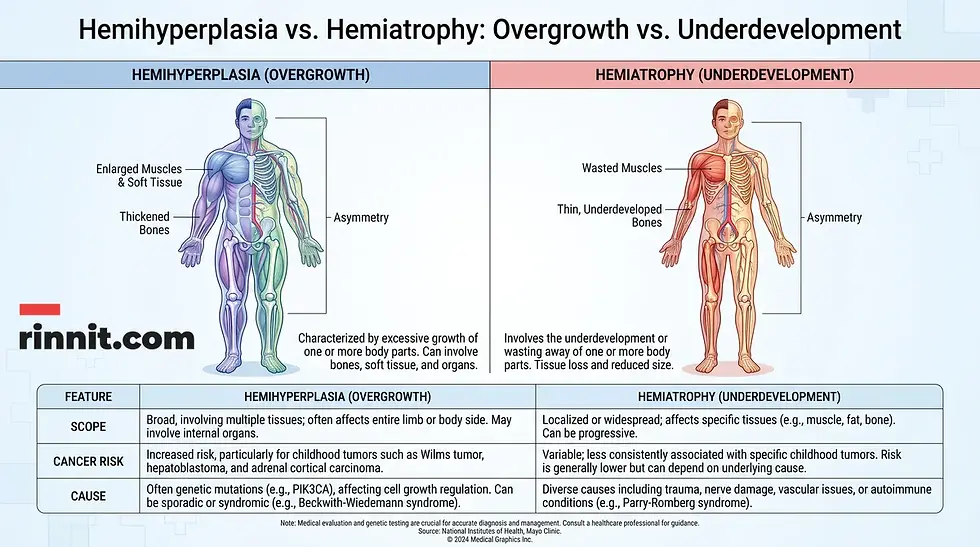
The condition is often categorized as a "rare disease" and can occur in isolation or as part of a broader genetic syndrome [1]. It is essential to distinguish it from hemiatrophy, which involves the underdevelopment of one side [1]. Unlike hemiatrophy, which usually impacts a single area, hemihyperplasia often affects multiple regions simultaneously [1].
Feature | Hemihyperplasia (Overgrowth) | Hemiatrophy (Underdevelopment) |
Primary Effect | One side grows larger than normal | One side fails to develop fully |
Scope | Often affects multiple body areas | Usually isolated to one area (e.g., arms) |
Associated Risks | Increased risk of pediatric cancers | Generally no increased cancer risk |
Internal Impact | Can involve enlarged abdominal organs | Primarily affects external limbs/features |
Identifying symptoms and genetic links
The most prominent symptom is the physical asymmetry of the face, torso, or limbs. In many cases, hemihyperplasia is a hallmark of Beckwith-Wiedemann syndrome, a genetic disorder that carries additional clinical features [1] [2].

Common Clinical Signs
Macroglossia: An abnormally large tongue that may interfere with breathing or eating [2].
Abdominal Wall Defects: Issues such as an umbilical hernia or omphalocele [2].
Organomegaly: Enlargement of internal organs like the liver, pancreas, or kidneys [1] [2].
Hypoglycemia: Low blood sugar levels, particularly in the neonatal period [2].
Ear Creases: Distinctive folds or pits in the earlobes [2].
The critical link to pediatric cancer
One of the most significant concerns for families navigating a hemihyperplasia diagnosis is the increased risk of cancer [1] [6]. The abnormal growth patterns that affect the body's exterior can also manifest in the internal organs, leading to the development of tumors.

Essential Screening Protocols
Because early detection is the most effective way to manage these risks, healthcare providers implement a rigorous screening schedule until the child reaches age 7 [1] [3]. This typically includes:
Research indicates that the risk of developing these tumors decreases significantly as the child enters adolescence [1], at which point the screening frequency may be reduced.
Diagnosis and management strategies
There is no single "gold standard" test to diagnose hemihyperplasia [1]. Instead, clinicians rely on a combination of physical evaluations, family history, and genetic testing. If asymmetry is detected, the child is often referred to a multidisciplinary team of specialists.
The Multidisciplinary Care Team
Pediatricians: For overall growth monitoring and coordination.
Geneticists: To confirm if the condition is sporadic or linked to Beckwith-Wiedemann syndrome [1].
Orthopaedists: To manage limb length discrepancies that could affect walking or spinal alignment.
Hepatologists & Nephrologists: To monitor the health of the liver and kidneys.
Plastic Surgeons: To address facial asymmetry if it impacts function or self-esteem.
Treatment and Surgical Options
While there is no cure [1], treatment focuses on improving quality of life and physical function. Surgery may be recommended to lengthen a shorter limb or, more commonly, to slow the growth of the larger limb (epiphysiodesis) to ensure the legs are even by the time growth stops [1] [3]. Orthotic inserts and physical therapy are also standard nonsurgical interventions.
Conclusion
A diagnosis of hemihyperplasia requires a proactive and vigilant approach to pediatric care. While the physical asymmetry presents its own set of challenges—from finding clothes to maintaining mobility—the primary focus remains on early cancer detection. With regular screenings and a dedicated medical team, most children with this condition lead healthy, active lives and reach a typical life expectancy [1].
For more information on pediatric growth disorders and support resources, visit Rinnit.com.
Frequently Asked Questions
Q: Is hemihyperplasia the same as hemihypertrophy?
A: Yes. These terms are used interchangeably to describe the overgrowth of one side of the body.
Q: Can hemihyperplasia be prevented?
A: No. When it occurs sporadically, it happens by chance during pregnancy. Genetic counseling is recommended for families with a history of the condition.
Q: Does it always cause cancer?
A: No, but the risk is significantly higher than in the general population. This is why regular screenings are mandatory until age 7.
Q: What is a Wilms tumor?
A: It is a type of kidney cancer that primarily affects children and is one of the main risks associated with hemihyperplasia.
Q: Will my child's growth eventually even out?
A: Generally, no. The asymmetry usually persists or becomes more obvious until the child stops growing.
Q: How often are the ultrasounds needed?
A: Most protocols recommend abdominal ultrasounds every 3 to 4 months until the child reaches age 7.
Q: Can it affect the brain?
A: Hemihyperplasia primarily affects the limbs, face, and abdominal organs; however, a neurologist is often part of the care team to monitor overall development.
Q: What is hepatoblastoma?
A: It is a rare form of liver cancer that occurs in infants and children.
Q: Is the condition painful?
A: The overgrowth itself is not typically painful, but limb length differences can lead to back or joint pain if not managed.
Q: Can it be detected before birth?
A: Sometimes. Large organ size or limb differences may be visible on high-resolution prenatal ultrasounds.
Q: What is Beckwith-Wiedemann syndrome?
A: It is a genetic overgrowth disorder that is the most common cause of hemihyperplasia.
Q: Will my child need surgery?
A: Not necessarily. Surgery is usually reserved for significant limb length differences or functional facial issues.
Q: What is an alpha-fetoprotein test?
A: It is a blood test used as a tumor marker to help detect liver cancer in its early stages.
Q: How does it affect daily life?
A: Challenges include finding well-fitting clothes and shoes, and potentially needing physical therapy for mobility.
Q: Does the cancer risk go away after age 7?
A: The risk decreases significantly, but long-term follow-up with a pediatrician is still recommended.
Related Reading
Sources
Cleveland Clinic. Hemihyperplasia. Cleveland Clinic. Last updated September 6, 2022. https://my.clevelandclinic.org/health/diseases/24121-hemihyperplasia
National Organization for Rare Disorders. Beckwith-Wiedemann Syndrome. NORD (National Organization for Rare Disorders). Last updated August 8, 2023. https://rarediseases.org/rare-diseases/beckwith-wiedemann-syndrome/
International Center for Limb Lengthening. Hemihypertrophy (Overgrowth Syndrome). International Center for Limb Lengthening. Accessed October 15, 2026. https://www.limblength.org/conditions/hemihypertrophy-overgrowth-syndrome/
Abraham P. What is the risk of cancer in a child with hemihypertrophy? Arch Dis Child. 2005;90(12):1312-1313. PMID 16301564. https://doi.org/10.1136/adc.2005.082792
Dempsey-Robertson M, et al. Incidence of abdominal tumors in syndromic and idiopathic hemihypertrophy/isolated hemihyperplasia. J Pediatr Orthop. 2012;32(3):322-326. PMID 22411341. https://doi.org/10.1097/BPO.0b013e3182471b04
Clericuzio CL, et al. Diagnostic criteria and tumor screening for individuals with isolated hemihyperplasia. Genet Med. 2009;11(3):220-222. PMID 19367194. https://doi.org/10.1097/GIM.0b013e31819436cf
Zarate YA, et al. Experience with hemihyperplasia and Beckwith-Wiedemann syndrome surveillance protocol. Am J Med Genet A. 2009;149A(8):1691-1697. PMID 19610116. https://doi.org/10.1002/ajmg.a.32966
Medical disclaimer
The information provided in this guide is for educational purposes only and should not be considered medical advice. Always seek the advice of a physician or other qualified health provider with any questions you may have regarding a medical condition. If you think you may have a medical emergency, call your doctor or 911 immediately.



Comments