Hammertoes: Symptoms, Causes, and How to Straighten Your Toes

Updated: 3 days ago
Medically reviewed by Dr. Baraa Alnahhal, MD · Last reviewed: October 2026
Quick Answer
Hammertoes are deformities in which the middle joint of a lesser toe points up while the tip points down [1] [2], mainly caused by wearing narrow, tight shoes or high heels for long periods [1] [2]. They progress from flexible to semi-rigid to rigid [1]. Symptoms include pain, corns and calluses [1] [2]. Most cases improve with deep toe-box shoes, padding and custom orthotics [1].
What the research says
Surgical correction has a low complication rate. In a review of 91 hammertoe repairs in 60 patients using two-pin fusion, 89 toes (98%) had no complication and no infections occurred (Boffeli et al., J Foot Ankle Surg, 2016) [4].
Other health conditions raise surgical risk in older adults. Among 78 patients aged 60 or older, having two or more comorbidities was linked to higher odds of superficial wound infection (OR 4.18) and of recurrence needing surgery (OR 23.15), although pain and function improved similarly in both groups (Maidman et al., Foot Ankle Orthop, 2020) [5].
In diabetes, releasing the tendon lowers pressure on the toe. In a randomized trial of 45 people with diabetic hammertoes, flexor tendon tenotomy cut peak toe plantar pressure from 205.6 kPa to 61.3 kPa after 3 months (Askø Andersen et al., BMJ Open Diabetes Res Care, 2024) [6].
What Is a Hammertoe?
A hammertoe is a structural change in the toe joints that causes them to point upward rather than lying flat against the ground [1]. This condition specifically involves the second (middle) joint of the lesser toes—the four toes next to the big toe [1] [2]. When a hammertoe forms, the tip of the toe points downward while the middle joint curls up [1], often creating a shape that resembles the head of a hammer.
If left untreated, the muscles and tendons in the foot eventually adjust to this cramped position and tighten. This can lead to a permanent “freezing” of the toe in a curled shape [2]. While a mild hammertoe might only be a cosmetic concern initially, advanced cases can significantly impact balance and the ability to walk comfortably [1] [2].
Feature | Hammertoe | Mallet Toe |
Affected Joint | Second (middle) joint | Third joint (near nail) |
Appearance | Upside-down “V” shape | Tip curls downward |
Common Location | Lesser toes (2nd-5th) | Lesser toes |
Claw toe is a related condition that bends in all three toe joints, curling the toe into a ball [1].

What Are the Different Types of Hammertoes?
Medical professionals categorize hammertoes into three distinct stages based on how much the joint can still move [1]. Identifying the stage is critical for determining whether the condition can be treated with conservative methods or if surgery is necessary.
Flexible Hammertoes: This is the earliest stage. Although a curl is visible, you can still manually straighten the toe or move the joint [1]. These respond best to non-surgical treatments [2].
Semi-Rigid Hammertoes: At this stage, the toe has become noticeably stiff [1]. It is difficult to uncurl the toe [1], and the muscles have begun to permanently shorten.
Rigid Hammertoes: This is the most advanced form. The toe is frozen in a curled position [1] and cannot be moved at all. Because the joint is stuck, rigid hammertoes are the most likely to require surgical correction [1] [2].
What Causes Hammertoes to Develop?
Hammertoes develop when constant pressure forces the toes out of their natural alignment for an extended period. Over time, the soft tissues—muscles and tendons—tighten to accommodate this new position. Several factors contribute to this imbalance:
Poorly Fitting Footwear: This is the leading cause. Shoes with narrow, pointed toe boxes or high heels squeeze the toes together [1] [2]. Children can also develop hammertoes if they continue wearing shoes they have outgrown [1].
Natural Foot Structure: People with naturally high arches or flat feet are more susceptible to toe joint changes [1]. Additionally, having a second toe that is longer than the big toe increases the risk of it being cramped inside standard shoes [1].
Underlying Health Issues: Conditions that affect the nerves or joints, such as diabetes or rheumatoid arthritis [1], can weaken the foot muscles and lead to curling.
Existing Foot Deformities: Bunions (bony bumps at the base of the big toe) often push the big toe toward the others, creating a crowding effect that forces the second toe into a hammertoe position [1].
Common Symptoms of Hammertoes
While the visible curl is the most obvious sign, hammertoes often cause physical discomfort that worsens when wearing tight shoes. Common symptoms include:
Localized Pain: Pain typically occurs on the top of the curled joint where it rubs against the shoe, or at the ball of the foot [1].
Corns and Calluses: These thick layers of skin form on top of the joint or the tip of the toe due to constant friction [2].
Restricted Movement: It may become difficult or painful to move the affected toe [1] or the foot as a whole.
Inflammation: The affected area may appear swollen or discolored (red or bruised) [1] [2] after long periods of standing or walking.

How Are Hammertoes Diagnosed?
A podiatrist can typically diagnose a hammertoe through a physical examination [1]. During the visit, the provider will move the toe joints to check for flexibility and ask about the types of shoes you wear most frequently [1]. They may also ask you to walk to see if the hammertoe is affecting your gait. In some cases, a foot X-ray is performed to assess the bone structure [1] [2] and determine the severity of the joint change.
Treatment Options for Hammertoes
The goal of treatment is to relieve pressure and return the toe to a more natural position. For flexible and semi-rigid cases, conservative treatments are usually successful [1].
Non-Surgical Management
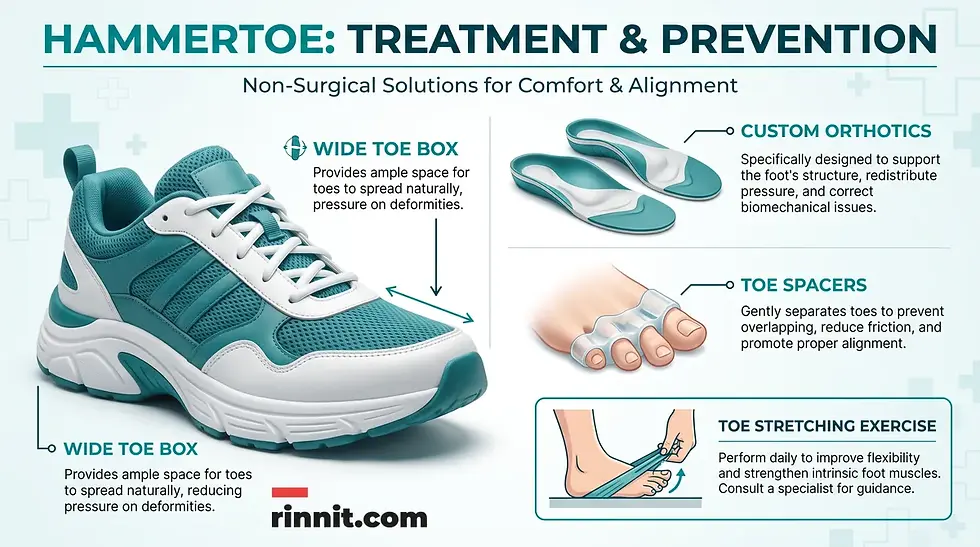
Footwear Adjustments: Switching to shoes with a wide, deep toe box [1] [2] is the most effective way to stop the progression of hammertoes.
Padding and Taping: Over-the-counter pads can cushion the joint to prevent corns [1] [2], while medical tape can help hold the toe in a straighter position [1].
Orthotic Devices: Custom or over-the-counter shoe inserts [1] can support the arch and redistribute weight, taking pressure off the toes.
Stretching Exercises: Specific toe stretches and exercises [1] [2] can help keep the tendons flexible and prevent further tightening.
Surgical Intervention
Surgery is generally reserved for rigid hammertoes that cause extreme pain or make walking nearly impossible [1] [2]. The procedure may involve removing a small piece of bone to allow the toe to lie flat or realigning the tendons [2].
How to Prevent Hammertoes
The best way to avoid hammertoes is to prioritize foot health when choosing footwear. Experts recommend following these simple guidelines:
Check the Toe Box: Ensure your shoes have enough room for your toes to wiggle. Avoid pointed-toe styles that cramp the front of the foot [1].
Shop in the Afternoon: Feet naturally swell throughout the day, so buying shoes in the late afternoon ensures a fit that will remain comfortable all day long [1].
Test for Comfort: Never buy shoes that feel tight with the hope that they will “stretch out.” They should be comfortable while sitting, standing, and walking from the moment you try them on [1].
Wearing comfortable, well-fitting shoes is the best way to prevent hammertoes [1]. Make sure no movement or position hurts, pinches, or pushes on your toes.
Conclusion
Hammertoes are a common but manageable foot condition. By recognizing the early signs—such as stiffness or a slight curl—and switching to more supportive footwear, most people can avoid the need for surgery. If you notice persistent pain or a toe that is becoming difficult to move, consulting a podiatrist early can help preserve your mobility and foot health.
Frequently Asked Questions
Q: Can hammertoes be straightened naturally?
A: Yes, flexible hammertoes can often be straightened without surgery by using toe spacers, orthotics, and switching to wider shoes.
Q: Will a hammertoe go away on its own?
A: Most hammertoes will not go away without intervention. While flexible cases may improve with shoe changes, rigid cases usually require treatment.
Q: What is the main cause of hammertoes?
A: The primary cause is wearing shoes that are too tight or narrow, which forces the toes into a cramped, curled position.
Q: Are hammertoes hereditary?
A: While the condition itself isn't strictly hereditary, you can inherit a foot structure (like high arches) that makes you more likely to develop them.
Q: Can I still exercise with a hammertoe?
A: Yes, but you should wear shoes with plenty of room and avoid activities that put excessive pressure on the front of the foot.
Q: How do I know if my hammertoe needs surgery?
A: Surgery is typically only recommended if the toe is rigid (cannot be moved) and causes severe pain that interferes with daily life.
Q: What is the difference between a hammertoe and a mallet toe?
A: A hammertoe bends at the middle joint, while a mallet toe bends at the joint closest to the toenail.
Q: Can children get hammertoes?
A: Yes, especially if they continue to wear shoes that they have outgrown.
Q: Do toe spacers really work?
A: Toe spacers can help keep flexible toes in the correct alignment and prevent the condition from worsening.
Q: How long does it take to see results from non-surgical treatment?
A: It can take several weeks of consistent treatment and shoe changes to notice a visible difference in toe alignment.
Q: Can diabetes cause hammertoes?
A: Yes, diabetes can cause nerve damage and muscle weakness in the feet, which increases the risk of toe deformities.
Q: What are the risks of leaving a hammertoe untreated?
A: Untreated hammertoes can become rigid, cause painful corns, and eventually affect your balance and gait.
Q: Are high heels bad for hammertoes?
A: Yes, high heels shift weight to the front of the foot and often have narrow toe boxes, both of which contribute to hammertoes.
Q: What kind of doctor treats hammertoes?
A: A podiatrist is a foot specialist who typically diagnoses and treats hammertoes.
Q: Is hammertoe surgery painful?
A: Like any surgery, there is a recovery period, but modern techniques aim to minimize discomfort and restore function quickly.
Sources
Cleveland Clinic. Hammertoes. Cleveland Clinic. January 12, 2024. https://my.clevelandclinic.org/health/diseases/17038-hammertoes
American Academy of Orthopaedic Surgeons (AAOS). Hammer Toe: Comprehensive Guide. OrthoInfo. Accessed October 15, 2026. https://www.orthoinfo.org/diseases--conditions/hammer-toe/
Goransson M, Dixon M. Hammertoe. In: StatPearls [Internet]. StatPearls Publishing. Last updated February 15, 2026. PMID 32644694. https://pubmed.ncbi.nlm.nih.gov/32644694/
Boffeli TJ, et al. Two-Pin Fixation of Proximal Interphalangeal Joint Fusion for Hammertoe Correction. J Foot Ankle Surg. 2016;55(3):480-7. PMID 26878808. https://doi.org/10.1053/j.jfas.2016.01.027
Maidman SD, et al. Comorbidities Associated With Poor Outcomes Following Operative Hammertoe Correction in a Geriatric Population. Foot Ankle Orthop. 2020;5(4):2473011420946726. PMID 35097407. https://doi.org/10.1177/2473011420946726
Askø Andersen J, et al. Effect of flexor tendon tenotomy of the diabetic hammertoe on plantar pressure: a randomized controlled trial. BMJ Open Diabetes Res Care. 2024;12(6). PMID 39631844. https://doi.org/10.1136/bmjdrc-2024-004398
Related Reading
Orthotics: Types, Uses and How Custom Shoe Inserts Work explains how orthotics support the feet and ankles.
Medical disclaimer
The information provided in this guide is for educational purposes only and should not be considered medical advice. Always consult with a qualified healthcare professional or podiatrist for the diagnosis and treatment of foot conditions. If you experience severe pain or difficulty walking, seek medical attention immediately.



Comments