Grade 3 Astrocytoma: What It Is, Why It Happens, and How It's Treated

Updated: 2 days ago
Medically reviewed by Dr. Baraa Alnahhal, MD · Last reviewed: October 2026
Quick Answer
A grade III astrocytoma is a fast-growing, high-grade (cancerous) brain tumor made of star-shaped astrocyte cells [1]. Symptoms include persistent headaches, seizures, vision changes and limb weakness [1]. Standard treatment combines surgery, radiation therapy and chemotherapy [1]. The five-year survival rate is approximately 52% to 58%, depending on the success of surgical removal [1].
What the research says
Adding temozolomide after radiotherapy improved survival. In the CATNON phase 3 trial (745 adults enrolled at the interim analysis) of newly diagnosed anaplastic glioma without 1p/19q co-deletion, 5-year overall survival was 55.9% with adjuvant temozolomide versus 44.1% without it (hazard ratio 0.65) (van den Bent et al., Lancet, 2017) [6].
Outcomes vary widely, even among IDH-mutant tumors. In a follow-up analysis of the CATNON trial (751 patients randomized; 432 IDH-mutant anaplastic astrocytomas analyzed), age, cognitive test score, temozolomide treatment, and several molecular markers each independently predicted survival (Tesileanu et al., Neuro-Oncology, 2021) [7].
What Is Grade 3 Astrocytoma?
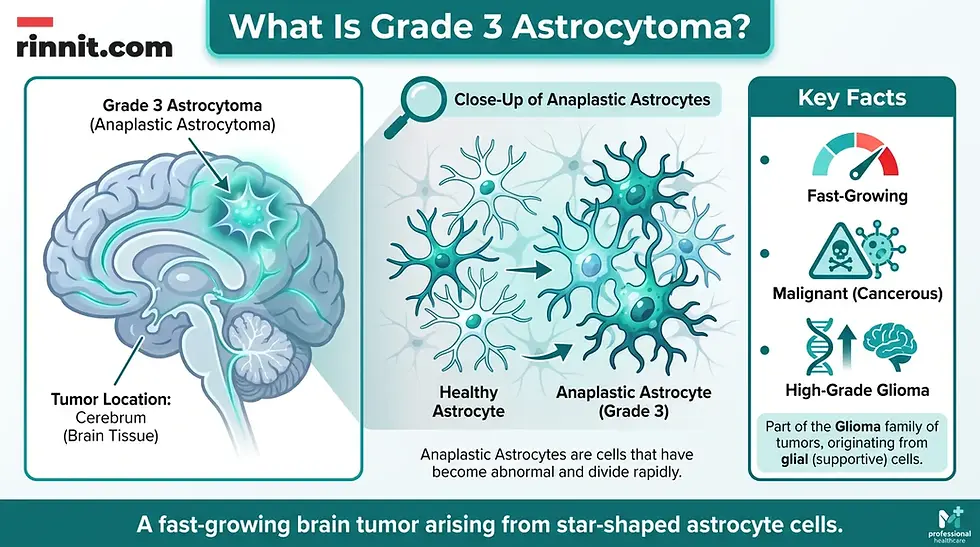
A grade 3 astrocytoma is a malignant (cancerous) tumor that develops in the central nervous system, which includes the brain and spinal cord. It is composed of astrocytes, which are star-shaped cells that provide vital support and protection to neurons (nerve cells) [1]. In 2021, the World Health Organization (WHO) reclassified this condition—previously known as anaplastic astrocytoma—as a “grade 3 astrocytoma” to help clarify diagnostic reports [1] [3].
As a high-grade tumor, it grows much faster and more aggressively than grade 1 or 2 astrocytomas [1]. It is a subtype of glioma, a broader category of tumors that also includes ependymomas and oligodendrogliomas [1]. While it is a serious diagnosis, it is treatable, and researchers are constantly developing new therapies through clinical trials [1].
Category | Details |
Medical Name | Grade 3 Astrocytoma (formerly Anaplastic Astrocytoma) |
Cell Type | Astrocytes (star-shaped support cells) |
Tumor Grade | Grade 3 (High-grade/Malignant) |
Prevalence | 5 to 8 per 100,000 people (combined with glioblastoma) |
Common Age Groups | Children (5–9) and Adults (30–50) |
What Are the Symptoms and Common Locations?
Symptoms of a grade 3 astrocytoma depend heavily on the tumor's size and its specific location within the brain [1]. General signs often include persistent headaches, lethargy or extreme drowsiness, and unexplained vomiting [1]. Many patients also experience personality changes, vision problems, or seizures [1].
Location-Specific Symptoms
The tumor most commonly grows in the cerebrum, the largest part of the brain [1]. Depending on which lobe is affected, symptoms can vary:
Physical symptoms like weakness in the arms and legs or a loss of coordination are also common markers that the tumor is affecting motor functions [1].

What Causes Grade 3 Astrocytoma?
The primary cause of this tumor is an overproduction of astrocyte cells [1]. While researchers are still studying why this overproduction occurs, a few specific risk factors have been identified. In fewer than 5% of cases, genetic changes or mutations are the cause [1]. Another known risk factor is exposure to ionizing radiation, often from previous treatments for other cancers like leukemia or lymphoma [1].
The condition is most frequently diagnosed in children between the ages of 5 and 9 and in adults between 30 and 50 [1]. Statistics show that it affects males more often than females [1] [2]. It may also occur alongside certain genetic conditions, including Neurofibromatosis Type 1, Li-Fraumeni syndrome, and Tuberous sclerosis [1] [2].
How Is It Diagnosed and Treated?
Diagnosis begins with a physical exam and a review of the patient's medical history. Healthcare providers use noninvasive imaging tests, such as MRI and CT scans, to determine the tumor's size and exact location [1]. A biopsy—where a small sample of the tumor is surgically removed and examined—is often necessary to confirm the grade and type of the tumor [1].
The Three-Pronged Treatment Approach
Most treatment plans for a grade 3 astrocytoma involve a combination of three therapies [1]:
Surgery: Usually the first step, the goal is to remove as much of the tumor as safely possible. Complete removal is challenging if the tumor has spread to nearby tissue [1].
Radiation Therapy: Following surgery, radiation is used to target and destroy any remaining cancer cells [2].
Chemotherapy: For adults, the FDA has approved the medication temozolomide [1]. While there is currently no specific medication approved for children [1], chemotherapy remains a standard part of pediatric care.
Complications can arise, including increased pressure within the skull (intracranial pressure), fluid buildup in the brain (hydrocephalus), or paralysis on one side of the body [1].

Frequently Asked Questions
Q: Is grade 3 astrocytoma the same as anaplastic astrocytoma?
A: Yes. “Grade 3 astrocytoma” is the updated medical term established by the WHO in 2021, replacing the older name “anaplastic astrocytoma.”
Q: Is this type of tumor cancerous?
A: Yes, a grade 3 astrocytoma is a malignant (cancerous), high-grade tumor that grows quickly.
Q: Can a grade 3 astrocytoma be cured?
A: While not considered curable, it is highly treatable. Advances in surgery and therapy have improved the outlook for many patients.
Q: What is the survival rate?
A: One study indicates a five-year survival rate of 52% to 58%. This rate is higher if the surgical team can completely remove the tumor. Survival figures vary between studies and with the tumor's molecular profile, so ask your care team what applies to your situation.
Q: How common is this tumor in children?
A: High-grade astrocytomas account for approximately 10% of all childhood central nervous system tumors.
Q: What is temozolomide?
A: It is an FDA-approved chemotherapy medication specifically used to treat adults with grade 3 astrocytomas.
Q: What are the side effects of treatment?
A: Common side effects include fatigue, headaches, nausea, hair loss, and a reduced appetite. Surgery carries risks like infection or seizures.
Q: Can the tumor spread to other parts of the body?
A: It typically spreads to nearby brain tissue but rarely travels to organs outside the central nervous system.
Q: What causes the headaches associated with these tumors?
A: Headaches are often caused by the tumor itself or by increased intracranial pressure (pressure within the skull).
Q: Are there clinical trials for this condition?
A: Yes, clinical trials are frequently available for both children and adults to test new treatments and prevention strategies.
Q: What is a glioma?
A: Glioma is a general term for tumors that start in the glial cells of the brain or spinal cord. Astrocytomas are a type of glioma.
Q: Does gender affect the risk?
A: Statistics show that grade 3 astrocytomas affect males more frequently than females.
Q: What should I ask my doctor after a diagnosis?
A: Ask about the recommended treatment plan, potential side effects, clinical trial eligibility, and your specific prognosis based on the tumor's location.
Q: Can genetic testing help?
A: Yes, genetic testing can sometimes identify mutations that might influence treatment decisions or explain why the tumor developed.
Q: How often is monitoring required after treatment?
A: Patients typically require regular follow-up imaging (like MRIs) to monitor for any signs of the tumor returning.
Sources
Cleveland Clinic. Grade 3 Astrocytoma (Formerly Known as Anaplastic Astrocytoma). Cleveland Clinic. Last updated September 27, 2023. https://my.clevelandclinic.org/health/diseases/grade-3-astrocytoma-anaplastic-astrocytoma
Peruzzi P, Prabhu V. Astrocytoma Tumors. American Association of Neurological Surgeons (AANS). April 15, 2024. https://www.aans.org/patients/conditions-treatments/astrocytoma-tumors/
National Brain Tumor Society. Astrocytoma, IDH-Mutant. National Brain Tumor Society. Last updated April 22, 2025. https://braintumor.org/brain-tumors/about-brain-tumors/brain-tumor-types/astrocytoma-idh-mutant/
Brain Tumour Foundation of Canada. Anaplastic Astrocytoma. Brain Tumour Foundation of Canada. Accessed October 15, 2026. https://www.braintumour.ca/brain_tumour_types/anaplastic-astrocytoma/
Louis DN, Perry A, Wesseling P, et al. The 2021 WHO Classification of Tumors of the Central Nervous System: a summary. Neuro Oncol. 2021;23(8):1231-1251. PMID 34185076. https://doi.org/10.1093/neuonc/noab106
van den Bent MJ, Baumert B, Erridge SC, et al. Interim results from the CATNON trial (EORTC study 26053-22054) of treatment with concurrent and adjuvant temozolomide for 1p/19q non-co-deleted anaplastic glioma: a phase 3, randomised, open-label intergroup study. Lancet. 2017;390(10103):1645-1653. PMID 28801186. https://doi.org/10.1016/S0140-6736(17)31442-3
Tesileanu CMS, van den Bent MJ, Sanson M, et al. Prognostic significance of genome-wide DNA methylation profiles within the randomized, phase 3, EORTC CATNON trial on non-1p/19q deleted anaplastic glioma. Neuro Oncol. 2021;23(9):1547-1559. PMID 33914057. https://doi.org/10.1093/neuonc/noab088
Medical disclaimer
This article is for general educational purposes only and is not a substitute for professional medical advice, diagnosis, or treatment. Always seek the advice of your physician or other qualified healthcare provider with any questions you may have about a medical condition. Never disregard professional medical advice or delay seeking care because of something you have read here. If you think you may have a medical emergency, call your doctor or emergency services immediately.



Comments