Gastroschisis: Symptoms, Causes, and Treatment for Newborns

Updated: 2 days ago
Medically reviewed by Dr. Baraa Alnahhal, MD · Last reviewed: October 2026
Quick Answer
Gastroschisis is a birth defect in which a hole in the abdominal wall lets the baby's intestines exit the body during pregnancy [1]. It is usually diagnosed by ultrasound between weeks 18 and 20 [1]. Surgery shortly after birth returns the organs and closes the opening, sometimes gradually using a silo pouch. The long-term prognosis is generally excellent.
What the research says
Most babies survive, but the hospital stay is long. A systematic review of 44 studies covering 3,770 infants with gastroschisis reported neonatal survival of 91.29%, with immediate surgical repair in 80.1% of babies (primary closure in 69%). Average hospital stay was 38 days for simple gastroschisis and 89 days for complex gastroschisis (Ferreira et al., J Matern Fetal Neonatal Med, 2022) [2].
Primary repair is favored when the abdomen allows it. The American Pediatric Surgical Association reviewed 92 studies and found support for primary fascial repair, without a staged silo, when abdominal space and the baby's stability permit it. Delivery after 37 weeks was considered optimal, and the authors noted that overall data quality is poor (Slidell et al., J Pediatr Surg, 2024) [3].
Infections around conception are linked to higher risk. A meta-analysis found increased odds of gastroschisis with periconceptional urinary tract infection (OR 1.54, 95% CI 1.29-1.8) and sexually transmitted infection (OR 1.4, 95% CI 1.01-1.79) (Vinogradov et al., Birth Defects Res, 2024) [4].
What is Gastroschisis?
Gastroschisis is a congenital condition where a baby's abdominal wall does not form correctly in the womb. This results in a 2- to 5-centimeter opening, typically to the right of the umbilical cord, through which the stomach and intestines can protrude. Because these organs are not contained within the body, they float in the amniotic fluid, which can lead to irritation, swelling, or twisting of the bowel.
Gastroschisis vs. Omphalocele
It is important to distinguish gastroschisis from omphalocele, another common abdominal wall defect.
Feature | Gastroschisis | Omphalocele |
Protective Membrane | No membrane; organs are exposed [1]. | Organs are covered by a transparent sac. |
Location | Typically to the right of the belly button. | Directly through the umbilical cord area. |
Prenatal Detection | Visible on ultrasound [1]. | Visible on ultrasound [1]. |
Organ Swelling | Common due to amniotic fluid exposure [1]. | Less common as organs are protected by a sac. |

Symptoms and Prenatal Signs
While a mother will not feel any physical symptoms of gastroschisis during pregnancy, the condition is frequently identified during routine prenatal screenings [1].
Ultrasound Findings
Exposed Organs: The stomach or intestines are clearly visible outside the fetal abdomen.
Intestinal Dilation: The exposed bowel may appear swollen or thickened.
Twisted Bowel: In some cases, the intestines may appear kinked or obstructed.
Hypothermia Risk: After birth, the exposed organs can cause the baby to lose heat rapidly, leading to low body temperature.
Causes and Risk Factors
The exact cause of gastroschisis remains unknown, but researchers believe it is a result of a developmental disruption early in pregnancy. It is a rare condition, affecting approximately one in every 2,000 babies born in the United States each year [1].
Identified Risk Factors
While the condition can affect any pregnancy, certain factors may increase the likelihood:
Maternal Age: Studies suggest it is more common in younger pregnant individuals [1].
Substance Use: The use of tobacco, alcohol, or illicit drugs during pregnancy [1].
Opioid Use: Prescription painkiller use has been linked to a higher incidence of birth defects.
Environmental Factors: Exposure to certain toxins or nutritional deficiencies may play a role.

Diagnosis and Prenatal Testing
Diagnosis typically occurs during the second trimester, usually between weeks 18 and 20, through routine prenatal care [1].
Diagnostic Methods
Prenatal Ultrasound: The primary tool for visualizing the abdominal wall and exposed organs.
Blood Screening: High levels of alpha-fetoprotein in the mother's blood can be an early indicator [1].
Fetal MRI: Used in complex cases to get a more detailed view of the baby's internal and external anatomy.
Management and Treatment
Treatment for gastroschisis begins immediately after birth [1]. The primary goal is to protect the exposed organs and return them safely to the abdominal cavity.
Immediate Post-Birth Care
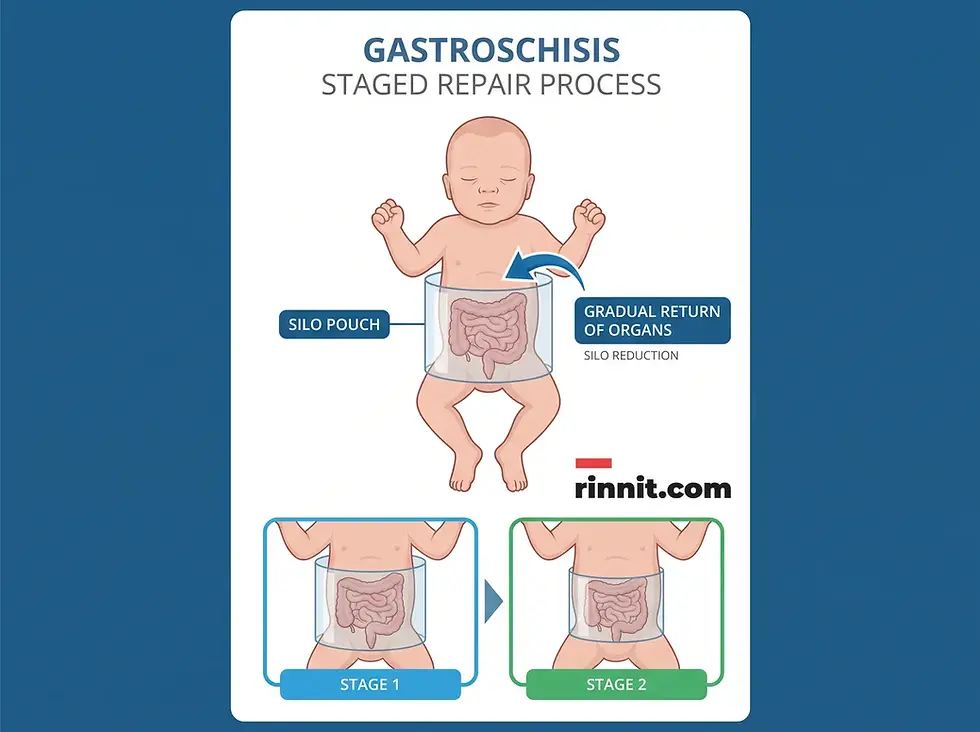
Before surgery can occur, the baby's exposed organs are placed in a sterile plastic pouch called a silo. This silo protects the intestines from infection, prevents dehydration, and keeps the organs warm.
Surgical Repair Options
The type of surgery depends on the baby's stability and the amount of exposed bowel.
Surgery Type | Description | Best For |
Primary Repair | Organs are returned and the hole is closed in a single procedure shortly after birth [1]. | Stable babies with a small amount of exposed bowel. |
Staged Repair | Organs are gradually moved back into the abdomen over several days or weeks using a silo. | Babies with significant swelling or a small abdominal cavity. |
Complications and Long-Term Outlook
Most babies with gastroschisis stay in the Neonatal Intensive Care Unit (NICU) for two weeks to several months [1]. During this time, they receive nutrients through an IV (intravenous line) until their bowels are functional enough to handle breastmilk or formula [1].
Potential Complications
Outlook
If gastroschisis is the baby's only health concern, the long-term prognosis is excellent [1]. Most children go on to live healthy, active lives without permanent digestive issues.
Call to Action: If you have received a prenatal diagnosis of gastroschisis, it is essential to coordinate your delivery at a hospital equipped with a specialized NICU and pediatric surgical team. Early planning and expert care are the keys to a successful recovery for your baby.
This article provides general information and is not a substitute for professional medical advice. Always consult a qualified healthcare provider about your pregnancy or your baby's health.
Frequently Asked Questions
Is gastroschisis fatal?
With modern surgical techniques and neonatal care, gastroschisis is rarely fatal. Most babies make a full recovery and grow up to be healthy children.
Can I deliver vaginally if my baby has gastroschisis?
Yes. Many babies with gastroschisis are born vaginally, though some may require a C-section depending on other obstetric factors. Your doctor will help determine the safest delivery method.
How long will my baby be in the NICU?
The stay can range from two weeks to several months, depending on how quickly the baby's bowels begin to function and how well they can tolerate feeding.
Will my baby have a normal belly button?
After the surgical repair, the belly button may look slightly different, but surgeons work to ensure the best cosmetic and functional result possible.
Does gastroschisis affect future pregnancies?
Having one baby with gastroschisis does not significantly increase the risk for future pregnancies, as the cause is usually not genetic.
What is a silo pouch?
A silo is a clear plastic bag used to hold and protect a baby's exposed organs before they are surgically moved back into the abdomen.
When can I start breastfeeding my baby?
Feeding usually begins once the bowels have healed and the baby can pass stool. This timing is determined by the neonatal medical team.
Are there long-term diet restrictions?
Most children do not have long-term diet restrictions, although those with complications like short bowel syndrome may require specialized nutritional support.
Is gastroschisis caused by something the mother did?
While certain risk factors like smoking are identified, the exact cause is unknown. It is a developmental fluke that can happen in any pregnancy.
Content reviewed and produced following the Rinnit editorial framework. Last updated: October 8, 2026.
References
Cleveland Clinic. Gastroschisis. Cleveland Clinic. January 19, 2022. https://my.clevelandclinic.org/health/diseases/22290-gastroschisis
Ferreira RG, Mendonça CR, Gonçalves Ramos LL, et al. Gastroschisis: a systematic review of diagnosis, prognosis and treatment. J Matern Fetal Neonatal Med. 2022;35(25):6199-6212. PMID: 33899664. DOI: 10.1080/14767058.2021.1909563
Slidell MB, McAteer J, Miniati D, et al. Management of gastroschisis: timing of delivery, antibiotic usage, and closure considerations (a systematic review from the American Pediatric Surgical Association Outcomes & Evidence Based Practice Committee). J Pediatr Surg. 2024;59(8):1408-1417. PMID: 38796391. DOI: 10.1016/j.jpedsurg.2024.03.044
Vinogradov R, Muthupunnackal A, Moffat M, et al. Genitourinary infection and gastroschisis: a systematic review and meta-analysis. Birth Defects Res. 2024;116(7):e2377. PMID: 38946111. DOI: 10.1002/bdr2.2377



Comments