Understanding Frailty: Symptoms, Causes, and Management Strategies

Updated: 2 days ago
Medically reviewed by Dr. Baraa Alnahhal, MD · Last reviewed: October 2026
Source currency note: This guide reflects medical information reviewed in August 2024. Always confirm current guidance with your healthcare professional.
Quick Answer: What is frailty?
Frailty is a medical state in which the body's reserves are depleted so it cannot handle or recover from illness or injury on its own. It affects about 1 in 10 people over 65 and 1 in 4 over 85. Signs include fatigue, weakness, falls and weight loss. It can be managed and sometimes reversed with rehabilitation and nutritional support. [3]
What the research says
Many older adults develop frailty over a few years. A meta-analysis of 46 studies (120,805 non-frail adults aged 60 and over, from 28 countries) found that 13.6% became frail during a median follow-up of 3.0 years. Frailty developed far more often in prefrail people (62.7 cases per 1,000 person-years) than in robust people (12.0) (Ofori-Asenso et al., JAMA Netw Open, 2019).
Care should be tailored to the person, but the evidence base is still thin. A Lancet review of frailty management recommends screening, case identification, and individually tailored interventions that preserve independence, physical function, and cognition, while noting that the evidence for individual and health-system interventions remains inadequate (Dent et al., Lancet, 2019).
Understanding the Spectrum of Frailty
Frailty is often mistaken for physical weakness or a normal part of aging. In the medical world, it describes a specific vulnerability: the body can no longer bounce back from health challenges on its own. It exists on a spectrum, from mild vulnerability to severe disability. Age is a major factor, but frailty can affect people of any age, particularly those with chronic illnesses or congenital conditions.
A useful way to picture it is the "health bank account" analogy. Every healthy habit, such as good nutrition, physical activity, and stress management, is a deposit that builds a reserve for the "withdrawals" caused by illness or injury. When a person develops frailty, the account is overdrawn, and they lack the internal resources to keep the body running without outside support.
Feature | Physical weakness | Medical frailty |
Primary focus | Muscle strength and mass. | Total body resilience and recovery. |
Scope | Mainly musculoskeletal. | Includes endurance, mental health, and brain function. |
Recovery | Usually straightforward with exercise. | Needs multi-disciplinary support and management. |
Impact | May limit specific activities. | Can lead to disability and loss of independence. |
Recognizing the Symptoms of Frailty
The symptoms go beyond feeling tired. They often appear as a mix of physical, functional, and emotional changes that signal a decline in the body's resilience. Spotting them early is critical for intervention.
Persistent fatigue: often feeling exhausted or lacking the energy to finish simple tasks.
Mobility problems: moving noticeably slower, or having trouble with balance and stability that leads to more frequent falls.
Functional decline: needing help with activities of daily living (ADLs) such as dressing, bathing, or feeding yourself.
Physical changes: unintentional weight loss (typically 10 pounds or more in a year) and reduced muscle strength or grip power.
Emotional and social shifts: developing depression or withdrawing from social activities and loved ones.
Incontinence: accidental leaking of urine or stool.
Causes and Contributing Factors
Frailty rarely has a single cause. It is usually the result of several health problems building up over time. Chronic medical conditions are the main drivers, because they put constant strain on the body's systems.
System affected | Contributing chronic conditions |
Musculoskeletal | Osteoporosis, arthritis, sarcopenia (muscle loss), and joint replacements. |
Neurological | Movement disorders, dementia, and other progressive diseases that affect memory and thinking. |
Cardiovascular | Heart disease and chronic circulatory problems. |
Respiratory | Asthma and chronic obstructive pulmonary disease (COPD). |
Metabolic | Diabetes, obesity, or being significantly underweight. |
Immune | Multiple sclerosis, rheumatoid arthritis, and other autoimmune diseases. |
Short-term events can also trigger or worsen frailty. A severe bout of flu, food poisoning, or a sudden injury such as a broken hip can quickly deplete a person's reserves and make it hard to return to their usual level of functioning.

Risk Factors and Complications
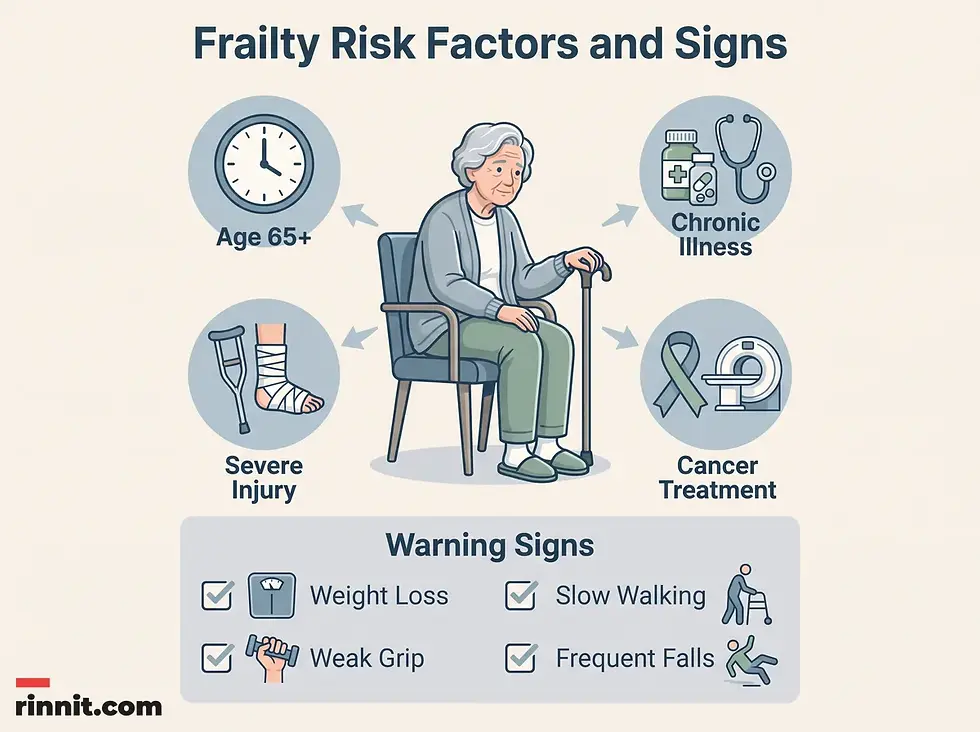
Anyone can develop frailty, but some factors raise the likelihood. Age is the most prominent, with prevalence climbing from about 1 in 10 people over 65 to about 1 in 4 people over 85. Severe illnesses such as sepsis, cancer treatments such as chemotherapy or radiation, and organ transplant surgery can also bring on frailty at any age.
Frailty can seriously affect life expectancy and quality of life. Complications include:
Increased vulnerability: minor illnesses can quickly escalate into life-threatening complications.
Lowered immunity: the body is less able to fight off new infections.
Treatment limitations: some surgical or invasive procedures may become too risky.
Loss of independence: many people eventually need assisted living or skilled nursing care.
Diagnosis and Clinical Assessment
Healthcare providers diagnose frailty with a physical exam and standardized scoring systems. More than a dozen scales are in use, and no single one is considered the best. Most focus on five key criteria:
Unintentional weight loss: losing 10 pounds (4.5 kg) or more without trying in the past year.
Weak grip strength: measured with a dynamometer and compared with others of the same sex and body type.
Low energy levels: frequent exhaustion or low endurance.
Slow walking speed: a measurable decline in how quickly a person moves.
Low physical activity: a lifestyle with very little movement or exercise.
Providers may also do a fall risk assessment and a body mass index (BMI) measurement to check for muscle loss. Some scales also factor in mental functioning, incontinence, and whether the person has a social support network.
Management and Treatment Pathways
Frailty is not always permanent. With the right support, it can often be managed and sometimes reversed. Treatment is multi-disciplinary and addresses both physical and social needs.
Therapeutic interventions
Physical therapy: improves balance, strength, and flexibility to prevent falls and maintain mobility.
Specialized rehabilitation: programs such as cardiac or pulmonary rehab help people recover from specific organ-related strain.
Nutritional support: working with an expert to address vitamin and mineral deficiencies and weight problems that contribute to weakness.
Support and community care
Activity programs: group exercise offers physical benefits and social contact, both vital for mental health.
Home and community care: community programs can help with daily tasks so people can stay in their homes longer.
Long-term care: in severe cases, assisted living, skilled nursing, or hospice care may be needed to keep the person safe and comfortable.
Treatment pillar | Goal |
Condition management | Treating underlying diseases to reduce strain on the body. |
Physical activity | Building muscle mass and improving endurance. |
Nutrition | Giving the body the fuel and nutrients it needs for repair. |
Social support | Reducing isolation and keeping the home environment safe. |
Prevention and Outlook
Preventing frailty means managing health proactively throughout life. Staying physically active, keeping a healthy weight, and eating well are the most effective strategies. Regular preventive screenings and safety measures, such as fall-proofing the home and wearing seat belts, also matter.
The outlook depends on how severe frailty is at diagnosis. When it is caught early, symptoms can often be slowed and sometimes reversed. Even in advanced cases, the goal is to protect independence and keep quality of life as high as possible for as long as possible.

Conclusion
Frailty is a complex medical state that calls for a proactive and compassionate approach. It is a spectrum of resilience, not an inevitable part of aging, so individuals and families can take real steps to protect their "health bank accounts." Early intervention, consistent physical activity, and strong social support are the keys to staying independent and healthy.
When to See a Healthcare Provider
If you or a loved one has unexplained weight loss, frequent falls, or persistent exhaustion, consult a healthcare provider. An early assessment with a frailty scale can lead to a personalized plan to rebuild strength and prevent further decline. For severe injuries or sudden changes in health, call your local emergency number (911 in the U.S.).
Frequently Asked Questions
What is the medical definition of frailty?
Frailty is a state in which the body cannot get through and recover from illness or injury on its own. It is a spectrum of vulnerability that involves physical, mental, and cognitive health.
Is frailty the same as being old?
No. Frailty is more common in older adults, but it is not an inevitable part of aging. It can also affect younger people with chronic illness, severe injury, or congenital conditions.
Can frailty be reversed?
Sometimes. It varies from case to case, but physical therapy, nutritional support, and treating underlying chronic conditions can slow frailty and, in some people, reverse it.
How do doctors test for frailty?
Doctors use a physical exam and frailty scales. Common criteria are unintentional weight loss, grip strength, energy level, walking speed, and activity level.
What are the main causes of frailty?
Chronic diseases such as heart or lung disease, severe injuries such as a broken hip, treatments such as chemotherapy, and lifestyle factors such as poor nutrition and inactivity.
Why is weight loss a sign of frailty?
Unintentionally losing 10 pounds (4.5 kg) or more in a year often signals loss of muscle mass and a decline in the body's reserves.
What is the "health bank account" analogy?
Health is like a bank account. Healthy habits are deposits, and illnesses and injuries are withdrawals. Frailty is when the account is overdrawn and the body needs outside support.
How does frailty affect surgery options?
People with frailty have a higher risk of complications, so doctors may decide that some procedures are too risky to perform.
What role does social support play in frailty?
A support network makes it easier to get food, medical care, and social and physical activity. Isolation can lead to depression and make frailty more likely.
What are the red flag symptoms of frailty?
Frequent falls, needing help with dressing or bathing, unintentional weight loss, and feeling exhausted after minimal effort all call for a medical evaluation.
References
Ofori-Asenso R, Chin KL, Mazidi M, et al. Global incidence of frailty and prefrailty among community-dwelling older adults: a systematic review and meta-analysis. JAMA Network Open. 2019;2(8):e198398. PMID 31373653. https://doi.org/10.1001/jamanetworkopen.2019.8398
Dent E, Martin FC, Bergman H, Woo J, Romero-Ortuno R, Walston JD. Management of frailty: opportunities, challenges, and future directions. The Lancet. 2019;394(10206):1376-1386. PMID 31609229. https://doi.org/10.1016/S0140-6736(19)31785-4
Cleveland Clinic. Frailty. Cleveland Clinic. August 26, 2024. https://my.clevelandclinic.org/health/diseases/frailty
Medical disclaimer
This article was prepared for general information only and is not a substitute for professional medical advice.



Comments