Foreign Accent Syndrome: Causes, Symptoms, and Recovery

Updated: 2 days ago
Medically reviewed by Dr. Baraa Alnahhal, MD · Last reviewed: October 2026
Quick Answer
Foreign accent syndrome is an extremely rare neurological condition in which a person's speech suddenly changes to sound like a foreign accent. It reflects a disruption in how the brain controls speech sounds, often from stroke, brain injury or other damage to the left frontal lobe. Speech therapy helps all types, and many cases can be reversed or managed. [3]
What the research says
Most self-reported FAS in one large series looked functional, not structural. Among 49 people reporting FAS, the study authors judged 35 (71%) as probably functional and 10 (20%) as probably structural. The most common triggers were migraine or severe headache (15 people) and stroke (12 people) (McWhirter et al., J Neurol Neurosurg Psychiatry, 2019).
Different brain lesions can cause FAS through one shared speech network. In 25 published cases of acquired FAS without aphasia, lesions were in different places, but at least 80% overlapped a network in the lower and middle precentral gyrus and the medial frontal cortex, including the larynx motor area (Higashiyama et al., Neuroimage Clin, 2021).
What is Foreign Accent Syndrome?
Foreign accent syndrome (FAS) is a condition where the rhythm and melody of a person's speech shift so significantly that they appear to be speaking with an accent from another region or country. Language experts clarify that these changes are usually not a perfect match for any specific natural accent. Instead, they are errors in sound production that listeners' brains try to sort into familiar patterns.
It is extremely rare. The condition was first described in 1907, and only about 100 cases have been confirmed since. There are several types, grouped by their underlying causes and how they show up in the patient.
Type | Description | Primary Cause |
Structural | Damage to brain areas controlling speech muscles. | Stroke, TBI, tumors |
Functional | No detectable structural brain damage. | Migraines, mental health conditions |
Mixed | Both structural abnormalities and functional triggers. | Combination of factors |
Developmental | Linked to neurodivergence. | Autism, ADHD |

Symptoms and Speech Changes
The primary symptoms of FAS relate to the "prosody" of speech: the rhythm, stress, and intonation that give language its characteristic sound. These disruptions are often sudden and highly noticeable to both the speaker and the people around them.
Core speech disruptions
Rhythm and speed: talking more slowly, at varying speeds, or with unusual pauses mid-word.
Articulation: dropping sounds (for example, "ouse" instead of "house") or substituting sounds (for example, "fumb" instead of "thumb").
Syllable stress: emphasizing the wrong syllables in a word, which can change how it sounds to listeners.
Pitch and tone: unusual inflections, such as a statement sounding like a question because the voice rises at the end.
Associated neurological signs
In structural FAS, people may also have other symptoms of brain damage, such as one-sided muscle weakness (hemiplegia), tremors, or trouble choosing the right words. Functional cases may sometimes come with symptoms of mental health conditions, including mood changes or disorganized thinking.
Causes and Risk Factors
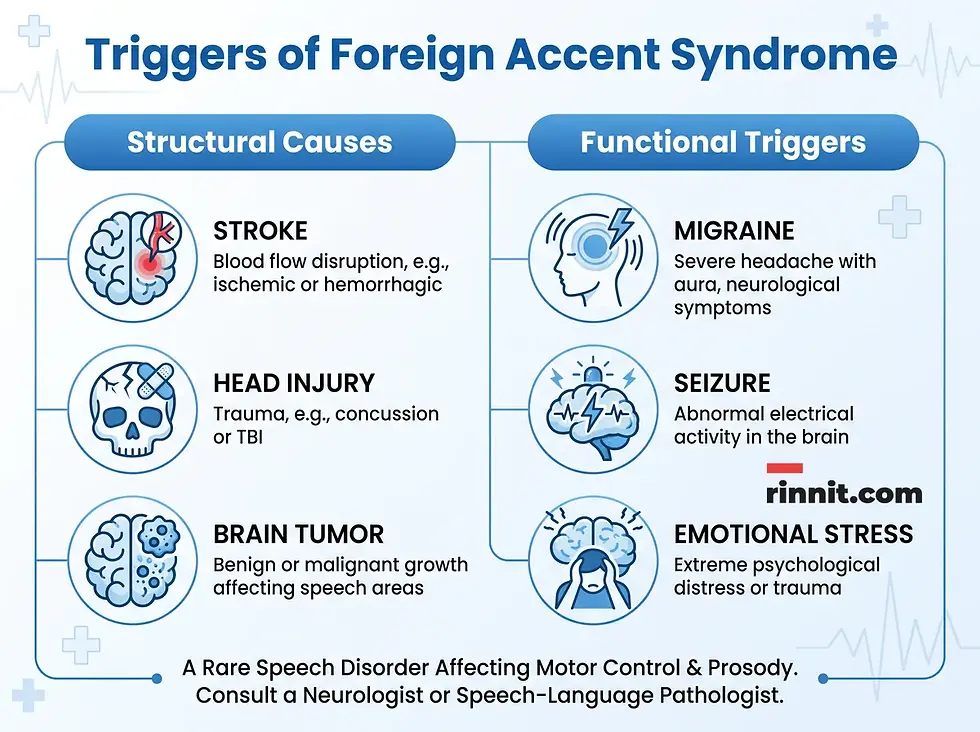
The causes of FAS fall into structural damage and functional disruptions. Knowing the source is critical for choosing the right treatment path.
Structural brain damage
Structural FAS is most often caused by damage to the left frontal lobe, which houses the brain's primary speech centers. Common causes include:
Stroke (ischemic or hemorrhagic): one of the most common causes of structural FAS.
Traumatic brain injury (TBI): significant head trauma that disrupts neural pathways.
Brain aneurysms or tumors: problems that damage or put pressure on speech-related brain regions.
Multiple sclerosis (MS): a condition that can damage the protective coating of nerves in the brain.
Functional and psychological triggers
Functional FAS occurs without a visible lesion on a brain scan. It is sometimes linked to:
Severe migraines: which can cause broad, temporary disruptions in brain activity.
Conversion disorder: a condition where disruptions in the brain cause real physical symptoms without a detectable structural cause.
Mental health conditions: such as schizophrenia or bipolar disorder, though these links need more research because the condition is so rare.
Diagnosis and Clinical Evaluation
Because FAS is so rare, diagnosis takes teamwork between neurologists and speech-language pathologists (SLPs). Structural FAS is the easiest to diagnose, because imaging and other tests can detect most of its causes.
Diagnostic methods
Advanced imaging: MRI, CT, and PET scans look for structural damage or abnormal activity in the frontal lobe.
EEG (electroencephalogram): checks for seizure activity that might be disrupting speech.
Speech assessment: SLPs analyze sound patterns in detail to tell FAS apart from other speech disorders such as dysarthria or apraxia of speech.
Psychological screening: helps identify possible functional causes, including conversion disorder.
Treatment and Path to Recovery
Treatment focuses on managing the underlying cause and retraining the brain to produce sounds correctly. Many cases, particularly functional ones, can be reversed.
Therapeutic approaches
Speech therapy: the cornerstone of treatment. SLPs help people understand their specific sound changes, retrain the muscles used for speaking, and restore natural rhythm and articulation.
Counseling and psychotherapy: important for managing the mental health impact, including the anxiety and depression that often follow the sudden loss of one's natural voice.
Medication: used to treat underlying triggers such as seizures, migraines, or mental health conditions.
Social and emotional support
Living with FAS can be isolating. People often face skepticism from loved ones or ridicule from strangers. Support groups and family education help people handle the social challenges of a "new" voice while they work toward recovery.

Frequently Asked Questions
Is Foreign Accent Syndrome a real medical condition?
Yes. FAS is a legitimate neurological condition confirmed by experts in over 100 cases worldwide since 1907.
Does the person actually learn a new accent?
No. The person is not learning an accent. Their brain is struggling to form sounds correctly, and listeners perceive the resulting errors as a foreign accent.
Can a stroke cause Foreign Accent Syndrome?
Yes. Stroke is one of the most common causes of structural FAS, because it can damage the speech centers in the left frontal lobe of the brain.
Is Foreign Accent Syndrome permanent?
Not necessarily. Some cases are temporary and even reversible, especially when the underlying cause is treated, while others, such as those caused by multiple sclerosis or frontotemporal dementia, are more likely to be permanent.
How rare is this condition?
Foreign accent syndrome is extremely rare. About 100 confirmed cases have been recorded in the medical literature since the condition was first described in 1907.
Can migraines cause sudden speech changes?
Yes. Severe migraines are linked to broad disruptions in brain activity and can be associated with functional FAS.
What is the difference between structural and functional FAS?
Structural FAS is caused by physical damage to the brain, such as a stroke or injury. Functional FAS occurs without a detectable structural cause.
How do doctors diagnose FAS?
Diagnosis combines brain scans (MRI, CT, PET), EEG, a neurological exam, and a detailed speech assessment by a speech-language pathologist.
Can children have Foreign Accent Syndrome?
A developmental subtype has been described in neurodivergent people, such as those with autism spectrum disorder or ADHD, but cases are extremely rare.
What should I do if my speech suddenly changes?
Sudden speech changes need urgent medical attention. Go to the nearest emergency room to rule out a stroke or other serious brain injury.
References
McWhirter L, Miller N, Campbell C, et al. Understanding foreign accent syndrome. Journal of Neurology, Neurosurgery, and Psychiatry. 2019;90(11):1265-1269. PMID 30826739. https://doi.org/10.1136/jnnp-2018-319842
Higashiyama Y, Hamada T, Saito A, et al. Neural mechanisms of foreign accent syndrome: lesion and network analysis. NeuroImage: Clinical. 2021;31:102760. PMID 34274725. https://doi.org/10.1016/j.nicl.2021.102760
Cleveland Clinic. Foreign accent syndrome. Cleveland Clinic. September 11, 2023. https://my.clevelandclinic.org/health/diseases/25242-foreign-accent-syndrome-fas
Medical disclaimer
This article was prepared for general information only and is not a substitute for professional medical advice.



Comments