Foot Drop: Symptoms, Causes, Treatment & Prevention — Complete Guide

Updated: 2 days ago
Medically reviewed by Dr. Baraa Alnahhal, MD · Last reviewed: October 2026
Quick Answer
Foot drop is difficulty lifting the front part of the foot, causing it to drag when walking. It is not a disease but a sign of an underlying neurological, muscular or anatomical problem, most often a compressed or injured peroneal nerve. It can be temporary or permanent, and treatment may include braces, physical therapy, nerve stimulation or surgery.
What the research says
Ankle-foot braces improve walking in people with stroke-related foot drop. A systematic review and meta-analysis of 19 studies (434 participants with stroke and gait problems) found that wearing an ankle-foot orthosis significantly improved walking speed (standardized mean difference 0.50, 95% CI 0.34–0.66), step length (0.41, 95% CI 0.18–0.63), and ankle angle at initial contact (0.66, 95% CI 0.34–0.98); the studies mainly measured immediate or short-term effects. (Choo & Chang, Sci Rep, 2021) [3]
Nerve stimulation works best when combined with physiotherapy. A meta-analysis of 14 studies (1,115 participants with foot drop after stroke) found that functional electrical stimulation of the peroneal nerve did not improve gait speed compared with conventional treatments overall, but stimulation combined with supervised physiotherapy improved gait speed more than supervised exercise alone; stimulation also improved ankle dorsiflexion, balance, and functional mobility, although the evidence was low quality and varied between studies. (da Cunha et al., Ann Phys Rehabil Med, 2021) [4]
At a Glance
Topic | Key Facts |
What it is | Difficulty lifting the front of the foot; the foot may drag when walking |
Nature | A sign of an underlying problem — not a disease |
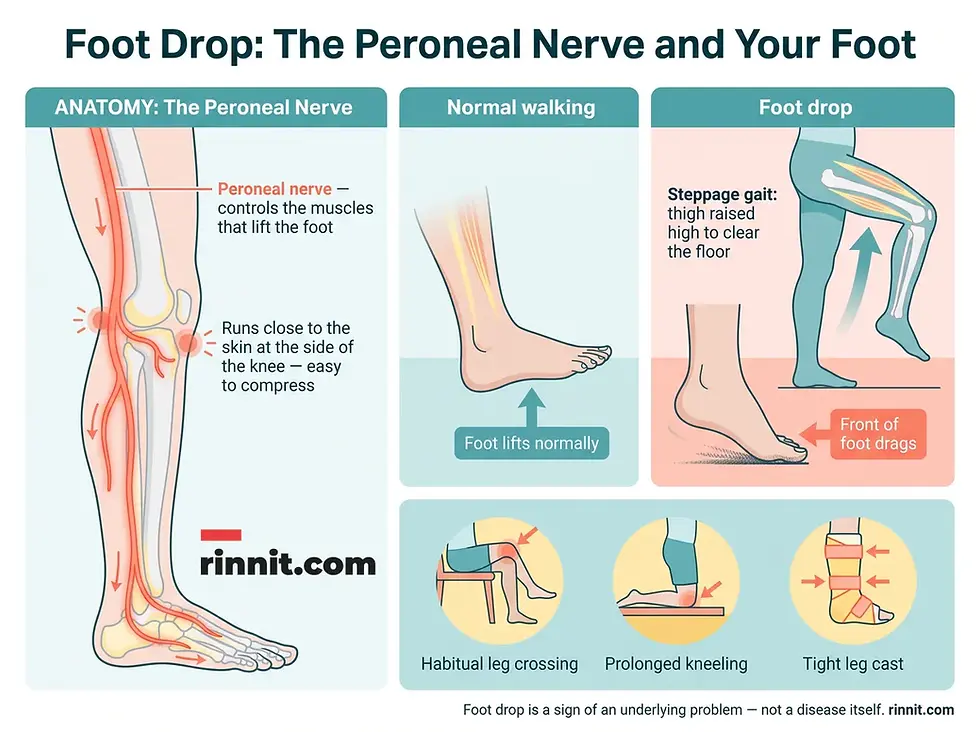
Main sign | Steppage gait: thigh raised high to clear the floor; foot slaps down |
Most common cause | Peroneal nerve injury or compression |
Other causes | Muscular dystrophy, polio, Charcot-Marie-Tooth disease, stroke, MS, ALS |
Duration | Can be temporary or permanent |
Diagnosis | Physical exam; X-ray, ultrasound, CT, MRI; EMG and nerve conduction studies |
Treatment | Braces/splints, physical therapy, nerve stimulation, surgery |
Home safety | Clear floors, no throw rugs, well-lit stairways, tape on stair steps |
What Is Foot Drop?
Foot drop, sometimes called drop foot, is a general term for difficulty lifting the front part of the foot. If you have foot drop, the front of your foot might drag on the ground when you walk.
Importantly, foot drop isn't a disease. Rather, it is a sign of an underlying neurological, muscular, or anatomical problem. Finding that underlying problem is the key to treatment.
Sometimes foot drop is temporary, but it can be permanent. If you have foot drop, you might need to wear a brace on your ankle and foot to support the foot and hold it in position.
Symptoms: How to Recognize Foot Drop
Foot drop makes it difficult to lift the front part of the foot, so it might drag on the floor when you walk. To help the foot clear the floor, a person with foot drop may raise the thigh more than usual when walking, as though climbing stairs. This unusual kind of walking is called a steppage gait, and it might cause the foot to slap down onto the floor with each step. In some cases, the skin on the top of the foot and toes feels numb.
Depending on the cause, foot drop can affect one or both feet.
Sign | What it looks or feels like |
Dragging foot | The front of the foot catches or drags on the ground |
Steppage gait | Thigh raised unusually high with each step, as if climbing stairs |
Foot slap | Foot lands heavily, slapping the floor |
Numbness | Skin on top of the foot and toes feels numb |
When to See a Doctor
If your toes drag on the floor when you walk, consult your healthcare professional. If foot drop isn't treated, it can cause a loss of mobility and function. This may lead to chronic pain, which can impact a person's quality of life.
Causes of Foot Drop
Foot drop is caused by weakness or paralysis of the muscles involved in lifting the front part of the foot. Three broad categories of problems can cause it.
Nerve Injury — The Most Common Cause
The most common cause of foot drop is compression of a nerve in the leg that controls the muscles involved in lifting the foot. This nerve is called the peroneal nerve.
A serious knee injury can lead to the nerve being compressed.
The nerve can be injured during hip or knee replacement surgery, which may cause foot drop.
A nerve root injury — a "pinched nerve" — in the spine can also cause foot drop.
People who have diabetes are more susceptible to nerve disorders, which are associated with foot drop. Learn more in our complete guide to diabetes.
Muscle or Nerve Disorders
Various forms of muscular dystrophy — an inherited disease that causes progressive muscle weakness — can contribute to foot drop. So can other neurological disorders, such as polio or Charcot-Marie-Tooth disease.
Brain and Spinal Cord Disorders
Disorders that affect the spinal cord or brain — such as stroke, multiple sclerosis, or amyotrophic lateral sclerosis (ALS) — may cause foot drop.
Risk Factors
The peroneal nerve controls the muscles that lift the foot, and it runs near the surface of the skin on the side of the knee. Activities that compress this nerve can increase the risk of foot drop.
Risk factor | How it compresses the peroneal nerve |
Leg crossing | People who habitually cross their legs can compress the peroneal nerve on their uppermost leg |
Prolonged kneeling | Occupations that involve prolonged squatting or kneeling — such as picking strawberries or laying floor tile — can result in foot drop |
Wearing a leg cast | Plaster casts that enclose the ankle and end just below the knee can exert pressure on the peroneal nerve |

How Foot Drop Is Diagnosed
Foot drop is usually diagnosed during a physical exam. Your healthcare professional will watch you walk and check your leg muscles for weakness. They may also check for numbness on your shin and on the top of your foot and toes.
Imaging Tests
Foot drop is sometimes caused by a mass pushing on a nerve. This can be an overgrowth of bone in the spinal canal or a tumor or cyst pressing on the nerve in the knee or spine. Imaging tests can help pinpoint these types of problems.
Test | What it does |
X-rays | Use a low level of radiation to visualize a soft tissue mass or a bone lesion that might be causing your symptoms |
Ultrasound | Uses sound waves to create images of internal structures; can check for cysts or tumors on the nerve or show swelling on the nerve from compression |
CT scan | Combines X-ray images taken from many different angles to form cross-sectional views of structures within the body |
MRI | Uses radio waves and a strong magnetic field to create detailed images of bones and soft tissues; particularly useful in visualizing soft tissue lesions that may be compressing a nerve |
Nerve Tests
Electromyography (EMG) and nerve conduction studies measure electrical activity in the muscles and nerves. These tests can be uncomfortable, but they're useful in determining the location of the damage along the affected nerve.
Treatment Options
The most common type of foot drop is caused by injury to the peroneal nerve, which controls the muscles that lift the foot. Treatment for foot drop depends on the cause. If the cause is successfully treated, foot drop might improve or even disappear. If the cause can't be treated, foot drop can be permanent.
Braces or Splints
A brace on your ankle and foot or a splint that fits into your shoe can help hold your foot in a normal position.
Physical Therapy
Exercises can strengthen your leg muscles and help you maintain the range of motion in your knee and ankle. These exercises might improve gait problems associated with foot drop. Stretching exercises are particularly important to prevent stiffness in the calf and heel.
Nerve Stimulation
Sometimes stimulating the nerve that lifts the foot improves foot drop.
Surgery
Depending on the cause — and if your foot drop is relatively new — nerve surgery might be helpful. If foot drop is long-standing, your healthcare professional might suggest surgery that transfers a working tendon to a different part of the foot to improve function.
Lifestyle and Home Remedies: Fall-Proofing Your Home
Because foot drop can increase your risk of tripping and falling, consider taking these precautions around your house:
Keep all floors clear of clutter.
Avoid the use of throw rugs.
Move electrical cords away from walkways.
Make sure rooms and stairways are well lit.
Place fluorescent tape on the top and bottom steps of stairways.
Preparing for Your Appointment
You're likely to start by seeing your family healthcare professional. Depending on the suspected cause of foot drop, you may be referred to a doctor who specializes in brain and nerve disorders, called a neurologist.
What You Can Do
Make a list of:
Your symptoms, including ones that seem unrelated to the reason for which you scheduled the appointment, and when they began.
Key personal information, including major stresses or recent life changes.
All medicines, vitamins or supplements you take, including doses.
Questions to ask your healthcare professional.
For foot drop, questions to ask your care team include:
What's causing my symptoms?
What tests do I need?
Is my condition likely temporary or chronic?
What treatment do you recommend?
Do you have brochures or other printed material I can have?
Don't hesitate to ask other questions.
What to Expect From Your Doctor
Your healthcare professional is likely to ask questions, such as:
Are your symptoms present all the time, or do they come and go?
Does anything seem to make your symptoms better?
Does anything seem to make your symptoms worse?
Do you notice weakness in your legs?
Does your foot slap the floor when you walk?
Do you have numbness or tingling in your foot or leg?
Do you have pain? If so, what is it like and where is it located?
Do you have a history of diabetes?
Do you have other muscle weakness?
Frequently Asked Questions
What is foot drop?
Foot drop is a general term for difficulty lifting the front part of the foot, so the front of your foot might drag on the ground when you walk. It is not a disease itself — it is a sign of an underlying neurological, muscular, or anatomical problem.
What causes foot drop?
The most common cause is compression or injury of the peroneal nerve, which controls the muscles that lift the foot — often from a knee injury, hip or knee replacement surgery, or a pinched nerve in the spine. Muscle and nerve disorders such as muscular dystrophy, polio, and Charcot-Marie-Tooth disease, and brain or spinal cord disorders such as stroke, multiple sclerosis, and ALS can also cause it.
Is foot drop temporary or permanent?
Foot drop can be either. Sometimes foot drop is temporary, but it can be permanent. If the underlying cause is successfully treated, foot drop might improve or even disappear; if the cause can't be treated, foot drop can be permanent.
What is a steppage gait?
A steppage gait is the unusual walking style people with foot drop develop to help the foot clear the floor — raising the thigh more than usual with each step, as though climbing stairs — which may cause the foot to slap down onto the floor with each step.
What tests diagnose the cause of foot drop?
Diagnosis starts with a physical exam and gait check, then may include imaging tests — X-rays, ultrasound, CT scan, and MRI — to look for masses pressing on the nerve, plus electromyography (EMG) and nerve conduction studies to locate damage along the affected nerve.
How is foot drop treated?
Treatment depends on the cause and may include braces or splints to hold the foot in position, physical therapy with stretching to prevent calf and heel stiffness, nerve stimulation, and surgery — nerve surgery if the problem is relatively new, or tendon transfer surgery if foot drop is long-standing.
What can I do at home to stay safe with foot drop?
Because foot drop raises your tripping and falling risk, keep floors clear of clutter, avoid throw rugs, move electrical cords away from walkways, keep rooms and stairways well lit, and place fluorescent tape on the top and bottom steps of stairways.
Conclusion
Foot drop is a warning sign, not a diagnosis — the dragging foot points to an underlying nerve, muscle, or brain/spinal cord problem that needs to be found.
The peroneal nerve is the usual suspect — it runs close to the skin at the side of the knee, making it vulnerable to injury, surgery, casts, and everyday compression habits like leg crossing and prolonged kneeling.
Action matters — treatment that targets the cause (braces, therapy, nerve stimulation, or surgery) can improve or even resolve foot drop, while simple home changes protect you from the falls that foot drop invites.
This guide covered what foot drop is, how to recognize the signs, the three cause categories, the risk factors you can control, the full diagnosis and treatment path, and practical fall-proofing steps.
Your Next Steps
Read a related guide — our complete guide to diabetes covers a condition that raises foot drop risk.
Share your thoughts — comment below with your questions or experience.
Stay updated — sign up on rinnit.com for new complete guides and health updates.
Disclaimer: This content is provided for general educational purposes only and is not a substitute for professional medical advice. Always consult a qualified healthcare professional for diagnosis and treatment.
References
Mayo Clinic Staff. Foot drop - Symptoms and causes. Mayo Clinic. January 15, 2025. https://www.mayoclinic.org/diseases-conditions/foot-drop/symptoms-causes/syc-20372628
Mayo Clinic Staff. Foot drop - Diagnosis and treatment. Mayo Clinic. January 15, 2025. https://www.mayoclinic.org/diseases-conditions/foot-drop/diagnosis-treatment/drc-20372633
Choo YJ, et al. Effectiveness of an ankle-foot orthosis on walking in patients with stroke: a systematic review and meta-analysis. Sci Rep. 2021;11(1):15879. PMID 34354172. https://doi.org/10.1038/s41598-021-95449-x
Jaqueline da Cunha M, et al. Functional electrical stimulation of the peroneal nerve improves post-stroke gait speed when combined with physiotherapy. A systematic review and meta-analysis. Ann Phys Rehabil Med. 2021;64(1):101388. PMID 32376404. https://doi.org/10.1016/j.rehab.2020.03.012



Comments