The Fibula Explained: Anatomy and Function of the Calf Bone

Updated: 2 days ago
Medically reviewed by Dr. Baraa Alnahhal, MD · Last reviewed: October 2026
Source currency note: This guide reflects medical information reviewed in May 2022. Always confirm current guidance with your healthcare professional.
Quick Answer: What is the fibula?
The fibula is the smaller of the two lower leg bones, commonly called the calf bone, running along the outer leg parallel to the tibia. It gives the calf structure, stabilizes the ankle and anchors muscles, tendons and ligaments. Although it bears little weight, it can fracture or weaken from osteoporosis, so diet and exercise help protect it. [4]
What the research says
The fibula carries a small share of the load. In a study of 10 cadaver lower limbs, the fibula took an average of 17% of a 1,500 N axial load, with the share rising as total load increased and when the ankle was dorsiflexed (Wang et al., Clinical Orthopaedics and Related Research, 1996 [1]).
It matters for ankle stability. A meta-analysis of donor-site outcomes after fibula bone harvesting in children (294 cases) found ankle instability in an average of 12.9% of cases, with risk related to age at surgery (Du et al., Journal of Plastic, Reconstructive & Aesthetic Surgery, 2023 [2]).
Osteoporosis is common. A meta-analysis of 86 studies covering more than 103 million people estimated global osteoporosis prevalence at 18.3% (95% CI 16.2% to 20.7%), higher in women (23.1%) than in men (11.7%) (Salari et al., Journal of Orthopaedic Surgery and Research, 2021 [3]).
Anatomy of the fibula
The fibula is the third longest bone in the human body, typically about 14 inches long in adults. It sits on the outer (lateral) side of the tibia [4].
Key structural parts
The fibula has three main sections that connect it to the rest of the leg and ankle [4]:
Fibula head (proximal end): The top end of the bone, just below the knee, which moves in coordination with the tibia.
Fibula shaft: The long, three-sided middle portion that forms the core structure of the calf.
Distal end: The lower end, which forms the outer part of the ankle joint where it meets the talus (an ankle bone).
Fibula vs. tibia
Both bones form the lower leg, but they have different roles [4].
Feature | Fibula (calf bone) | Tibia (shin bone) |
Position | Lateral (outside) | Medial (inside) |
Weight-bearing | No (supports muscles and the ankle) | Yes |
Size | Smaller and thinner | Larger and stronger |
Primary role | Muscle attachment and ankle support | Body weight support |

Functions of the calf bone
Although it is not the main weight-bearing bone, the fibula is essential for several functions [4]:
Muscle attachment: It anchors many muscles and tendons in the lower leg and ankle.
Ankle stability: Its lower end helps form the ankle joint and provides lateral stability during movement.
Ligament support: It connects important knee ligaments to the lower body, helping the joints work together.
Structural integrity: It defines the shape and structure of the calf and outer leg.

Common conditions and injuries
Because it is thinner than the tibia, the fibula is more prone to certain types of damage [4].
Fibula fractures
A fracture (break) in the fibula often results from trauma or sudden stress. Symptoms include localized pain, swelling, bruising, and difficulty moving the leg. A specific type, the avulsion fracture, happens when a sudden pull from a muscle or ligament tears a small piece of bone away [4].
Osteoporosis
Osteoporosis weakens bones and makes them brittle and more likely to break. Because it often has no obvious symptoms, many people do not know they have it until a fracture happens. Females and adults over 50 have a higher risk [4].
Diagnostic testing and treatment
Healthcare providers use several tools to assess fibula health and treat injuries [4]:
DEXA scan: A bone density test that uses low-level X-rays to measure bone strength and detect bone loss.
Imaging: X-rays, MRI, and CT scans show the location and severity of fractures.
Immobilization: Most fractures need a splint or cast to hold the bone in place while it heals.
Surgery: Severe breaks may need surgery to realign the bone with plates or screws.
Conclusion
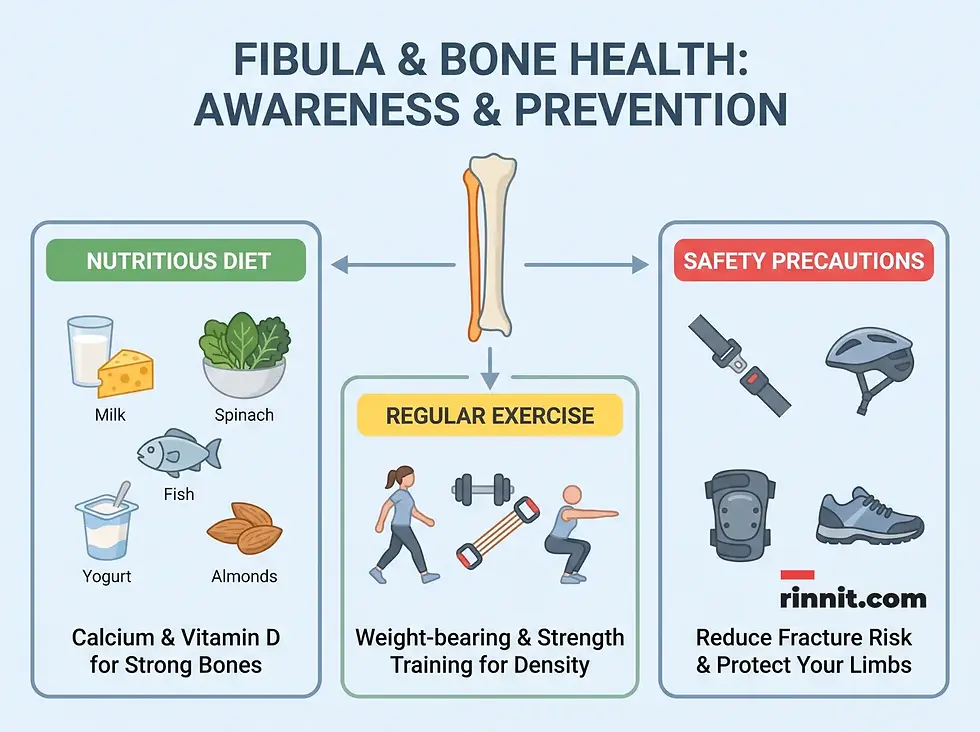
The fibula may not carry the weight of the body, but it is indispensable for the stability and function of the lower leg. From anchoring muscles to supporting the ankle, this “calf bone” is a key player in everyday movement. By prioritizing bone health and taking safety precautions during physical activity, you can protect the fibula and keep your legs strong over the long term.
If you have had a leg injury or are concerned about your bone density, talk with an orthopaedic specialist about your bone health and testing options.
Frequently Asked Questions
What is the fibula?
The fibula is the smaller of the two bones in your lower leg, commonly called the calf bone.
Is the fibula a weight-bearing bone?
Not in the way the tibia is. The tibia supports your body when you stand and move, while the fibula mainly supports muscles, tendons, and the ankle.
Where is the fibula located?
The fibula runs from just below the knee to the ankle, on the outer (lateral) side of the leg.
What are the symptoms of a fibula fracture?
Common symptoms include pain, swelling, bruising, and difficulty moving the leg normally.
What is an avulsion fracture?
An avulsion fracture is a break that happens when a muscle or ligament pulls a small piece of bone away, often because of a sudden movement.
Who is most at risk for osteoporosis in the fibula?
Females and adults over age 50 have a higher risk of developing osteoporosis.
How is a broken fibula treated?
Treatment typically involves immobilization with a cast or splint, and sometimes surgery for severe fractures.
What is a DEXA scan?
A DEXA scan is a bone density test that uses low-level X-rays to measure bone strength and detect signs of osteoporosis.
Can you walk with a broken fibula?
Walking may be difficult or impossible depending on the severity of the fracture, and some people can put weight on the leg. Either way, you need a medical evaluation before you try.
How can I keep my fibula healthy?
A diet rich in bone-supporting nutrients, regular exercise, and proper safety equipment can help maintain bone strength and prevent injury.
Related Reading
Fibula Fracture Guide: Understanding Symptoms, Causes, and Treatment explains how fibula fractures happen and how they heal.
Broken Ankle: Symptoms, Causes, Treatment & Complete Guide covers ankle fractures, which often involve the lower fibula.
Tibia Fracture: Symptoms, Treatment and Recovery Time describes breaks in the shinbone that runs beside the fibula.
High Ankle Sprain: Understanding Syndesmotic Injuries explains injuries to the ligaments that join the tibia and fibula.
References
Wang Q, Whittle M, Cunningham J, et al. Fibula and its ligaments in load transmission and ankle joint stability. Clinical Orthopaedics and Related Research. 1996;(330):261-270. PMID 8804301. https://doi.org/10.1097/00003086-199609000-00034
Du W, Zhou W, Zhou L, et al. Donor-site morbidity of free fibula flap in pediatric patients: a systematic review and meta-analysis. Journal of Plastic, Reconstructive & Aesthetic Surgery. 2023;83:207-214. PMID 37276738. https://doi.org/10.1016/j.bjps.2023.04.048
Salari N, Ghasemi H, Mohammadi L, et al. The global prevalence of osteoporosis in the world: a comprehensive systematic review and meta-analysis. Journal of Orthopaedic Surgery and Research. 2021;16(1):609. PMID 34657598. https://doi.org/10.1186/s13018-021-02772-0
Cleveland Clinic. Fibula (calf bone). Cleveland Clinic. Last reviewed May 23, 2022. https://my.clevelandclinic.org/health/body/23122-fibula-calf-bone
Medical disclaimer
This article was prepared for general information only and is not a substitute for professional medical advice.



Comments